 TD
TD
Key Takeaways
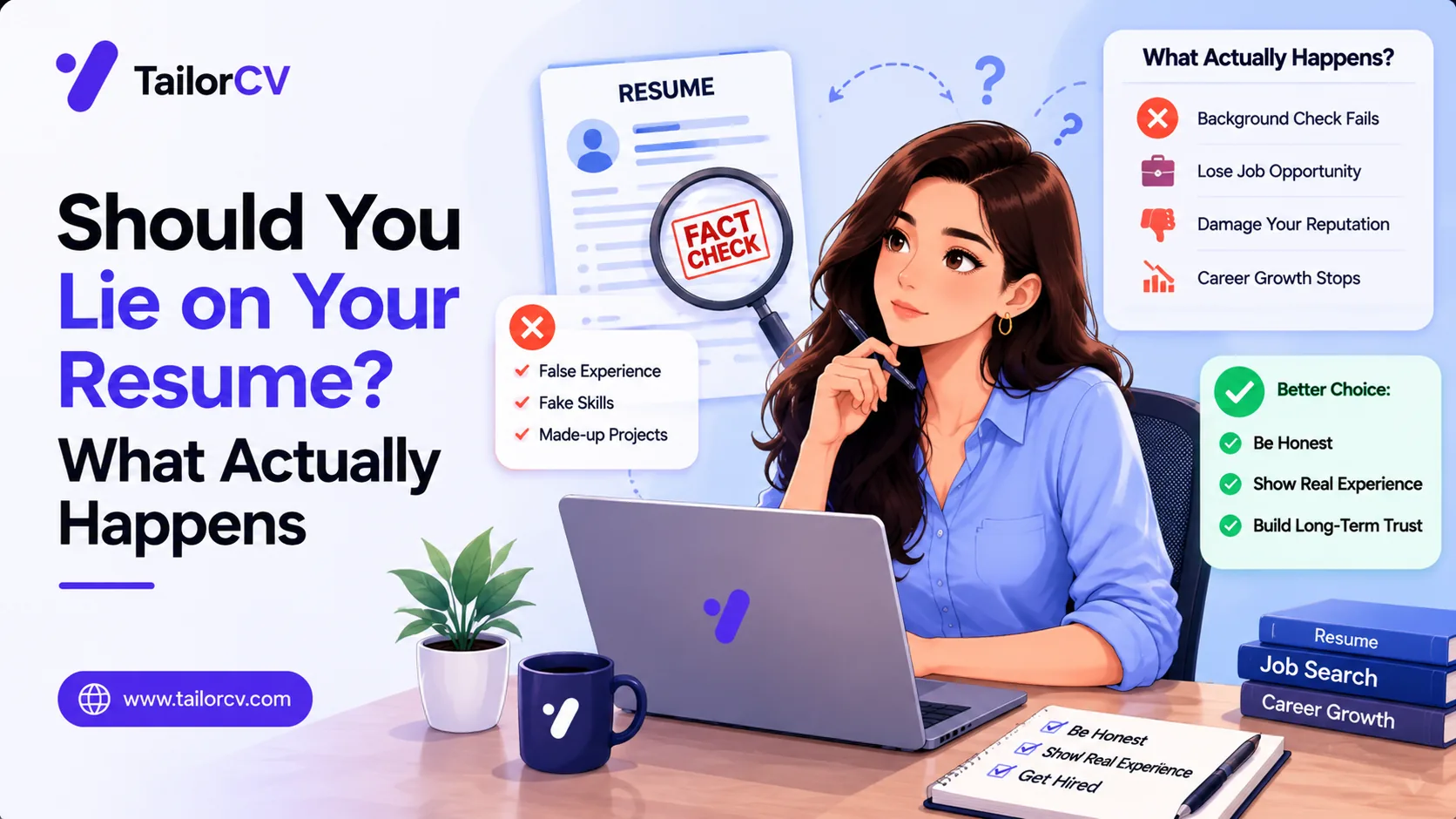
- No - and the reason is practical rather than moral: the payoff is one interview and the detection risk runs for your whole tenure.
- Lies are mostly caught by routine process, not dramatic investigation.
- Before hiring the offer is simply withdrawn, and that is the mild, common outcome.
- There is a real difference between misrepresenting facts and presenting facts well.
- Every reason to lie has a legitimate answer that works better and carries no risk.
The honest reason people consider it is not dishonesty. It's desperation. You've sent eighty applications, heard nothing, and the postings all demand five years of something you have two years of. Adding three years feels less like fraud and more like correcting an unfair filter.
This guide takes that seriously rather than lecturing. Here's what actually gets caught and how, what the consequences genuinely are — including the ones that arrive years later — and, more usefully, what to do instead when your history is weaker than the posting demands. Because the real problem is almost never that you needed to lie. It's that the true version of your resume was being presented badly.
The Short Answer
No — and the reason is practical, not moral. Resume lies have an unusually bad risk profile: the payoff is a single interview, the detection risk is high and never expires, and the penalty can be losing a job you already have.
Most bad decisions in a job search are recoverable. This one compounds. A lie that works follows you into the job, into your next background check, and into every reference conversation for the rest of your career.
What Actually Gets Caught, and How
People imagine lies are caught by dramatic investigation. They're mostly caught by routine process.
Employment dates and titles. Background checks verify these directly with employers or through payroll databases. This is the single most-caught category, and it's caught almost automatically. Inflating a title from "Analyst" to "Senior Analyst," or stretching an end date to close a gap, is checked as a matter of course.
Degrees and certifications. Universities confirm attendance and graduation through standard verification services. Certification bodies publish searchable registries. A claimed degree that wasn't completed is one of the most frequently detected and most severely punished lies, because it's binary — you either have it or you don't.
Skills. Not caught by a checker — caught in the room. You claim advanced SQL and someone asks you to describe a join, or hands you a screen. This is where padded keyword lists collapse. Stuffing a skills section with terms you can't defend gets you past the ATS filter and then destroyed in the interview — the exact failure described in keeping a human voice in AI-tailored resumes.
Fabricated achievements. Behavioural interviews are designed to find these. A STAR-method follow-up — what exactly did you do, who else was involved, what went wrong — cannot be improvised convincingly about something that never happened. Interviewers ask three layers deep precisely because invented stories run out at layer two.
References and the industry. Fields are smaller than they look. A hiring manager who knows someone at your former employer makes one informal call, and that call isn't governed by any policy about what can be disclosed.
The Consequences Are Worse Than People Assume
Before hiring: the offer is withdrawn. This is the mild outcome, and it's the common one.
After hiring: termination for cause, in most jurisdictions, at any point. This is the part people underestimate. There is no statute of limitations on a resume lie — discovery three years in, during a routine re-screen or a promotion check, is still grounds for dismissal. You can lose a job you've done well for years, over a claim you barely remember making.
Legal exposure: generally not criminal on its own, but it becomes fraud when you obtained money through a material misrepresentation, and it's genuinely criminal when you falsely claim a licensed credential — medicine, law, engineering, accounting. Those are regulated titles, and claiming one is an offence in itself.
Reputational: the slowest and most expensive. Industries have long memories, recruiters keep notes in their systems, and a rescinded offer is a conversation that gets repeated.
Daily: you have to sustain it. Every day in a job you got by claiming skills you lack is a day of managing exposure, and the stress is real.
The Grey Zone: Where the Line Actually Is
Not everything is a lie. There's a real difference between misrepresenting facts and presenting facts well, and conflating them makes people either paralysed or reckless.
This is fine — it's good resume writing:
- Describing genuine work in the posting's language. Re-expressing real experience in the words the job uses is the core of tailoring, not deception.
- Using strong action verbs for work you actually did.
- Leading with relevant experience and giving less space to irrelevant roles — see how far back a resume should go.
- Omitting a short irrelevant job. A resume is an argument, not a sworn archive.
- Using years instead of months for dates, consistently, as long as the years are true.
- Claiming credit for genuine team contributions, phrased accurately ("contributed to," "led the X workstream").
- Quantifying honestly with a real, defensible figure.
This is a lie:
- A degree you didn't complete, or a certification you don't hold.
- Dates that don't match reality.
- A title you never had.
- Metrics you invented.
- Skills you can't demonstrate.
- Someone else's work described as yours.
The test is simple: could you defend this in detail, under three follow-up questions, to someone who knows the field? If yes, it's presentation. If no, it's a lie. Presentation is a skill worth developing. Lying is a risk not worth taking.
What to Do Instead — The Part That Actually Helps
Every reason to lie has a legitimate answer that works better.
"I don't have the required years of experience"
Job postings are wish lists, not specifications. Most list requirements the successful hire won't fully meet. Apply anyway if you hit roughly two-thirds, and make the case on evidence rather than tenure.
Lead with demonstrable output: projects and a portfolio prove capability more directly than a year count. This is the whole method behind getting a job with no experience and landing a first tech role. Your ATS score as a fresher will be lower on tenure and can still be strong on skills.
"I have an employment gap"
Gaps are ordinary in 2026 and recruiters see them constantly. Explaining one honestly costs far less than the risk of falsified dates — which is the most-verified field on your resume. How to explain an employment gap covers the wording, and a line in your cover letter handles it before it becomes a question.
"My title undersells what I did"
Keep the real title and let the bullets carry the scope. "Analyst" with bullets showing you led a workstream and managed stakeholders reads as underlevelled and ready for more — which is exactly the impression you wanted. An inflated title with the same bullets just fails verification for no additional benefit.
"I'm switching fields and my history looks irrelevant"
Reframing is legitimate and powerful. Career-change resumes work by translating real experience into the target field's terms, supported by a career-change portfolio. Moving into tech and non-tech to data both follow that pattern. None of it requires a false claim.
"I'm not getting past the ATS"
This is the most common real cause, and it's the most fixable — it's usually a presentation problem misdiagnosed as a qualification problem. Your true experience may simply be described in words the system doesn't match.
Check it directly: run your resume against a specific posting with a free ATS score and read the missing-keyword list. Most of those gaps are things you've genuinely done but phrased differently. Fix the language, increase the match, fix formatting that breaks the parser, and use a parser-friendly structure. The difference between a tailored and a generic resume is usually larger than the difference a lie would buy — and matching a posting quickly makes it repeatable across every application.
If You Already Lied
Two cases.
You haven't been hired yet. Correct it. Send an updated resume, or raise it in the interview plainly: "I want to correct something on my resume." Some processes end there. Many don't, and the ones that continue now involve someone who trusts you more than they did before.
You're already in the job. Harder, and worth real thought. The exposure doesn't decay — background re-screens, promotions, and internal transfers all re-verify. Weigh proactive disclosure to someone you trust against continued exposure. Consider whether your actual performance now demonstrates the capability the claim was about, since that changes the conversation substantially. Get professional advice if a licensed credential is involved, because that category carries consequences the others don't.
The Interview Is Where Inflated Claims Die
Even when a lie survives screening, it has to survive a conversation — and interviews are structured almost perfectly to expose it.
Behavioural questions go three layers deep. An interviewer asks what you did, then what specifically was yours versus the team's, then what went wrong and how you handled it. Real experience has that much detail. Invented experience runs out at layer two. This is exactly why the STAR method and a genuine story bank work — they're built from things that actually happened, so the follow-ups are easy.
Consistency is checked across answers. Your account of why you left your last job, what your strengths are, and where you see yourself in five years all have to fit one story. Fabrications create small contradictions that prompt more probing, and the behavioural question set is designed to surface them.
Skills claims get tested directly. A padded skills section leads to a technical screen you can't pass, and failing on something you claimed is far worse than never claiming it.
The honest version has a real advantage here: you can answer any follow-up indefinitely, which is what confidence in an interview actually comes from. Prepare properly with a mock interview, the full prep guide, company research, questions to ask them, why should we hire you, and your greatest weakness — plus the practical details like what to wear, video and panel formats, second rounds, and following up.
Honest Ways to Look Stronger
If the goal is a more impressive resume, these all work and none carry risk:
- Lead with results, not duties. Quantified achievements beat responsibility lists, and most people's real numbers are better than they assume.
- Use stronger verbs for the same true work — action verbs that carry weight.
- Fix the structure. A well-built resume at the right length with a sharp summary presents identical experience far better.
- Cut what dilutes. Trimming roles too old to matter concentrates the argument.
- Evidence soft skills rather than listing them — how to show them properly.
- Add real proof. A portfolio or career-change portfolio demonstrates capability no claim can.
- Get referred. A referral does more for your odds than any embellishment — referral applications convert at multiples of cold ones, and networking and informational interviews build them.
- Apply faster and wider on real fit. Finding a job fast and a sustainable daily volume beat one exaggerated application. If silence is wearing you down, how long it takes to hear back and job search burnout are worth reading — desperation is what makes lying feel reasonable.
Frequently Asked Questions
Is lying on a resume illegal? Usually not criminal by itself, but it becomes fraud where you obtained money through material misrepresentation, and it is genuinely criminal to falsely claim a licensed credential such as a medical, legal, or engineering qualification. In nearly all cases it's grounds for termination regardless of legality.
How do companies find out about resume lies? Mostly through routine process — background checks verify dates and titles, universities and certification bodies confirm credentials, technical interviews expose claimed skills, and behavioural follow-ups break down invented achievements. Informal industry contact catches the rest.
Can I be fired years later for a resume lie? Yes. There's no expiry. Discovery during a promotion check, an internal transfer, or a routine re-screen years into the job is still grounds for dismissal for cause in most jurisdictions.
Is exaggerating the same as lying? Describing real work in stronger, better-targeted language is good resume writing. Inventing facts — dates, titles, degrees, metrics, skills — is lying. The test: could you defend it under three follow-up questions from someone who knows the field?
What if I don't meet the job requirements? Apply anyway if you meet roughly two-thirds. Postings are wish lists. Lead with evidence — projects, a portfolio, quantified results — rather than tenure, and make sure your genuine experience is described in the posting's language so it isn't filtered out for the wrong reason.
Putting It All Together
Don't lie on your resume. Not primarily because it's wrong, but because the trade is terrible: you risk a job you already have, and a reputation that takes years to rebuild, in exchange for one interview you'd probably fail at the technical stage anyway.
The more useful realisation is that most people who consider lying don't have a qualifications problem — they have a presentation problem. Their real experience is described in language the ATS doesn't match and a recruiter doesn't register. Fixing that is legal, fast, repeatable, and usually produces a bigger improvement than the lie would have.
Start by finding out whether that's your situation. Run your honest resume against a job you want with a free ATS score. If the missing keywords are things you've actually done but worded differently, you never needed to lie — you needed to tailor.
What is your resume scoring right now?
Scan it against a job description and get your ATS match score in about a minute.
Drop your resume here or choose a file
PDF only. Max 2 MB.
We never share your data or use it to train AI models.

Templates that keep this structure intact
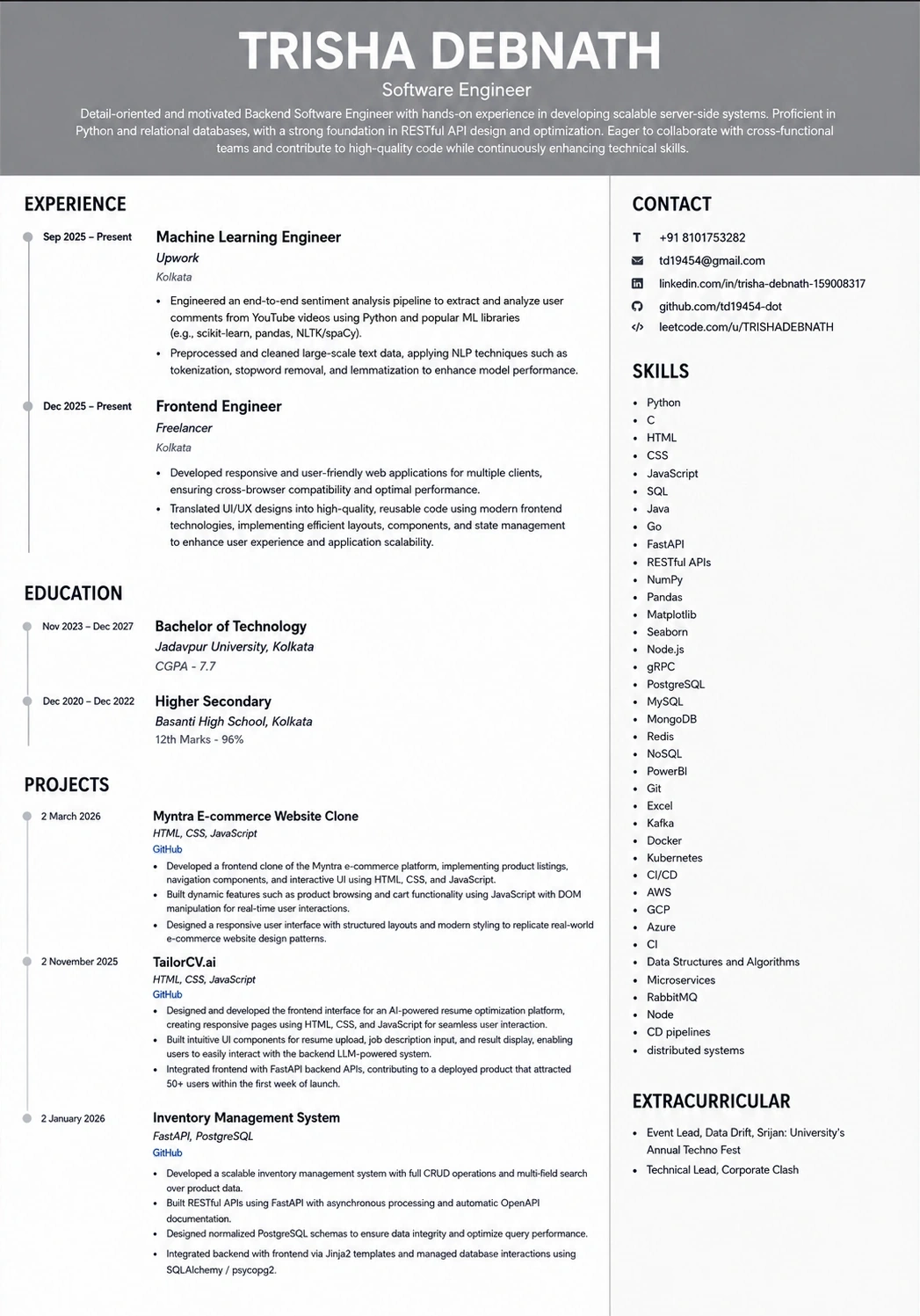
This template is ATS-tested — start from it and the formatting rules in this guide are already handled.
Was this guide useful?
Be the first to rate it.