 TD
TD
Key Takeaways
- Conduct thorough company research beyond the "About Us" page, focusing on revenue, product launches, and team challenges.
- Prepare specific answers to "Why this company?" and tailor your responses to connect your experience with the company's context.
- Use a structured framework for research, starting with the company's basics, products, and financial health.
- Understand the competitive landscape and industry trends to impress interviewers with your market knowledge.
- Utilize various sources such as company websites, LinkedIn, and news outlets to gather comprehensive insights before the interview.
Company research before an interview is one of the most impactful things you can do - and one of the things most candidates do too superficially. Reading the company's "About Us" page is not research. Knowing the company's revenue, recent product launches, competitive position, engineering culture, and specific team challenges is research.
Prepare your research in parallel with your interview answers. Read the behavioral interview guide and practice with the free AI mock interview tool. Make sure your resume is optimized with the TailorCV ATS score checker before the interview even starts.
Why Company Research Matters More Than You Think
Company research does three things:
- Helps you answer "Why this company?" - the most important interview question for most hiring managers
- Helps you ask intelligent questions - which signals preparation, curiosity, and cultural fit
- Helps you tailor your answers - so you connect your experience to their specific context
A candidate who says "I'm excited because your team recently shipped X and I worked on a similar problem with Y approach" will be remembered. A candidate who says "I admire your culture and mission" will not.
The Research Framework - 5 Layers
Layer 1 - The Company (30 minutes)
Start with the basics, but go deeper than most candidates:
| Option | What to know |
|---|---|
| What they do: | Primary product or service · Customer segments (B2B, B2C, enterprise, SMB, consumer) · Revenue model (SaaS, marketplace, services, advertising) · Geography (local, regional, global) |
| Company stage and health: | Public or private? If public, check the most recent earnings call transcript on Seeking Alpha or the IR website. · If private: funding stage (Seed, Series A-D, pre-IPO), recent funding round, total funding, notable investors · Revenue range (if public or reported): growth rate signals health · Headcount: check LinkedIn for headcount trend - growing or contracting? |
| Products: | Use the product if it is a consumer or SaaS product - even a 30-minute trial session gives you real observations · Read recent product announcements on the blog or Product Hunt · Check the App Store or web reviews for user sentiment |
| Sources: | Company website, About page, Blog, Press section · Crunchbase - funding, investors, acquisitions · LinkedIn Company page - headcount, employee count over time · Y Combinator profile (if applicable) · TechCrunch / The Information for funded tech companies |
Layer 2 - The Industry and Competitive Landscape (20 minutes)
Understanding the company in its market context impresses interviewers significantly.
| Option | What to know |
|---|---|
| Who are their main competitors? | G2, Capterra, Product Hunt - see what alternatives customers compare them against · Google "Company X vs Competitor" - see how they position themselves |
| What's the industry trend? | Is the market growing or contracting? · Are there regulatory changes affecting the industry? · What macro trends are driving demand for this company's product? |
| Recent news: | Set a Google alert for the company name before your interview · Check TechCrunch, Business Insider, Financial Times for coverage · Check LinkedIn for company posts and what their executives have been saying |
Layer 3 - The Team You Are Joining (20 minutes)
Research the specific team, not just the company.
| Option | What to know |
|---|---|
| The hiring manager: | Find them on LinkedIn - what is their background? · Have they published any articles, given talks, or written company blog posts? · Understanding their career trajectory tells you what they value |
| The team: | What is the team size? (Often mentioned in the job posting or discoverable on LinkedIn) · What technologies does the team use? (Engineering blog, job postings, GitHub) · What are current team members' backgrounds? (signals what the team prioritizes) |
| The engineering / team culture: | Engineering blog (if they have one) · Glassdoor reviews - look for patterns, not individual complaints · Blind (Teamblind) for tech company candid reviews · Levels.fyi for tech compensation context |
Layer 4 - The Role (10 minutes)
Re-read the job description carefully, multiple times.
Extract:
- What specific problems does this role solve?
- Which skills are listed first? (These are usually most important)
- What does "success" look like in this role? (Often stated in the JD)
- What would the first 90 days involve? (Often mentioned for senior roles)
Connect each major responsibility to a specific example from your experience. This is how you answer behavioral questions - with company-relevant context.
Layer 5 - Preparing Your Questions (10 minutes)
Company research feeds your questions. The best questions come from your research gaps.
Examples of research-based questions:
"I saw that [Company] recently [announced X / launched Y / entered Z market]. How is the [role/team] contributing to that initiative?"
"I read your engineering blog post about [topic] - how has that approach evolved since then?"
"I noticed on LinkedIn that the team has grown by about 40% in the last year. What does that growth look like on the [specific team]?"
"Glassdoor reviews from a year ago mentioned some challenges with [process / tool / culture]. Is that something that's been addressed?"
What to Do With Your Research
In the "Why this company?" question:
Bad: "I admire your mission and culture." Good: "I've been following [Company] for about 18 months since you launched [specific feature]. I've been using the product in my personal workflow and I noticed [specific thing]. The engineering blog post about [topic] showed me the kind of technical problem-solving I want to be part of. And the fact that you're now entering [market] - which I have direct experience in at [your current company] - makes the timing feel really right."
In the "Tell me about yourself" answer:
Include a company-specific hook at the end. "Which is why this role at [Company] specifically is interesting to me - especially given that you're [thing you researched]."
In your behavioral answers:
Connect your past examples to their specific context. "At [Company], I solved a similar problem to what you're facing with [thing you researched] by [action]."
Quick Research Checklist (30 minutes total)
- What does the company sell and who buys it?
- What stage is the company (funding, headcount, growth)?
- What are the top 2-3 competitors?
- What is the most recent significant company news?
- What has the hiring manager published or spoken about?
- What does the Glassdoor or Blind consensus say about working there?
- What are 3 specific things about this company that made me apply?
- What are 3 intelligent questions I can ask?
Conclusion
Company research is not a performance - it is genuine preparation that makes every interview answer more specific, more credible, and more compelling. Candidates who have done real research stand out visibly from those who have not.
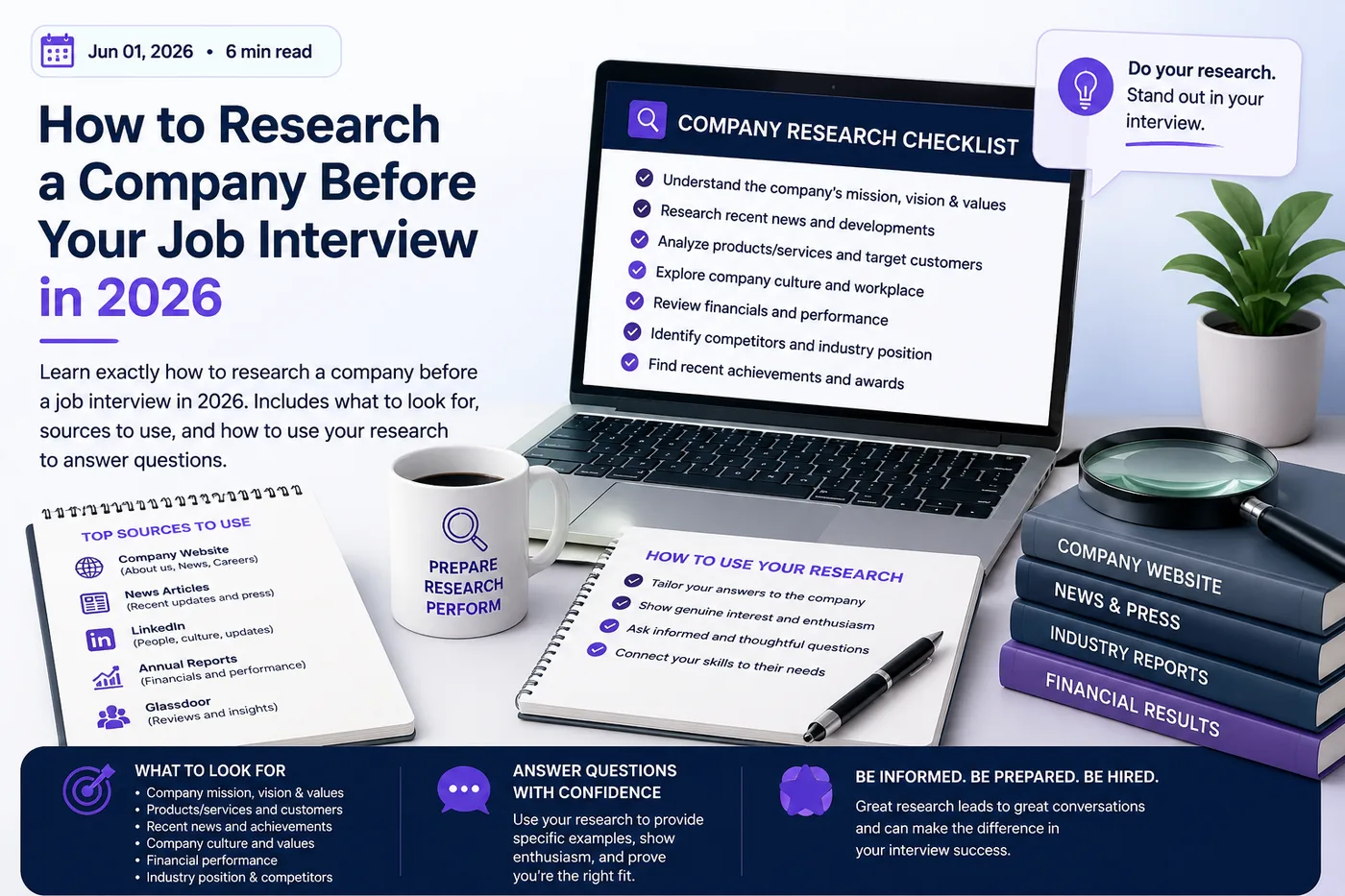
Interviewers ask "What do you know about us?" and "Why do you want to work here?" - and the answers that get job offers are specific, demonstrating genuine understanding of the company's situation. This guide tells you exactly what to research, where to find it, and how to use it.
Spend 60-90 minutes per company on research before a final round interview. For first screens, 30 minutes is sufficient.
Pair your research with the behavioral interview guide, the how to answer tell me about yourself guide, and the full interview preparation guide. Practice with the mock interview tool for delivery confidence.
Related Guides
- 20 Common Interview Mistakes to Avoid
- How to Answer "Tell Me About Yourself"
- How to Prepare for a Job Interview
- Behavioral Interview Questions and Answers
- Group Discussion Tips
- How to Follow Up After a Job Interview
- Best Questions to Ask in a Job Interview
- Virtual Interview Tips
- Coding Interview Preparation Guide
- Final Round Interview Tips
- Phone Interview Tips
- Technical Interview Preparation Guide
- Why Am I Not Getting Interviews for Jobs I'm Qualified For?
- ATS Mistakes Experienced Professionals Make (And Why Your Resume Stops Working After 5+ Years)
- 200 Best Action Verbs for Resume in 2026 - By Role and Category
- Cover Letter Guide 2026 - How to Write a Cover Letter That Gets Read
- First 90 Days at a New Job in 2026 - How to Succeed and Stand Out
- How to Build a Professional Portfolio in 2026 - Guide for All Industries
- What to Bring to a Job Interview
Make This Practical
Use this advice as interview practice, not just reading material. Start a role-specific session with the AI mock interview tool, prepare your opening with How to Answer Tell Me About Yourself, and structure evidence-heavy answers with the STAR Method Interview Answers Guide.
Before the interview, make sure the resume that earned the call is still aligned with the role. Check it with the free ATS score checker, review Common Interview Mistakes to Avoid, and use How to Follow Up After an Interview once the conversation is over.
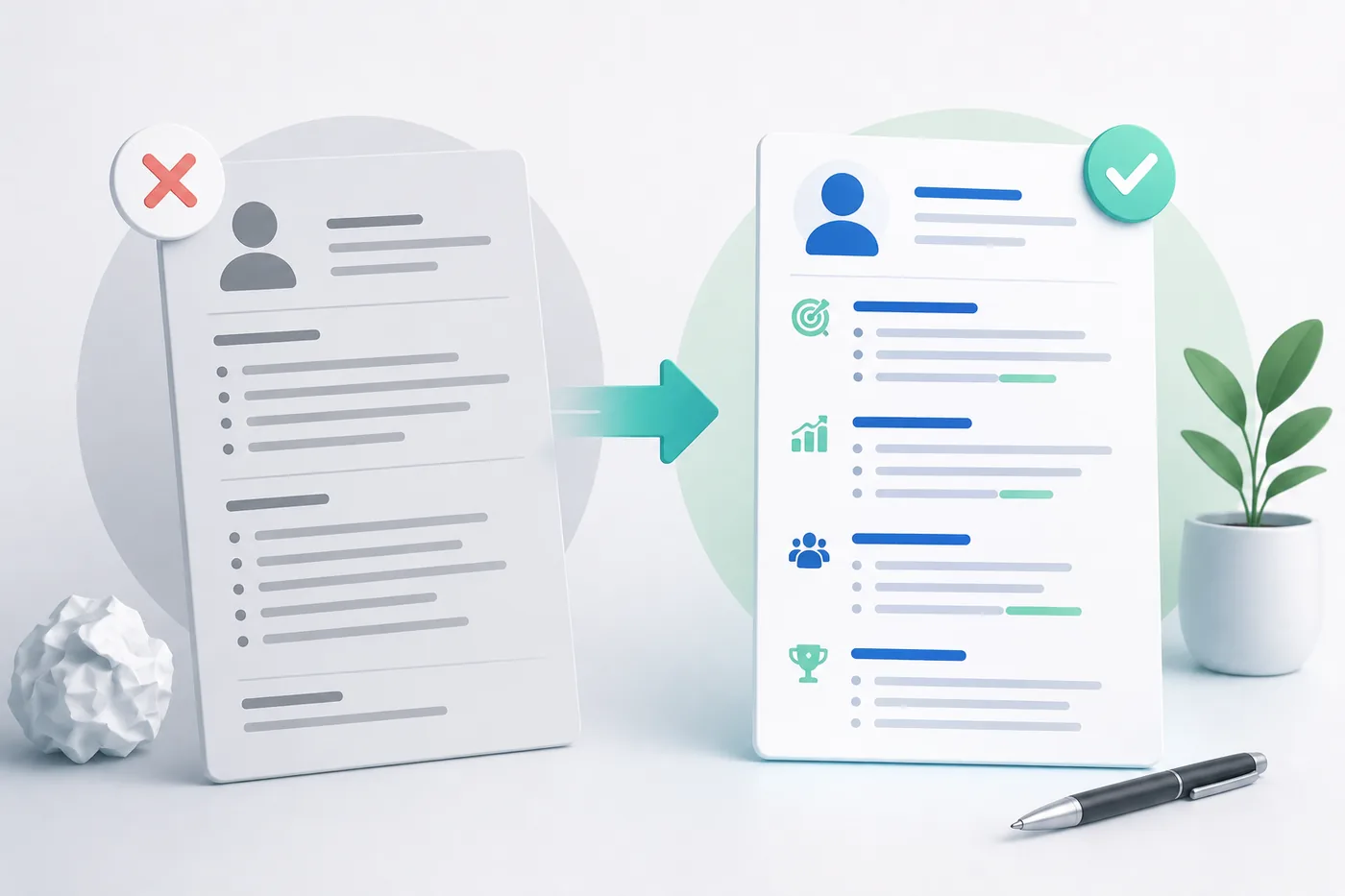
Comparison of Superficial vs. In-Depth Company Research
Understanding the difference between superficial research and in-depth research can significantly affect your interview performance. Here’s a comparison to illustrate the key aspects:
| Aspect | Superficial Research | In-Depth Research |
|---|---|---|
| Company Overview | Reads the "About Us" page | Analyzes the company's mission, vision, and values |
| Recent Developments | Mentions a recent press release | Discusses the implications of recent product launches and innovations |
| Financial Health | Looks at basic revenue figures | Reviews financial reports, growth trends, and market position |
| Industry Position | Knows the company name and what it does | Identifies key competitors and analyzes market share and positioning |
| Company Culture | General statement about culture | Provides specific examples of company values in action and employee testimonials |
| Team Dynamics | Assumes a collaborative work environment | Investigates team structure, roles, and current challenges faced by the team |
| Relevant Questions | Asks generic questions about the role | Asks tailored questions that reflect understanding of the company's current projects and challenges |
Frequently Asked Questions
Why is company research important before an interview?
Company research is crucial because it allows you to provide informed answers to common interview questions like "Why this company?" and "What do you know about us?" When you demonstrate a deep understanding of the company's recent developments, culture, and challenges, you significantly increase your chances of making a memorable impression. This preparation also helps you tailor your responses effectively, making your experience more relevant to the role.
What specific information should I look for when researching a company?
When researching a company, focus on aspects such as their revenue, recent product launches, competitive positioning, and workplace culture. Understanding specific team challenges can also help you connect your experience to the company's needs and demonstrate your genuine interest. For a comprehensive approach, consider using the behavioral interview guide to align your research with your interview answers.
How can I use my research to prepare for interview questions?
Utilize your research to answer questions like "Why do you want to work here?" by referencing specific projects or initiatives that excite you. For example, saying, "I'm impressed by your recent launch of X" shows you've done your homework and allows you to connect your skills to the company's objectives. This strategy not only demonstrates your enthusiasm but also aligns your answers with the company's current context.
What are some common mistakes to avoid during company research?
One common mistake is relying solely on the company's "About Us" page for information. This surface-level research can leave you unprepared for deeper questions. Instead, seek out recent news articles, industry reports, and employee reviews to gain a well-rounded understanding of the company. For more insights on interview preparation, check out the 20 Common Interview Mistakes to Avoid in 2026.
How can I effectively communicate my research during the interview?
To effectively communicate your research, weave specific details into your answers during the interview. For instance, you can say, "I noticed your team recently faced challenges with Y, and I believe my experience with Z could be beneficial." This not only highlights your knowledge but also shows how your skills align with their needs. Additionally, prepare insightful questions based on your research; refer to the Best Questions to Ask in a Job Interview in 2026 for ideas.
Was this guide useful?
Be the first to rate it.