 SS
SS

Key Takeaways
- AI can effectively identify keywords and perform gap analysis by comparing your resume with job descriptions.
- It excels at reformatting vague statements into structured, results-oriented bullet points when given specific information.
- AI can match terminology between your resume and job descriptions to enhance relevance.
- To avoid hollow language in AI-generated resumes, provide specific metrics, accomplishments, and personal insights.
- The key to successful AI-assisted resume tailoring is feeding it real, detailed inputs rather than relying on generic prompts.
You paste your resume into an AI tool. You add the job description. You click generate.
The output comes back polished. Every sentence is grammatically perfect. The keywords are all there. The format looks clean.
But something is wrong.
The resume sounds like it was written by a committee of robots who have read a lot of LinkedIn posts but never actually worked a job.
"Results-driven professional with a passion for leveraging synergistic approaches to drive impactful outcomes."
Nobody talks like this. Nobody who has actually done real work uses this language.
And recruiters - who read hundreds of resumes - can feel it immediately. They cannot always say why. But they feel the hollowness.
Understanding how recruiters read resumes makes clear why this matters: they are making fast judgments, and hollow language is a signal they have been trained to distrust.
AI-assisted resumes that fail do not fail because of the AI. They fail because of how people use the AI.
This guide shows you how to use AI to tailor your resume in a way that is faster, more keyword-optimized, and still sounds unmistakably like you.
What AI Is Actually Good at in Resume Tailoring
Before we fix the problem, let us understand what the tool does well.
Your resume after optimization
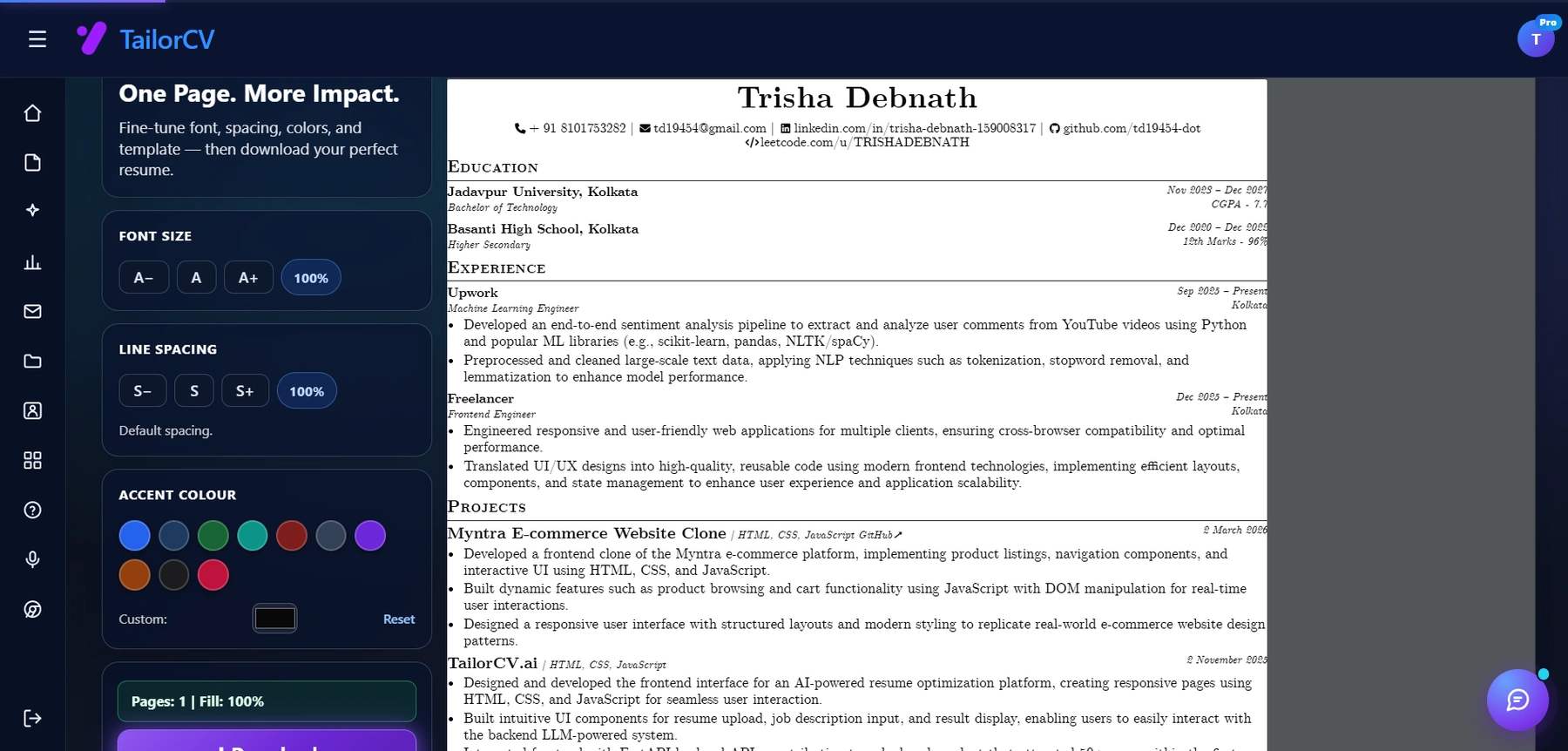
This is the optimized result, and it is usually how a spilling two-page draft gets back onto one page without deleting anything worth keeping.
AI excels at:
Keyword identification and gap analysis AI can read a job description in seconds and identify which terms appear most frequently, which are in the "required" vs "preferred" sections, and which are missing from your resume. This is tedious manual work - AI does it instantly. This process is what the job description keyword extraction guide teaches you to do manually.
Reformatting bullet points AI can take a vague responsibility statement and turn it into a structured result-first bullet with proper verb and context - if given enough information about the actual outcome.
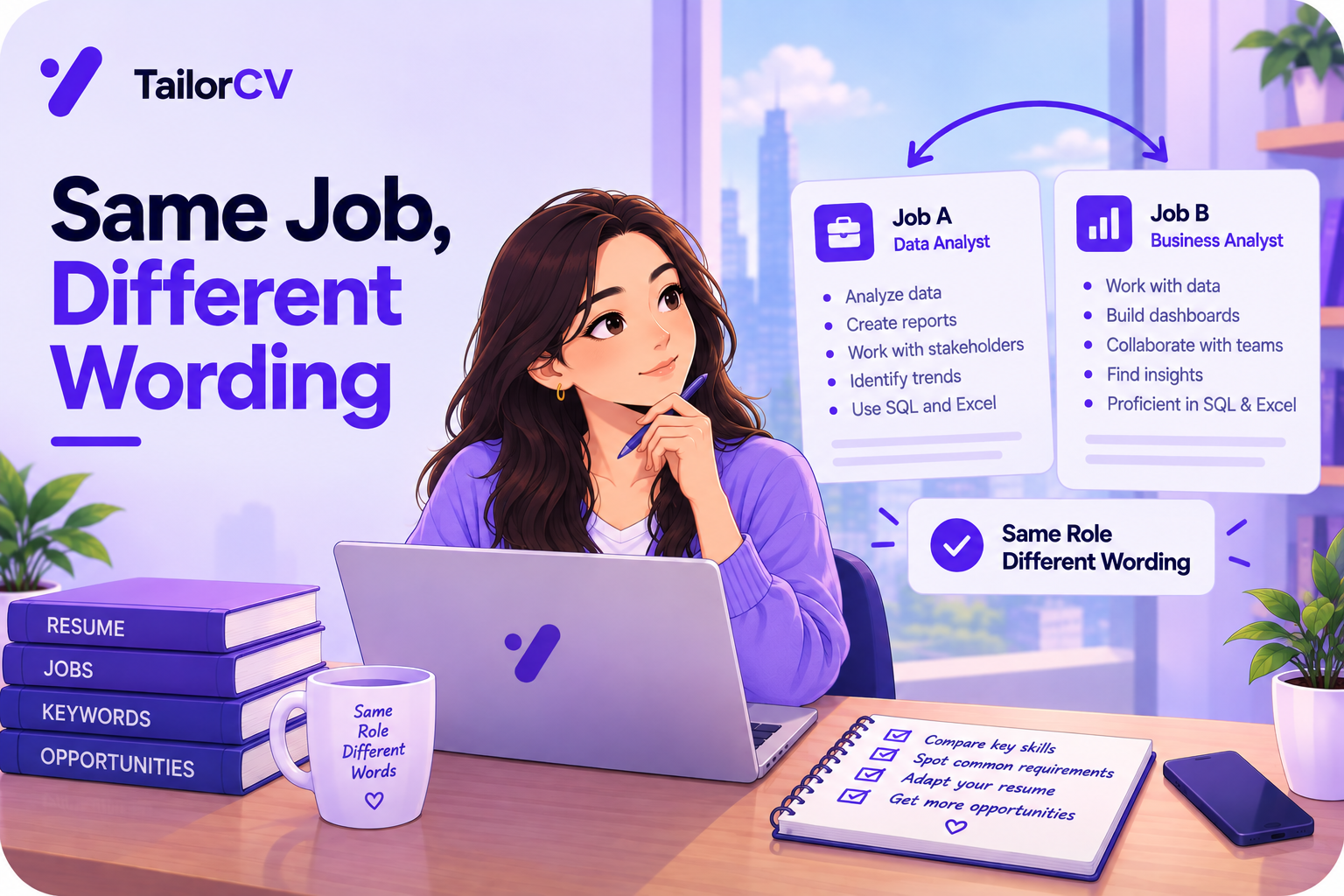
Matching terminology If the job description uses "customer success" and your resume says "client satisfaction," AI will catch that and suggest the match. This is the core of how to match resume keywords to job description.
Checking ATS formatting AI-based tools can flag ATS formatting issues that would cause parsing failures - columns, tables, unusual fonts, missing section headers.
Generating first drafts AI can produce a first draft of a tailored summary or bullet point set much faster than manual writing. The first draft is not the final product.
Where it struggles (without your input):
- Inventing specific results (percentages, dollar amounts, timelines) - it will make generic ones up
- Capturing your personality and communication style
- Understanding the nuance of your actual role vs. your job title
- Knowing which accomplishments were most strategically important
- Conveying genuine motivation or passion for the specific company
The Root Cause of AI-Generated Resume Syndrome
AI sounds hollow when it has not been given specific information.
It is asked to "write a strong marketing manager resume" with a generic profile and a job description. It has no specific results to draw from. So it generates plausible-sounding but empty language.
The fix is not to avoid AI. The fix is to give AI real information to work with.
The Right Way to Use AI for Resume Tailoring
Step 1: Feed It Real, Specific Inputs
Before generating anything, prepare your input document.
Your input should include:
- Your actual job title at each company
- The real metrics and results from each role (revenue, user numbers, time saved, percentage improvements)
- The actual tools and systems you used
- Specific project names or initiatives you led
- What changed in the business because of your work
Bad AI input: "I was a marketing manager who ran campaigns."
Good AI input: "I was a Marketing Manager at a 200-person B2B SaaS company. I ran email and LinkedIn campaigns for mid-market accounts. Our best campaign drove 340 leads in Q2 2024. I was responsible for a $300k annual marketing budget. I managed two junior marketers. We grew MQL volume by 62% YoY. I used HubSpot, Salesforce, and Marketo."
The more specific your input, the more specific - and human - the AI output.
Step 2: Use AI for Keyword Matching, Not Sentence Writing
The highest-value AI use in resume tailoring is keyword analysis, not content generation.
Use AI to:
- Identify the top 10-15 keywords in the job description
- Check your current resume for those keywords
- Flag gaps and suggest where to add them
Then add the keywords yourself - in sentences you have written, in language that sounds like you. Understanding resume keyword density helps you place those keywords in the right sections and the right frequency.
TailorCV's keyword gap analysis does exactly this. It shows you which required keywords are missing and scores your ATS match - so you can add them manually in your own voice, not have them auto-inserted into awkward sentences.
Step 3: Edit Every AI-Generated Line
Treat AI output as a first draft that needs your editing - not a finished product.
After AI generates bullet points or a summary, go through each sentence and ask:
- Does this sound like how I would describe my own work?
- Is this specific enough, or could it be from anyone's resume?
- Does it include a real metric or specific outcome?
- Does it use industry language I would actually use, or generic filler?
Delete anything hollow. Rewrite anything that could have been written by someone who has never met you.
Step 4: Keep Your Voice in the Summary
The professional summary is where voice matters most.
It is the first thing a human reads. It either sounds like a real person or it does not.
Use AI to generate three different versions of your summary. Pick the one that comes closest to how you would actually describe yourself. Then rewrite it in your own words, keeping the structure and keywords, but changing the language to sound like you.
AI-generated (hollow):
"Results-oriented data professional with expertise in leveraging advanced analytics to drive data-driven decision-making across cross-functional teams."
Edited version (human):
"data analyst who turns messy datasets into decisions people actually act on. At [Company], I built the dashboards that showed the product team their retention was dropping three months before it became a crisis - and that early warning shaped the feature roadmap that turned it around."
Same keywords. Same ATS match. Completely different impact.
Step 5: Use AI to Check, Not to Create
One of the most powerful AI uses is as a reviewer, not a writer.
Write your resume yourself. Then use AI to check:
- Does this match the job description keywords? (gap analysis)
- Are there bullet points that could be stronger?
- Is my summary relevant to this specific role?
- Are there ATS formatting issues?
This approach keeps your voice while using AI's speed for the analytical review layer.
The Red Flags That Signal an AI-Written Resume
Recruiters are learning to recognize AI-written resumes. Avoid these signals:
Overuse of transition words: "Furthermore," "Additionally," "Consequently" - real resume bullet points do not use these.
"Passion for" and "commitment to": These words appear in almost every AI resume summary. Cut them.
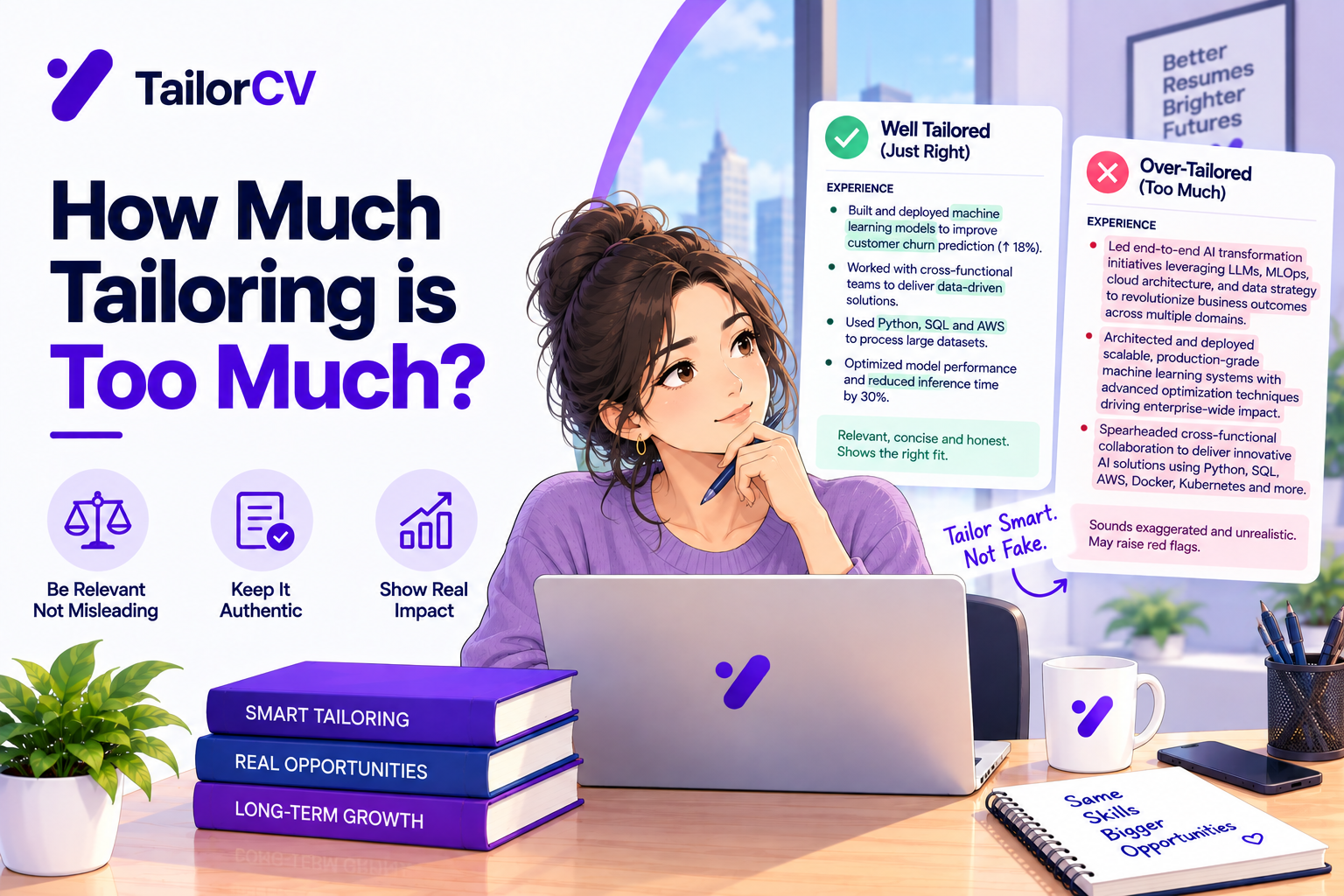
Vague result statements: "Significantly improved performance" - improved what? By how much? In what timeframe? If there is no number, the result is hollow. Quantifying achievements is what separates real results from AI filler.
Overly formal tone: Real people do not describe their jobs the way a legal brief does. If it sounds stiff, it sounds AI-generated.
Perfect grammar with zero personality: Grammatical perfection is not the goal. Authenticity is. A slightly informal but specific and confident bullet is better than a perfectly structured but hollow one.
Balancing ATS and Human
Here is the tension:
ATS needs keywords, structured format, and matching terminology. Humans need authenticity, specific results, and clear communication.
The combination that wins both:
- Clear structure: Section headers that ATS can read (Experience, Skills, Education) - follow resume formatting best practices
- Keyword coverage: Target keywords appearing naturally 3-4 times across the document
- Specific results: Real numbers and outcomes in every work experience bullet
- Human language: Sentences that a real person would write, not a content generator
- One-sentence summary: Each role can be summarized in one honest sentence before bullets
Use TailorCV to optimize the ATS layer. Use your own editing to preserve the human layer.
Check My Resume's ATS Score and Keyword Match
A Quick Test: Read Your Resume Out Loud
Before you submit any resume - AI-tailored or not - read it out loud.
If you stumble on a sentence, a real person would too. If a phrase makes you feel vaguely embarrassed, cut it. If a bullet sounds like it was written about someone you have never met, rewrite it.
Your resume should feel like you wrote it - because ultimately, you did. The AI just helped you tailor it faster.
This is the same principle behind using a mock interview - reading out loud catches what silent proofreading misses.
Make This Practical
Do not guess whether the resume is ready. Upload it to the free ATS score checker, compare the result with the ATS Score Guide, and fix formatting issues using ATS Resume Formatting Mistakes and ATS Resume Parser Friendly Format.
After the technical cleanup, improve relevance. Use Resume Matching With Job Description, strengthen keyword coverage with the Resume Keywords Guide, and avoid overdoing it by checking ATS Keyword Mistakes. If the layout itself is weak, rebuild with an ATS-friendly resume template.
For resumes written by someone else entirely, tailoring a resume you didn't write covers checking facts, claims and voice before you tailor.
FAQ
Can recruiters detect AI-written resumes?
Experienced recruiters are developing a strong intuition for AI-generated language. Hollow phrases, generic results, and perfect-but-soulless structure are the tells. The fix is to edit heavily and inject specific, real information.
Will AI-tailored resumes score better on ATS?
Yes - when the tailoring is done correctly. Keyword matching improves significantly. But poor AI use (generic output, keyword stuffing as described in the keyword density guide) can actually hurt readability without improving ATS scores.
Should I tell employers I used AI to tailor my resume?
No - there is no expectation or requirement to disclose this. AI is a tool, like spell-check or a dictionary. The content of your resume is still your professional history.
Which AI tool is best for resume tailoring?
The best tool is one that shows you keyword gaps and gives you control over the final content - rather than one that auto-generates everything. TailorCV works on this principle: it analyzes the match, surfaces gaps, and gives you a tailored version that you review and edit before sending. For more insights on how to effectively tailor your resume, check out our post on hidden keywords in job description.
Related Guides
- How to Write a Resume with AI
- How to Tailor Your Resume for Every Job
- Resume Keyword Density Guide
- How AI Resume Matching Works
- ATS Keyword Mistakes That Cost Interviews
- How to Write Resume Bullet Points
- How to Write a Resume Summary
- How to Stop Sounding Generic on Your Resume
- Generic Resume Mistakes That Cost Interviews
- ATS Score Guide
- Resume Extension vs Manual Tailoring: What You Actually Save (2026)
Conclusion
AI is not the problem. How people use AI is the problem.
Use AI for what it does well: keyword analysis, gap identification, structural suggestions, formatting checks.
Do the work that only you can do: specific results, authentic voice, real context, genuine motivation.
The winning resume in 2026 is not written entirely by AI or entirely by hand. It is a collaboration - where AI handles the data layer and a human handles the truth layer.
Tailor My Resume With AI - and Keep My Voice
See what tailoring is worth on your resume
Score your current resume against a real job description before you change a word.
Drop your resume here or choose a file
PDF only. Max 2 MB.
We never share your data or use it to train AI models.

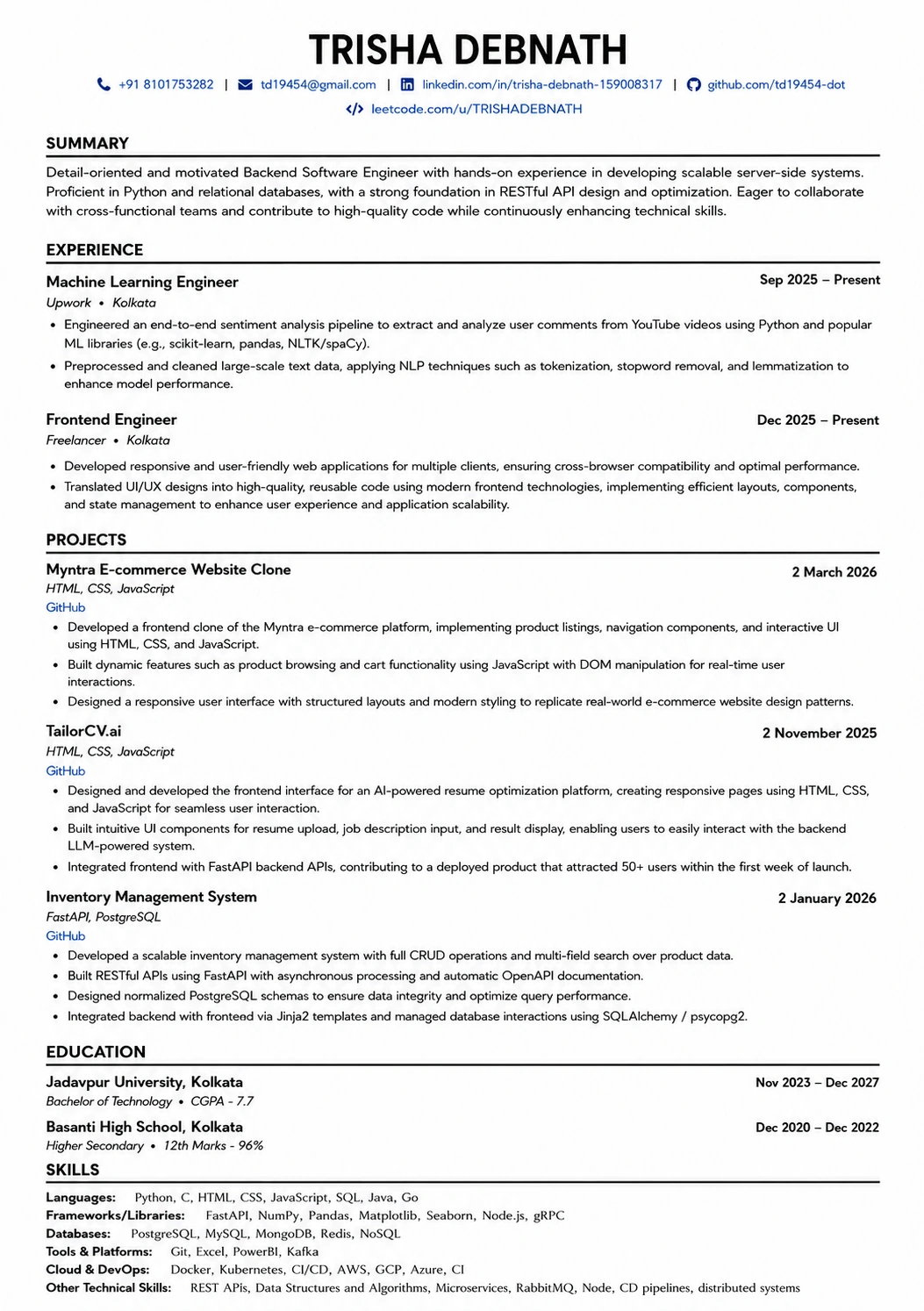
Start from a template that tailors well
Clean structure means swapping keywords per job takes minutes, not a re-layout every time.
Was this guide useful?
Be the first to rate it.