 TD
TD
Key Takeaways
- Three things are being tested at once by this question, not just your self-assessment.
- Do not start from a list of your best qualities - start from the job.
- The structure that works has three parts and runs roughly thirty to sixty seconds.
- Generic virtues like "hard-working" and "team player" carry no information because everyone says them.
- The question arrives in several forms, and the same prepared material handles all of them.
"What are your strengths?" sounds like the easy one. It isn't — it's just the one people under-prepare, because it feels like it can be improvised. It can't, and the reason is that the question is not really asking what you're good at.
It's asking whether you know what this job requires, and whether you can prove you have it. Most candidates answer the first question ("I'm a hard worker") and skip the second entirely. This guide covers how to pick the right strength for a specific role, the structure that turns a claim into evidence, full sample answers, and the mistakes that make an otherwise strong candidate sound generic.
What the Question Is Actually For
Three things are being tested at once.
Self-awareness. Do you have an accurate read on your own capability? Someone who names a real, specific strength reads as more credible than someone who claims everything.
Relevance. Have you understood the job? A strength that matters here signals you read the posting properly. A generic one signals you'd give the same answer in any interview — because you would.
Evidence. Can you back it up? This is the part that separates answers, and it's where most people stop early. A claim without proof is just an adjective.
There's a fourth, quieter test: whether you can talk about yourself without either shrinking or overselling. Both are noticed.
Step 1: Choose the Right Strength
Don't start with a list of your best qualities. Start with the job.
Read the posting and find what it leads with. The first two or three requirements are usually the real priorities — postings are ordered roughly by importance. That's the same signal you use when matching your resume to the job description, and it works identically here.
Pick a genuine strength that overlaps. The intersection of what they need most and what you're actually good at is your answer. If that intersection is empty, you may be interviewing for the wrong role.
Prefer specific over broad. "Communication" is too broad to mean anything. "Translating technical constraints for non-technical stakeholders" is specific enough to be interesting, and specific enough to prove.
Make sure you can evidence it. A strength you can't demonstrate with a real example is a liability, not an asset — it invites follow-up questions that expose it. That's the same principle behind not claiming skills you can't defend.
Prefer strengths already visible on your resume. Consistency matters. If your answer connects to something they can see in your experience bullets, it lands as confirmation rather than a new claim. This is one more reason to tailor the resume to each posting — it sets up your interview answers.
Researching the company sharpens the choice further, because a strength aimed at their actual situation beats one aimed at the job title.
Step 2: The Structure That Works
Three parts, roughly thirty to sixty seconds total.
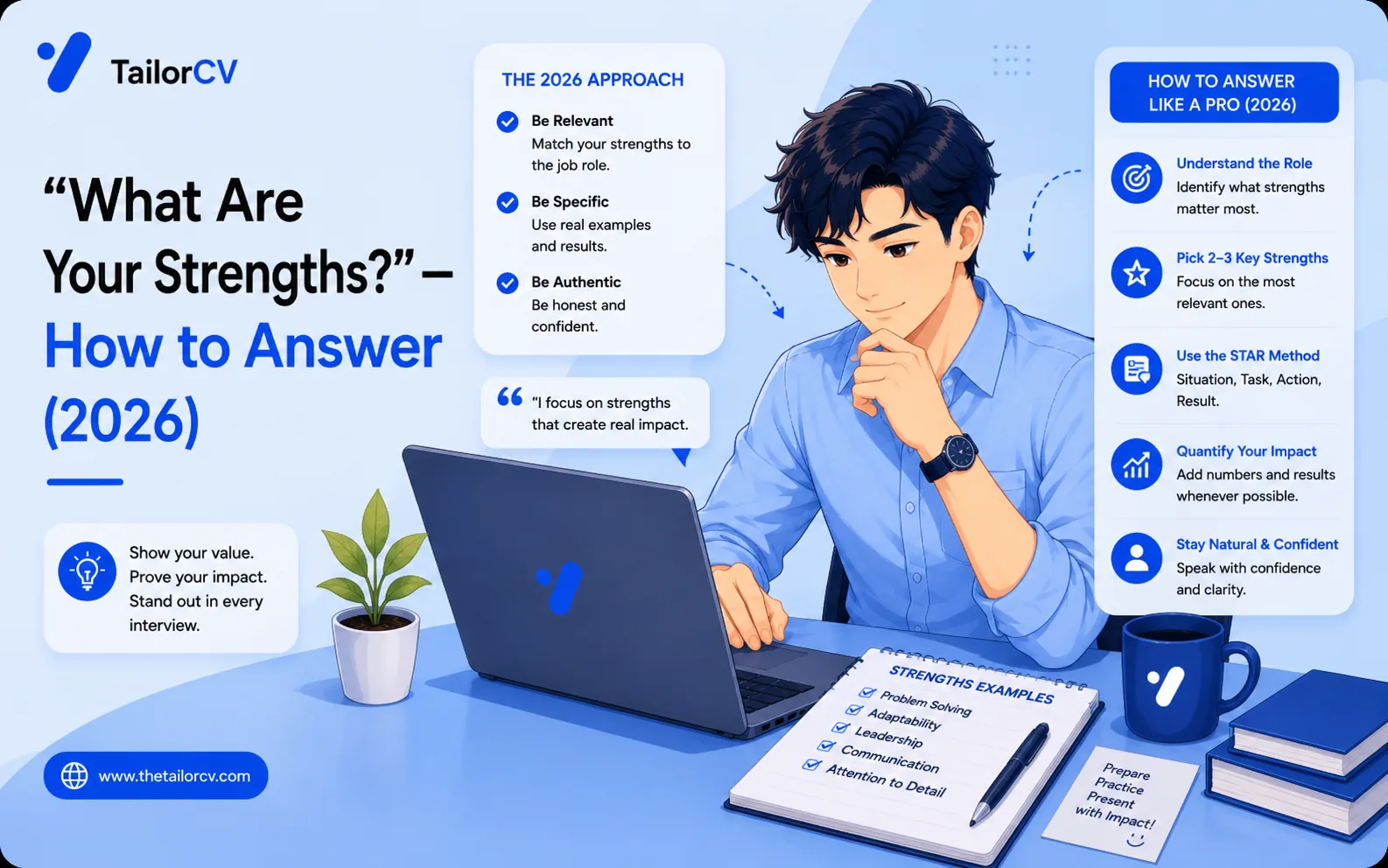
1. Name it clearly. One sentence, specific. Don't hedge, don't stack three strengths together.
2. Prove it with a concrete example. This is the weight of the answer. Use a real situation with a real outcome — the STAR method structure works well here in compressed form: brief situation, what you did, what resulted. Keep it tight; this isn't a full behavioural answer.
3. Connect it to their role. One sentence linking the strength to what this job needs. This is the part almost everyone omits, and it's what makes the answer feel aimed rather than recycled.
Prepare two or three of these in advance, drawn from your interview story bank, so you can pick whichever fits the role in front of you.
Sample Answers
For an analytical role:
"My strongest area is turning messy data into decisions people actually act on. In my last role our churn reporting was three separate spreadsheets that nobody trusted, so I consolidated them into one dashboard and added a simple cohort view. Within a quarter the customer team was using it in their weekly planning, and we caught a churn spike about six weeks earlier than we would have before. This role sits between the data and the commercial team, so that translation piece is most of the job."
For a project or delivery role:
"I'm good at keeping complicated projects moving when there's no formal authority involved. On our platform migration I was coordinating four teams that didn't report to me, and the main thing I did was make the dependencies visible — a single shared timeline everyone could see, updated weekly. We shipped roughly on schedule with two teams reporting they'd have missed their part without it. Your posting describes a lot of cross-functional coordination, which is the same problem."
For a client-facing role:
"My main strength is handling difficult client conversations early rather than letting them build. When one of our largest accounts was unhappy about delivery timelines, I asked for a call before the renewal conversation rather than after, laid out what had gone wrong honestly, and agreed a revised plan. They renewed, and the relationship was better afterwards than before. Given this role owns renewals, that willingness to have the awkward conversation first seems relevant."
For an early-career candidate:
"I pick things up quickly and independently. During my final-year project I needed to build an API and hadn't worked with one before, so I taught myself over about two weeks and shipped a working version — it's on my portfolio. My internship team then had me take on a similar piece because of it. This role mentions several tools I haven't used yet, and my honest pitch is that learning them fast is the thing I've repeatedly proven I can do."
That last one is worth noting: it converts inexperience into evidence of adaptability, which is exactly the move that works when you're getting a job with no experience or landing a first tech job. A portfolio and strong projects make it concrete.
Mistakes to Avoid
Generic virtues. "Hard-working," "team player," "passionate," "detail-oriented" — everyone says these, so they carry no information. If your answer would fit any candidate in any interview, it's not an answer. This is the interview version of sounding generic on a resume.
A disguised weakness. "I'm a perfectionist" is a cliché that interviewers hear constantly and read as evasion. Save the honest self-assessment for the weakness question, where it belongs and where it's actually asked for.
No example. The single most common failure. A named strength with no proof is an adjective. The example is the answer.
Listing five strengths. One well-evidenced strength beats five unsupported ones. Naming many signals you couldn't decide which mattered here — which is a relevance failure.
Something irrelevant to the role. True, well-evidenced, and beside the point still fails. Relevance is half the test.
Overclaiming. "I'm the best communicator on any team I've been on" reads as poor judgement. Confidence is in the evidence, not the intensity of the adjective.
Rambling. Past ninety seconds you're losing them. Practise it out loud — a mock interview is the fastest way to hear your own length.
Variations You Should Expect
The question arrives in several forms, and the same prepared material handles all of them:
- "What's your greatest strength?" — the standard version; give one, well-evidenced.
- "What would your manager say you're best at?" — frame it as their perspective, ideally citing real feedback you've had.
- "What makes you a good fit for this role?" — broader, closer to why should we hire you, but built from the same evidence.
- "What do you bring that others don't?" — asks for differentiation; pick the strength that's least common in your field.
- "Tell me what you're known for on your team." — invites a reputation-based answer; real feedback works well.
These sit alongside the other core questions worth rehearsing: tell me about yourself, why do you want this job, why did you leave your last job, where do you see yourself in 5 years, and the behavioural set.
Preparing Properly
Write two or three strength answers out, tied to real examples, and practise them aloud until the example is fluent — the wording of the claim can vary, but the story shouldn't wander. Then pick per interview, based on the posting.
Fit it into full preparation: research the company, work through the complete interview prep guide, prepare questions to ask them, sort out what to wear, and adapt for video, panel, and second-round formats. Afterwards, follow up properly, then handle salary expectations and negotiation.
And it starts before the interview: you only get asked if your tailored, ATS-friendly resume got through. Check the match with a free ATS score and raise it where it's weak.
Finding Your Real Strengths
If you struggle to name one, that's common — most people are poor judges of what they're unusually good at, because their own strengths feel unremarkable to them.
Look at what people ask you for. The thing colleagues route to you is a strength, whether or not it's in your job description. It feels ordinary to you precisely because it's easy for you.
Read old feedback. Performance reviews, written praise, and messages from managers contain specific language about what you do well — and quoting real feedback in an interview is unusually persuasive because it isn't self-assessment.
Find your fastest work. Tasks that take you noticeably less time than they take others usually indicate genuine aptitude.
Check your own results. Look at where your quantified achievements cluster. If your best numbers are all in one area, that's your strength with evidence already attached — and it should already be visible on a well-structured resume.
Ask directly. Two or three colleagues, asked what they'd say you're best at, will give you language you'd never have chosen yourself. Informational interviews and networking conversations can surface the same thing from outside your team.
Then check the market side: which of these does your target field actually value? A strength nobody's hiring for is a hobby. Researching the company and reading several real postings tells you which of your genuine strengths is worth leading with — the same extraction you use for keywords and matching the job description.
Make the Strength Visible Before the Interview
The answer lands harder when the interviewer has already seen evidence of it. That means your written materials should point at the same thing.
On the resume: lead your bullets with the strength you plan to name, quantified and phrased with strong verbs. Make sure it appears in your summary, and that soft skills are evidenced rather than listed. Cut old roles that dilute it and keep the length tight so the strength isn't buried.
In the application: tailor to each posting so the strength you emphasise matches what that role prioritises — in five minutes, using fast posting-matching. A tailored resume beats a generic one precisely because it makes one argument clearly instead of several vaguely.
With proof: a portfolio or strong projects let the interviewer verify the claim rather than take it. This matters most for career changes and moves into tech, where a career-change portfolio carries the argument the history can't.
And make sure it's read at all: none of it helps if the ATS filters you first. Check with a free ATS score, clear formatting that breaks parsing, and raise the match where it's low.
Frequently Asked Questions
What is the best answer to "what are your strengths"? One specific strength that matters for this particular role, proved with a real example and a concrete outcome, then linked back to what the job needs. Specificity and evidence matter far more than which strength you choose.
How many strengths should I mention? One, or at most two. A single well-evidenced strength is more persuasive than a list, and listing several suggests you haven't worked out which one matters here.
Can I use the same strength in every interview? Only if it genuinely fits each role. The strength should be chosen from the overlap between what you're good at and what that specific posting prioritises, so it usually varies.
What if my strength is a soft skill? That's fine, as long as it's specific and evidenced. "Communication" is too broad; "translating technical constraints for non-technical stakeholders, with an example" works. The same rule applies to soft skills on your resume.
Should my answer match my resume? Yes. A strength that connects to something visible in your experience reads as confirmation rather than an unsupported new claim, and it makes the whole application feel coherent.
Putting It All Together
"What are your strengths" is a relevance-and-evidence test wearing a friendly disguise. Pick a genuine strength that overlaps with what this role actually prioritises, prove it with one concrete example and a real outcome, and close by connecting it to the job. Thirty to sixty seconds, one strength, no generic virtues.
The candidates who do badly here aren't the ones with fewer strengths — they're the ones who answered the question they expected instead of the one being asked. Prepare two or three evidenced answers, choose per posting, and you'll be more specific than most of the people you're competing against.
Before any of it matters, make sure you're getting the interview at all: run your resume against the posting with a free ATS score, and tailor it so the strength you're about to describe is already visible on the page.
Was this guide useful?
Average 5.00 / 5.00 · 1 rating