 TD
TD

Key Takeaways
- Condensing is almost always safer than deleting. A one-line entry keeps your timeline intact and costs almost no space.
- Delete a role outright only if removing it leaves no visible gap: it overlapped another job, was very short, or sits before the period you are showing.
- Recent roles - roughly the last five years - should stay visible even when unrelated, because a hole there is the first thing a recruiter asks about.
- Grouping several short or similar roles under one heading ("Retail and hospitality roles, 2018-2021") turns noise into one tidy line.
- Background checks and application forms may ask for full history even when your resume does not - never let the two contradict.
- Unrelated jobs usually contain one transferable bullet. Keep that bullet; drop the rest.
Your resume has a job on it that has nothing to do with the role you want, and it is eating space. You can shrink it or drop it - but if deleting it leaves a hole in your dates, you have swapped an irrelevant line for a suspicious gap, which is worse.
The rule of thumb: condense recent unrelated jobs to a line or two, delete only what leaves no gap, and group short roles together. The rest of this guide shows how to decide, job by job.
Why Deleting a Job Can Hurt More Than Keeping It
An irrelevant job costs you a little space. A gap costs you attention.
Recruiters rebuild your timeline
In a skim, recruiters glance at the dates on each entry. If one job ends in March 2022 and the next starts in January 2023, that nine-month hole draws a question - even though you were working the whole time, in a job you chose to hide.
The irony is that the real job would have been a non-issue. A retail role between two office jobs raises no concern. An unexplained gap does. The post on resume red flags recruiters notice ranks unexplained gaps well above unrelated jobs.
Parsers flag gaps too
Some ATS setups compute "months since last employment" or flag gaps above a threshold for review. A removed job can create a gap in the data even if a human reader would not care. The mechanics are covered in dates and gaps parsing errors.
Your history exists outside your resume
Application forms, LinkedIn and background checks often ask for complete employment history. If your resume omits a job and the form lists it, the mismatch looks like concealment, not editing. Keep your LinkedIn and resume consistent on dates even when detail differs.
The Decision: Keep, Condense, Group or Cut
For each unrelated role, work through this table.
| Situation | Action | Example |
|---|---|---|
| Within the last 5 years, 6+ months long | Keep, condense to 1-2 bullets | Current retail job while retraining in data |
| Within last 5 years, under 3 months | Cut if no gap results; otherwise one line | Two-month temp job between contracts |
| Overlapped another job you list | Cut freely | Weekend tutoring during a full-time role |
| Several short similar roles in a row | Group into one entry | Three hospitality jobs 2017-2020 |
| Older than 10-15 years and unrelated | Cut or fold into "Earlier career" line | 2008 call-centre job for a 2026 senior role |
| Unrelated but has one strong transferable result | Keep, show only that result | Sales job with a standout number |
| Your only job, however unrelated | Keep, reframe transferable bullets | Fresher with one part-time job |
The two questions that matter: does removing it leave a gap, and is it recent? If the answer to both is no, cutting is safe.
How to Condense a Job to One or Two Lines
Condensing keeps the timeline and frees most of the space.
The one-line entry
Keep title, employer, and dates. Drop all bullets, or keep one.
Before: Sales Associate - Lifestyle Stores, Pune, 2022-2024 - Assisted customers with product selection and purchases - Handled billing and cash reconciliation at close of day - Maintained visual merchandising standards - Trained three new joiners on POS system - Achieved monthly sales targets consistently
After: Sales Associate - Lifestyle Stores, Pune, 2022-2024 - Trained three new joiners on the POS system and ran end-of-day cash reconciliation.
Five lines become two. The kept bullet shows training and accuracy - both transferable to an operations or analyst role.
Pick the bullet that travels
From each unrelated job, keep the single bullet closest to the target role's requirements. Useful transferable categories:
| Target role needs | Look in the unrelated job for |
|---|---|
| Data / analysis | Any reporting, reconciliation, tracking, spreadsheets |
| Customer-facing | Complaint handling, retention, satisfaction scores |
| Operations | Scheduling, inventory, process fixes, cost savings |
| Leadership | Training others, supervising shifts, onboarding |
| Sales / growth | Targets hit, upselling, revenue numbers |
The general principle is covered in adjacent skills: getting resume credit.
How to Group Several Short Roles
A string of short jobs creates visual noise and can look like job-hopping. Grouping them turns five entries into one.
The grouped entry format
Retail and Hospitality Roles - Various employers, Mumbai, 2017-2020 - Worked across three retail and café roles while studying; promoted to shift lead at the last, managing a team of five.
Use grouping when the roles were similar, short and unrelated to the target. Keep the overall date range accurate. If an application form later asks for each employer, list them there; the resume grouping is a presentation choice, not a concealment.
When grouping is not appropriate
Do not group roles that are relevant - each deserves its own title and bullets. And do not group recent professional roles to disguise frequent moves; recruiters see through it. If frequent moves are the real issue, see tailoring a resume after job hopping.
When Cutting Outright Is Safe
Cutting is fine in four situations.
1. The role overlapped another listed job
If you tutored on weekends while working full-time, cutting the tutoring leaves no gap. Your timeline is covered by the main job.
2. The role is before the period you are showing
For a mid or senior resume showing the last 10-15 years, anything before that window can go - or be summarised as "Earlier roles in retail banking, 2006-2011". See how far back your experience should go.
3. The role was very short and sits inside a gap you would explain anyway
A three-week temp job during a job search adds little. If you list the job search period some other way - or the gap is short enough not to need explaining - it can go.
4. The role was a false start
A job you left within the first month or two, in a clearly different field, often does more harm than good. If your dates flow without it, cut it. Be ready to mention it if asked directly.
Worked Example 1: A Career Changer With Recent Unrelated Work
Situation: Sneha spent five years as a teacher (2019-2024), then retrained in data analysis. Since mid-2024 she has worked part-time at a coaching centre while building projects. She is applying for junior analyst roles.
Her instinct was to delete the coaching centre job because it is "just teaching again". That would leave her most recent 18 months blank - the first thing a recruiter would ask about.
Better approach:
Data Analysis Projects - self-directed, 2024-present - Built a dashboard analysing 3 years of coaching-centre attendance and results in SQL and Power BI; centre now uses it for batch planning.
Part-time Instructor - Apex Coaching Centre, 2024-present - Teach maths to 60 students weekly while completing data analytics training.
Mathematics Teacher - Greenfield School, 2019-2024 - Tracked and analysed test results for 180 students per term to identify weak topics; average scores rose 11%.
The part-time job stays at one line. The teaching years are condensed to the one bullet that shows analysis. Her timeline is complete, and her projects lead.
Worked Example 2: A Mid-Career Candidate With a Detour
Situation: Vikram has eight years in supply-chain operations, with one year (2021-2022) spent running his family's restaurant during the pandemic. He wants to cut the restaurant year for a logistics manager role.
Cutting it leaves a one-year hole in the middle of a strong career. Keeping it at length wastes space.
Before (cut): Supply Chain Lead, 2022-present / [gap] / Operations Analyst, 2017-2021
After (condensed): Operations Manager - Family restaurant business, 2021-2022 - Ran supplier ordering and inventory for a 40-cover restaurant through lockdown; cut food waste by roughly 25%.
One line, one bullet, and it is actually relevant - inventory and supplier management are core logistics skills. The detour becomes evidence.
Worked Example 3: A Senior Candidate Trimming the Early Years
Situation: Farah is applying for a head of finance role. Her resume runs from 2004 and includes an early sales job, two junior accounting roles and fifteen years of progressively senior finance positions. It is three pages.
Approach:
- Keep full detail for the last 12 years (2014-present).
- Condense 2008-2014 finance roles to one line each with the strongest bullet.
- Replace the 2004-2008 sales and junior roles with: "Earlier career: sales and accounts roles, 2004-2008."
The resume drops to two pages, the timeline stays continuous, and nothing is hidden. More on length is in one page or two: the decision.
Worked Example 4: A Graduate With Five Short Jobs
Situation: Kunal graduated in 2023 and, while looking for a marketing role, worked five short jobs: two months at a call centre, three months as a delivery partner, four months in retail, a two-month event staffing contract, and seven months (and counting) as a content intern. He is applying for junior content marketing roles.
Listing all five in full makes him look scattered. Deleting four of them leaves most of 2023-2024 blank.
Approach: group the unrelated roles, keep the relevant one in full.
Content Intern - Digital agency, Mumbai, 2025-present - Write 3 blog posts and 10 social captions a week for 4 clients; two posts ranked on the first page for their target keywords.
Customer-facing roles - Various employers, Mumbai, 2023-2025 - Worked in call-centre, retail and event roles while building a writing portfolio; handled 60+ customer calls a day at the call centre.
The timeline is continuous, the relevant role leads, and the grouped entry turns five short jobs into evidence of work ethic and customer communication. If an application form asks for each employer, he lists them there. Pairing this with a small portfolio link makes the case even stronger - see adding a portfolio link to your resume.
At Each Career Stage
| Stage | What usually gets cut | What should stay |
|---|---|---|
| Fresher | School activities, generic workshops | Part-time jobs (they show reliability), internships |
| Early career | College clubs, very short temp jobs | Every professional role, condensed if unrelated |
| Mid-career | Early unrelated jobs, internships | Recent roles even if unrelated; promotions |
| Senior | Everything before the 10-15 year window | A one-line "Earlier career" summary |
Freshers: keep part-time work
A café or retail job looks unrelated, but it shows you can hold a job, and deleting it can leave your recent months blank. Condense it to one line with a transferable bullet.
Senior candidates: cut from the old end
Trimming belongs at the start of your career, not the middle. Removing a mid-career role creates exactly the gap this guide is about.
Edge Cases and Exceptions
A job ended badly
A role you were let go from is still part of your timeline if it was long or recent. Condense it rather than delete it, and prepare a short, neutral explanation.
You were self-employed or freelancing
Freelance periods fill timelines well. Even if the work was unrelated, a line like "Freelance photographer, 2021-2022" is better than a gap.
The job was with a company that no longer exists
List it anyway, with a brief descriptor ("fintech startup, closed 2023"). The company's fate does not remove your experience.
Government forms ask for complete history
Some applications - government, defence, finance - require every job. Your resume can be selective; the form cannot. Keep dates consistent between the two. See resumes for government jobs.
Common Mistakes When Cutting Experience
Deleting your current job because it is unrelated
A blank "present" is the gap recruiters notice fastest. Keep current employment visible, even as one line.
Stretching dates to cover a removed job
Extending the previous job's end date to hide a gap is falsifying a verifiable fact. Reference and background checks compare dates. Never do this; condense the real job instead. Tailoring without lying explains why dates are the highest-risk place to stretch.
Cutting the only evidence of a key skill
Sometimes the "irrelevant" job is the only place you managed people or handled money. Check your target posting's requirements before cutting - the post on what counts as relevant experience helps you spot these.
Inconsistency between versions
If one tailored version groups roles and another lists them separately, and a recruiter sees both - through a referral and a direct application, say - the difference looks odd. Keep dates identical across versions. Duplicate content across resume versions covers what can and cannot vary.
Forgetting LinkedIn
If LinkedIn lists a job your resume cuts, that is fine as long as dates do not conflict. If LinkedIn shows the job overlapping a period your resume shows as a gap, update one of them.
What to Say When an Interviewer Asks About It
Cutting a job from your resume means you may be asked about it - on an application form, in a background check, or by an interviewer who noticed it on LinkedIn. Have a short, neutral answer ready.
For a condensed or grouped role
"Between 2017 and 2020 I worked in retail and cafés while studying. I became shift lead at the last one, which is where I first trained new staff." Two sentences, then steer back to the relevant role.
For a role you cut entirely
"I left it off because it was a two-month contract outside my field - happy to talk about it. I took it while finishing my certification." Owning the omission calmly removes any sense that it was hidden.
For a short job you left quickly
"It wasn't the right fit - the role turned out to be mostly cold calling, and I wanted analytical work. I moved on within six weeks and joined my next company soon after." Keep it factual, avoid criticising the employer, and do not over-explain.
| Question | Weak answer | Strong answer |
|---|---|---|
| "What were you doing in 2021?" | "Oh, nothing much." | "Running my family's restaurant through lockdown - supplier ordering and inventory." |
| "Why isn't this job on your resume?" | "I didn't think it mattered." | "I trimmed older, unrelated roles to keep it to two pages - glad to walk through it." |
| "Why did you leave after two months?" | "The manager was terrible." | "The role was different from the description; I found a better match quickly." |
Build these answers alongside your other stories; the interview story bank method keeps them ready.
How This Fits Into Tailoring
Cutting and condensing is a space edit. Do it after you know what the posting needs, so you keep the right transferable bullet from each role.
A quick sequence
- Identify the posting's top three requirements.
- For each unrelated job, find the one bullet that speaks to any of them.
- Condense the job to that bullet, or to one line.
- Check the timeline: any gaps over three months that were not there before?
- Group short similar roles if the list is still long.
- Cut only roles that pass the "no gap, not recent" test.
For the broader tailoring order, see what to change when tailoring, and for which bullets deserve rewriting in the jobs you keep, see which bullets to rewrite.
Check it before sending
Run the trimmed resume through the free ATS scan to confirm dates still parse cleanly and the relevant evidence is picked up - about a minute. If you want help rewording the transferable bullet in each condensed job, the AI resume optimizer rewrites toward the posting using only what is already on your resume.
Quick Checklist
- Have you listed every job in your window, including unrelated ones?
- For each unrelated role: keep, condense, group or cut?
- Did you keep one transferable bullet from each condensed role?
- After cutting, are there any new gaps over three months?
- Is your current job still visible?
- Do the dates match your LinkedIn and any application forms?
- Do you have a one-line answer ready for anything you removed?
Frequently Asked Questions
Is it OK to leave a job off my resume?
Yes, a resume is not a legal record. Leaving off a job is fine when it does not create a visible gap, overlapped another role, or is outside the period you are showing. Keep application forms and background-check disclosures complete and accurate, though.
Will removing a job create an employment gap?
Only if nothing else covers those dates. Check your timeline after cutting: if the previous job ends months before the next one starts, condense the removed job to one line instead of deleting it.
Should I include irrelevant work experience on my resume?
Include recent irrelevant jobs in condensed form - usually one line and one transferable bullet. Older irrelevant jobs can be cut or folded into a single "Earlier career" line.
How do I list several short jobs without looking like a job hopper?
Group similar short roles into one entry with a combined date range and one summary bullet, such as "Retail roles, various employers, 2017-2020". Do this only for roles unrelated to the target.
Do employers check jobs I left off my resume?
Background checks typically verify the jobs you list and sometimes ask for full history on a separate form. Omitting a job from your resume is not lying, but listing false dates to cover it is.
Should I remove a job I was fired from?
If it was short and removing it leaves no gap, you can. If it was long or recent, keep it and be ready to explain briefly and neutrally in an interview. Deleting a long recent job usually creates a bigger question than the job itself.
How many bullets should an irrelevant job have?
Zero to two. One is usually right: the single achievement that best transfers to the target role.
What if my only experience is irrelevant?
Keep it and reframe. Almost every job has transferable evidence - reliability, customer handling, training, numbers. Pair it with projects that show the target skill; see adjacent skills resume credit.
How long can a gap be before it needs explaining?
Gaps of a few months rarely raise questions. Longer gaps - roughly six months or more - are worth a one-line explanation, either on the resume or ready for the interview.
Can I leave an internship off my resume once I have a full-time job?
Yes, once you have enough professional experience that the internship adds nothing. If it is in the same field or company as your current role, it can stay as a single line.
What to Do Now
Print or open your resume and circle every job that does not relate to the posting. For each, apply the table: keep, condense, group or cut. Then check your dates top to bottom for any new gaps.
Once the timeline is clean and the space is freed, use it for what matters: stronger bullets in your relevant roles. Next, read how far back your experience should go to set the right window for your level, and reordering your work history if your most relevant job is not your most recent.
What is your resume scoring right now?
Scan it against a job description and get your ATS match score in about a minute.
Drop your resume here or choose a file
PDF only. Max 2 MB.
We never share your data or use it to train AI models.

Templates that keep this structure intact
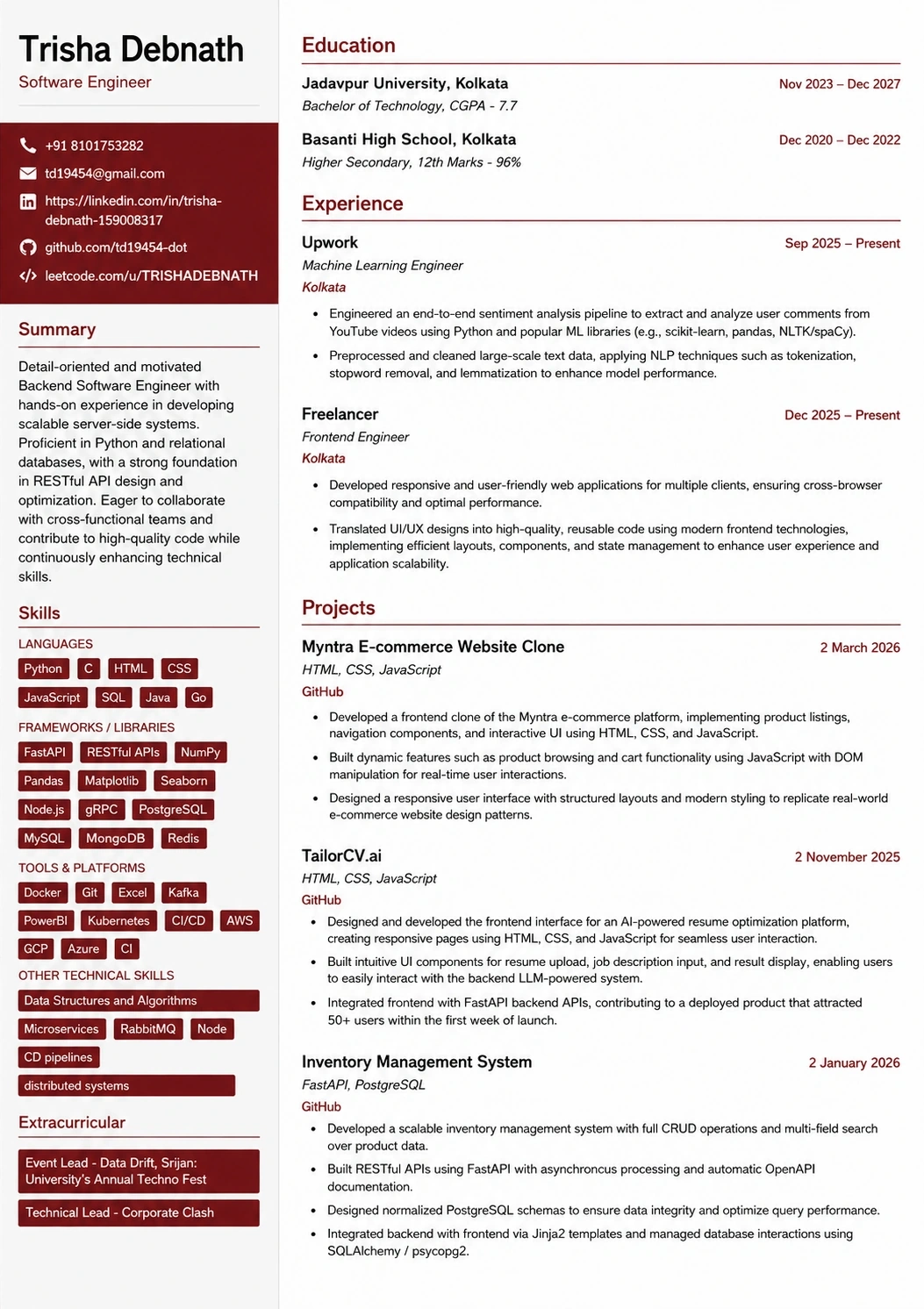
This template is ATS-tested — start from it and the formatting rules in this guide are already handled.
Was this guide useful?
Be the first to rate it.