 SS
SS
Key Takeaways
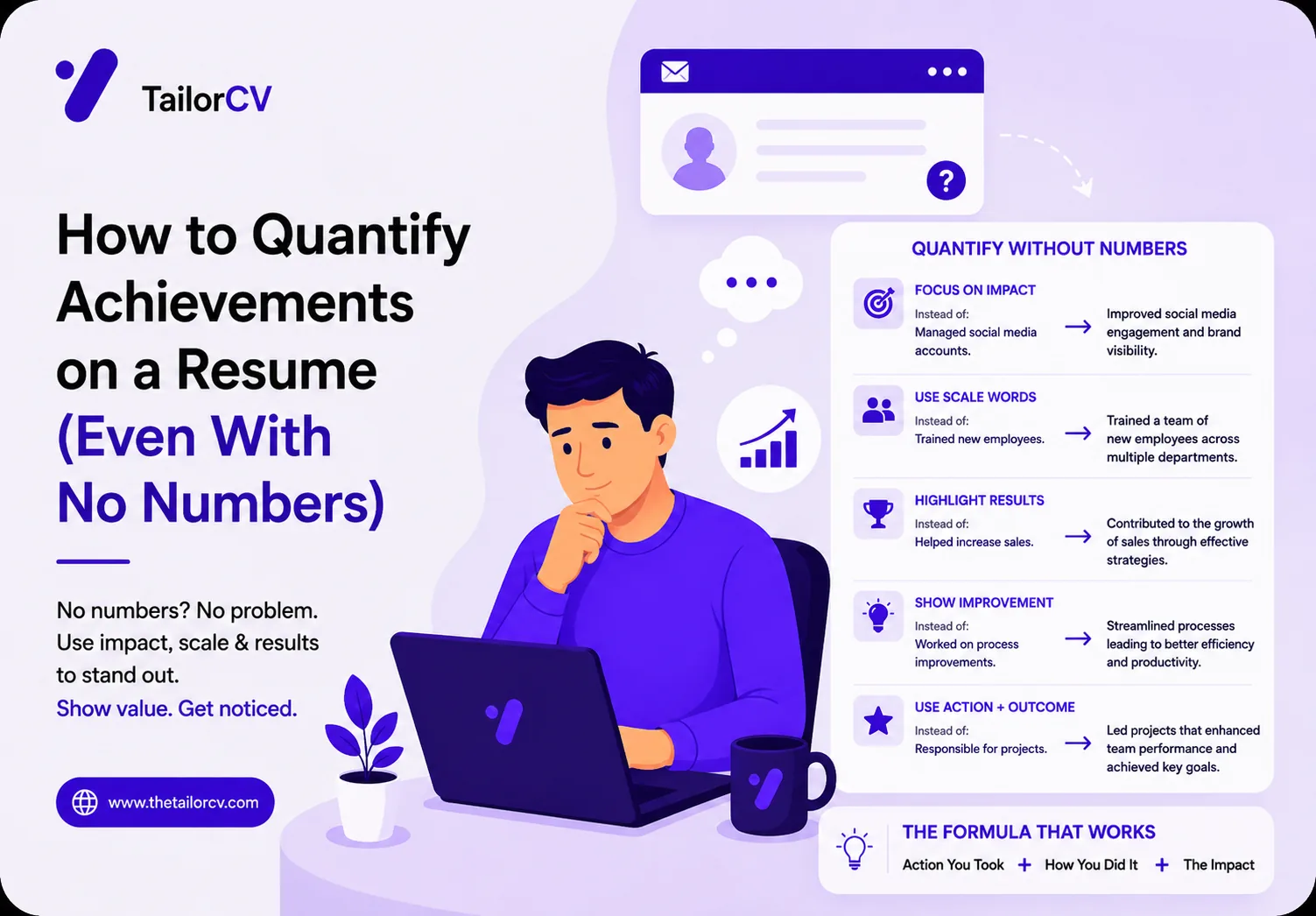
- Quantifying achievements on a resume makes it more memorable and credible, helping candidates stand out to recruiters.
- Use five types of numbers: scale, impact, speed, efficiency, and volume to showcase your contributions effectively.
- Recruiters typically spend only 6-10 seconds scanning resumes, so numbers help grab their attention and provide evidence of your capabilities.
- If you think you have no metrics, consider various aspects of your work, such as user base, project timelines, or team size to find quantifiable data.
- Honest approximations can be used when exact numbers are unavailable, as they still provide valuable context to your achievements.
The single biggest difference between a forgettable resume and one that earns interviews is quantification. Recruiters read hundreds of resumes that all say "improved performance," "led a team," and "managed projects." The candidates who advance are the ones who say "improved page load time from 4.8s to 1.1s," "led a team of 7 engineers," and "delivered a project 3 weeks ahead of schedule."
This guide shows you exactly how to quantify your achievements - even when you think you have no numbers - across every major role type.
Before adding your quantified bullets, make sure your resume format passes ATS. Use the ATS score checker to compare it against the job description and read the resume optimization guide for keyword matching. If you are still setting up your resume, the ATS-friendly templates provide the right structure.
Why Numbers Matter on a Resume
Recruiters spend an average of 6-10 seconds scanning a resume. Numbers are visually distinctive - they stop the eye. "Reduced deployment time" slides past. "Reduced deployment time from 45 minutes to 8 minutes" sticks.
Numbers also answer the implicit question every recruiter has: "How good are they, really?" Claims without evidence are noise. Numbers are evidence.
5 Types of Numbers to Use on a Resume
1. Scale numbers
How large was the system, dataset, team, or user base?
- 2M daily active users
- 50K monthly transactions
- 14-person engineering team
- $12M annual budget
2. Impact numbers
What measurably improved?
- Reduced latency by 60%
- Increased revenue by $180K
- Improved retention from 58% to 74%
3. Speed numbers
How much faster did something happen?
- Cut deployment time from 45 minutes to 8 minutes
- Reduced onboarding from 14 days to 3 days
- Shipped 18 features in 12 months
4. Efficiency numbers
How much time, money, or effort was saved?
- Saved 12 hours of manual work per week
- Reduced support tickets by 34%
- Cut AWS costs by $22K monthly
5. Volume numbers
How much did you do?
- Reviewed 200+ pull requests per year
- Interviewed 40 candidates per quarter
- Managed 8 client accounts
How to Find Numbers When You Think You Have None
Most people believe they have no metrics. They almost always do.
Ask yourself:
- How many users used what I built?
- How many requests did my API handle per day?
- How many team members did I work with?
- How many hours per week did my automation save?
- How much did the metric improve before and after my change?
- How much data was in the database I managed?
- How many clients, accounts, or projects did I support?
- How long did the project take? Was it on time?
- What percentage of the goal was achieved?
If you genuinely do not have a number, use an approximation:
- "approximately 50K records"
- "estimated 6 hours per week saved"
- "supported a team of about 12"
An honest approximation is better than no number.
50 Quantified Resume Bullet Examples by Role
Software Engineer
- Reduced API latency from 620ms to 140ms by adding Redis caching, improving SLA compliance from 88% to 99.4%.
- Shipped 22 API endpoints in 3 months for a payments platform processing 1.4M+ daily transactions.
- Added test coverage from 12% to 81% across the checkout service, reducing production defect rate by 44%.
- Migrated 11 legacy cron jobs to Kafka-based event consumers, eliminating 3 weekly on-call incidents.
- Reviewed 300+ pull requests across 4 engineering teams in 12 months, maintaining 48-hour review SLA.
Data Analyst
- Built a Power BI dashboard replacing 9 manual Excel reports, saving the analytics team 12 hours per week.
- Wrote SQL queries to analyze 1.2M transaction records, identifying a 17% drop in repeat purchases after first order.
- Reduced manual data entry errors by 61% by introducing automated validation checks in the reporting pipeline.
- Presented customer segmentation analysis to leadership, informing a campaign that improved repeat orders by 9%.
- Created 14 KPI dashboards across sales, marketing, and product teams, consolidated from 40+ separate Excel sheets.
Data Scientist
- Trained an XGBoost churn model on 2M customer records with 0.87 AUC, enabling targeted campaigns that reduced 90-day churn by 14%.
- Reduced model training time by 3.4x by migrating from single-GPU to 8-GPU distributed PyTorch training.
- Automated weekly sentiment analysis on 50K+ support tickets, reducing manual tagging from 8 hours to 20 minutes per week.
- Deployed 4 production ML models using MLflow and AWS SageMaker with automated retraining and drift monitoring.
- Identified $280K in quarterly overstock savings by building a demand forecasting model with 91% MAPE accuracy.
DevOps Engineer
- Reduced average deployment time from 42 minutes to 9 minutes by migrating to GitHub Actions with parallel job execution.
- Cut AWS monthly costs by $22K by rightsizing EC2 instances, removing unused volumes, and implementing auto-scaling.
- Improved system availability from 99.6% to 99.96% by introducing blue-green deployments and automated rollbacks.
- Wrote 280 lines of Terraform modules that replaced 3 days of manual environment provisioning with a 40-minute automated setup.
- Led SOC 2 Type II compliance infrastructure work across 12 AWS services, passing the audit with zero critical findings.
Product Manager
- Launched a self-serve onboarding flow that reduced time-to-first-value from 11 days to 3 days and improved 30-day retention by 22%.
- Defined OKRs for a 4-team product area and tracked 6 leading indicators in weekly reviews with C-suite stakeholders.
- Ran 6 A/B tests that identified copy changes increasing annual plan upgrades by 18%.
- Delivered a dispute management feature 2 weeks ahead of schedule, enabling an enterprise contract worth $320K ARR.
- Grew MAU from 8K to 21K in 9 months through 3 major feature launches and 14 incremental improvement sprints.
UX Designer
- Redesigned checkout flow, reducing abandonment from 71% to 53% - an increase of $48K monthly revenue.
- Led 30 user interviews across 3 research sprints that reshaped the Q2 roadmap and cancelled 2 low-value features.
- Built a 90-component Figma design system adopted by 4 product teams, reducing design-to-engineering handoff time by 55%.
- Improved task success rate from 52% to 84% through navigation restructuring validated by tree testing with 200 participants.
- Achieved WCAG 2.1 AA accessibility compliance across 6 core user flows, expanding accessible user base by an estimated 11%.
Marketing
- Grew organic search traffic from 12K to 48K monthly sessions through a content SEO strategy across 40 published articles.
- Reduced cost per lead from $84 to $31 by restructuring Google Ads campaigns and improving landing page conversion.
- Managed a $450K annual digital marketing budget across Google, Meta, and LinkedIn with 4.2x blended ROAS.
- Built email automation sequences that increased trial-to-paid conversion from 18% to 27% for 3K+ monthly trial signups.
- Launched a referral program that generated 1,200 new customers in 90 days at $8 CAC versus $62 average CAC.
Sales
- Closed $1.8M in ARR in FY2025, 124% of quota across 28 enterprise accounts.
- Reduced average sales cycle from 92 days to 57 days by introducing a structured discovery framework.
- Managed a pipeline of 80+ accounts, converting 34% to closed-won versus team average of 22%.
- Onboarded 12 new SMB clients in Q3 with 100% 90-day retention rate.
- Generated $340K in expansion revenue through upsells and cross-sells across existing accounts.
Customer Service / Support
- Maintained 96% CSAT score across 1,200+ monthly support tickets over 18 months.
- Reduced average first response time from 9 hours to 2.4 hours by building a ticket triage process and macro library.
- Created a self-service knowledge base of 80+ articles that deflected 28% of incoming support volume.
- Resolved 94% of tickets at first contact, above team average of 78%.
- Onboarded and trained 5 new support agents, reducing their ramp time from 6 weeks to 3 weeks.
Operations / Project Management
- Led a warehouse relocation project completed 3 weeks ahead of schedule and $40K under budget.
- Reduced fulfillment error rate from 3.8% to 0.6% by implementing a barcode scanning process across 3 warehouse locations.
- Managed 14 concurrent supplier relationships, reducing average lead time by 22%.
- Automated a weekly inventory reconciliation process that saved 8 hours of manual work per week.
- Improved on-time delivery rate from 81% to 96% by redesigning the dispatch scheduling workflow.
How to Add Numbers to an Existing Bullet
Take a vague bullet and transform it:
Before:
- Improved website performance
After:
- Improved Lighthouse performance score from 42 to 91 by implementing lazy loading, code splitting, and critical CSS inlining, reducing bounce rate by 18%.
Before:
- Led a data analysis project
After:
- Analyzed 80K customer records in Python and SQL to identify high-churn cohorts, leading to a retention campaign that saved $120K in annual recurring revenue.
Before:
- Managed social media accounts
After:
- Grew LinkedIn follower count from 4K to 22K in 8 months through a daily content strategy, generating 3 inbound enterprise leads per month.
Conclusion
Quantifying your resume achievements is not about exaggerating - it is about being specific. Every vague claim has a number behind it. Your job is to find it, estimate it honestly, and use it.
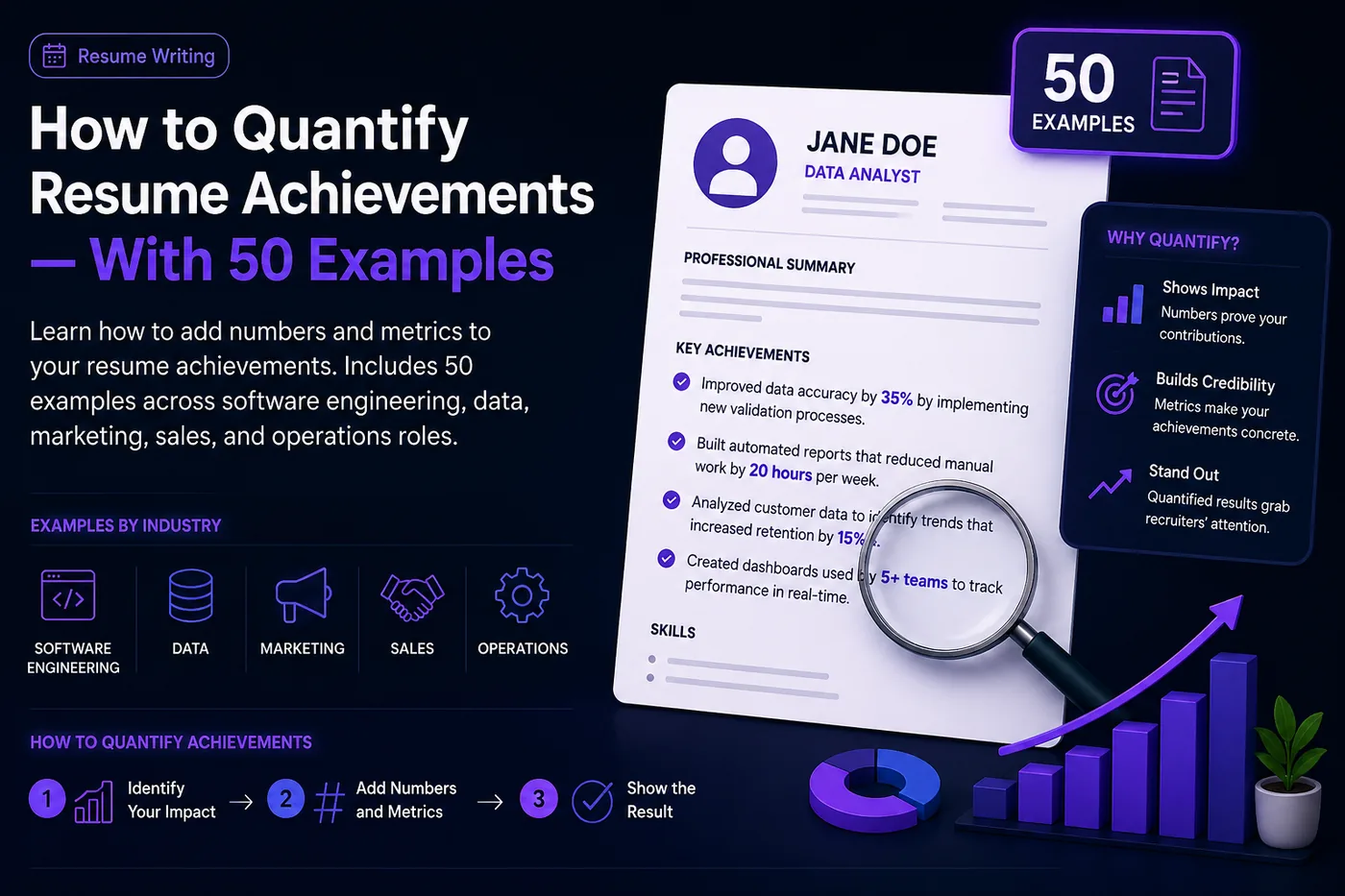
Numbers make your resume scannable, credible, and memorable. They transform vague claims into proof.
Once your bullets are strong, run your full resume through the TailorCV ATS score checker to make sure your keywords also match the job description. Use the resume templates to ensure your format is clean. If you are still building your resume from scratch, read the resume optimization guide for the full structure.
Related Guides
- 200 Best Action Verbs for Resume
- Top Skills to Add to Your Resume
- How to List Certifications on a Resume
- How to List Education on a Resume
- How to Write a Resume Headline
- How to Write a Resume Summary
- Soft Skills for Resume
- What Not to Put on a Resume
- How to Explain Resume Gaps
- Ideal Resume Length
- How to Add Projects in Resume for Freshers: 10 Smart Tips to Impress Recruiters
- First Time Resume With No Experience: Complete Guide for Freshers & College Students
- Chronological vs Functional Resume in 2026 - Which Format to Use
- Cover Letter Guide 2026 - How to Write a Cover Letter That Gets Read
- MBA Resume 2026 - Complete Guide with Examples
- Why Am I Not Getting Interviews for Jobs I'm Qualified For?
- How to Answer "Tell Me About Yourself" in 2026 - With Examples
Make This Practical
Use this guide as part of a complete job-search workflow. Check your resume with the free ATS score checker, improve targeting with the Resume Optimization Guide, and choose a clean format from the ATS-friendly resume templates.
After the resume is ready, strengthen the rest of the application. Draft a targeted letter with the AI cover letter generator, practice interviews with the AI mock interview tool, and create a project-backed proof page with the portfolio website builder if you need a stronger online presence.
Weak vs Strong Resume Achievements
Transforming vague achievements into quantified statements can significantly enhance the impact of your resume.
| Weak Achievement | Strong Achievement |
|---|---|
| Improved sales | Increased sales by 25% in Q2 2023 |
| Managed a team | Led a team of 10 marketing professionals |
| Developed a new software feature | Developed a new software feature that reduced user onboarding time by 30% |
| Increased customer satisfaction | Improved customer satisfaction scores from 75% to 90% over 6 months |
| Organized company events | Organized 5 successful company-wide events attracting over 300 participants each |
Frequently Asked Questions
Why is quantifying achievements important on a resume?
Quantifying achievements on a resume is crucial because it provides concrete evidence of your capabilities and successes. Recruiters often scan resumes quickly, and numbers stand out, making your claims more memorable and impactful. For tips on crafting effective statements, check out our guide on how to write resume bullet points.
What types of numbers should I include in my resume?
You should consider including various types of numbers such as scale numbers (e.g., team size, user base), percentage improvements (e.g., sales growth), and timeframes (e.g., project completion). This diversity in metrics can help showcase your achievements more comprehensively. For a deeper dive into action words that enhance your resume, visit our post on 200 best action verbs for resume.
How can I find metrics to quantify my achievements?
If you feel you lack quantifiable achievements, start by reviewing your past roles and responsibilities. Consider aspects like project timelines, budget management, and team sizes. You can also think about the results of your work in terms of efficiency or revenue. For more guidance, explore our article on how to list education on a resume for inspiration on structuring your accomplishments.
Can quantifying achievements help with ATS optimization?
Yes, quantifying your achievements can enhance your resume's ATS (Applicant Tracking System) optimization. Including specific numbers and metrics can help your resume align with job descriptions that use similar language. To ensure your resume format is ATS-friendly, use our free ATS score checker to evaluate and improve your document.
What are some examples of quantified achievements for different roles?
In our blog post, we provide 50 examples of quantified achievements tailored for various roles, including software engineering, marketing, and sales. These examples illustrate how to effectively incorporate metrics into your resume to increase its impact. For additional strategies on summarizing your skills, check out our guide on how to write a resume summary.
What is your resume scoring right now?
Scan it against a job description and get your ATS match score in about a minute.
Drop your resume here or choose a file
PDF only. Max 2 MB.
We never share your data or use it to train AI models.

Templates that keep this structure intact
This template is ATS-tested — start from it and the formatting rules in this guide are already handled.
Was this guide useful?
Be the first to rate it.