 TD
TD

Key Takeaways
- Tailoring your resume means customizing it for a specific job by using the job description's language and highlighting relevant skills.
- Generic resumes are likely to get rejected by applicant tracking systems (ATS), while tailored resumes significantly increase the chances of getting noticed.
- A tailored resume can enhance your interview rate by 50%, as only 20% of candidates adapt their resumes for each application.
- To tailor your resume effectively, read the job description thoroughly and focus on required skills, qualifications, and company values.
- Avoid common mistakes by ensuring your resume aligns closely with the job description to improve ATS compatibility and recruiter response.
Most people send the same resume to every job and wonder why they get no callbacks.
For stronger results, use this guide together with the ATS score guide, the resume optimization tool, and ATS-friendly resume templates.
They assume the hiring manager will make an exception.
They do not.
In 2026, tailoring your resume is the difference between a stack of rejections and an interview.
This is not about lying. This is about matching your story to the role you want.
You will learn:
- what resume tailoring really means
- how to extract job description keywords
- how to rewrite your summary, skills, and bullet points
- how to use tools to improve your ATS score
- how to avoid the common tailoring mistakes
This guide is practical and direct. No fluff. No guesswork.
What Does "Tailoring Your Resume" Actually Mean?
tailoring your resume means making a version of your resume that fits one specific job.
Not every job. One job.
It means using the exact language that the job description uses. It means highlighting the skills and experience that matter most for that role. It means removing details that are not relevant.
A tailored resume is not a new resume every time. It is a smarter version of the same resume that matches a role.
Tailoring means customizing your resume for the job description and the hiring process.
Tailored vs Generic
| Resume Type | What it does | ATS friendly? | Recruiter response |
|---|---|---|---|
| Generic resume | Uses broad wording, one size fits all | Low | "Not a close fit" |
| Tailored resume | Mirrors role language and priorities | High | "Looks designed for this role" |
A generic resume is easy to send. A tailored resume is more likely to get clicked.
Why You Must Tailor Your Resume for Every Job (2026 Reality)
ATS filters kill generic resumes.
Most companies use applicant tracking systems. They scan resumes for keywords. If your resume does not match, it is often rejected before a human sees it.
Recruiters can tell instantly.
They see resumes that are too general. They can tell which candidates did not read the job description. Those resumes get passed over.
Stats matter.
A tailored resume can increase interview rate by 50%. 60% of job postings use ATS keyword matching. Only 20% of candidates adapt their resumes for each application.
You are not just competing with people. You are competing with their job description keywords.
If you want to stand out in 2026, you must tailor your resume for every job. That is the new normal.
Step-by-Step: How to Tailor Your Resume for Any Job
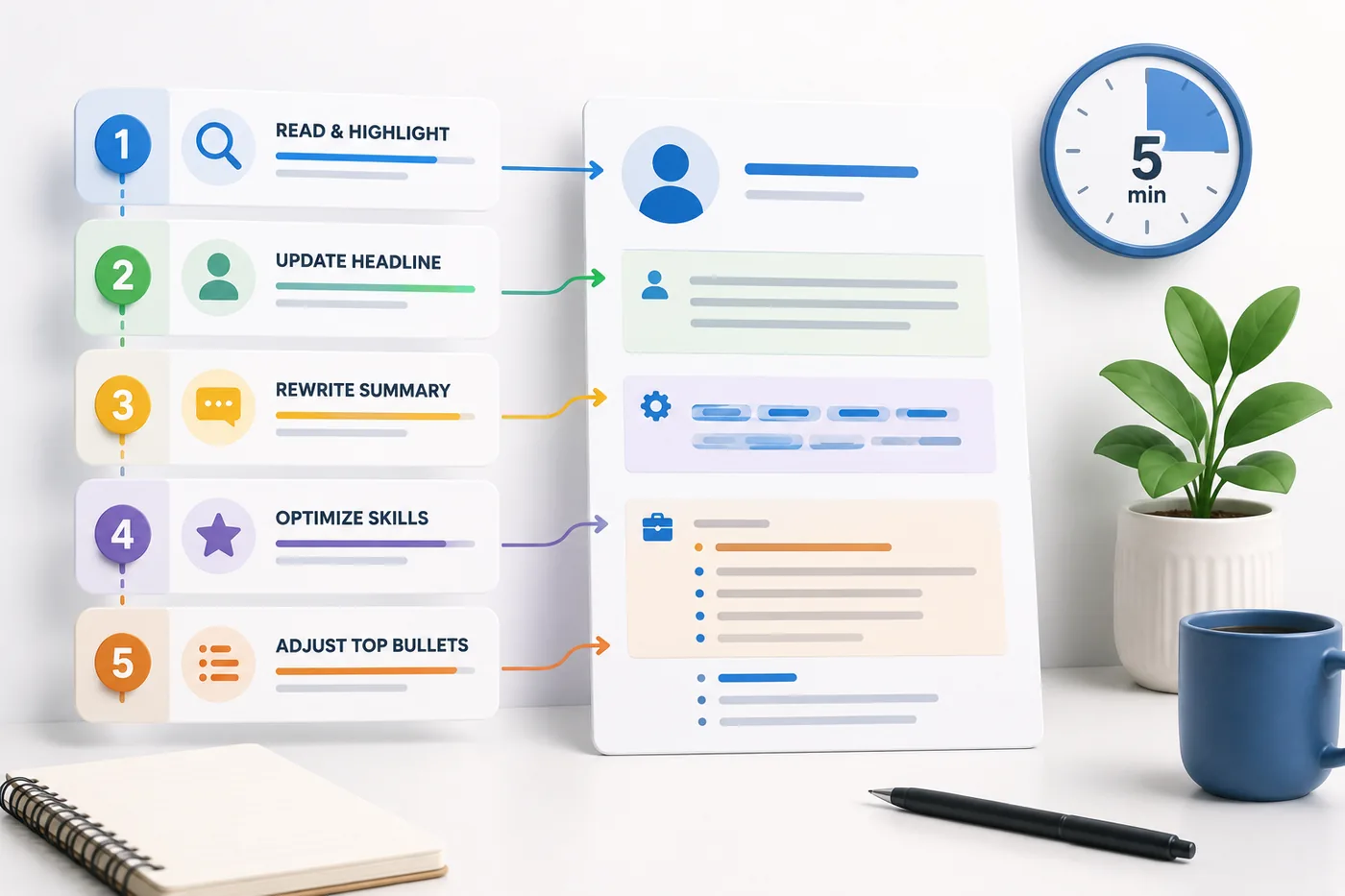
Step 1: Read the Job Description Like a Detective
Start with the job description. Read it carefully. Every line matters.
Pay attention to:
- required skills
- preferred qualifications
- responsibilities
- tools and technologies
- company values
- product focus
Look for patterns. If "product-led growth" appears twice, it is important. If "SQL" is in the required section, make sure it is obvious on your resume.
Find the top 3 skills the role demands. These are the ones you should signal clearly.
Write them down. That is your tailoring map.
Pro Tip
If a word repeats in the job description, it is not an accident. Use it in your resume.
Step 2: Identify the Must-Have Keywords
Now highlight the exact job description keywords.
This is not word salad. This is the language ATS uses.
List these keywords:
- titles and role names
- technical skills
- industry terms
- software and tools
- metrics and outcomes
For example:
- "customer success" vs "client success"
- "full stack developer" vs "backend engineer"
- "SEO optimization" vs "search optimization"
Use the exact form the company uses. If they say "DataOps", say "DataOps".
Keywords are the trigger words that make your resume pass filters and get human attention.
Track keywords in a short table.
| Job Description | Your Resume |
|---|---|
| Python, Flask, Docker | Python, Flask, Docker |
| ATS score optimization | ATS score optimization |
| cross-functional teams | cross-functional teams |
Step 3: Mirror the Job Description Language
This is the most powerful step.
You do not need to copy the JD verbatim. You need to mirror its style and tone.
If the JD says "drive customer retention", use the same phrase. If the JD says "lead analytics initiatives", do the same.
This does two things:
- it improves ATS match
- it makes your resume read like a fit for the role
If the JD says "drive growth", avoid "increase revenue" in that section. If it says "agile product development", do not use only "scrum team".
Match the key phrases. Keep your resume honest. Avoid overclaiming.
Step 4: Rewrite Your Professional Summary for Each Role
Your summary is the first thing recruiters read. It should be tailored first.
Your summary should include:
- your title
- the job title you are applying for
- your top qualifications
- a strong result or two
- one keyword from the job description
Before:
Experienced software engineer with strong backend skills and a history of building APIs.
After:
Technical product engineer with 6 years of experience building Python and Flask web services for SaaS products. Skilled in API architecture, cloud deployment, and scaling systems for user growth. Ready to drive product-led growth for an early-stage platform.
Use the job title if it matches your experience. Use the primary tools and metrics from the JD.
Step 5: Adjust Your Skills Section
The skills section should reflect the role.
Use the list of must-have keywords. Place the most relevant skills first.
If the job requires:
- AWS
- Terraform
- Kubernetes
- CI/CD
Then your skills section should look like:
- AWS
- Terraform
- Kubernetes
- CI/CD
- Python
- Docker
Remove skills that are not relevant to this job. Keep the list focused. A long list of unrelated tools dilutes your match.
If the JD asks for "job description keywords" like "UX research" or "data governance", add them if you have them. Only include skills you can discuss.
Step 6: Reorder and Rewrite Your Bullet Points
This step matters more than you think.
Reorder accomplishments to match the job. Put the strongest, most relevant bullets first.
If the job asks for "customer-facing analytics tools", make sure you have a bullet about that near the top.
Rewrite bullets to include:
- context
- action
- result
- keyword
Before:
- Built a reporting dashboard for the operations team
After:
- Built a reporting dashboard using Python and Flask to improve operations visibility and reduce reporting time by 30%
If the job requires "process automation", add:
- Automated weekly reconciliation workflows with Python and Airflow, reducing manual effort by 40%
Do not include every job detail. Include only what supports this application.
Focus on the results that matter to this role. Use the language from the job description.
Step 7: Check Your ATS Score Before Applying
This is the final step.
A resume that is tailored but still fails ATS is a problem. Check your ATS score before you apply.
Compare your resume to the job description. Use tools to identify missing keywords and formatting issues. A strong ATS score means your resume is visible to recruiters.
If the score is low:
- add missing keywords
- simplify sections
- remove unusual formatting
- verify section headers
If you want a quick check, use Check Your ATS Score.
A tailored resume plus a high ATS score is a winning combination.
Before vs After: Tailored Resume Example
This is a real example for a software engineer role.
Before
- Developed internal dashboards and reporting tools
- Worked with backend systems and databases
- Collaborated with product teams to deliver features
After
| Before | After |
|---|---|
| Developed internal dashboards and reporting tools | Developed internal analytics dashboard using Python and Flask to improve product usage insights for cross-functional teams |
| Worked with backend systems and databases | Worked with PostgreSQL, Redis, and Docker to scale backend systems for 100k monthly users |
| Collaborated with product teams to deliver features | Collaborated with product and UX teams to deliver customer-facing features on time |
Before / After Code Block Style
Before: Worked on backend APIs for several products
After: Designed and built REST APIs with Python and Flask to support new product launches, improving response time by 45%
The after version:
- uses the exact words from the job posting
- shows measurable results
- focuses on what the employer wants
That is how you tailor your resume.
Common Mistakes When Tailoring a Resume
- Sending one resume to every job
- Using the wrong title language
- Listing unrelated skills
- Ignoring required keywords
- Copying the job description verbatim
- Forgetting to update your summary
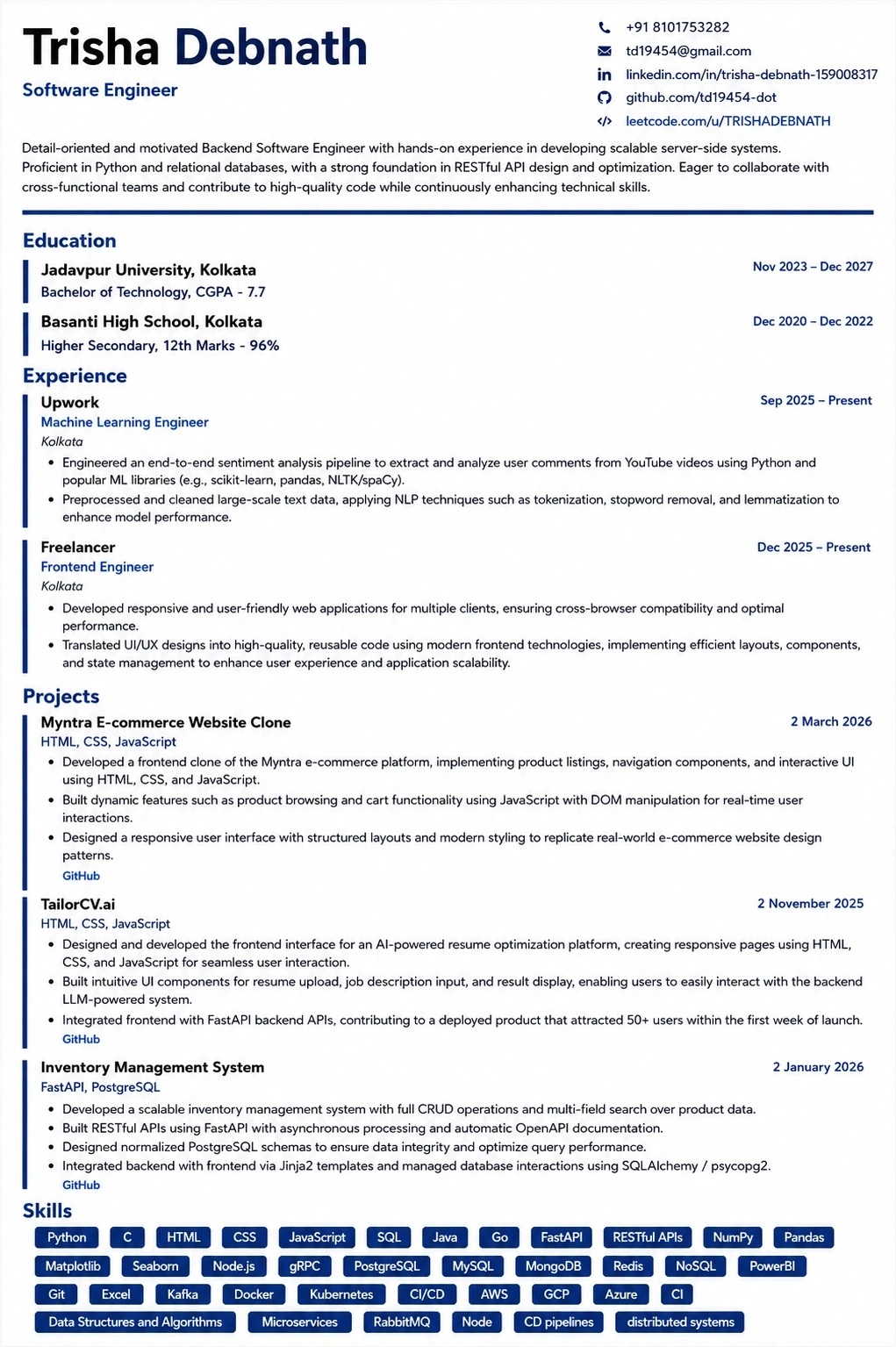
Your resume after optimization
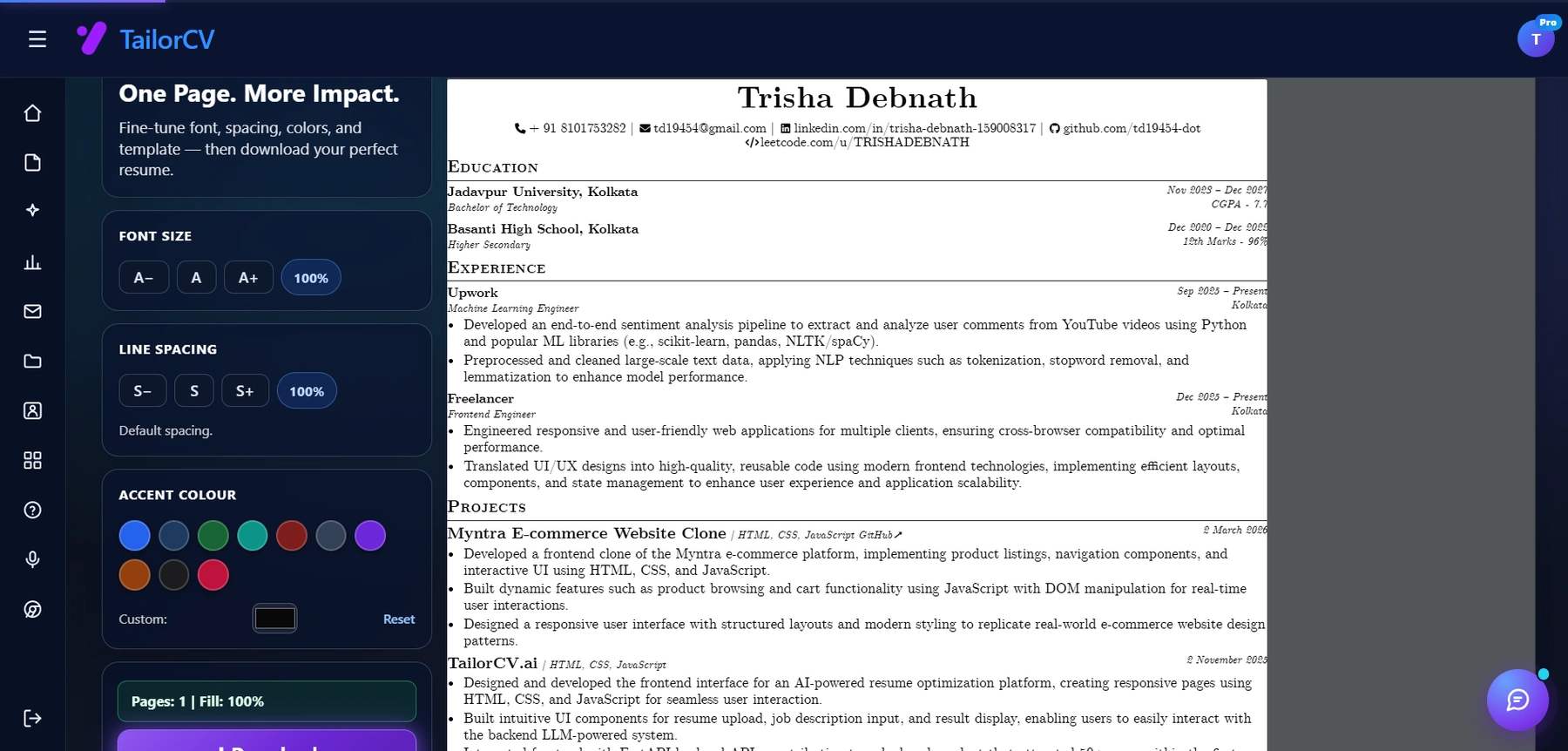
This is the resume after tailoring. The content is already matched to the posting; these controls are how you fit it onto one page - font size, line spacing, accent colour and template, with a live page counter.
How TailorCV Makes Resume Tailoring 10x Faster
Manual tailoring is slow. It takes time to read every job description, rewrite bullets, and update keywords.
TailorCV solves that. Paste the JD. Upload your resume. The AI rewrites your resume with the right keywords and format.
It also checks ATS performance. It highlights the exact job description keywords you must include. That removes the guesswork.
If you want to skip the busy work, try Optimize My Resume Free. You still stay in control. You still own the final version. But the tool does the heavy editing.
This is especially useful when:
- applying to multiple roles in the same week
- shifting between industries
- trying to match different seniority levels
- preparing for a job in a new sector
TailorCV is not just a shortcut. It is a way to make sure your resume is built around the job description.
For more prep, try AI Mock Interview and browse smart Resume Templates.
Make This Practical
Do not guess whether the resume is ready. Upload it to the free ATS score checker, compare the result with the ATS Score Guide, and fix formatting issues using ATS Resume Formatting Mistakes and ATS Resume Parser Friendly Format.
After the technical cleanup, improve relevance. Use Resume Matching With Job Description, strengthen keyword coverage with the Resume Keywords Guide, and avoid overdoing it by checking ATS Keyword Mistakes. If the layout itself is weak, rebuild with an ATS-friendly resume template.
When you have many postings open, tailoring at volume: 20 applications without 20 rewrites shows how to cluster and tier them.
FAQ
How long does it take to tailor a resume?
It should take 15-30 minutes per application.
The first time is slower.
Once you know the steps, it becomes faster.
Should I tailor my resume for every job?
Yes.
Every job is different.
A resume that is not tailored is a missed opportunity.
Will tailoring improve my ATS score?
Yes.
Tailoring increases keyword match and relevance.
That means a better ATS score.
Can I use the same resume for similar jobs?
Yes, with a close match.
If two jobs ask for the same skills, one tailored version may work for both.
But always review the job description before you apply.
What if I don't have all the required skills?
Focus on the skills you do have.
Use related experience and keywords.
Be honest, but show how your strengths match the role.
How often should I update my resume?
Update it each time you apply.
At minimum, refresh your summary and key bullets for each new job.
One strong tailored version beats a generic resume every time.
Does resume tailoring mean changing the whole resume?
No.
It means changing the most relevant sections.
Your base resume stays the same.
You update the summary, skills, and top bullets.
Can I tailor my resume without tools?
Yes.
You can do it manually.
But tools save time and improve keyword coverage.
Related Guides
- How to Improve Your ATS Score
- What is an ATS Score and Why Does It Decide Your Job Application Before Any Human Reads It
- ATS Score Guide for
- Resume Keywords Guide
- 35 Powerful Technical Skills in Resume for Freshers With No Experience (2026 Guide)
- Cover Letter Guide
- Why Am I Not Getting Interviews for Jobs I'm Qualified For?
- Business Analyst Resume
- Career Change Resume
- Content Writer Resume
- How to Use LinkedIn for Job Search
- LinkedIn Profile Optimization Guide
- Job Description Keyword Extraction - Complete Guide for 2026
- ATS Keyword Mistakes That Are Costing You Interviews (And How to Fix Them in 2026)
- How to Match Resume Keywords to Job Description - 2026 Guide
- Data Analyst Resume 2026
- How to Match Your Resume to a Job Description in Under 10 Minutes (2026 Guide)
- Marketing Manager Resume 2026 - Complete Guide with Examples
- Autofill vs Auto-Tailor: What Job Search Extensions Actually Do (2026)
Conclusion
tailoring your resume is not optional in 2026. It is a requirement.
Read the job description like a detective. Find the job description keywords. Mirror the language. Rewrite your summary. Adjust your skills. Reorder your bullets. Check your ATS score.
These are the exact steps that get interviews.
If you want the fastest way to customize resume for job application, use AI to speed it up. Your tailored resume will land more views. It will get more callbacks. It will make recruiters notice you.
Start now. Start tailoring your resume for every job. Start Tailoring Your Resume Free
See what tailoring is worth on your resume
Score your current resume against a real job description before you change a word.
Drop your resume here or choose a file
PDF only. Max 2 MB.
We never share your data or use it to train AI models.

Start from a template that tailors well
Clean structure means swapping keywords per job takes minutes, not a re-layout every time.
Was this guide useful?
Be the first to rate it.