TD
TD
Key Takeaways
- You can almost always describe the type of work, your role, the tools and the scale without revealing protected details.
- Anonymise clients by industry and size ("a top-5 private bank"), not by vague phrases ("a major client").
- Use relative numbers - percentages, multiples, ranges - instead of exact figures that could identify a client or reveal financials.
- Describe the problem category and your method rather than the product, code name or client-specific outcome.
- Check your NDA or employment contract. When in doubt, ask your employer what you may say publicly.
- Prepare an interview line explaining why some details are withheld. Handled calmly, confidentiality reads as professionalism, not evasion.
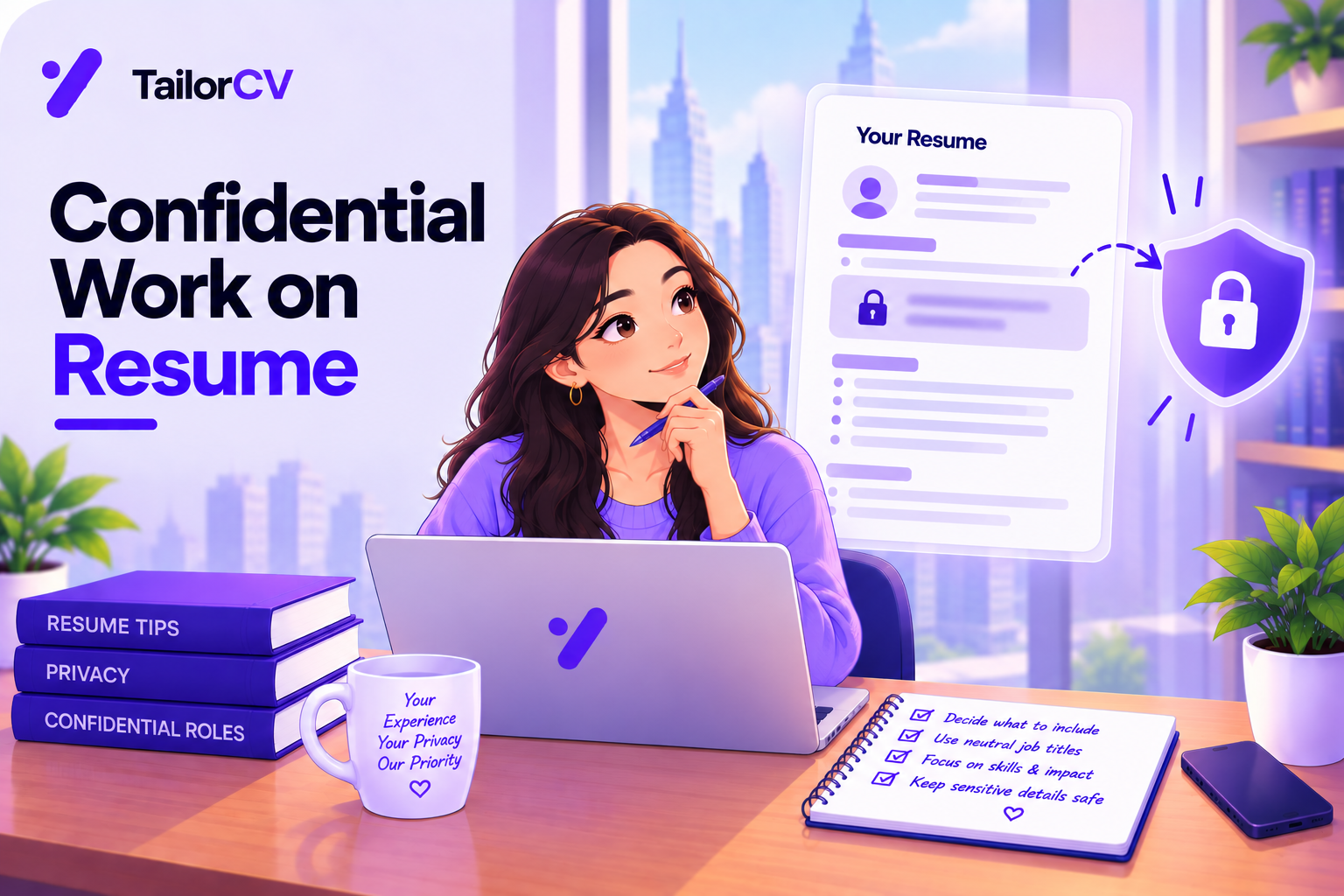
Most of your work is under NDA, done for clients you cannot name, or tied to unreleased products - and you still need a resume that matches the job. You can describe the work's type, your role, the tools and the scale in detail without disclosing what is protected. The skill is anonymising precisely: "a top-5 Indian private bank" instead of "a major client", and "cut processing time 40%" instead of a figure that reveals someone's financials.
This guide covers what you can usually say, how to anonymise clients and numbers, and how to tailor confidential work to a posting.
Why Vague Descriptions Hurt You
Confidentiality is real, but many people over-correct into bullets that say nothing.
Vague bullets look like filler
"Worked on confidential projects for major clients" tells a recruiter nothing about your skill, scale or impact. It reads like padding, and recruiters skim past it. Resume red flags recruiters notice lists vague, unverifiable claims near the top.
Keyword matching needs specifics
ATS matching and recruiter searches look for tools, methods and domains. "Proprietary work" has no searchable terms; "fraud detection models in Python for a private bank" does. See what recruiters actually search for.
Interviewers need something to ask about
If your resume gives no detail, interviews become awkward. A well-anonymised bullet gives the interviewer a safe starting point.
What You Can Usually Say
Most confidentiality agreements protect specific information, not the fact that you did a type of work.
| Usually safe to share | Usually protected |
|---|---|
| Your role and responsibilities | Client names (unless publicly disclosed) |
| Industry and size of the client | Internal financial figures |
| Type of problem solved | Product code names, unreleased features |
| Tools, languages and methods used | Proprietary algorithms or source code |
| Team size and your part | Specific client strategies or pricing |
| Relative outcomes (%, multiples) | Security details, system architecture specifics |
| Timeframe and scale indicators | Anything marked classified or restricted |
This is general guidance, not legal advice. Your own agreement is what counts - read it, and if unsure, ask your employer or former employer what you can say.
How to Anonymise Clients
The goal is to give scale and context without identification.
Use industry + size + region
| Too vague | Too specific (if confidential) | Well anonymised |
|---|---|---|
| "A major client" | "HDFC Bank" | "A top-5 Indian private bank" |
| "A large retailer" | "Reliance Retail" | "A national retailer with 1,000+ stores" |
| "A tech company" | "Named unicorn startup" | "A Series C fintech with 8M users" |
| "A government body" | "Specific ministry programme" | "A central government digital-services programme" |
| "A pharma client" | "Named global pharma" | "A global top-20 pharmaceutical company" |
Be careful that the combination of details does not identify the client. "The largest e-commerce company in India" is effectively a name.
Ask when you are unsure
A short message to your manager, HR or former employer's legal team settles most doubts, and it is far better than guessing.
"I'm updating my resume and want to describe my work on the payments programme accurately without breaching confidentiality. Would it be okay to describe the client as 'a top-5 Indian private bank' and mention a roughly 30% reduction in false positives? Happy to adjust the wording."
Offering your proposed wording makes it easy to say yes. Keep the reply; if the question ever comes up later, you have it in writing.
Use publicly disclosed relationships when you can
If the company has publicly announced the partnership - a press release, a case study on your employer's site - naming the client is usually fine. Check first.
How to Handle Numbers
Exact financial figures are often the most sensitive part.
Prefer relative measures
Too revealing: "Reduced the client's annual logistics cost from ₹84 crore to ₹71 crore."
Anonymised: "Reduced the client's annual logistics cost by about 15% through a warehouse network redesign."
Percentages, multiples ("3x faster"), and ranges ("₹50-100 crore programme") show scale without disclosing exact figures.
Scale indicators that rarely reveal much
Team size, number of users, stores, transactions per day, number of countries, length of the programme - these usually show scale safely. When unsure, round generously ("1M+ users").
When you cannot share outcomes at all
Describe the problem, your method and the adoption instead of the result: "Designed the credit-risk model now used for all SME loan decisions" shows impact through adoption. Estimating impact honestly covers presenting outcomes when data is limited.
Describing the Work Itself
Name the problem category, not the product
Protected: "Built the recommendation engine for Project Falcon, launching in Q3."
Safe: "Built a product recommendation engine for an e-commerce client's unreleased app, handling about 50,000 requests per second in load tests."
Name tools and methods freely
Your tools and methods are generally yours to mention: Python, Spark, React, DCF modelling, penetration testing, lean six sigma. These carry most of the keyword value.
Describe your role precisely
Confidential work is often team work. Say what you did - designed, led, analysed, built - and the team size. See tailoring when your work was a team effort.
What to Watch For, by Field
Different fields protect different things. Knowing the usual sensitivities helps you anonymise the right details.
| Field | Usually protected | Safe way to describe it |
|---|---|---|
| Banking and finance | Client names, deal values, trading strategies | "Advised on 6 M&A transactions of ₹200-1,500 crore in consumer sectors" |
| Law | Client identities, case details, privileged matters | "Drafted and negotiated 40+ commercial contracts for technology clients" |
| Healthcare | Patient data (always), sometimes hospital data | "Analysed outcomes data for 12,000 patients to redesign discharge planning" |
| Consulting | Client names, findings, fees | Industry + size + relative outcome |
| Technology | Unreleased products, code, architecture, security | Category + tools + scale in testing |
| HR and recruitment | Employee data, salaries, individual cases | "Ran compensation benchmarking for a 3,000-person workforce" |
| Defence and government | Anything classified, programme names | General domain + standards + reliability |
Personal data is never negotiable
Whatever your agreement says, never include individuals' personal data - patients, employees, customers - on a resume or portfolio. Aggregate counts are fine; names, records and identifiable details are not.
Writing the Summary When Your Best Work Is Confidential
Your summary is the first thing a reader sees, so it should carry your strongest anonymised evidence rather than a generic description.
Generic: "Experienced consultant who has worked with leading organisations on confidential strategic initiatives."
Specific and safe: "Operations consultant with five years redesigning supply chains for national FMCG and global pharmaceutical companies - typically cutting logistics cost 10-15%."
The second version names industries, scale and a relative outcome range, which is usually safe and far more useful. The three-sentence structure in summary in three sentences works well here, and the action-plus-result shape from how to write resume bullet points applies to every anonymised bullet.
When everything must stay general
If even industries are sensitive - some defence and intelligence work - lead with your methods, standards and environment: "Software engineer with six years building high-availability, security-critical systems under strict documentation and testing standards." Then use the interview to add what you safely can.
Tailoring Confidential Work to a Posting
The tailoring process is the same as normal; you just work within limits.
- Identify the posting's top requirements.
- For each, find confidential work that demonstrates it.
- Describe it using the anonymisation methods above.
- Lead with the anonymised bullets that best match.
- Use the posting's vocabulary for the tools and methods.
Posting requirement: "Experience building fraud detection systems at scale."
Tailored, anonymised bullet: "Built real-time fraud detection models in Python and Spark for a top-5 Indian private bank, scoring about 2M transactions a day; false positives fell roughly 30%."
The bullet names the domain, tools, scale and outcome - everything the posting needs - with no client name or absolute financials.
Worked Example 1: A Consultant With Only Client Work
Situation: Akshay has five years at a consulting firm. Every project was for a client he cannot name. He is applying for an operations strategy role.
Before: "Delivered multiple operations engagements for leading clients across industries."
After: - "Redesigned the distribution network for a national FMCG company (₹10,000+ crore revenue), cutting logistics cost about 12% across 18 warehouses." - "Built the S&OP process for a global top-20 pharmaceutical company's India business; forecast accuracy rose from 60% to around 78%."
For grouping and presenting consulting work generally, see consulting vs industry tailoring.
Worked Example 2: An Engineer on Unreleased Products
Situation: Divya works on an unreleased hardware product at a large tech company. Her NDA prevents discussing features.
Before: "Worked on a confidential product team."
After: "Firmware engineer on an unreleased consumer hardware device - wrote power-management drivers in C for an ARM-based system, extending battery life about 25% in internal testing."
She describes the category (consumer hardware), her role, the tools and a relative result - without naming the product or its features. Interviewers in hardware are used to this.
Worked Example 3: Defence or Government Work
Situation: Manish spent six years on defence-related software projects with security restrictions. He is moving to the private sector.
Approach:
- Describe the domain generally: "mission-critical communication systems for a government defence programme".
- Focus on methods and standards: real-time systems, C++, security clearance-level processes, rigorous testing and documentation.
- Use scale and reliability indicators: "systems requiring 99.99% availability".
- Mention clearance status only if appropriate and permitted, as it may matter for some private-sector roles.
"Developed real-time C++ communication software for a government defence programme, meeting 99.99% availability requirements under strict security and documentation standards."
He checks with his former employer's security office about what he may state publicly. For translating government experience to private-sector language, see tailoring across industries.
Worked Example 4: A Lawyer With Only Privileged Matters
Situation: Kavitha is a corporate lawyer with seven years at a law firm, applying for in-house legal counsel roles. Almost every matter she worked on is privileged, and client names cannot be disclosed.
Before: "Advised clients on various confidential corporate transactions and legal matters."
After: - "Advised on 9 private equity investments in consumer and technology companies (₹50-400 crore) - due diligence, share purchase agreements and closing." - "Drafted and negotiated 60+ commercial contracts for technology clients, including SaaS licences and data processing agreements." - "Led the legal workstream on a cross-border acquisition by a listed Indian company, coordinating with counsel in 3 jurisdictions."
No client is named, no deal is identifiable, and every bullet still shows the type of work, scale and her role. For in-house roles, she adds a line on business-facing work: "Trained 3 client teams on contract negotiation basics." In interviews, she discusses her approach to matters in general terms, which in-house hiring managers - often former law firm lawyers themselves - expect.
Portfolios and Case Studies Under NDA
Designers, developers and consultants often need a portfolio too.
Options that respect confidentiality
| Option | How it works |
|---|---|
| Anonymised case study | Remove client names, logos and real data; describe process and outcome |
| Recreated work | Rebuild a similar example with dummy data |
| Password-protected pages | Share only with interviewers, if your agreement allows |
| Process-focused write-ups | Show your thinking and methods rather than the output |
| Personal projects | Demonstrate the same skills on your own work |
For building a portfolio page quickly, the portfolio builder lets you publish case studies with the level of detail you choose. See also adding a portfolio link to your resume.
Handling Confidentiality in Interviews
Interviewers will ask about your work. Prepare one calm line.
"A lot of my work was under NDA, so I'll describe the problem and my approach without naming the client. The client was a large private bank; the problem was fraud false-positives..."
Then give as much detail as you safely can about your method and reasoning. Interviewers respect people who protect confidential information - it signals you will protect theirs. Stories built this way fit well in the interview story bank method, and you can rehearse them with the mock interview tool.
At Each Career Stage
| Stage | Typical confidentiality issue | Best approach |
|---|---|---|
| Fresher / intern | Internship under NDA | Describe tools, tasks and scale; skip client and product names |
| Early career | Unreleased product or client work | Problem category + your role + relative results |
| Mid-career | Many client engagements | Group by industry; anonymise with size and region |
| Senior | Strategic, financial or board-level work | Scope and relative impact; ranges for money |
Interns: you can still say a lot
An NDA on an internship rarely stops you describing what you did. "Built data-cleaning scripts in Python for a retail client's sales data (about 2M rows)" reveals nothing protected.
Senior candidates: numbers become sensitive
Senior roles involve revenue, margins and strategy. Ranges and percentages protect the company while still showing scale.
Edge Cases and Exceptions
The confidential project later became public
Once a product launches or a deal is announced, you can usually describe it more openly. Check the public record and your agreement.
Your employer is itself confidential
Stealth startups sometimes ask employees not to name them. Use a description - "Stealth-stage fintech startup (Series A)" - and name it once it launches.
A reference checker asks about the project
Your former manager can confirm your role without breaching confidentiality. Let them know how you have described the work so your accounts match.
You worked on something controversial
If a project became publicly controversial, describe your specific work neutrally and be ready to discuss it calmly in interviews.
Common Mistakes
Being vaguer than necessary
"Confidential projects" with no detail wastes the space. You can almost always say more than you think.
Accidentally identifying the client
Combining "largest", "Mumbai-based", "telecom" and a specific year can make a client obvious. Check the combination, not just each detail.
Sharing exact financials
Absolute revenue, cost or pricing figures are often the most sensitive details. Use percentages and ranges.
Inventing specifics to fill the gap
Do not replace protected details with made-up ones. Anonymised truth is fine; fabrication is not. See tailoring without lying.
Forgetting LinkedIn
LinkedIn is public. Apply the same or stricter anonymisation there, and keep it consistent with your resume - see keeping LinkedIn and your resume in sync.
How This Fits With Tailoring
Confidential work does not change the tailoring steps - it changes how you describe evidence. Pick the posting's top requirements, find matching work, anonymise it precisely, and lead with it.
The free ATS scan shows whether your anonymised bullets still contain the terms the posting needs - about a minute. If tools and methods are missing, add them; those are rarely confidential. The AI resume optimizer can reword anonymised bullets toward the posting without adding details you did not include. For choosing which bullets to rework, see which bullets to rewrite.
Quick Checklist
- Have you checked your NDA or employment contract?
- Are clients described by industry, size and region rather than name?
- Does no combination of details identify a client?
- Are exact financial figures replaced with percentages, multiples or ranges?
- Are tools, methods and your role named clearly?
- Is LinkedIn anonymised at least as carefully as your resume?
- Do you have a calm one-line explanation for interviews?
Frequently Asked Questions
How do I describe confidential work on my resume?
Describe the type of work, your role, the tools, the scale and relative outcomes, while anonymising clients by industry and size. Avoid names, exact financials and protected product details.
Can I mention client names on my resume?
Only if the relationship is public or your agreement permits it. Otherwise describe the client by industry, size and region, such as "a top-5 Indian private bank".
How do I show results if the numbers are confidential?
Use percentages, multiples and ranges instead of absolute figures, or describe adoption and scope, such as "model now used for all SME loan decisions".
Is it OK to say "confidential" on my resume?
You can note that work was under NDA, but do not let it replace detail. A precisely anonymised bullet is far more effective than a label.
What if my NDA prevents me describing my work at all?
That is rare for describing your role and skills. Check the agreement and ask your employer what you may say. Focus on tools, methods, scale and your responsibilities.
How do I build a portfolio if my work is under NDA?
Use anonymised case studies, recreated examples with dummy data, process-focused write-ups, or personal projects that show the same skills.
What do I say in interviews about confidential projects?
Explain briefly that the work was under NDA, then describe the problem, your approach and the outcome in general terms. Interviewers usually respect this.
Should I list security clearance on my resume?
Only if relevant to the role and permitted. Some private-sector roles value clearance; others do not need it.
Can I be sued for describing my work on a resume?
Describing your role, skills and general results is very unlikely to breach a typical confidentiality agreement. Revealing protected information - client names, trade secrets, exact financials - could. When unsure, ask your employer or get legal advice.
Should I mention the NDA itself on my resume?
Usually not. A precisely anonymised bullet speaks for itself. Mention the NDA in interviews when explaining why some details are general.
What to Do Now
List your three most relevant confidential projects. For each, write down the industry and size of the client, the problem category, your role, the tools and a relative outcome. Turn each into a bullet using the anonymisation tables above.
Check your agreement for anything you are unsure about. Then read team vs individual credit if the projects were team efforts, and estimating impact honestly for building defensible numbers.
See what tailoring is worth on your resume
Score your current resume against a real job description before you change a word.
Drop your resume here or choose a file
PDF only. Max 2 MB.
We never share your data or use it to train AI models.

Start from a template that tailors well
Clean structure means swapping keywords per job takes minutes, not a re-layout every time.
Was this guide useful?
Be the first to rate it.