 TD
TD
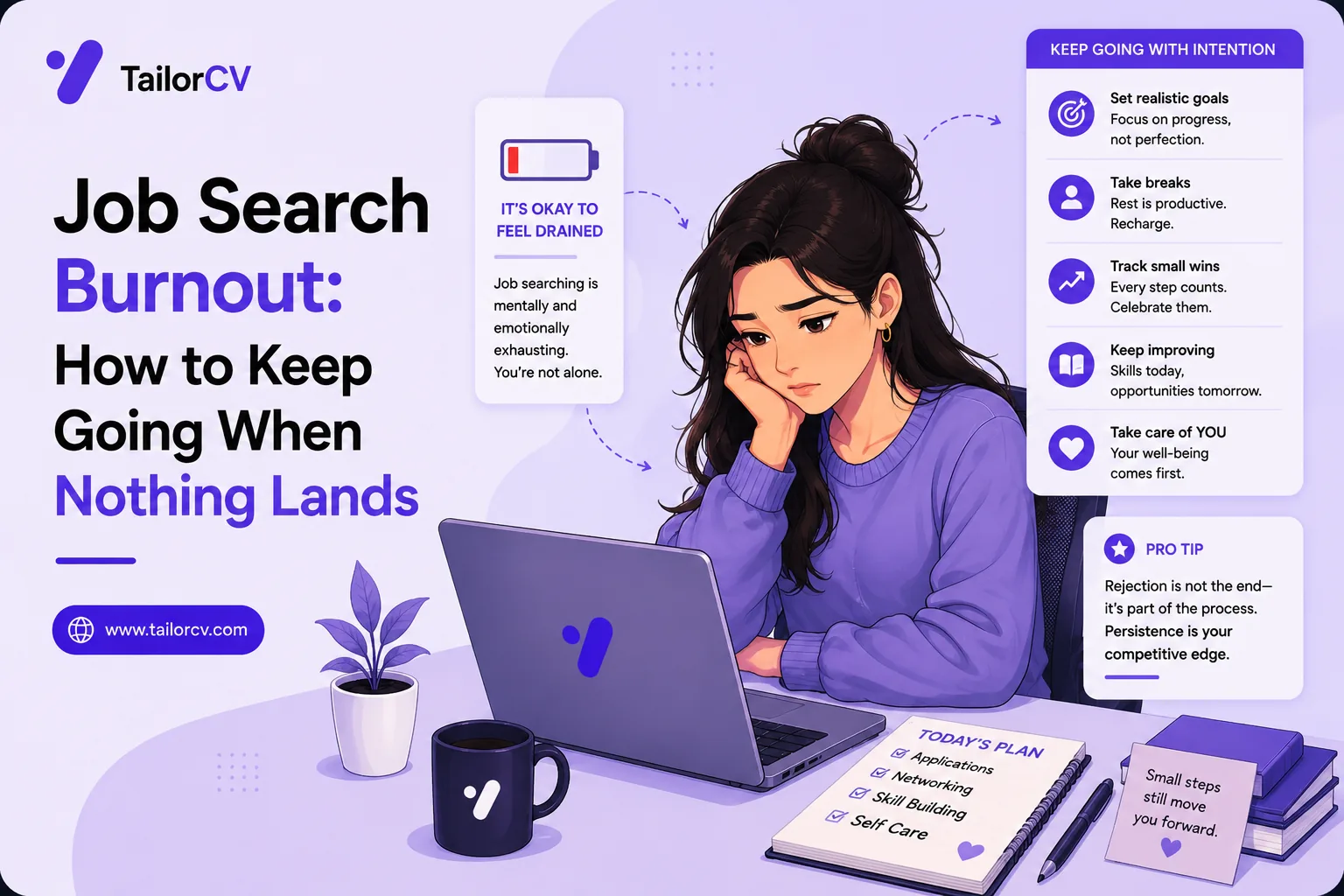
Key Takeaways
- Six structural features make job searching uniquely exhausting - none of them are about you.
- Burnout and ordinary discouragement need different responses, so it is worth telling them apart.
- Much job search burnout is caused by doing high volumes of work that does not convert, so fix the cause rather than the feeling.
- Fixed working hours with a real end matter, because the endlessness is the problem.
- A single-digit response rate is ordinary in a competitive market - knowing the base rate stops each rejection reading as a verdict.
There's a particular kind of tiredness that comes from job searching, and it doesn't match the effort involved. You've sent forty applications, which is maybe fifteen hours of work, and you feel wrecked in a way that fifteen hours of actual work never does.
That's not weakness and it isn't a character problem. Job searching has a structure that is unusually good at exhausting people, and understanding why is most of the fix. This guide covers what's actually draining you, how to tell burnout from ordinary discouragement, and a system that protects your energy — which, not coincidentally, also produces better results.
Why This Is Uniquely Exhausting
Six structural features, none of which are about you.
The feedback is almost entirely negative or absent. Most applications produce silence. You do the work and receive nothing — not even a no. Very few human activities run on that ratio, and none of them feel good.
Rejection is personal by design. You're not submitting a product. You're submitting a summary of your life and being told it isn't enough, repeatedly. The mind struggles to file that as a routine business outcome.
There's no completion. No task ends. There's no point at which you've done enough and can stop, so guilt fills every hour you're not applying — including the ones where rest was the correct choice.
Effort and outcome are decoupled. More applications don't reliably produce more interviews, which breaks the basic loop that makes work feel sustainable. This is also why silence is such a poor guide — as how long it takes to hear back explains, silence looks identical whether you were filtered instantly or narrowly missed.
It's usually solitary. No colleagues, no shared frustration, no one who sees the effort.
The stakes are real. Money, housing, status, identity. It isn't a hobby you can shrug off.
Put those together and it would be surprising if it didn't exhaust people. Treating your reaction as a reasonable response to a badly-structured process, rather than a personal failing, changes what you do about it.
Burnout or Discouragement?
Worth distinguishing, because they need different responses.
Discouragement is a low patch. You feel flat, then a good conversation lifts you. Motivation returns after a break. This is normal and manageable.
Burnout looks different:
- You avoid applying even when you have time and energy for other things
- Applications get sloppier — the same generic resume everywhere, because tailoring feels impossible
- You feel numb about outcomes rather than disappointed
- Physical signs: disrupted sleep, headaches, appetite changes
- Rejections stop registering, which feels like resilience and isn't
- You've started believing the search is futile rather than difficult
That last one matters most. Discouragement says this is hard. Burnout says this is pointless. The second is a distortion, and once you're in it you'll make worse decisions — including abandoning approaches that were about to work.
If you recognise the second list, the answer is not to try harder. It's to change the system, and often to take a genuine break first. If it's persistent, affecting sleep and functioning over weeks, that's worth talking to a professional about — job search burnout shades into depression more often than people admit, and treating it as a motivation problem when it isn't just prolongs it.
Fix the Cause, Not Just the Feeling
Here's the part most advice skips. Much job search burnout is caused by doing high volumes of work that doesn't convert. If your applications aren't producing responses, you're paying a large emotional cost for almost no return — and no amount of self-care makes that sustainable.
So the most effective anti-burnout measure is often technical rather than emotional: make the work convert.
Diagnose it honestly. Run your resume against a posting you're genuinely qualified for with a free ATS score. A low match on a job you can clearly do means you've been filtered on language, not judged on merit — and every one of those silences you took personally was a formatting and wording problem. That reframe alone lifts people, because it converts a verdict on your worth into a fixable technical issue.
Then fix it once and benefit on every application afterwards: clear formatting that breaks the parser, move to a parser-friendly structure, increase your match with the right keywords without stuffing, tighten the structure, quantify achievements, use stronger verbs, fix the summary and length, and cut roles too old to matter.
The other structural fix: make tailoring cheap. Much of the exhaustion comes from the belief that doing it properly takes an hour per application — which makes every application a large decision. Tailoring in five minutes and fast posting-matching change the economics enough that tailoring every application stops being a source of dread. And since tailored resumes convert far better than generic ones, you get better results from less total effort — which is the only sustainable combination.
A Sustainable System
Fixed hours with a real end. Decide your working hours and stop when they're done. The endlessness is the problem, so impose an ending. Two focused hours beats six anxious ones.
Lower the volume, raise the conversion. A moderate number of well-matched applications outperforms mass generic applying on both results and energy — see how many jobs to apply to per day. Fewer, better is the whole strategy.
Track process, not outcomes. You control applications sent, conversations had, skills built. You don't control responses. Measure what you control, or you're grading yourself on someone else's decisions.
Batch similar work. All applications in one block, all outreach in another. Context switching costs more than people think.
Build in human contact. The isolation does real damage. Networking and informational interviews feel human in a way portals never do, and they happen to be the fastest channel — referrals and referral applications convert at multiples of cold ones. Doing more of the thing that's both better for your mood and better for your odds is the easiest trade available.
Take real days off. Not guilty half-days. A genuine day where you don't check anything. Nobody hires on Sunday.
Keep something that isn't the search. Exercise, a project, people, anything with a visible completion. You need at least one area producing evidence you're competent, because the search won't for a while.
Prepare for interviews during quiet stretches. It's productive, it's within your control, and it converts anxious waiting into readiness. Build a STAR story bank, rehearse tell me about yourself, why do you want this job, strengths, weaknesses, why you left, and five years. Run a mock interview and work through the full prep guide.
Handling the Rejections
Expect a low hit rate as normal, not as a verdict. A single-digit response rate is ordinary in a competitive market. Knowing the base rate stops each individual no from meaning anything.
Don't over-read silence. It carries no information about your worth — it's what a process with too many applicants produces.
Extract the signal, drop the rest. If actual feedback arrives, use it. Otherwise there's nothing to analyse, and analysing it anyway is how people spiral. Handling job rejection goes deeper.
Notice where you're failing. Applications but no interviews is a resume problem — fixable, and the ATS score will show it. Interviews but no offers is an interview problem — also fixable, via prep and behavioural practice. Knowing which one you have converts a vague sense of failure into a specific task, and that alone reduces the weight of it.
Watch your judgement when you're depleted. Burnout makes people accept bad offers, negotiate poorly, undersell on salary, and miss job scams that target exactly this state.
If Your Situation Is Harder
Some searches are structurally longer, and it helps to know that in advance rather than reading it as personal failure. No experience and first tech roles take time — projects, a portfolio, and realistic fresher ATS expectations help. So do career changes, moving into tech, and non-tech to data, where a career-change portfolio carries weight. An employment gap adds friction and is explainable.
Longer isn't failing. But if the search is structurally long, the system has to be sustainable — sprinting doesn't work on a marathon.
Taking a Break Without Losing Ground
The fear that stops people resting is that a pause costs them momentum. In practice, depleted applications convert so poorly that a genuine break usually costs nothing and often helps.
Take a real one. A week where you don't check, apply, or refresh. Half-measures produce guilt without recovery, which is the worst of both.
Keep passive channels running. Job alerts stay on. Your LinkedIn profile and headline keep working while you don't — recruiters search regardless of whether you're actively applying.
Set a return date before you stop. An open-ended break is harder to come back from than a defined one.
Come back with a fixed plan. Return to a system, not to an open browser and a vague intention — the weekly structure above, or the one in how to find a job fast.
Use a short break productively if you can't take a full one. Switch from applying to preparing: company research, questions to ask them, what to wear, video and panel formats, second-round questions, and salary negotiation. It's lower-rejection work that still moves you forward.
Financial pressure sometimes makes a real break impossible, and that's a genuine constraint rather than a failure of discipline. If so, reduce scope rather than stopping: fewer applications, better targeted, with the referral and networking channels prioritised because they carry less rejection per unit of effort.
Where the Energy Actually Goes
Worth auditing, because most people spend the most energy on the least productive channel.
High cost, low return: mass cold applications through portals. Maximum rejection exposure, minimum conversion. This is where burnout is manufactured.
Moderate cost, high return: tailored applications to fresh, well-matched postings — tailored beats generic by enough to justify the extra minutes, especially when tailoring takes five.
Low cost, high return: referrals and warm introductions. Less rejection, better odds, and human contact.
Low cost, compounding: informational interviews. Almost no rejection risk, and they generate opportunities weeks later.
One-time cost, permanent return: fixing the resume itself. An afternoon on ATS readability, keyword matching, and fast posting-matching improves every application you send from then on.
Shifting even a third of your time from the first category to the last four changes both how the search feels and how it performs. That's the core move: the version of a job search that burns you out least is also the version that works best, because both depend on doing less low-conversion work.
Frequently Asked Questions
Is job search burnout real? Yes. The structure of job searching — near-constant negative or absent feedback, personal rejection, no completion point, and effort decoupled from outcome — reliably exhausts people. It's a predictable response to the process, not a personal weakness.
How do I know if I'm burnt out or just discouraged? Discouragement lifts after a break or a good conversation. Burnout means avoiding applications despite having energy, sloppier work, numbness rather than disappointment, physical symptoms, and believing the search is pointless rather than hard.
How do I stay motivated during a long job search? Set fixed working hours with a real end, track what you control rather than responses, lower volume while raising conversion, build in human contact through networking, and take genuine days off. Motivation follows structure, not the reverse.
Should I take a break from job searching? Yes, if you're showing burnout signs. A genuine week off usually produces better applications afterwards than a month of depleted ones. Sloppy high-volume applying converts badly, so pushing through often costs more than resting.
Why does rejection in a job search hurt so much? Because you're submitting a summary of your life and being judged on it, repeatedly, usually alone, with real stakes. Knowing that a low response rate is normal — and that most silence is a filtering issue rather than a verdict — makes each individual no carry less weight.
Putting It All Together
Job search burnout is a predictable response to a badly-structured process, not a personal failure. The feedback is negative or absent, there's no completion, effort doesn't reliably produce outcomes, and it's lonely. Anyone would find that hard.
The fix has two halves, and most advice only gives you one. Protect your energy: fixed hours, real days off, human contact, tracking what you control, something in your life that isn't the search. But also fix the cause — because the biggest single source of burnout is doing lots of work that doesn't convert. Fewer, better-tailored applications that actually get responses are less exhausting than mass applying into silence, and they work better.
If you've been sending applications and hearing nothing, start there. Run your resume against a job you're qualified for with a free ATS score. If the match is low, those silences were never a verdict on you — they were a fixable problem, and finding that out is usually the thing that makes it possible to keep going.
What is your resume scoring right now?
Scan it against a job description and get your ATS match score in about a minute.
Drop your resume here or choose a file
PDF only. Max 2 MB.
We never share your data or use it to train AI models.

Was this guide useful?
Be the first to rate it.