 SS
SS

Key Takeaways
- The working standard is 10 to 15 years of detailed work history, with everything inside that window getting full treatment.
- A resume is not an archive - every section either supports the argument that you can do this job, or dilutes it.
- The rule adapts to your career stage rather than applying identically to everyone.
- You do not have to choose between full bullets and deleting a role - a condensed block preserves continuity at almost no cost.
- Four specific situations justify going further back than fifteen years.
Almost every resume carries at least one job that should not be there. A role from 2004 that has nothing to do with what you do now, a summer job listed for completeness, an early position kept because deleting it feels like erasing history. Meanwhile the roles that actually decide the hire are compressed into three thin bullets because there was no room left.
That's the real cost of getting work-history depth wrong: it isn't that old jobs look bad, it's that they eat the space your recent, relevant work needed. This guide covers how far back a resume should go in 2026, the standard rule, the situations where breaking it is correct, and how to keep older experience that genuinely matters without letting it crowd out everything else.
The Short Answer: 10 to 15 Years
The working standard is 10 to 15 years of detailed work history. Everything inside that window gets full treatment — company, title, dates, and quantified bullets. Everything older either disappears or collapses into a single condensed line.
There are two reasons this window exists, and neither is arbitrary.
Relevance decays. What you did in 2010 says very little about what you can do in 2026. Tools changed, methods changed, the market changed. A recruiter reading your resume is trying to predict your next two years, and recent work predicts that far better than distant work.
Space is finite. Your resume has a fixed budget — see the ideal resume length guide for how many pages you actually get. Every line spent on a 2008 role is a line not spent on the work that would win you this job. That trade is almost always bad.
So the question isn't really "how far back should I go" — it's "what earns its space." The 10-15 year window is just a reliable default answer.
Why This Matters More Than It Looks
A resume is not an archive. It's an argument that you can do a specific job, and every section either supports that argument or dilutes it. This is the same principle behind tailoring rather than sending a generic resume: the document is aimed at one role, not at your whole past.
There's a screening dimension too. The applicant tracking system weighs your resume against the posting, and it matches on language, not on career narrative. Old, unrelated roles add words that don't match, which dilutes the density of terms that do. That's a quiet drag on your ATS score, and it's part of why understanding how to pass the ATS starts with deciding what belongs on the page at all.
The human reading it has the same problem in a different form. Recruiters skim, and a resume that opens with a decade of history before reaching anything relevant loses them. The anatomy of a strong resume puts your most persuasive material where attention actually lands.
By Career Stage
The rule adapts to where you are.
Freshers and early career (0-3 years). The question barely applies — include everything professional you have, plus internships, projects that demonstrate real skill, and relevant coursework. Your challenge is having enough, not having too much, which is the whole premise of getting a job with no experience. Your ATS score as a fresher reflects a thinner history, and a portfolio fills gaps a short resume can't — especially when landing a first tech job.
Mid-career (4-12 years). Include essentially your full professional history, because most of it sits inside the window anyway. Cut only genuinely unrelated early jobs — the retail role before your career started, for instance. Spend the recovered space deepening recent bullets.
Senior (12-20 years). Now the rule bites. Give the last 10-15 years full detail and compress everything before it. This is where most people over-include, and where experienced professionals make ATS mistakes that a shorter, sharper document would avoid.
Very senior (20+ years). Detail the last 10-15 years, then use one condensed "Early Career" line. You are being hired for recent scope and current judgment, not for the full sequence.
How to Compress Older Roles Without Deleting Them
You don't have to choose between full bullets and nothing. A condensed block preserves continuity at almost no cost:
Early Career: Analyst roles at Redwood Systems and Latham & Co (2006-2012)
One line. It shows the history exists, closes any apparent gap, and consumes almost no space. No bullets, no detail, no dates broken out month by month.
Use this when older roles establish progression, when a recognisable employer name carries weight, or when omitting them would create a confusing hole in your timeline. Keep the formatting plain — no tables or columns, which break the parser and undermine an otherwise parser-friendly structure.
When to Break the 10-15 Year Rule
Four situations justify going further back.
The old role is directly relevant. If you worked in healthcare for six years, left, and are now returning to healthcare, that experience is the strongest thing you have. Include it with detail regardless of date. Relevance beats recency every time — the rule is a proxy for relevance, not a replacement for it.
Academic, scientific, or medical CVs. These are a different document with different conventions — publications, grants, and appointments are cumulative and complete by design. The distinction is covered in resume vs CV, and getting it wrong matters more than any date rule.
Government, defence, or clearance-related applications. Some processes require full, unbroken employment history. Follow the instructions in the posting; they override every general convention here.
A career change where the old field is the bridge. If you're changing industries or moving into tech, older experience sometimes connects better to the target role than your most recent job does. Lead with the connection, and let a career-change portfolio carry proof the resume can't.
Age Discrimination: The Honest Version
Many people ask this question because they're worried about age bias. It's a fair concern and it deserves a straight answer.
Trimming to 10-15 years does reduce obvious age signalling, and that's a legitimate reason to do it. But treat it as a side effect of a decision you should make anyway, not as the goal. A resume trimmed for relevance is a better resume; a resume trimmed purely to hide something reads defensive and usually shows.
Practical steps that help without distorting the document: drop graduation years from your education section, cut roles older than the window, keep your summary focused on current capability rather than total years, and make sure your skills and tools are current — which is also what keeps you from sounding generic. Your LinkedIn profile and headline should match the same window, since a recruiter will check both.
What doesn't help: lying about dates. It's a factual claim that reference and background checks routinely catch, and the downside is severe — the full picture is in should you lie on your resume.
What About Gaps?
Cutting old roles sometimes creates an apparent gap. Usually this is fine — nobody expects a 2003 job to be listed. If a real gap sits inside your active window, address it directly rather than hiding it with vague dates; how to explain an employment gap covers the wording, and a line in your cover letter can handle it cleanly.
Be prepared to speak to it too. Gaps come up in interviews, and a calm, prepared answer built with the STAR method beats an improvised one. The same applies to why you left your last job.
Practical Checklist
Go through your resume once with these questions:
- Is this role inside the last 15 years? If not, it needs a strong relevance argument to survive.
- Does it support the job I'm applying to? Use the posting as the test — the same judgement behind matching your resume to the job description.
- Would the space serve me better elsewhere? Deeper recent bullets almost always beat an extra old role.
- Can it be compressed instead of cut? One "Early Career" line often solves it.
- Does the document still read as a continuous career? If cutting created confusion, add the condensed line back.
Then check your work: run the trimmed resume against a real posting with a free ATS score and see whether the match improved. Usually it does, because the same keywords now sit in a denser document.
After the Trim
Once the history is the right depth, the rest of the resume does the work. Rewrite recent bullets with strong action verbs and quantified outcomes. Make sure soft skills are evidenced, not listed. Confirm your file format and naming are right before you send. Then tailor it to each posting — the 5-minute version makes that sustainable across many applications.
From there it's the rest of the search: how many applications per day is realistic, networking and referrals, and following up after applying. Then interviews — research the company, rehearse behavioural questions, tell me about yourself, why do you want this job, and why should we hire you, with a mock interview and the full prep guide behind you. Finish with salary negotiation and, when it goes wrong, handling rejection.
Frequently Asked Questions
How far back should a resume go in 2026? Ten to fifteen years of detailed work history is the standard. Roles inside that window get full bullets; anything older is either cut or compressed into a single "Early Career" line. The exception is genuinely relevant older experience, which you keep regardless of date.
Should I include a job from 20 years ago? Only if it's directly relevant to the role you're targeting, or if omitting it would create a confusing gap. Otherwise compress it into a one-line early-career summary. Relevance, not recency, is the real test.
Does removing old jobs create a gap on my resume? Not in any way that concerns recruiters — nobody expects two-decade-old roles to be listed. Gaps only matter inside your active 10-15 year window, and those should be addressed honestly rather than disguised.
Should I remove my graduation year? You can, and many people do to reduce age signalling. It isn't required and its absence isn't suspicious. Focus first on trimming to relevance; the age-signal benefit follows naturally.
Do these rules apply to an academic CV? No. Academic, scientific, and medical CVs are cumulative by design and include full publication and appointment history. That's a different document with different conventions.
Putting It All Together
Ten to fifteen years of detail, with anything older compressed to a line or cut entirely — that's the rule, and it holds for most people most of the time. Break it when older experience is genuinely relevant, when the document is a CV rather than a resume, or when the process demands full history.
The deeper point is that resume space is a budget, not an archive. Every line either argues that you can do this specific job or it dilutes the ones that do. Trim to relevance, spend the recovered space on recent, quantified, tailored work, and you end up with a shorter document that says more.
Run your trimmed version against a real job posting with a free ATS score — if the match went up after cutting, that's the proof the old roles were costing you.
What is your resume scoring right now?
Scan it against a job description and get your ATS match score in about a minute.
Drop your resume here or choose a file
PDF only. Max 2 MB.
We never share your data or use it to train AI models.

Templates that keep this structure intact
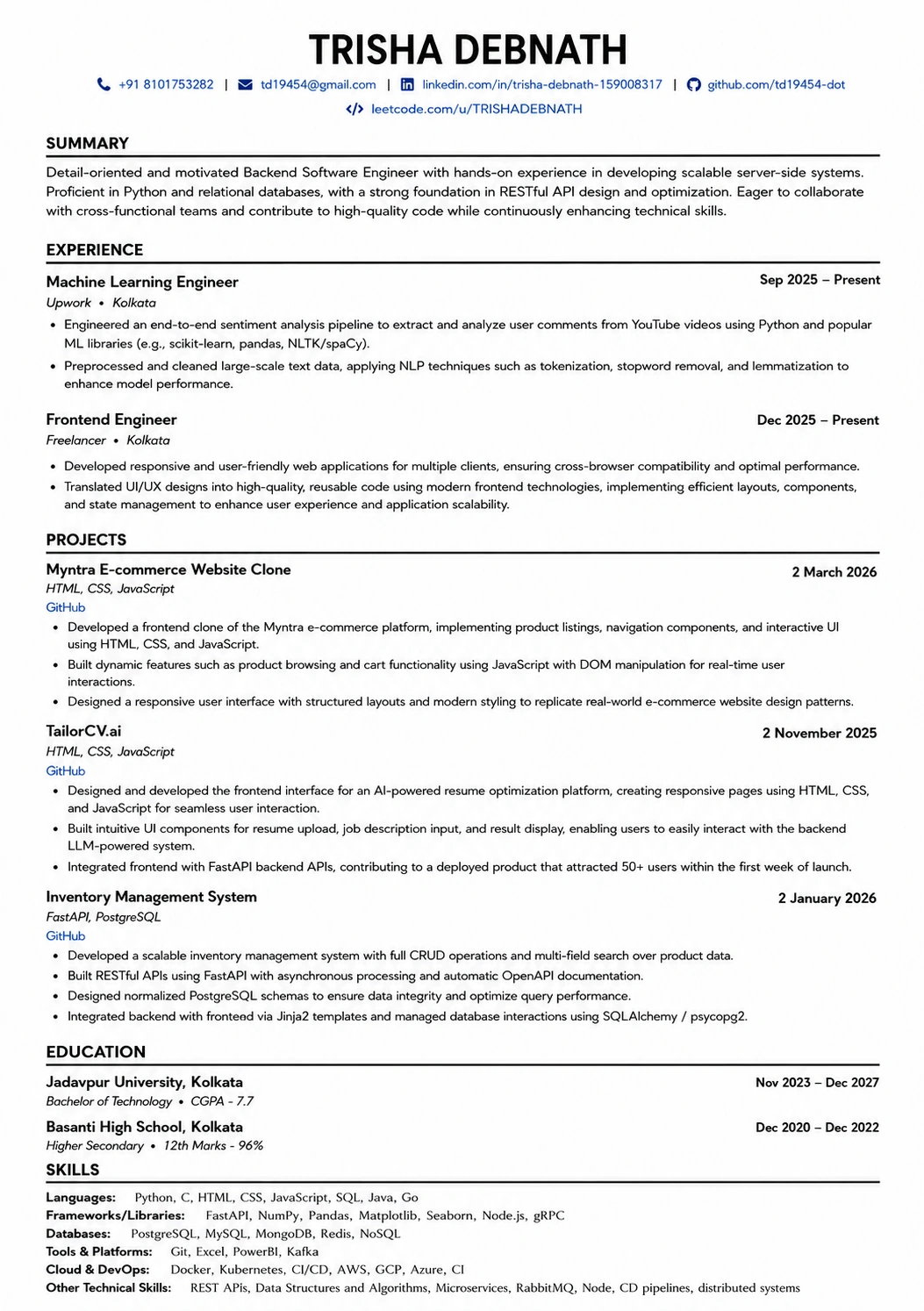
This template is ATS-tested — start from it and the formatting rules in this guide are already handled.
Was this guide useful?
Be the first to rate it.