 SS
SS
Key Takeaways
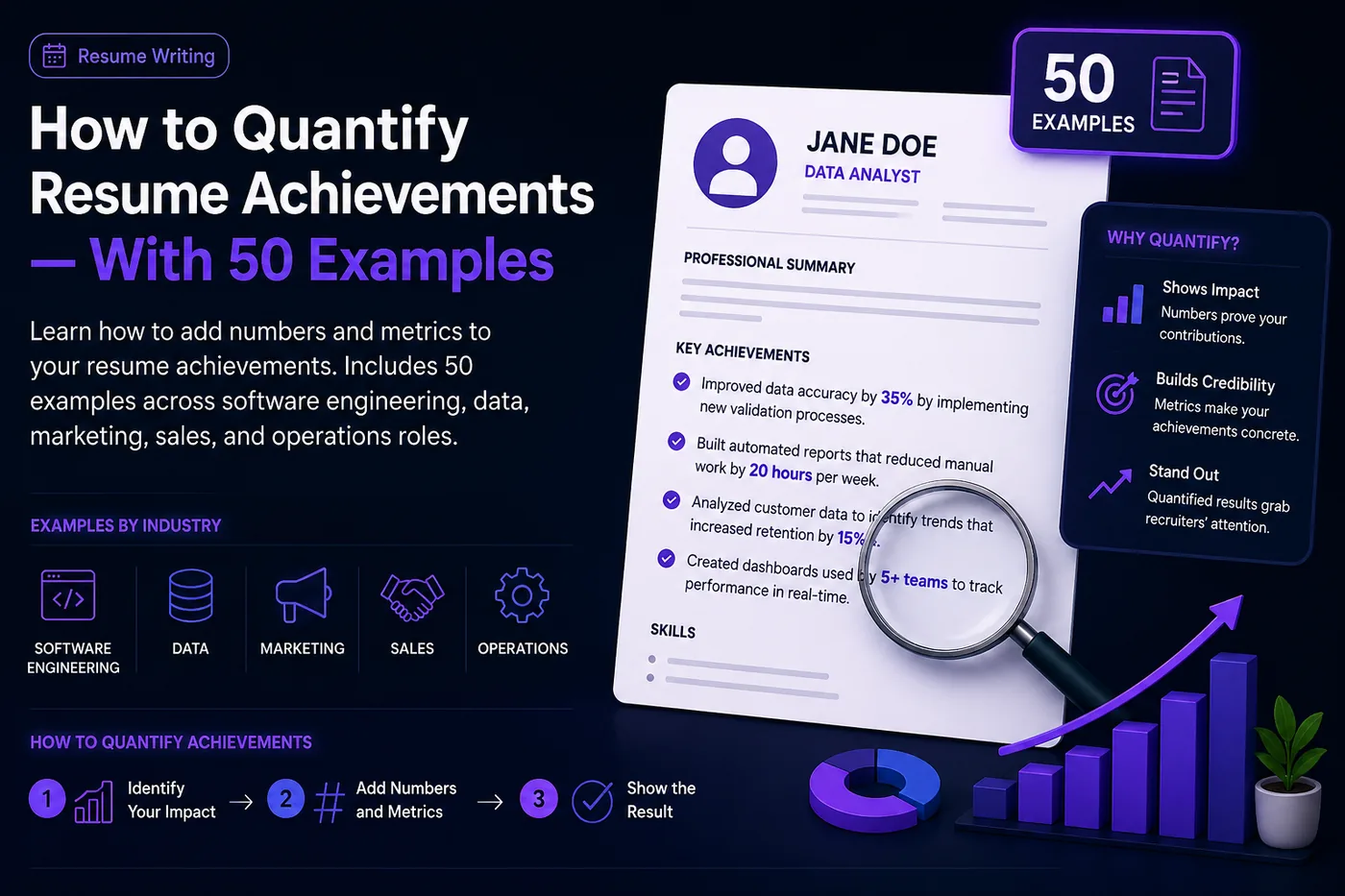
- Numbers turn a duty ("managed a team") into proof ("led 6 engineers to ship 3 releases a quarter").
- You have more numbers than you think: time, money, volume, frequency, and percentage.
- Use the X-Y-Z formula: accomplished X, measured by Y, by doing Z.
- Never invent a number. An honest estimate with a range beats a fabricated precise figure.
Why Numbers Win
A recruiter skims a resume in seconds. "Responsible for social media" says nothing. "Grew Instagram from 2K to 18K followers in 8 months" says everything: scale, speed, and result. Numbers are the fastest way to make a claim believable, and they survive an ATS scan because they sit inside your real bullet text.
The X-Y-Z Formula
Google's own resume advice popularized this pattern, and it still works:
Accomplished [X] as measured by [Y] by doing [Z].
- X = the result
- Y = the metric that proves it
- Z = the action you took
Example: "Cut invoice processing time (X) by 40% (Y) by automating data entry with a Python script (Z)."
Five Places to Find Numbers
Even in a "non-numeric" job, these five categories almost always hide a metric:
- Time — how much faster? "Reduced onboarding from 3 weeks to 5 days."
- Money — saved, earned, or managed. "Managed a $250K annual budget."
- Volume — how many? "Handled 60+ support tickets daily."
- Frequency — how often? "Published 4 articles per week."
- Percentage — up or down? "Improved retention 15% year over year."
Before and After
- Before: Helped improve the sales process.
-
After: Redesigned the lead-qualification checklist, lifting close rate from 18% to 27% across a 12-person sales team.
-
Before: Responsible for customer support.
- After: Resolved 90% of tickets within one business day while maintaining a 4.8/5 satisfaction score.
When You Genuinely Have No Numbers
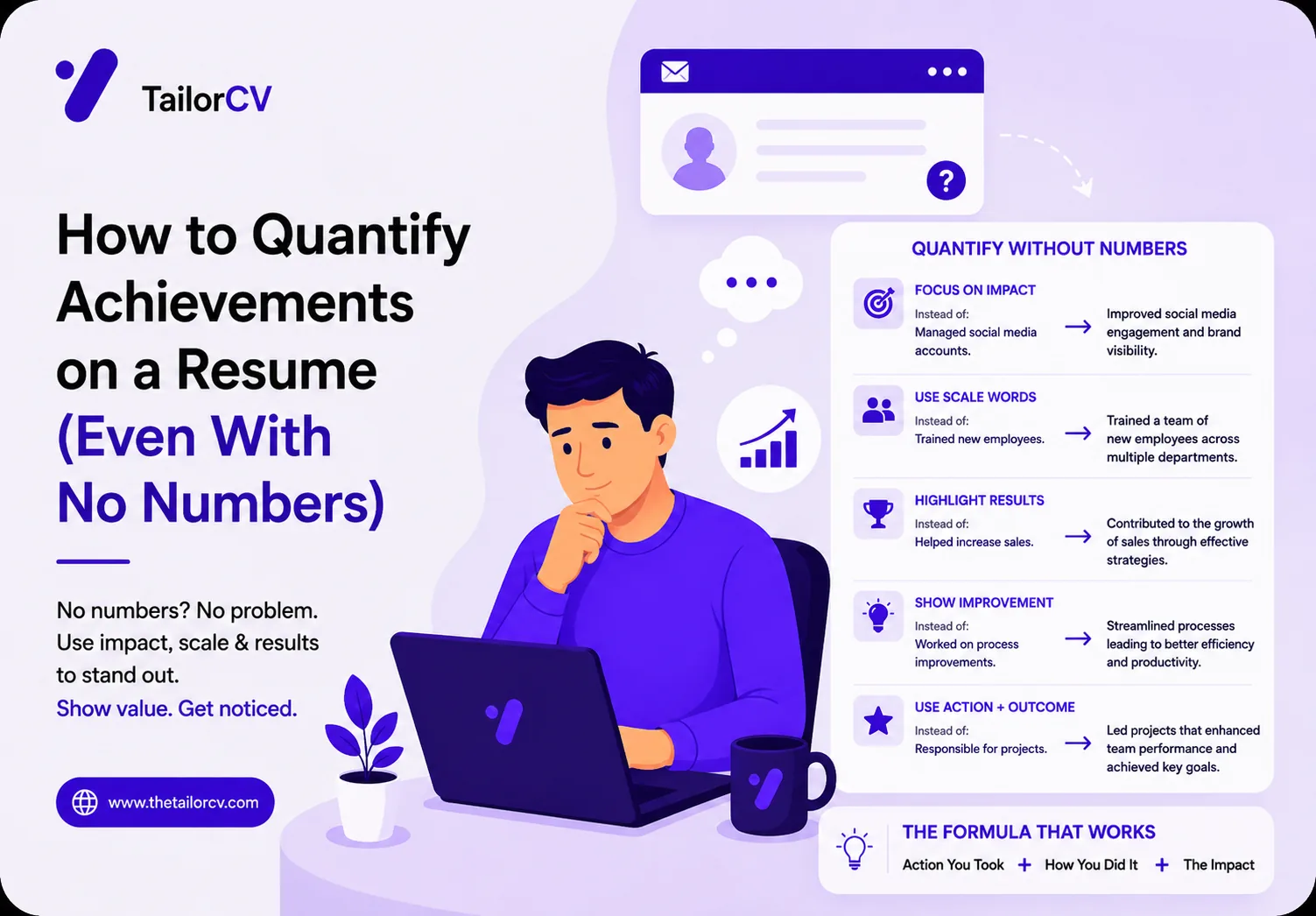
Estimate honestly with a range or a scale word: "roughly 30 clients," "a mid-six-figure budget," "the largest project on the team." If you truly cannot quantify, quantify the scope: team size, audience size, or the number of stakeholders you coordinated.
The Metrics-Finding Worksheet
Most people say "my job wasn't measurable" and then, walked through the right questions, find five numbers in ten minutes. Sit down with each role and answer these prompts. Any "yes" is a bullet waiting to be written.
- Scale: How many people, customers, tickets, or dollars did you touch? Even "supported 8 enterprise accounts" is a number.
- Change: Did anything go up or down while you owned it? Revenue, errors, wait times, satisfaction, churn.
- Speed: Did you make something faster? A process, a report, an onboarding, a response time.
- Frequency: How often did you do the thing? Per day, per week, per sprint.
- Comparison: Were you the first, the top, the biggest, or the only? "First hire on the team," "top performer of six reps."
- Reach: How big was your audience or your blast radius? Readers, users, regions, teams.
- Money: Did you save, earn, or manage money? Budgets managed count even if you did not "earn" the revenue.
- Team: How many people did you lead, mentor, or coordinate across?
Run every role through those eight prompts and you will almost always surface more numbers than you can fit.
Before and After, by Role
The transformation looks a little different in every field. Here is what turning duties into results looks like across common roles.
| Role | Before | After |
|---|---|---|
| Customer Support | "Answered customer inquiries and resolved issues." | "Resolved 60+ tickets daily at a 94% first-contact resolution rate, holding a 4.8/5 CSAT across 18 months." |
| Sales | "Responsible for meeting sales targets." | "Exceeded quota by an average of 118% across six quarters, closing $1.2M in new business in the last fiscal year." |
| Software Engineering | "Worked on improving application performance." | "Cut API p95 latency from 850ms to 240ms by adding caching and query indexing, improving checkout completion 9%." |
| Marketing | "Managed the company's social media accounts." | "Grew combined social following from 4K to 31K in a year and drove 22% of inbound demo requests through organic content." |
| Operations | "Helped streamline internal processes." | "Redesigned the vendor onboarding workflow, cutting setup time from 10 days to 3 and saving ~15 staff hours a week." |
| Teaching / Training | "Taught classes and supported student learning." | "Raised average exam pass rates from 72% to 88% across three cohorts of 30+ students by redesigning the practice curriculum." |
Notice the pattern in every pair: the "before" describes activity, the "after" describes impact. Numbers are simply the most efficient proof of impact.
Where to Put the Numbers
A number buried at the end of a long sentence loses its punch. Front-load it. Compare:
- Weak: "Worked on a project to reduce customer churn, which ended up dropping by about 15% over the year."
- Strong: "Cut customer churn 15% in one year by launching a proactive outreach program for at-risk accounts."
Lead with the strong verb, land the number early, and end with the "how." The action verb at the front and the metric near it do the heavy lifting in the half-second a recruiter spends on the line.
Common Mistakes With Numbers
- Fabricating precision. "Increased efficiency by 37.2%" from a job with no analytics reads as invented. An honest "by roughly a third" is more believable.
- Vanity metrics. "Sent 10,000 emails" is activity, not achievement. "10,000 emails driving a 24% open rate and 340 signups" is achievement.
- Numbering everything. If all ten bullets carry a statistic, the resume starts to feel like a spreadsheet and each number loses weight. Two or three strong metrics per role is the target.
- Confidential leaks. Do not publish revenue figures your employer treats as private. Convert to percentages or multiples.
- Context-free numbers. "$2M" means nothing without a frame. "$2M annual budget across four teams" tells the story.
How This Interacts With the ATS
Numbers do double duty. To a human, they are proof. To an applicant tracking system, they sit inside real, keyword-rich bullets that the parser reads as genuine experience rather than a bare skills list. A bullet like "Automated invoice reconciliation in Python, cutting processing time 40%" carries the keyword ("Python"), the context, and the metric all at once — which is exactly the kind of line that scores well and survives the scan.
Estimating Honestly When You Have No Hard Data
Many real achievements were never formally measured, and that is fine — you can estimate responsibly without inventing precision. The key is to reconstruct a defensible number rather than fabricate a specific one.
- Reconstruct from what you know. If you handled "most" support tickets on a two-person team that saw about 500 a week, "~250 tickets weekly" is a fair estimate.
- Use ranges and qualifiers. "Roughly 30 clients," "a mid-six-figure budget," "cut turnaround by about a third." These read as honest, not vague.
- Quantify scope instead of outcome. If you cannot measure impact, measure size: team of 8, audience of 5,000, 12 stakeholders, three regions.
- Anchor to a comparison. "The largest project on the team," "our fastest onboarding to date." These convey scale without a precise figure.
An interviewer can tell the difference between a thoughtful estimate and a fabricated statistic. The first shows you think in terms of impact; the second collapses the moment they probe it.
Quantifying Across Different Career Levels
The kind of number that impresses shifts as you advance:
- Entry level: scope and effort. "Analyzed 800 survey responses," "handled 100+ transactions per shift," "built a tool used by 40 classmates." You are proving you can execute.
- Mid level: outcomes you drove. "Cut churn 15%," "shipped 3 features that lifted conversion 9%," "reduced processing time from 10 days to 3." You are proving impact.
- Senior and leadership: scale and strategic results. "Owned a $2M budget," "led a 15-person org," "grew ARR from $4M to $11M in two years." You are proving you move the business.
Match your metrics to your level, and lead each role with the number that best proves the value expected at that stage.
Building Quantified Bullets Into a Tailored Resume
Numbers do their best work when they are also relevant to the specific job. A metric that matters to one role may be noise to another — a growth number dazzles a startup and means less to a compliance-heavy enterprise that cares about accuracy and risk reduction. When you tailor your resume to a posting, you are not just matching keywords; you are choosing which of your quantified wins to feature. Lead with the metrics that map to what this employer values, and your resume reads as though it was written for them — because it was. A resume that pairs the right keywords with the right numbers is what convinces both the ATS and the hiring manager in the same read.
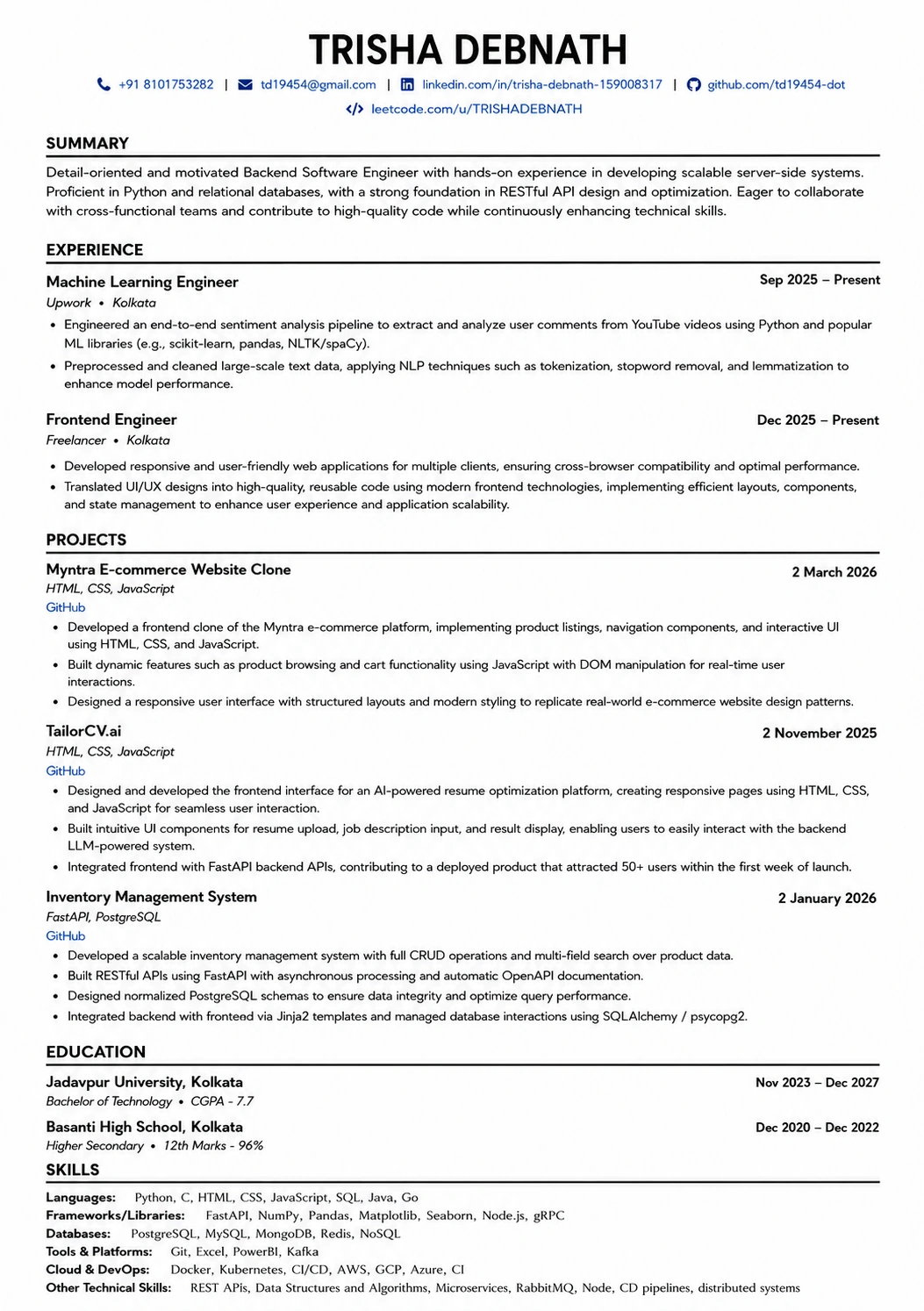
Your resume after optimization
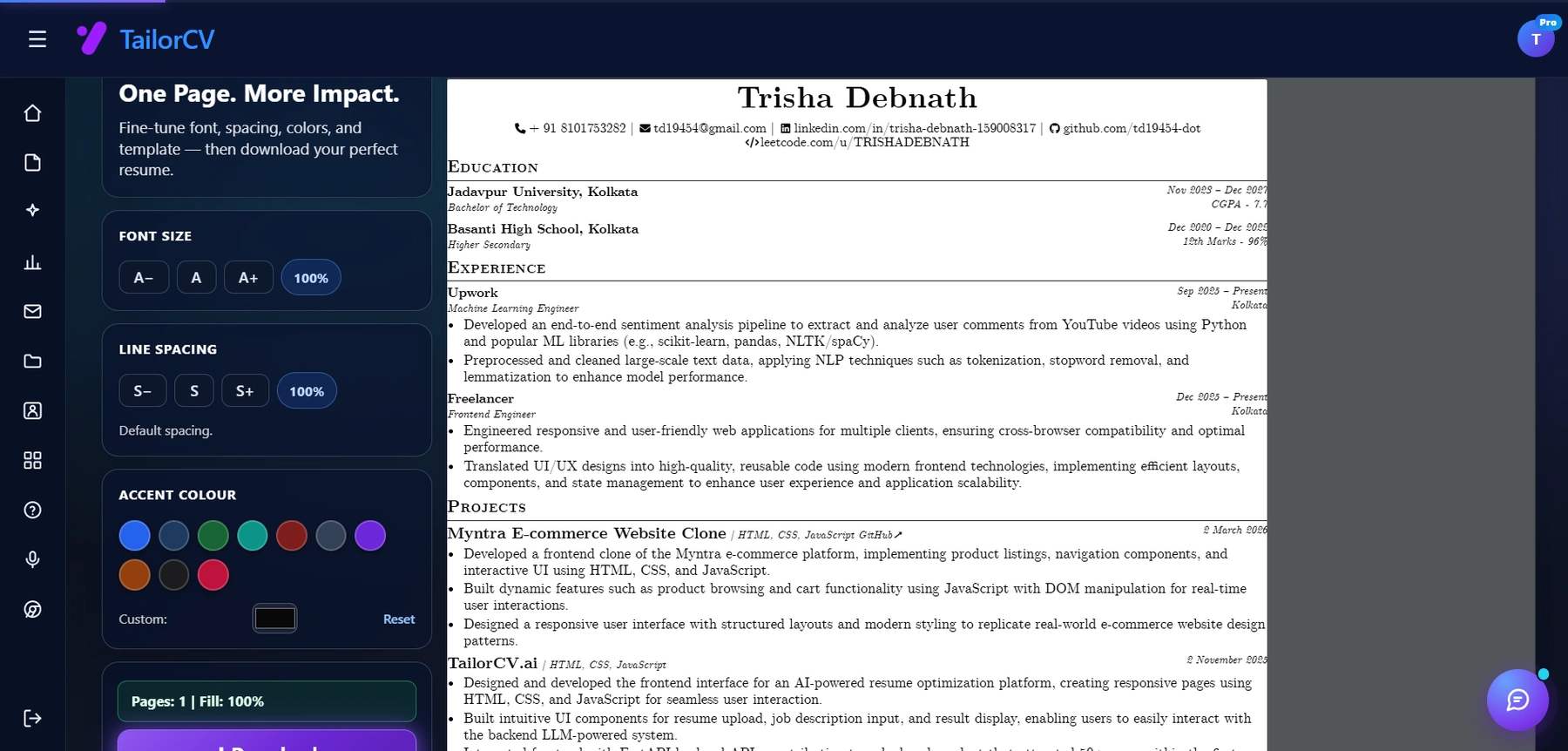
Font size, spacing, accent colour and template are all adjustable, with a live page counter.
If you were never given exact figures, estimating impact honestly shows how to build defensible estimates from what you observed.
Frequently Asked Questions
What if my company treats numbers as confidential?
Use relative figures instead of absolutes: "grew revenue 30%" rather than the dollar amount. Percentages and multiples are rarely confidential.
Should every bullet have a number?
No. Aim for a number in your top two or three bullets per role. A resume where every line has a statistic starts to feel padded.
Can I quantify soft skills?
Indirectly. "Mentored 4 junior designers, two of whom were promoted within a year" proves leadership with a number without claiming "great mentor."
What if my results were a team effort?
Claim your real contribution honestly. "Contributed to a team that grew revenue 30%" is fine; so is "Owned the analytics workstream of a project that grew revenue 30%." Do not claim the whole outcome as solely yours, but do not erase yourself either.
Should I use exact numbers or rounded ones?
Round sensibly. "Cut costs by about 20%" is more credible than "by 19.7%" unless you genuinely have precise data. Precision implies measurement; only claim it if you measured it.
My last job had strict confidentiality — how do I show impact?
Use relative figures and scope. "Managed a portfolio in the low eight figures" or "improved retention double digits" conveys scale without disclosing protected numbers. Percentages and ranges are almost never confidential.
How many quantified bullets should a resume have overall?
Aim for a number in the top two or three bullets of each recent role. Across a one-page resume that is roughly six to nine metrics — enough to prove a pattern of impact without turning the page into a data dump.
The Rule You Can Never Break: Honesty
Everything about quantifying achievements rests on one non-negotiable foundation: the numbers must be true. A fabricated statistic is a liability that detonates at the worst possible moment — in an interview, when a sharp interviewer asks "how did you measure that 40% improvement?" and you have no answer, or later, when a reference contradicts a claim. Invented metrics also tend to sound invented; a suspiciously precise "increased efficiency by 37.2%" from a role with no analytics reads as fiction to an experienced hiring manager. The good news is you never need to lie, because honest estimation covers every real situation: reconstruct a defensible figure from what you know, use ranges and qualifiers when you lack precision, quantify scope when you cannot quantify outcome, and convert confidential absolutes into percentages. A resume built on true numbers survives every interview probe and every reference check — which is the entire point of putting numbers on it in the first place. Impressive-but-false loses to modest-but-true every time it is tested, and in a serious hiring process, it will be tested.
Putting It All Together
Quantifying achievements is the single highest-return edit you can make to a resume. Walk each role through the eight-prompt worksheet, rewrite your top bullets with the X-Y-Z formula, front-load the number, and keep every figure honest. The result is a resume that a recruiter believes in seconds and an ATS scores as real experience — the two audiences you have to win to get the interview.
What is your resume scoring right now?
Scan it against a job description and get your ATS match score in about a minute.
Drop your resume here or choose a file
PDF only. Max 2 MB.
We never share your data or use it to train AI models.
Templates that keep this structure intact
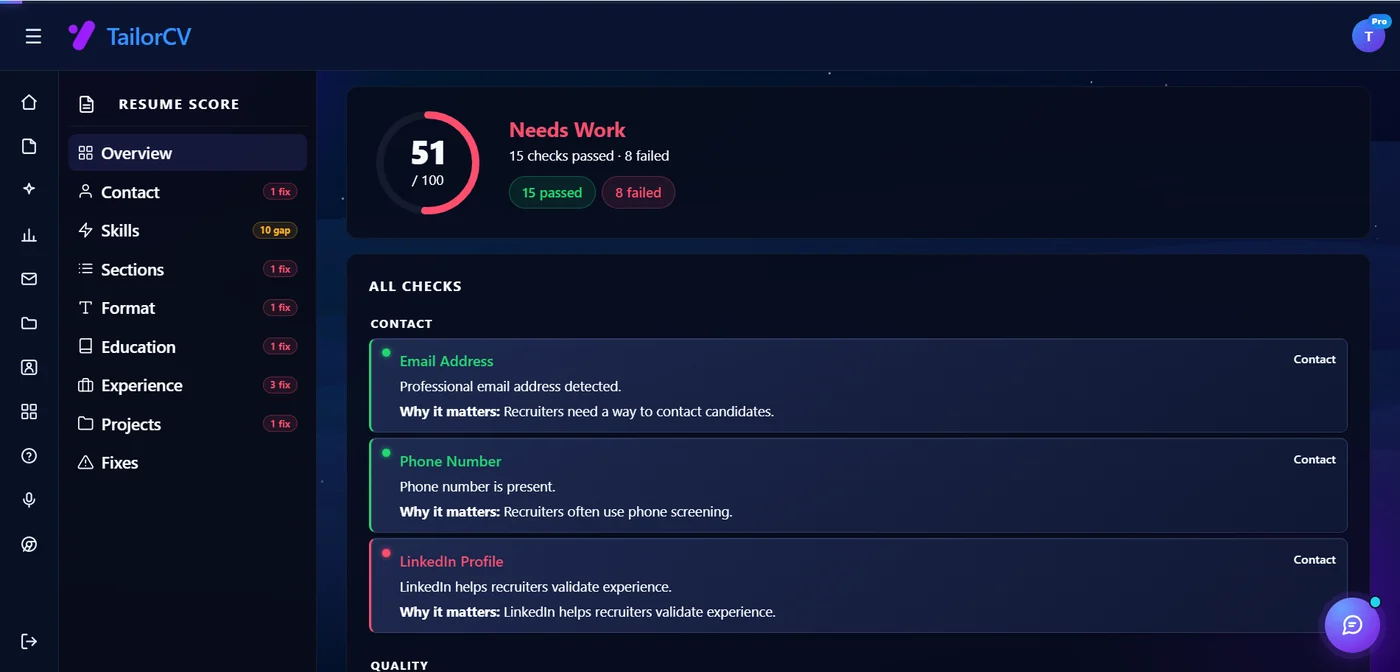
This template is ATS-tested — start from it and the formatting rules in this guide are already handled.
Was this guide useful?
Be the first to rate it.