SS
SS
Key Takeaways
- Aim to submit between 3 to 8 tailored job applications per day for effective job searching, rather than mass applying to numerous positions.
- Quality over quantity is crucial; generic resumes often fail to pass automated screenings, leading to low callback rates.
- Applying too few times, such as 2-3 applications per week, can stall your job search due to insufficient data points and feedback.
- Determine your optimal application volume based on the tailoring effort required, the time you can dedicate, and the specificity of the roles you are targeting.
There's no universal magic number, but the range most experienced job seekers and recruiters converge on is somewhere between 3 and 8 genuinely tailored applications per day, not 50 mass-submitted ones. The question "how many jobs should I apply to" is really two questions people conflate: how many can you physically submit, and how many can you submit well. Before you scale up your daily count, it's worth checking whether your current resume is even passing automated screening with the free ATS score checker, because a low score means every extra application just compounds the same problem instead of fixing it.
The Spray-and-Pray Instinct, and Why It Backfires
When a job search drags on, the instinct is almost always to apply to more. It feels productive: more tabs open, more "Submitted" confirmations, more activity in your tracker. But volume without tailoring runs into a hard ceiling fast, because most job descriptions today are screened by applicant tracking systems before a human recruiter ever opens the resume.
A resume that's the same for every role, or only lightly reworded, tends to miss the specific keywords, tools, and phrasing each posting is looking for. The result is a low match score, a resume that never surfaces in a recruiter's search, and a callback rate that stays flat no matter how many applications you send. You can read more about exactly how this filtering happens in why your resume gets no responses and how recruiters spot generic resumes.
There's also a less obvious cost: time. Every hour spent blasting out untailored applications is an hour not spent on the things that actually move a search forward - tailoring a resume properly, following up on applications already in the pipeline, or reaching out to someone who works at a company you actually want to join. Fifty rushed applications a day usually produce a worse outcome than eight considered ones, because the fifty compete against every other undifferentiated resume in the pile, while the eight are built to stand out in a specific one.
The Opposite Failure: Applying to Almost Nothing
It's worth saying plainly that the opposite extreme also fails, just more quietly. Sending two or three applications a week, even if each one is beautifully tailored, usually isn't enough volume to generate a steady stream of interviews. Job searching has a numbers component whether you like it or not: not every well-matched application gets a response, roles get filled internally, postings get pulled, and some recruiters simply never reply.
If you only apply to a handful of roles a week, a single bad week of market conditions, a hiring freeze at your top-choice company, or one recruiter who doesn't respond can stall your entire search. Low volume also means you get less feedback, in the form of interview requests or rejections, about whether your resume and targeting are actually working. A search built on two applications a week can take many months longer than it needs to, not because the applications are bad, but because there simply aren't enough data points to learn from or convert.
The honest answer is that both extremes fail for different reasons: too much volume degrades quality per application, too little volume starves the process of chances to convert. The right number sits in between, and it depends on your specific situation.
A Framework for Finding Your Real Number
Instead of copying someone else's number, work it out from four inputs that actually differ from person to person.
- How tailored each application really is. If you're rewriting your summary, reordering bullet points, and matching keywords to the job description every time, you physically cannot sustain a high volume - and you shouldn't try to. If you have a strong base resume and a fast, repeatable adaptation process (more on this below), you can sustainably do more per day without cutting corners.
- How much time you actually have. Someone job searching full-time after a layoff has very different daily capacity than someone searching evenings and weekends around a current job. Be honest about the hours you can give a search each day, then work backward to a number, rather than picking a number and hoping the hours appear.
- How senior or niche the role is. Senior, specialized, or niche roles - a director-level marketing hire, a rare combination of skills, a small target list of companies - naturally have fewer open postings at any given time, and each one usually needs deeper tailoring to speak to specific requirements. Entry-level and high-volume roles, like retail, hospitality, or general customer service, have more open postings and can reasonably support a higher daily count with lighter tailoring per application.
- How urgent the need is. Searching six months ahead of a planned move is a different game than searching after an unexpected layoff with a runway of a few months. Urgency is a legitimate reason to increase volume temporarily, as covered later in this post, but it shouldn't be the default setting for an entire search.
Put those four together and you get a personal range, not a single number. A senior, niche-role candidate with limited daily time and no immediate urgency might land at 2-3 a day. A recent graduate applying to entry-level roles with a flexible base resume and open availability might comfortably manage 8-10 a day without sacrificing quality. Most people land somewhere in the 3-6 range once they account for real constraints.
What "Quality" Actually Means, Per Application
"Tailor every application" is easy advice to give and vague advice to follow unless you know what it actually requires. In practical terms, a quality application includes:
- Keywords matched to that specific posting - the actual tools, certifications, and terminology used in the job description, not just your industry's general vocabulary. See how to match resume keywords to job descriptions for a repeatable process.
- A resume genuinely adjusted for that role, not just a title swap - reordered bullet points that lead with the most relevant experience, a summary that speaks to this job's priorities, and skills sections that reflect what's actually being asked for. How to tailor your resume for every job walks through how much actually needs to change.
- A cover letter that isn't a copy-paste template, when one is requested - even a short, three-paragraph letter that references the company and role specifically outperforms a generic one that could be sent anywhere. The AI cover letter generator can produce a strong first draft in the time it would take to write a weak one from scratch.
- A quick ATS check before submitting, confirming the tailored version actually reads well to automated screening, not just to your own eye.
None of this requires hours per application once you have a strong base resume and a process. If your base resume is solid, a genuinely tailored application - adjusted keywords, reordered content, a short custom cover letter, and an ATS check - realistically takes somewhere in the range of 15 to 30 minutes once you've done it a few times. That's the number to plan your daily capacity around, not "how many tabs can I open in an hour."
A Sample Weekly Plan
A common mistake is treating a job search as 100% application volume with nothing else. A more realistic week splits time between three activities: tailoring and submitting applications, outreach and networking, and interview readiness. Here's what a balanced week can look like for someone searching close to full-time:
Monday: 4 tailored applications (mornings), 2 networking messages to people at target companies (afternoon) Tuesday: 4 tailored applications, 1 follow-up email on an application from last week Wednesday: 3 tailored applications, 30 minutes of mock interview practice Thursday: 4 tailored applications, 2-3 networking messages Friday: 3 tailored applications, review the week's tracker and update follow-up dates Weekend: Light research on next week's target companies, resume/portfolio maintenance, rest
That's roughly 18 tailored applications for the week, alongside consistent networking and interview prep, rather than 18 applications crammed in with nothing else. Someone searching part-time around a current job might scale this down to 8-10 applications a week with the same balance of activities. The specific numbers matter less than the principle: applications are one input to a search, not the whole search. For the outreach side, networking tips for job search and how to write a cold email to a recruiter cover how to make that time count instead of sending messages that get ignored.
Building a System So Volume and Quality Aren't a Trade-off
The reason most people believe they have to choose between quantity and quality is that they're doing everything manually and from scratch each time. A few pieces of infrastructure remove that trade-off almost entirely:
- One strong, comprehensive base resume that includes every relevant accomplishment, metric, and skill you have - even ones you won't use for every application. Tailoring becomes a subtraction and reordering exercise instead of a from-scratch rewrite. See managing multiple resume versions for how to organize this without losing track of what changed where.
- A tracking system that records which version of your resume went to which company, on what date, with what follow-up plan. Without this, you either lose track entirely or waste time reconstructing what you sent. The job application tracker template is built for exactly this.
- A reusable but customizable cover letter structure - a consistent opening, body, and closing format where only the specifics change per role, rather than reinventing the structure every time.
- Templated but personalized outreach messages for networking and follow-ups, so you're not starting from a blank page for every recruiter or contact. Follow-up email after application has message structures you can adapt quickly.
- A fast tailoring workflow, such as how to tailor a resume in 5 minutes, for roles similar enough to your base resume that they don't need a full rebuild.
With this kind of system in place, the "cost" of tailoring drops significantly, which means the volume you can sustainably manage per day goes up without any drop in per-application quality. This is the actual lever for applying to more jobs - not skipping tailoring, but making tailoring faster.
Pacing Yourself: Why Sustainable Beats Aggressive
A job search is rarely a single week - it's usually a multi-week or multi-month process, and the pace you set in week one needs to be a pace you can still hold in week six. An aggressive sprint of 15-20 applications a day for a few days, followed by burnout and a week of doing nothing, produces worse total output than a steady 5 a day sustained for a month.
Burnout in a job search shows up in specific, recognizable ways:
- Applications start going out with typos or the wrong company name left in from a previous version
- You stop reading job descriptions closely before applying
- Rejection emails start feeling personal rather than statistical
- You avoid opening your tracker because it's become a source of dread instead of information
If any of that sounds familiar, the fix isn't to push harder - it's to drop your daily target to something you can hold consistently, and protect time for rest and non-search activities. A search that runs at a sustainable 4-6 applications a day for eight weeks will almost always outperform one that runs at 20 a day for one week and then stalls. Treat your daily number as a floor you can hit reliably, not a ceiling you occasionally spike to and then can't sustain.
When to Increase Volume, and When to Slow Down Instead
Your target number isn't fixed for the whole search - there are legitimate signals in both directions.
Reasons to increase volume:
- You've been searching for 3-4 weeks with a genuinely tailored process and are getting some interviews, but need a larger pipeline to convert more offers
- Your timeline has become more urgent - a lease ending, savings running low, a hard deadline from a visa or relocation situation
- You've built enough efficiency in your process (per the systems above) that more applications no longer means less tailoring per application
- You're targeting a high-volume field where more open roles exist and lighter tailoring is genuinely appropriate, as covered in resume for candidates with no experience
Reasons to slow down and diagnose instead:
- You've sent 30+ well-tailored applications with zero interviews - this points to a resume, targeting, or ATS problem, not a volume problem. Start with why is my ATS score low and resume review checklist before applying
- You're getting interviews but no offers - that's a different problem entirely, and more applications won't fix it. See recruiter ghosting after interview if the silence is happening after interviews specifically
- You notice your per-application quality slipping as your daily count rises - that's a sign to scale back down, not push through
- You're applying broadly to roles that aren't a real fit just to hit a number - this produces activity without progress, and it's worth pausing to reset targeting rather than continuing to apply
The through-line is that application count is a lever you should be adjusting deliberately based on what the data from your own search is telling you, not a number you set once at the start and never revisit.
Adjusting for Remote and Distributed Roles
If you're searching for remote positions specifically, the calculus shifts slightly. Remote postings often draw a much larger applicant pool than location-restricted roles, since geography no longer limits who can apply. That doesn't mean you should apply to more of them with less care - if anything, differentiation through tailoring matters more, not less, because you're competing against a bigger pool. Remote job search guide covers targeting strategy specific to distributed roles, including how to signal remote-readiness in a resume, which is a factor that doesn't apply to in-office searches at all.
Make This Practical
The shift to make is from counting applications to measuring quality per application, and from applications-only to a balanced weekly system. Check each resume's fit before you submit with the free ATS score checker, build and store your tailored versions with a resume from the resume template library, draft a genuinely custom cover letter in minutes with the AI cover letter generator, track your pipeline with the job application tracker template, and stay interview-ready between callbacks with the AI mock interview tool. Related reading: how much to change your resume for every job and why your resume gets no responses.
FAQ
Is applying to 50 jobs a day ever a good strategy?
Rarely. It usually produces a low response rate because there's no realistic way to tailor 50 resumes a day, and it burns out your ability to keep the search going for the weeks it typically takes. A steady 3-8 tailored applications a day tends to outperform quantity-first approaches over a multi-week search.
What's the minimum number of applications per week that actually works?
There's no fixed floor, but very low volume, like two or three applications a week, usually doesn't generate enough interview chances to keep momentum, even if each one is well-tailored. Somewhere in the range of 15-30 tailored applications a week, spread across the week rather than batched into one day, tends to keep a pipeline moving.
How long should a full job search take?
It varies widely by field, seniority, and market conditions, but most searches take several weeks to a few months. Track your progress with the job application tracker template so you can see trends in response rate over time, not just individual outcomes.
What if I'm not getting any responses at all?
Stop increasing volume and start diagnosing the resume and targeting itself. See why your resume gets no responses and why is my ATS score low for the most common causes.
Should I apply to jobs I'm not fully qualified for?
Yes, selectively, but factor this into your daily number rather than treating it as free volume - these applications usually need more careful framing, not less. See resume tailoring for underqualified candidates for how to present partial fit honestly and effectively.
Does the right number change based on the industry I'm in?
Yes. High-volume, less-specialized fields like retail, hospitality, or entry-level customer service can generally support more applications per day with lighter tailoring, since roles are more interchangeable. Specialized or senior roles usually mean fewer open postings and a need for deeper tailoring per application, which naturally caps your daily number lower.
Is it better to apply the same day a job is posted, or take time to tailor properly?
Applying early can help, but not at the cost of a rushed, untailored resume - a well-matched application submitted a day or two later usually beats a generic one submitted within the hour. If you have a strong base resume and a fast process, you can often do both.
How do I know if my daily number is actually working?
Track response rate, not just application count, in your tracker. If your response rate stays near zero over several weeks of genuinely tailored applications, the fix is almost never "apply to more" - it's fixing the resume and targeting first, using the resume review checklist before applying.
Next Step
Before you send another application, run your resume through the free ATS score checker to see exactly where it stands - it takes less time than a single untailored application, and it tells you whether volume or quality is your actual bottleneck.
What optimizing actually does to your resume
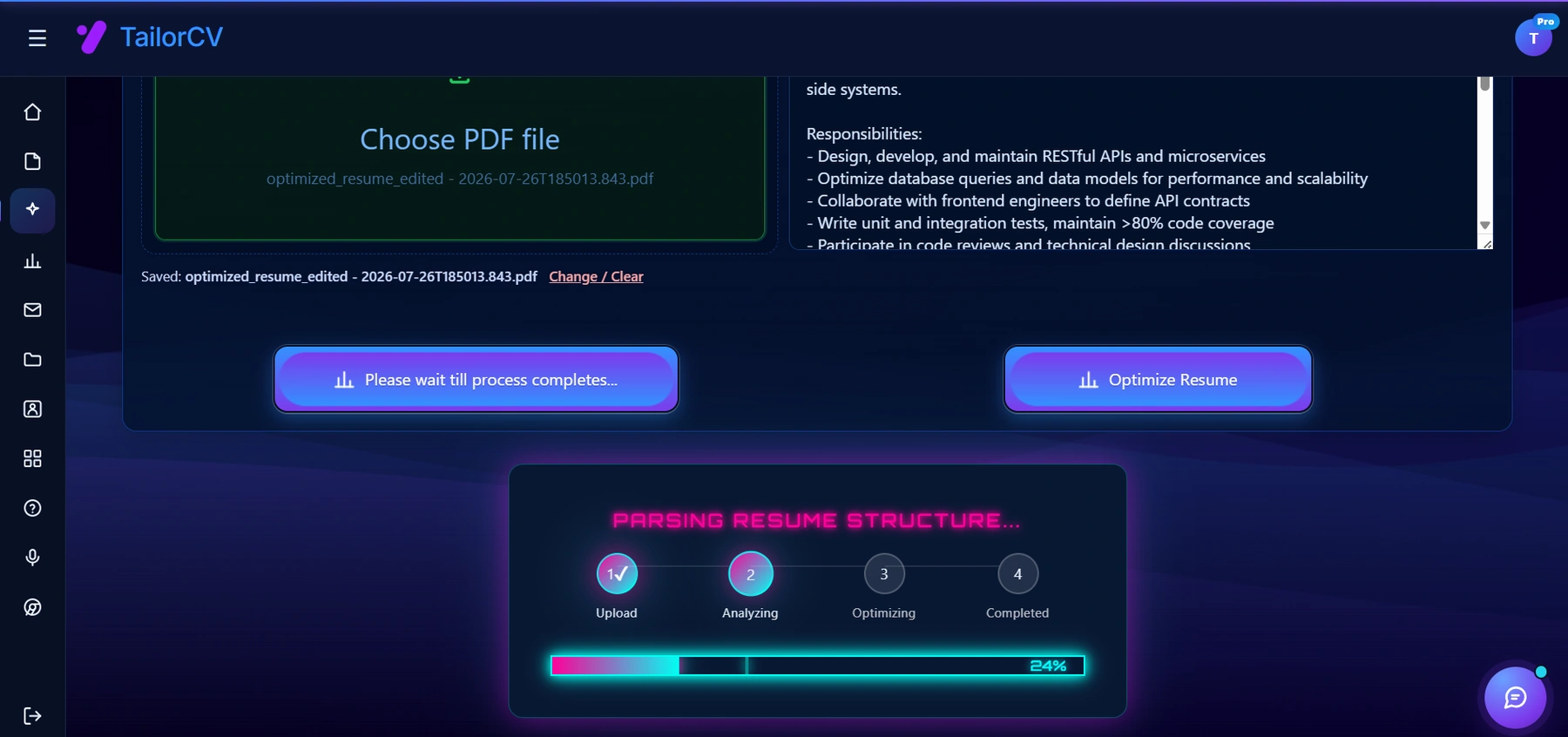
Optimising runs against the specific job description you paste in, not in the abstract.
What is your resume scoring right now?
Scan it against a job description and get your ATS match score in about a minute.
Drop your resume here or choose a file
PDF only. Max 2 MB.
We never share your data or use it to train AI models.

Was this guide useful?
Be the first to rate it.