 TD
TD
Key Takeaways
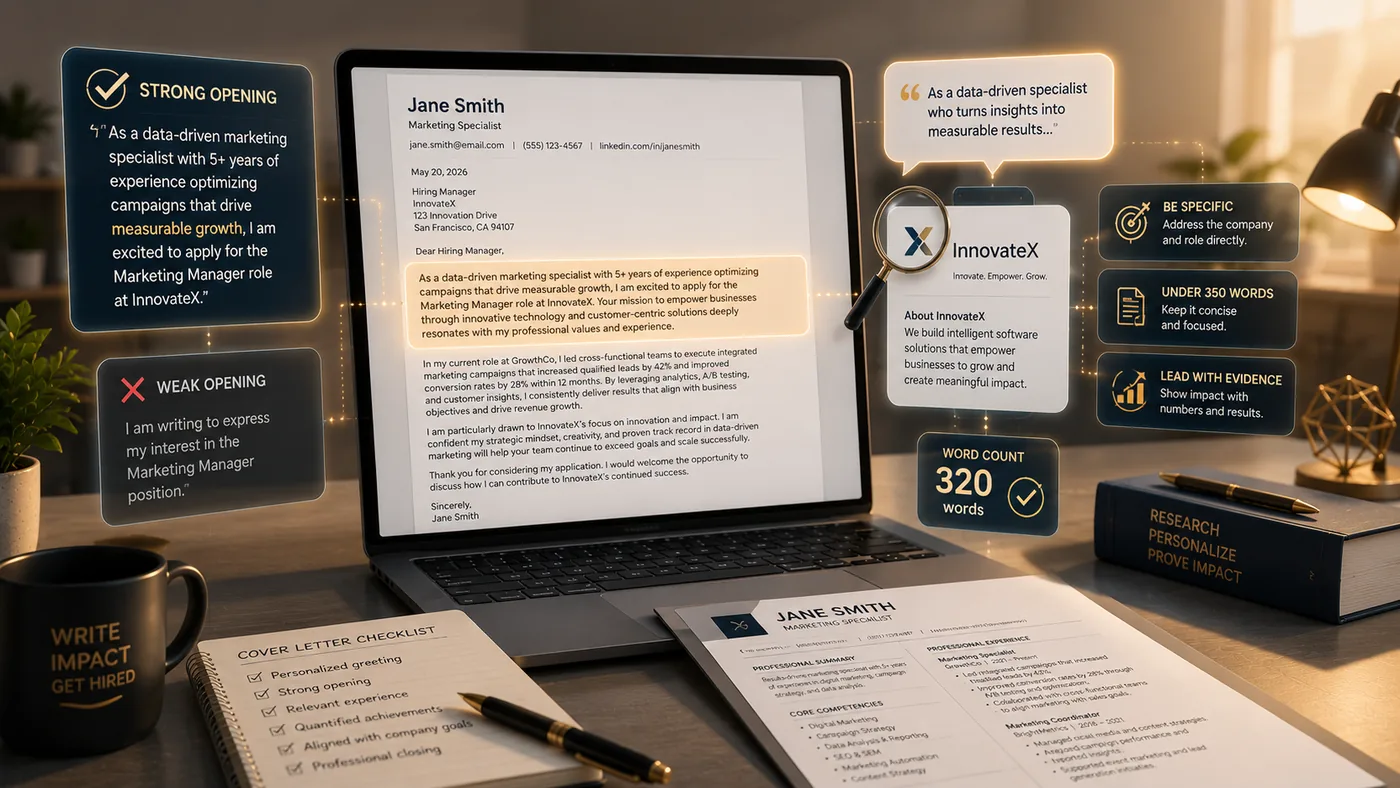
- A cover letter in 2026 is still relevant, but a poorly written one can harm your application more than not submitting one at all.
- Strong cover letters should be specific, concise, and connect your experiences to the company's needs, rather than repeating your resume.
- The ideal cover letter length is 250-350 words, structured with a hook, relevant achievements, reasons for interest in the company, and a call to action.
- Avoid generic openings; instead, lead with a specific achievement or connection to the company's work to capture attention.
- While large companies may skip cover letters, hiring managers at smaller firms often read them carefully, making a strong cover letter potentially decisive.
A cover letter in 2026 is not dead - but a bad one is worse than none at all. When companies ask for a cover letter, it is one more piece of evidence. When you submit a generic, three-paragraph letter that starts with "I am writing to express my interest in the position," you are telling the recruiter that you did not try.
A strong cover letter is specific, short, and connects your evidence to their problem. It does not repeat your resume line by line. It answers a different question: why you, why this company, why now.
Before sending any application, make sure your resume is optimized first. Use the ATS score checker to check keyword matching, read the resume optimization guide, and ensure your resume uses an ATS-friendly template. Your cover letter is the complement to a strong resume, not a substitute.
Do Companies Still Read Cover Letters?
Research varies, but the general rule is:
- Most ATS systems do not parse cover letters for scoring. They are reviewed by humans.
- Recruiters at large companies often skip cover letters unless the application specifically requires one.
- Hiring managers at small companies, startups, and competitive roles often read them carefully.
- A great cover letter can break a tie between two equally qualified candidates.
- A bad cover letter can hurt a strong resume candidate.
The safest approach: always write one when asked, make it strong, keep it short.
Cover Letter Format for 2026
Keep it to one page or fewer. Ideal length is 250-350 words.
What the finished letter looks like
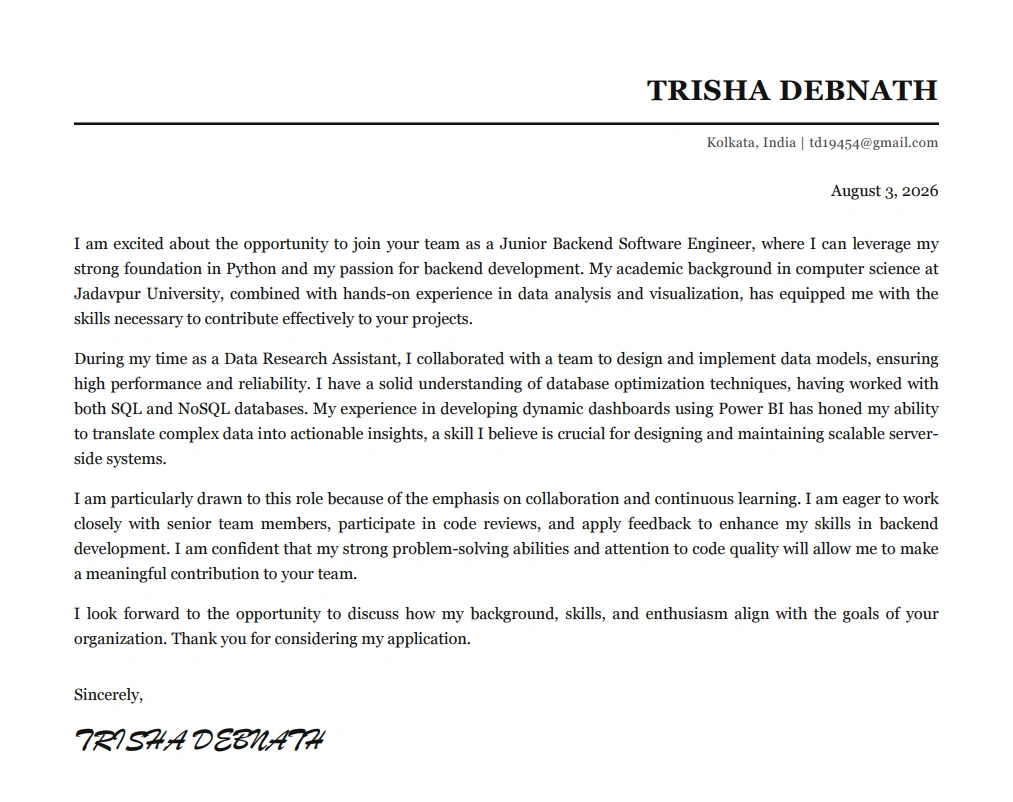
A format like this parses cleanly - one column, standard headings, everything the parser needs where it expects to find it.
Structure:
- Opening paragraph - hook and specific role
- Middle paragraph 1 - your most relevant achievement
- Middle paragraph 2 - why this company specifically
- Closing paragraph - call to action
No need for a formal "Dear Sir/Madam" opening. Use the hiring manager's name if you can find it. If not, "Dear [Company Name] Hiring Team" is acceptable.
Opening Paragraph
Your first sentence must not be "I am writing to apply for the [role] position."
Instead, lead with a specific achievement, a direct connection to the company's work, or a clear statement of what you bring.
Weak Opening
I am writing to express my strong interest in the software engineer position at Acme Corp. I am a passionate developer with 3 years of experience and I believe I would be a great addition to your team.
Strong Opening
In my last role, I reduced a payment API's response time from 620ms to 140ms by redesigning the caching layer - and that type of backend performance work is exactly what I am looking for more of at Acme Corp. I noticed you are scaling your payments infrastructure to support APAC expansion, which aligns with the distributed systems challenges I want to tackle next.
The strong version leads with evidence, shows company research, and connects your work to their current initiative.
Middle Paragraphs
Paragraph 1 - Your strongest, most relevant achievement. Use the same action + result format as your resume but write in full sentences.
"At TechCorp, I led the backend migration of our monolithic order management API to 4 microservices, which reduced inter-team deployment blocking by 80% and cut our average release cycle from 3 weeks to 4 days. It was complex work that required designing for eventual consistency, backward compatibility, and incremental rollout - the kind of system design challenge I'm looking for at scale."
Paragraph 2 - Why this company, specifically.
"I've followed Acme's engineering blog for over a year. Your recent post on distributed transaction handling across regions showed a level of systems thinking I haven't seen many companies write about publicly. That transparency about hard problems is exactly the culture I want to build in."
Do not write "I am passionate about your mission to change the world." That is true of every applicant. Be specific.
Closing Paragraph
Keep it confident but not pushy.
"I'd welcome the chance to discuss how my background in [X] could contribute to [Y] at [Company]. Thank you for your time and consideration."
Then sign off: "Best regards, [Your Name]."
Cover Letter Template
[Your Name] [Email] | [LinkedIn] [Date]
Generating the letter from a job description
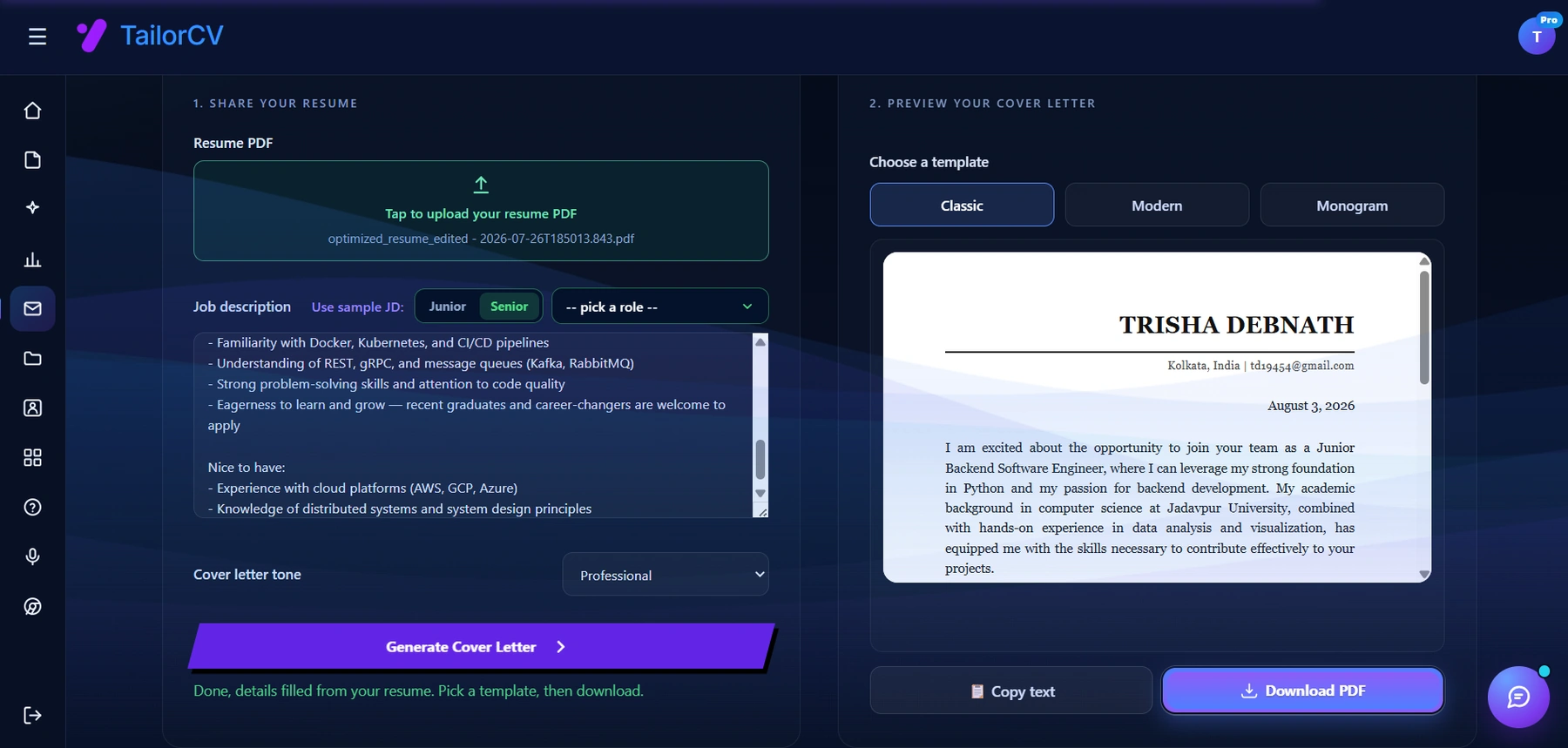
Details are pulled from your resume automatically, and the tone control decides how formal the letter reads before you download it.
[Hiring Manager Name or "Hiring Team"] [Company Name]
[Opening paragraph - specific achievement + connection to company's work]
[Middle paragraph - your strongest, most relevant achievement in full sentences]
[Why this company - specific, researched reason]
[Closing - thank you + interest in discussing further]
Best regards, [Your Name]
Cover Letter Examples by Role
Software Engineer Cover Letter Opening
"Last quarter, I shipped a distributed job queue in Python and Redis that processed 2M background tasks per day with zero data loss - and I saw in your job description that you're building exactly this type of reliable async infrastructure. I'd love to bring that experience to [Company]."
Product Manager Cover Letter Opening
"Six months after I launched our self-serve onboarding redesign, customer support volume dropped 34% and 30-day retention improved by 22%. When I saw that [Company] is prioritizing PLG motion in your 2026 roadmap, I knew I had directly relevant experience to offer."
Data Analyst Cover Letter Opening
"I built a Power BI dashboard that replaced 9 manual weekly reports, saving our analytics team 12 hours per week and becoming the primary reporting tool used by the CEO in every board meeting. I'd like to bring that kind of practical analytics impact to [Company]'s data team."
Common Cover Letter Mistakes
Mistake 1: Summarizing your resume
Recruiters already have your resume. The cover letter should add context, motivation, and company-specific reasoning - not repeat bullet points.
Mistake 2: Generic company praise
"I admire your innovative culture and commitment to excellence" could apply to any company. Research a specific product decision, blog post, engineering challenge, or company value and reference it.
Mistake 3: Too long
Anything over 400 words for an individual contributor role is too long. Be ruthless about editing.
Mistake 4: Passive language
"I believe I would be a great fit" is weak. "I led X and it resulted in Y, which is directly relevant to your team's Z" is strong.
Mistake 5: No clear ask
End with something. "I'd love to discuss" or "I'd welcome a conversation" is better than trailing off with nothing.
Should You Always Write a Cover Letter?
- Required by job posting -> always write one.
- Optional on the application -> write one for roles you really want, skip for mass applications.
- Not mentioned -> check if there is a cover letter field. If yes, fill it. If no, skip.
The effort of a good cover letter is only worth it when you are genuinely interested in the role. For roles you are lukewarm about, focus your energy on resume optimization and ATS keyword matching instead.
Related Guides
- How to Write a Two Weeks Notice
- How to Decline a Job Offer Professionally
- How to Quit Your Job Professionally
- How to Write a Cold Email to a Recruiter
- How to Build a Professional Portfolio
- How to Get a Job With No Experience
- How to Handle Job Rejection
- How to Negotiate a Salary Offer
- How to Use LinkedIn for Job Search
- LinkedIn Profile Optimization Guide
- Networking Tips for Job Search
- Remote Job Search Guide
- How to Explain Resume Gaps in 2026 - Honest Strategies That Work
- How to Write a Resume Headline in 2026 - With 30 Examples
- How to Write a Resume Summary in 2026 - With 20 Examples
- 200 Best Action Verbs for Resume in 2026 - By Role and Category
Make This Practical
A cover letter is strongest when it is connected to a tailored resume. First check your resume with the free ATS score checker, then draft a role-specific letter with the AI cover letter generator. If you need structure, use the Cover Letter Guide 2026 to keep the message focused and recruiter-friendly.
Use the letter to explain context that does not fit neatly on the resume. Career changers can pair it with the Career Change Resume Guide, candidates with gaps can use How to Explain Resume Gaps, and direct outreach works better when combined with How to Write a Cold Email to a Recruiter.
Conclusion
A strong cover letter in 2026 is short, specific, and company-researched. It leads with your best evidence, connects clearly to what the company is building, and ends with a confident ask.
Before writing your cover letter, make sure your resume is in excellent shape. Run it through the TailorCV ATS score checker, optimize it with the job description, and use an ATS-ready template. Then write your cover letter as the final layer of persuasion - not the first.
For interview preparation after you land the callback, read the interview preparation guide.
Frequently Asked Questions
Do companies still read cover letters in 2026?
Yes, many companies still read cover letters, especially smaller organizations and startups. While large companies may overlook them unless specifically requested, a well-crafted cover letter can differentiate you from other candidates. To ensure your cover letter stands out, avoid common pitfalls by reviewing our guide on cover letter mistakes to avoid in 2026.
What should I include in my cover letter?
Your cover letter should include specific examples of how your skills and experiences align with the job requirements. It’s essential to answer the questions: why you, why this company, and why now. To help you structure your cover letter effectively, consider using our ATS-friendly cover letter format to ensure it's easy for recruiters to read.
How can I write a cover letter with no work experience?
If you're writing a cover letter with little to no work experience, focus on your skills, education, and any relevant volunteer work or projects. Highlight your enthusiasm for the role and the company, and explain how your background makes you a good fit. For specific templates and guidance, check out our post on how to write a cover letter with no work experience.
What are the biggest mistakes to avoid in a cover letter?
Common mistakes include using a generic template, failing to tailor your letter to the job, and repeating information from your resume. It's also crucial to keep your cover letter concise and focused on how you can solve the employer's problems. For a detailed list of what to avoid, refer to our article on cover letter mistakes to avoid in 2026.
How can I ensure my cover letter passes ATS?
To ensure your cover letter passes Applicant Tracking Systems (ATS), use relevant keywords from the job description and maintain a clear, simple format. Avoid complex designs that might confuse the software. You can also use our free ATS score checker to assess your cover letter's compatibility with ATS requirements.
Was this guide useful?
Be the first to rate it.