SS
SS
Key Takeaways
- Teal is a job search command centre with a resume builder attached; TailorCV is built around one loop, per job.
- The job tracker is the most interesting difference between them, and it is a genuine difference in philosophy.
- TailorCV wins ATS scoring and tailoring clearly.
- Both free plans are unusually good, but they are generous about different things.
- They are not really competing for the same job, which is why "which is better" has no clean answer.
Teal is one of the best-liked tools in this category, and that reputation is earned. Its job tracker is excellent, its free plan is unusually generous, and the product is polished in a way that most competitors are not.
TailorCV overlaps with it in places and diverges sharply in others. We build TailorCV, so read accordingly — but this is not going to be a hit piece, because Teal genuinely does several things better than we do, and you deserve to know which.
The short version: Teal helps you run an organised job search. TailorCV helps you win the applications. Those sound like the same goal. They are not. If you want the short version, our Teal alternative page has the feature table without the essay.
The 30-Second Verdict
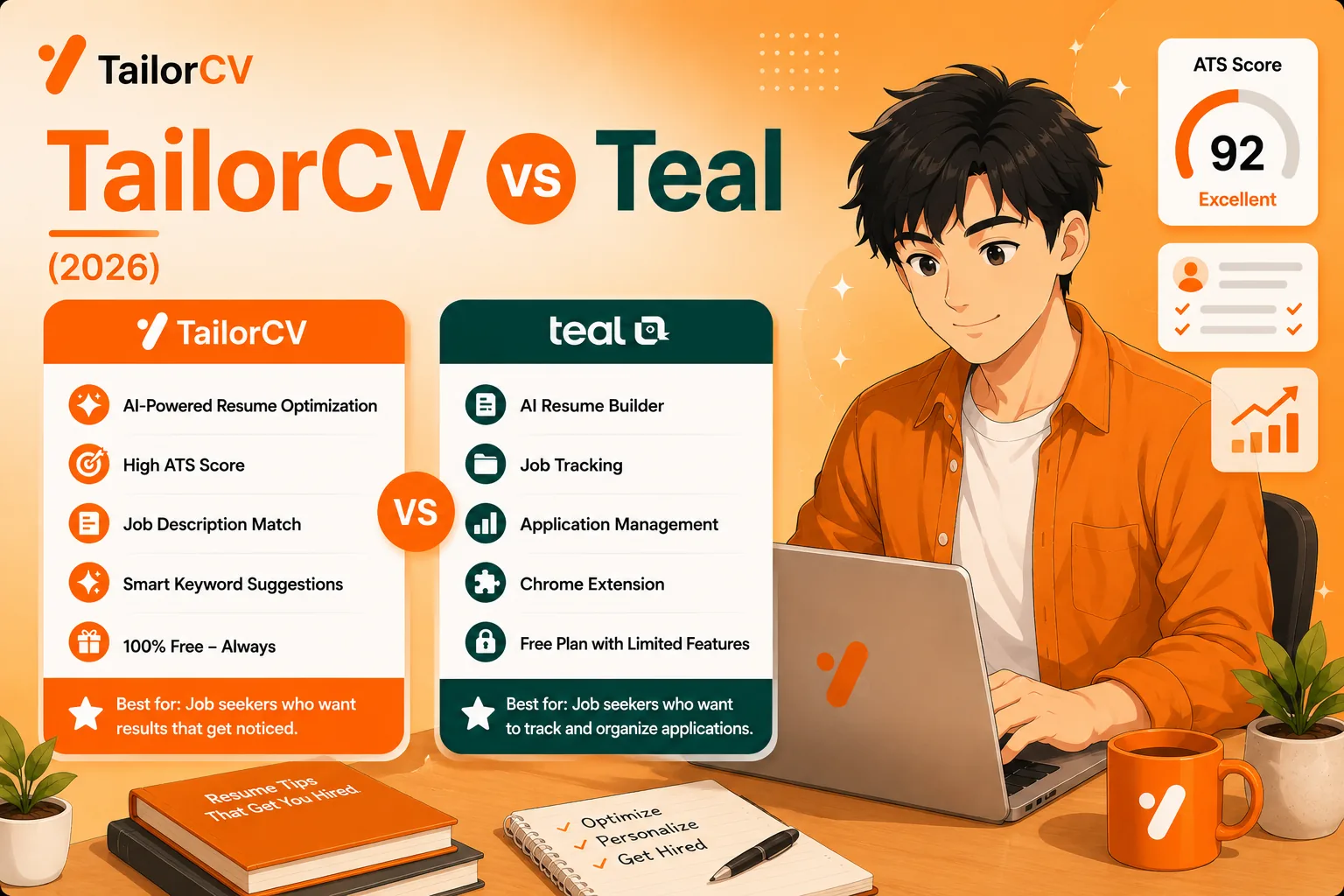
| TailorCV | Teal | |
|---|---|---|
| Core bet | The resume is the bottleneck | The search is the bottleneck |
| Free plan | Unlimited ATS scores | Unlimited job tracking |
| Paid price | $59.99/year (₹1,999 in India) | ~$29/month (Teal+) |
| Job tracker | Fills itself in | Best-in-class, manual |
| Mock interviews | Included | Not offered |
| Portfolio site | Included | Not offered |
Choose Teal if you are running a big search, organisation is your pain, and you want the most usable free plan available.
Choose TailorCV if you are applying and hearing nothing back, and you want the resume rewritten per job rather than filed neatly.
What Teal Actually Is
Teal is a job search command centre with a resume builder attached.
Its heart is the job tracker. Install the Chrome extension, see a job on LinkedIn or Indeed, click save, and it lands in your dashboard. From there you move it through stages — bookmarked, applied, interviewing, offer — add notes, set follow-up reminders, and keep the whole search in one board instead of a spreadsheet you abandoned in week two.
It is very well made. Probably the best free tracker available, and free is carrying real weight in that sentence: Teal's free plan includes unlimited job tracking, unlimited resumes, ten templates, and the extension. That is genuinely generous, and it is why Teal has the following it does.
Teal+ — around $29/month, with weekly (~$13) and quarterly (~$79) options — unlocks deeper AI: unlimited resume analysis, stronger keyword matching, unlimited cover letters.
What Teal does not really do is tell you whether your resume survives the filter. It highlights keywords from a posting and shows which appear in your resume. Useful — closer to a highlighter than a diagnosis.
What TailorCV Actually Is
TailorCV is built around one loop: get the resume past the filter, per job.
Your resume after optimization
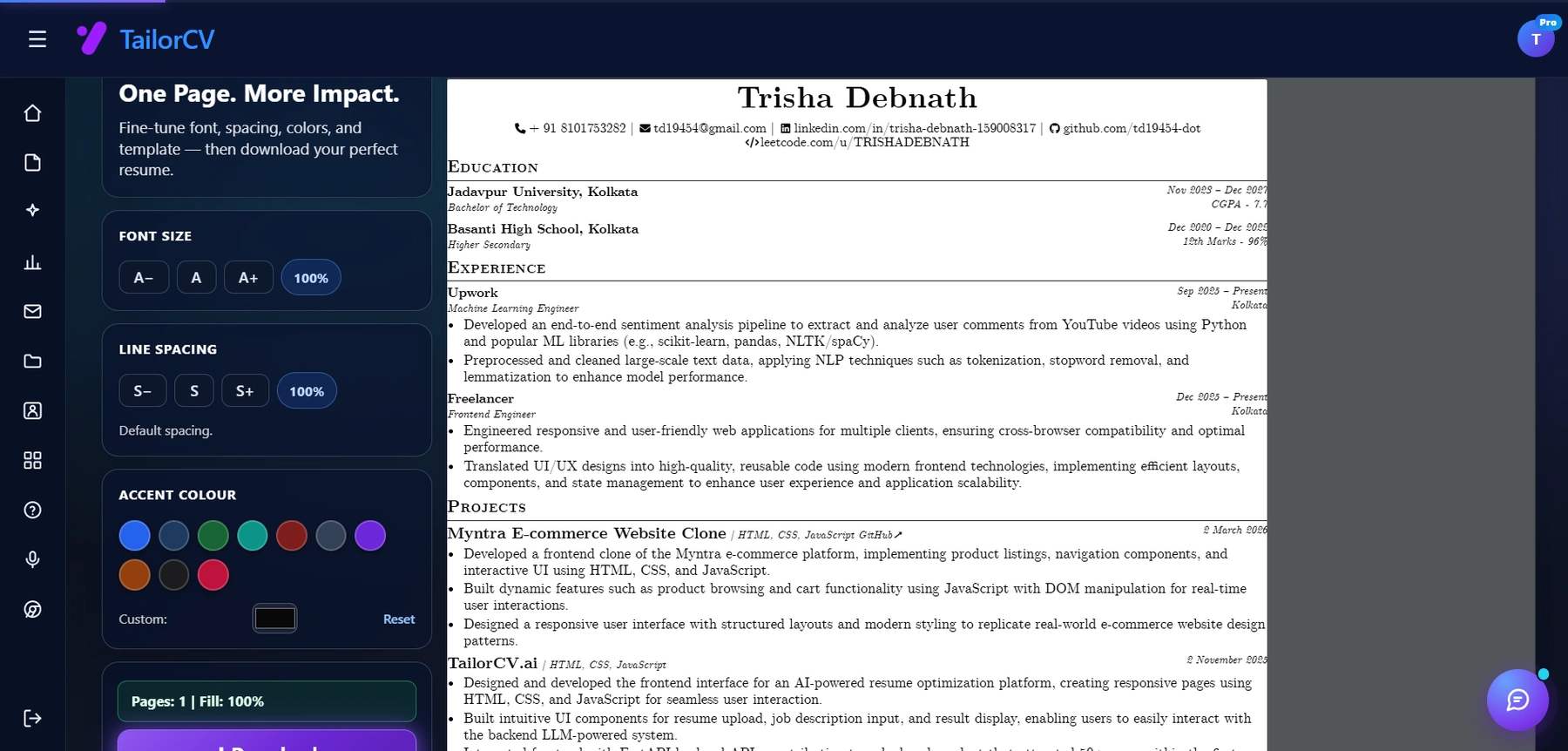
The optimized resume renders live beside the controls, so you see the page count change as you adjust.
Paste a job description and your resume. Get a free ATS match score — unlimited — with the exact missing keywords. The AI rewrites your bullets to carry that language honestly, without inventing anything. Download the tailored PDF. Next job.
Then the things that come immediately after: a matching cover letter, AI mock interviews for the role, interview prep, a portfolio site, and a Job Tracker that records every tailored version with its score and its job.
Round 1: The Job Tracker — A Real Difference in Philosophy
This is the most interesting comparison between us, so it is worth doing properly.
Teal's tracker is a filing cabinet, and an excellent one. You find a job, you click save, you get a link and a status column and a notes field. Drag-and-drop stages, follow-up reminders, and it scales happily to a hundred roles. If you are applying to eighty jobs over four months — which is closer to reality than most people admit — the difference between a real tracker and a spreadsheet is the difference between following up on time and forgetting a company existed.
TailorCV's tracker fills itself in. You do not save jobs manually. You tailor a resume for a posting — from the job board itself, via our extension — and the role, the company, your ATS score and the exact PDF you sent are all recorded automatically, as a byproduct of doing the work. You are not maintaining a list; the list maintains itself.
That difference shows up six weeks in. Teal can tell you that you applied to Company X on the 3rd. It holds a link and whatever you typed. TailorCV can tell you which resume you sent them, what it scored, and let you re-download it before the interview.
Where Teal genuinely beats us, though: their tracker holds far more roles than ours, it has notes and reminders we do not have yet, and it lets you bookmark jobs you have no intention of tailoring for. If you want to save forty interesting roles and decide later, Teal handles that and we do not. That is a real gap and we are not going to hide it in a footnote.
So: theirs is the better tracker. Ours knows more about each job it holds. Pick the one that matches how you actually work.
Round 2: ATS Scoring and Tailoring
TailorCV wins this clearly.
Teal's keyword matching is real but light — it shows you which words from the posting appear in your resume. It does not give a rigorous, formatting-aware ATS analysis, and the deeper matching sits behind Teal+.
More importantly, it does not do the rewriting. Neither does Jobscan, neither does anyone else in this category — which is exactly the gap we were built for.
Here is what that gap feels like. You learn you are missing "stakeholder management", "Agile" and seven more. Now it is 11pm and you are trying to work those into a bullet about a college project without lying and without sounding like a machine. Then again tomorrow, for a different job.
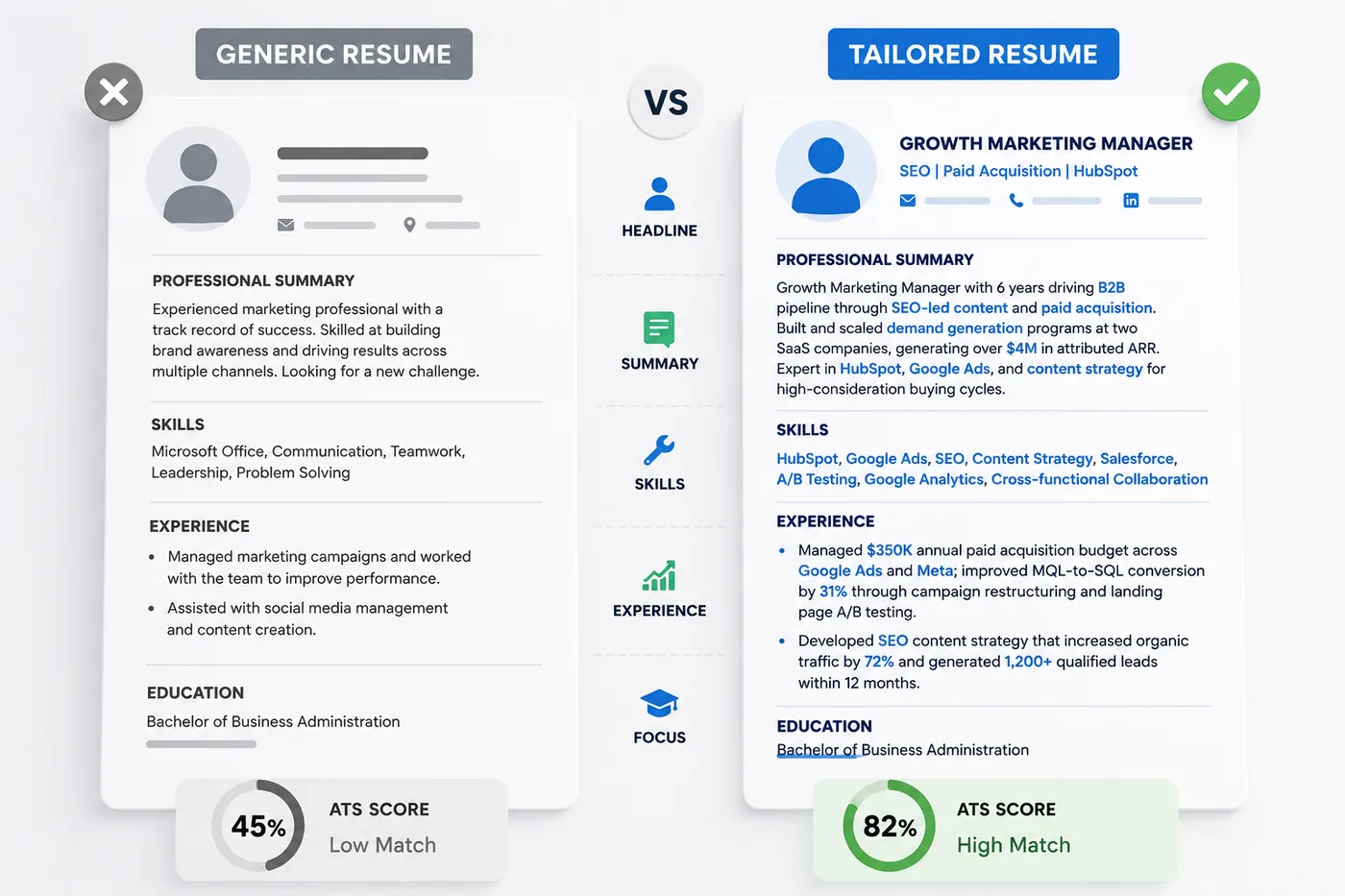
By week three most people stop tailoring and start sending one generic resume everywhere, and the reply rate quietly collapses. Our tailored vs generic resume piece shows what that costs.
TailorCV closes it in about a minute per job — under a hard rule that the AI may only rephrase what is genuinely on your resume. It will not invent an employer, a project or a skill.
Round 3: The Free Plan
Even, and both are unusually good — but they are generous about different things.
Teal free: unlimited job tracking, unlimited resumes, 10 templates, the Chrome extension. AI features are credit-limited. You can genuinely run an entire search on it without paying, which is more than almost any competitor offers.
TailorCV free: unlimited ATS scores, forever. Not five a month, not one. Plus a free portfolio site.
The philosophies are visible in those choices. Teal gives away the organisation and charges for the AI. We give away the diagnosis and charge for the rewriting. Both are honest positions. Which is better depends entirely on which half you need.
If you are early in a search and want to know whether your resume is even the problem, ours costs nothing and answers that. If you have forty applications to organise, theirs costs nothing and does that.
Round 4: Pricing
Teal (2026): Free plan as above. Teal+ around $29/month — roughly $348/year — with $13/week and ~$79/quarter options.
TailorCV (2026): Free as above. Pro $59.99/year ($4.99/week or $7.99/month for shorter commitments).
$348 a year against $59.99 a year — call it 6x.
To be fair to Teal, and this matters: they are meaningfully cheaper than Jobscan's $49.95/month, and their free tier is good enough that plenty of people genuinely never pay at all. That is a user-friendly position and we respect it. If you never need Teal+, the price comparison is academic.
We also price by region. TailorCV Pro is $59.99/year globally, $24.99/year in lower-income countries, and ₹1,999/year in India — around ₹5.5 a day. Same product everywhere; only the number moves. Teal charges $29/month to everyone, which is a fine choice for a US professional and a much harder one for a fresher in Pune or Kathmandu.
If you do need paid features, the gap is real in any currency. If you do not, Teal free is genuinely excellent and we will not pretend otherwise.
Round 5: Resume Building
Teal wins on the building experience.
Their builder is genuinely pleasant — clean templates, sensible editing, easy variants, ten templates free. If you are writing a resume from scratch, it is a nice place to do it.
We have a builder and 20+ templates too, and they are good, but our centre of gravity is tailoring an existing resume rather than authoring a new one. Upload the PDF you already have and we work from that.
Round 6: The Chrome Extension — Save the Job, or Solve It?
Both are good. They do genuinely different things.
What the extension looks like on a real posting
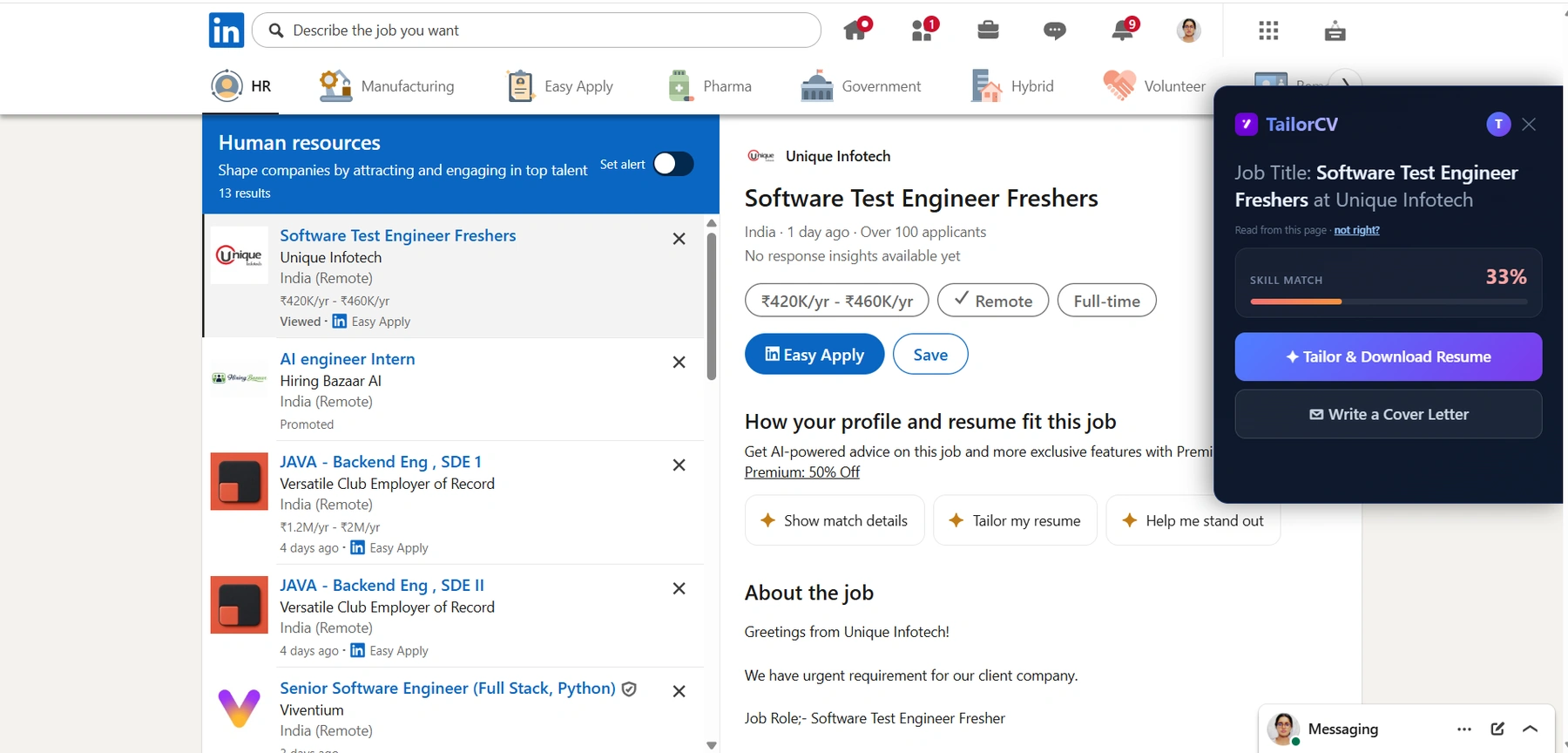
Rather than duplicating a resume in a builder and hand-editing it per job, the panel does the match check and the tailoring on the posting itself.
Teal's extension saves the job. You are on a posting, you click, and it lands in your tracker with the description and link intact. It is the smoothest part of their product and it is tightly integrated with the board. If your workflow is "collect roles now, apply later", it is excellent.
Ours tailors the resume on the posting. The panel opens beside the job — LinkedIn, Indeed, Naukri, Greenhouse, Lever, Workday, Ashby, Glassdoor, ZipRecruiter, Monster, SimplyHired, Dice, Wellfound — reads the description off the page, and shows your skill match against that role before you click anything. One click tailors your resume and downloads the PDF. Another writes the matching cover letter. Both save to your Job Tracker with the score and the job attached.
Fifteen boards work out of the box, and the panel opens on any site from the toolbar, because plenty of good roles sit on company career pages nobody has an adapter for. It reads a posting four ways — structured job data when published, site-specific rules where we have them, a content heuristic where we do not, and a manual paste box as the fallback — so it survives sites we have never tested.
That difference is the whole philosophy in miniature. Teal's extension makes your list better. Ours makes your application better. Clicking save is not the hard part of job hunting. Nobody was ever rejected for poor bookmarking.
Why the friction point matters: copy-pasting a job description takes ninety seconds. Trivial once. But you pay it on every application, and it bites hardest on the eleventh one at the end of a long day — exactly when you think "close enough" and send the generic resume. That is how tailoring dies: not from disagreement, from friction. Ours is built so tailoring costs one click from the page you are already on. More here.
Round 7: Everything After the Application
TailorCV wins on breadth.
Teal stops at the application. We cover what comes next: AI mock interviews with role-specific questions and instant feedback, interview prep generated from the actual posting, and a portfolio website builder that turns your resume into a live link — which matters for freshers whose one-page PDF undersells them.
Teal offers none of these. If you want them alongside Teal, that is another subscription somewhere else.
What Teal Does Genuinely Well
We would rather be useful than pretend Teal is bad software. It is one of the better products in this space.
- The tracker is excellent — better than ours for volume, notes and reminders. If organisation is your problem, use it.
- The free plan is the most generous in the category. Unlimited tracking is not a teaser; it is a product you can run a whole search on.
- The extension is smooth and tightly integrated with the tracker.
- The builder is a pleasure to use, and ten free templates is more than most people need.
- It is priced far more reasonably than Jobscan, and the free tier means many users never pay.
If we were not building TailorCV, and someone asked us for a free job tracker, we would say Teal without hesitating.
So Who Should Pick Which?
Pick Teal if:
- You are drowning in applications and need one organised board
- You want the best free plan available and may never pay
- You want to bookmark roles you have not applied to yet
- You want notes and follow-up reminders per job
- Your resume already performs well
Pick TailorCV if:
- You are applying and hearing nothing back
- You want the resume rewritten per job, not just filed
- You want unlimited free ATS scores to find out if the resume is even the problem
- You want mock interviews and a portfolio site in the same tool
- You want your tracker to know what you sent, not just where
- $59.99/year vs ~$348/year is a real difference to you (₹1,999 vs ~₹29,000 in India)
Use both if you like — Teal free for tracking, TailorCV free for scoring. That combination costs nothing and covers both halves, and honestly it is not a bad setup.
Why an Organised Search Can Still Fail
There is a trap in job hunting that a good tracker makes easier to fall into, and it is worth naming because Teal is very good at exactly the thing that hides it.
An organised search feels like progress. Your board is tidy. Forty roles, colour-coded, moving through stages. You applied to eleven this week — that is more than last week. The dashboard rewards you for volume, and volume feels like effort, and effort feels like it should produce results.
But the board measures activity, not outcomes. It cannot tell you that all forty applications used the same generic resume, that thirty-two of them were filtered out by software in under a minute, and that no human being ever read a word you wrote. It shows eleven neat cards in the "Applied" column and stays quiet about the fact that eleven is not better than three if all eleven were auto-rejected.
This is the specific failure mode we watch people fall into: they get more organised, they apply to more roles, they hear nothing, and they conclude the market is brutal. Sometimes it is. But often the market never saw them. Our piece on tailored vs generic resumes puts numbers on the difference.
The mechanics are worth understanding. When you apply through a portal — Workday, Greenhouse, Taleo, Naukri — your PDF is parsed into structured data. A recruiter then filters that data, usually using the exact terms from the job description. And here is the part that catches people: the filter matches language, not meaning. If the posting says "stakeholder management" and your resume says "worked with clients and teams", a human would call those identical. The filter will not. It is string matching, not comprehension — and the keyword mistakes people make usually come from assuming otherwise.
So the tidy board and the empty inbox are not a contradiction. They are the same story told from two ends.
None of this is a criticism of Teal — it is doing precisely what it promises, and doing it better than anyone. It is a caution about what tracking is. A filing cabinet is genuinely useful. It is just not a strategy, and no amount of organising the record of your rejections changes the next one.
A Ten-Minute Test That Settles It
You do not have to take our word for any of this. Find out instead.
Step 1: Pick a job you genuinely want. Copy the full description, requirements included.
Step 2: Score your current resume against it with a free ATS score. Unlimited, no card. Read the number, then read the missing keywords list — that list is the real information.
Step 3: Be honest about what comes back.
- 80% or above? Your resume is genuinely strong and organisation really is your bottleneck. Teal is your answer, its free plan will cover you, and you can stop reading comparison articles.
- 55–75%? The dangerous middle. Your resume reads well and a human would say it is good — and it is quietly losing to people who tailored, because "good" does not rank against a specific posting.
- Below 55%? You are being filtered before anyone reads you. A tracker cannot see this happening, which is exactly why it can go on for months.
Step 4: Ask which number your board has been hiding. If you have forty tidy applications and two replies, the board was never the problem — and it was never going to tell you that.
Frequently Asked Questions
Is Teal really free? Yes, genuinely. Unlimited job tracking, unlimited resumes, 10 templates, the extension. AI features are credit-limited and deeper matching is in Teal+, but you can run a full search free — which is rare in this category.
Does TailorCV have a job tracker like Teal's? Yes, but built differently. Every resume you tailor is saved automatically with its ATS score and the job it was written for. Teal's holds more roles and has notes and reminders; ours knows what you actually sent. Different strengths.
Which has better ATS scoring? Ours, clearly. Teal's matching is a keyword highlighter; ours scores the match, names what is missing, and then rewrites the resume to fix it.
Is Teal better than TailorCV? For tracking a large search, Teal's tracker is better and we would say so plainly. For getting the resume past the filter — scoring, rewriting, interview prep — that is what we are built for.
Can I use my existing resume? Yes. Upload the PDF you already have; no retyping into a builder.
Will the AI invent experience I do not have? No. It rephrases and re-emphasises what is genuinely on your resume. It will not fabricate employers, projects or skills — getting caught in the interview is worse than not getting one.
Putting It All Together
Teal and TailorCV are not really competing for the same job, which is why "which is better" has no clean answer.
If your problem is "I have applied to forty things and I have lost track" — that is Teal. The tracker is excellent, the free plan is the best around, and you may never need to pay. Go use it; we mean that.
If your problem is "I have applied to forty things and heard nothing" — a tidier list of the forty rejections does not change the forty-first outcome. What changes it is the resume you send. That is the thing we built.
And the two are not mutually exclusive: Teal free for the board, TailorCV free for the score. Zero rupees, both halves covered.
The way to find out which problem you have takes ten minutes and costs nothing. Run a free ATS score against a job you genuinely want. If it comes back at 85%, your resume is fine and organisation really is your bottleneck — Teal is your answer. If it comes back at 58%, you have just found where your search has been dying, and no tracker in the world was ever going to fix it.
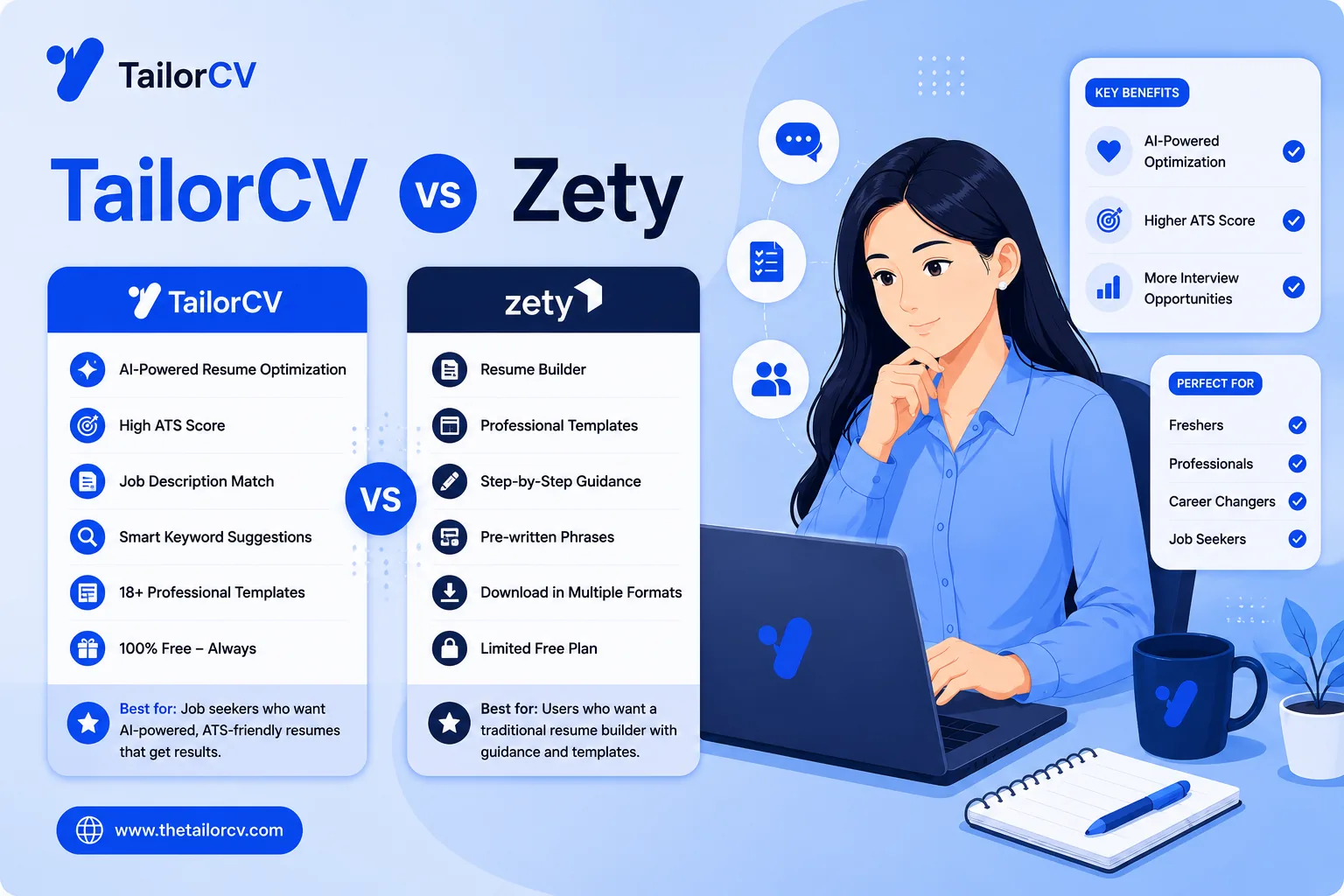
Comparing other tools? We have honest breakdowns of TailorCV vs Jobscan, vs Careerflow, vs Zety and vs Enhancv — plus a four-way roundup and the best free ATS checkers compared.
Sources: Teal pricing and free plan features verified July 2026 from Teal's pricing page and independent 2026 reviews including Teal HQ Review. Teal+ figures vary slightly by source and billing period. TailorCV pricing from our own pricing page. Prices change — check current pages before subscribing.
See what tailoring is worth on your resume
Score your current resume against a real job description before you change a word.
Drop your resume here or choose a file
PDF only. Max 2 MB.
We never share your data or use it to train AI models.

Start from a template that tailors well
Clean structure means swapping keywords per job takes minutes, not a re-layout every time.
Was this guide useful?
Be the first to rate it.