 SS
SS
Key Takeaways
- The .txt download is the single most common complaint about Zety, and it catches people at the worst possible moment.
- Zety's $1.95 14-day trial auto-renews at $25.95, which is why most people click it.
- Zety wins at building a resume from scratch - that is what it is for.
- TailorCV wins job-specific tailoring and the ATS question.
- The criticisms are about the pricing model rather than the product itself.
Zety is one of the most visible resume builders on the internet. If you have ever searched "resume template" or "how to write a resume", you have landed on one of their pages — they have an enormous content library and it ranks for nearly everything.
The builder itself is good. Clean templates, guided writing, sensible structure. If you are starting from a blank page, Zety will get you to a decent-looking resume quickly.
But there is one thing about Zety you should know before you spend an hour in it, and we would rather tell you now than let you find out at the end: on the free plan, you cannot download a PDF. You can build the whole resume, pick a template, fill in every section — and when you click download, you get a .txt file with all the formatting stripped out. The PDF is behind the paywall.
We build TailorCV, so this is not a neutral review. But that fact is not our opinion, it is their pricing page, and it shapes everything below.
The 30-Second Verdict
| TailorCV | Zety | |
|---|---|---|
| What it is | Tailoring engine | Resume builder |
| Free plan | Unlimited ATS scores, PDF download | Build only — .txt download |
| Paid price | $59.99/year (₹1,999 in India) | $25.95 every 4 weeks (~$337/yr) |
| Annual option | $59.99 | $71.40 |
| Tailors to a job | Yes — rewrites bullets | No |
| Mock interviews | Included | Not offered |
| Portfolio site | Included | Not offered |
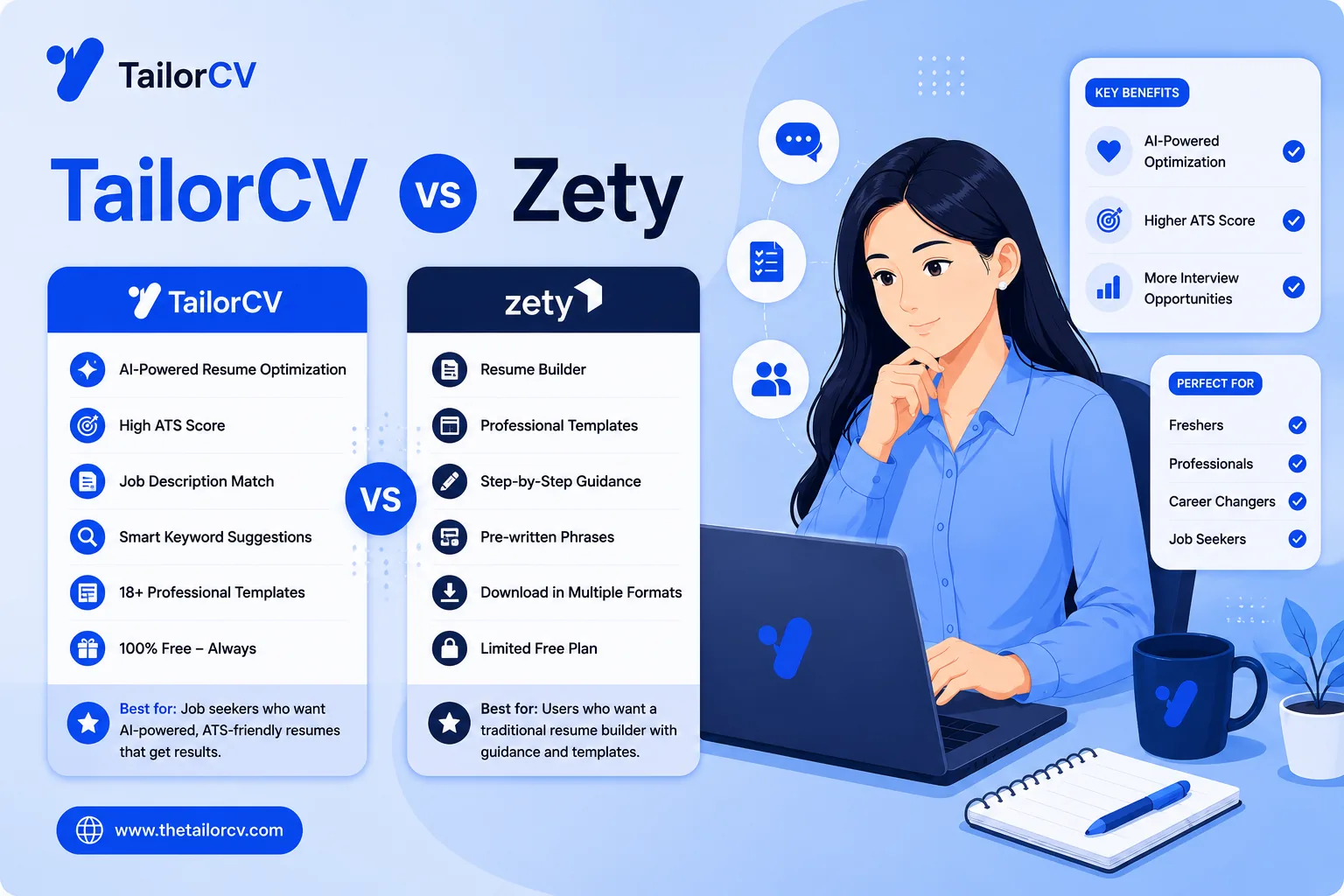
Choose Zety if you are starting from nothing, you want a guided builder with polished templates, and you are happy to pay to download.
Choose TailorCV if you already have a resume and it is not getting replies, and you want it tailored per job rather than rebuilt.
The Thing You Need to Know First: the .txt Download
Let us deal with this properly, because it is the single most common complaint about Zety and it catches people at the worst possible moment.
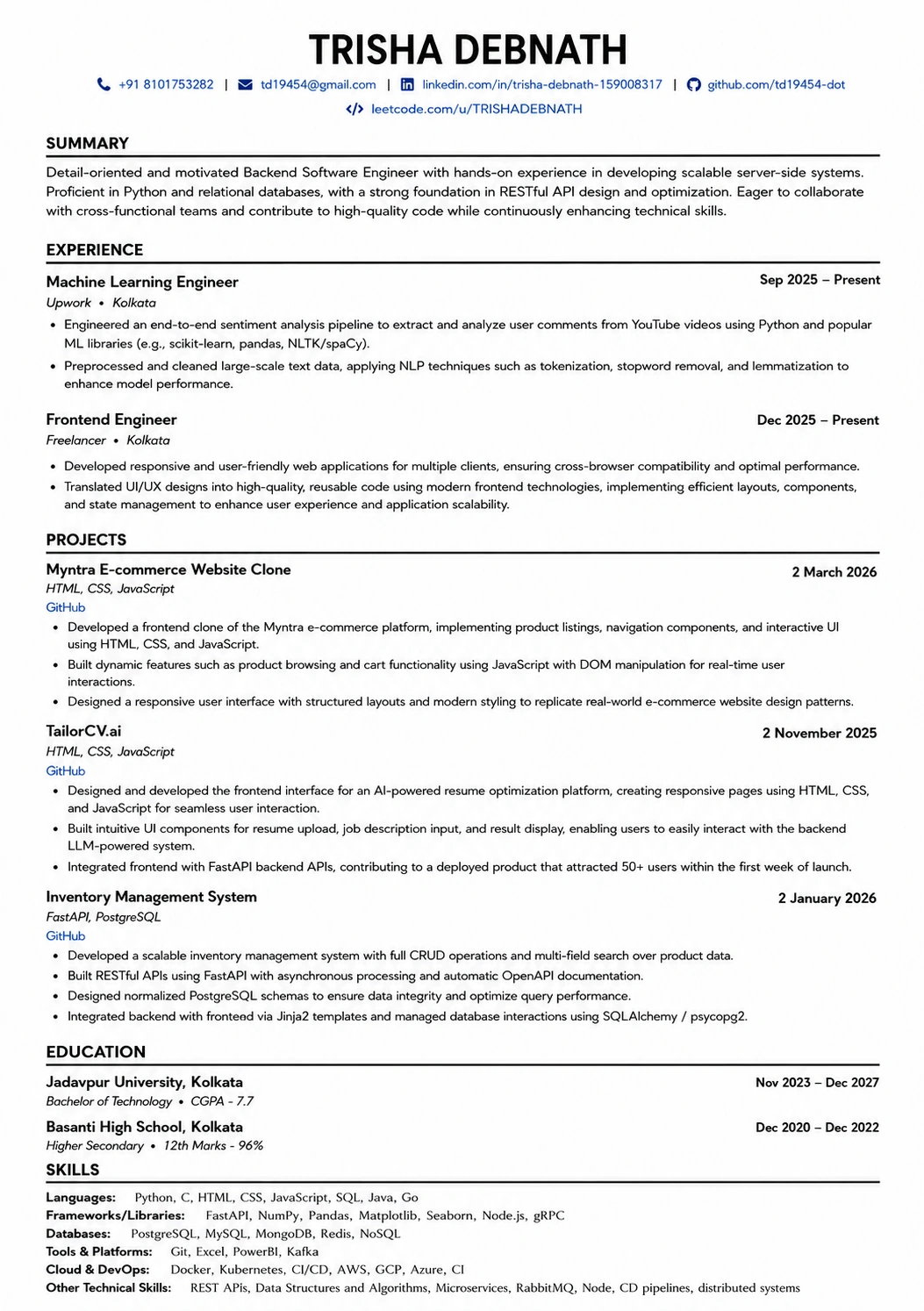
Your resume after optimization
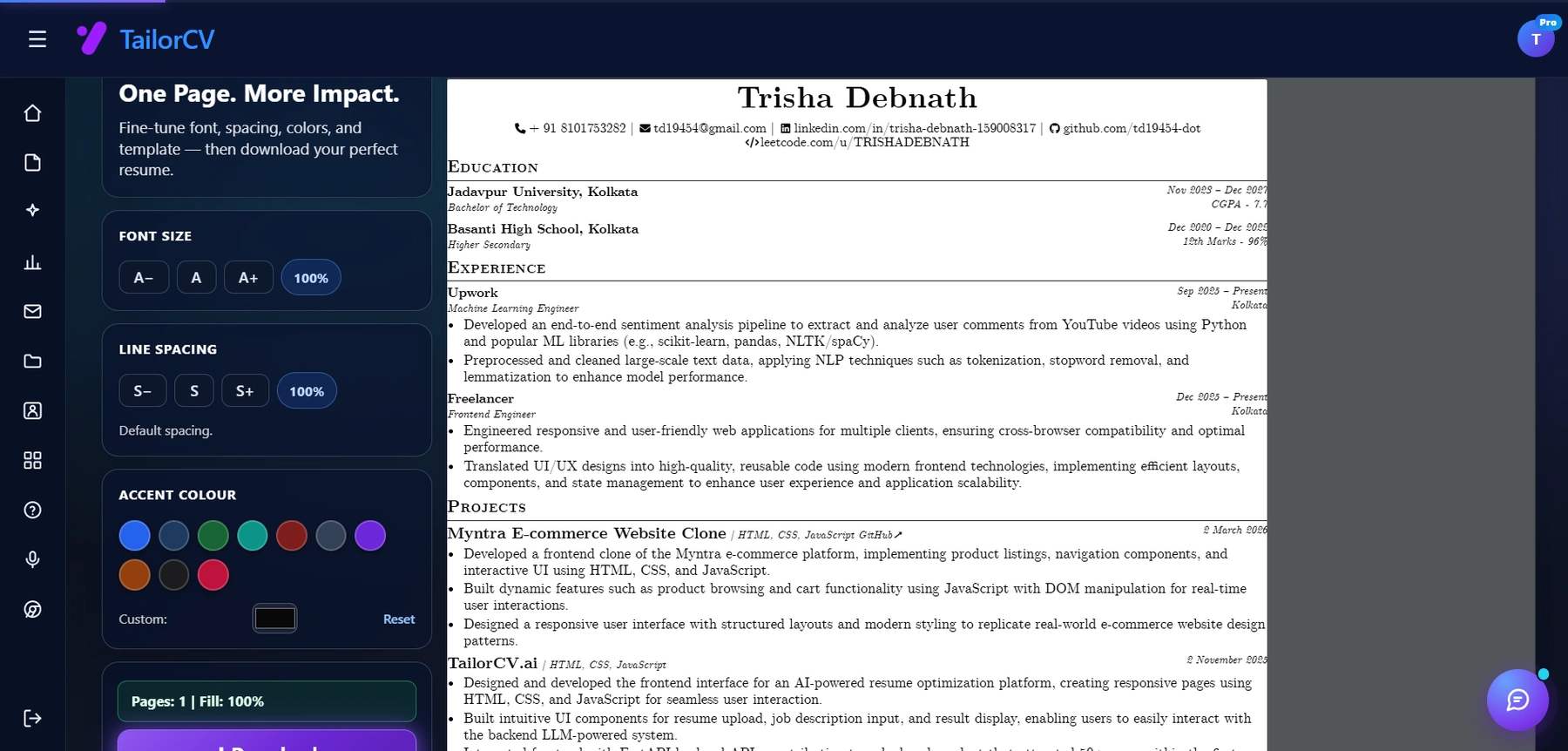
This is the optimized result, and it is usually how a spilling two-page draft gets back onto one page without deleting anything worth keeping.
Zety's free plan lets you use the builder and all the templates. You invest real time — an hour, maybe two — getting your resume right. Then you click download, and you discover that free means plain text only. Every bit of the formatting you just spent an hour on is gone. The template you chose is irrelevant. What you get is a wall of unformatted text you could have written in Notepad.
To get the PDF or Word file — the thing you actually came for — you pay.
We are not going to call this a scam, because it is disclosed and plenty of freemium products gate the export. But it is worth being clear-eyed about what it does to you psychologically: you find out the price after you have done the work. By the time you hit the paywall, you have sunk an hour, the resume looks good on screen, and you have an application due. That is the moment you are least able to walk away and most likely to pay. The design of that flow is not an accident.
Compare that to the pricing you actually clicked in on: "free resume builder".
The Other Thing: $1.95 Becomes $25.95
Zety's paid entry point is a 14-day trial for $1.95. That reads as almost free, and it is why most people click it.
What happens next is that it auto-renews at $25.95 every four weeks unless you cancel first. Note "every four weeks", not "every month" — that is thirteen billing cycles a year, not twelve. So the real annual cost of the monthly plan is about $337, not the ~$311 you would get from multiplying by twelve.
This is the most common Zety complaint online by a wide margin: people take the $1.95 trial, forget, and find $25.95 charges on their card. Again — it is disclosed. But "disclosed" and "designed to be missed" are not mutually exclusive, and a four-week billing cycle on a 14-day trial is not an arrangement that exists for your benefit.
Their annual plan is $71.40/year ($5.95/month), which is genuinely reasonable and is the plan we would point you at if you decide Zety is what you want.
Round 1: Pricing
Zety (2026):
- Free: build and edit with all templates — .txt download only
- Pro trial: $1.95 for 14 days, then $25.95 every 4 weeks (~$337/year)
- Annual: $71.40/year (~$5.95/month)
TailorCV (2026):
- Free: unlimited ATS scores, everywhere — real PDF downloads
- Pro: $59.99/year ($4.99/week or $7.99/month for shorter commitments)
Here we are going to be fair rather than dramatic: $71.40 against $59.99 is not a meaningful gap. If you buy Zety's annual plan, you are paying roughly what you would pay us. We are not going to manufacture outrage about eleven dollars.
The real gap is between Zety's monthly path — $337/year — and ours at $59.99. That is about 5.6x, and the monthly path is the one most people end up on, because the $1.95 trial is the door everyone walks through.
We also price by region, which we think is the honest thing to do. TailorCV Pro is $59.99/year globally, $24.99/year in lower-income countries, and ₹1,999/year in India — about ₹5.5 a day. Same product; only the number moves. Zety charges the same to everyone.
And our free plan gives you a real PDF. Not a .txt.
Round 2: Building a Resume from Scratch
Zety wins this. It is what they are for.
If you are staring at a blank page, Zety is genuinely helpful. The guided flow asks the right questions, the templates are polished, and the pre-written content suggestions give you something to react to rather than a blinking cursor. For a first-ever resume, that scaffolding is real value.
We have a builder and 20+ templates too, and they are good — but authoring from zero is not our centre of gravity. Ours is the resume you already have.
If your problem is "I have never written a resume and I do not know where to start", Zety is a reasonable answer and we will not pretend otherwise.
Round 3: Tailoring to a Specific Job
TailorCV wins, and this is the fundamental difference.
Zety builds you a resume. One resume. A good one, generically speaking. What it does not do is adapt that resume to the specific posting you are applying to tomorrow.
That matters more than it sounds, because of how applications actually work. When you submit through a portal — Workday, Greenhouse, Taleo, Naukri — your PDF is parsed into structured data, and a recruiter or filter searches that data using terms lifted from the job description. And the filter matches language, not meaning. If the posting says "stakeholder management" and your beautifully built Zety resume says "worked with clients and teams", a human would call those identical. The software will not. It is doing string matching, not comprehension.
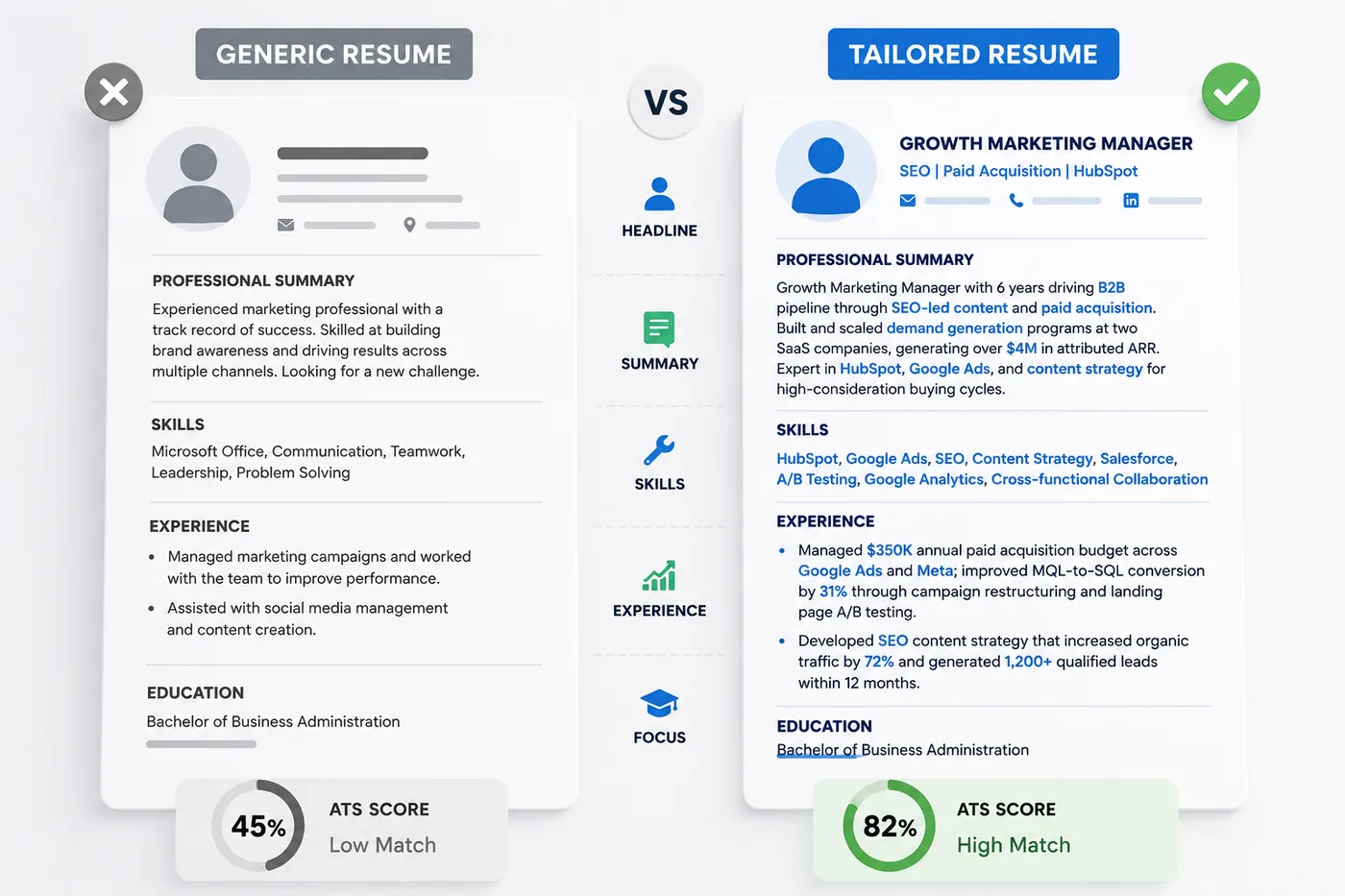
So a well-built generic resume gets filtered out just as efficiently as a badly built one. The template did not save it. Our tailored vs generic resume piece shows what that costs in practice.
TailorCV starts from the posting. Paste it with your resume, get a free ATS match score for that role — unlimited — with the exact missing keywords, and the AI rewrites your bullets to carry that language honestly, without inventing anything you did not do. About a minute per job.
Round 4: The ATS Question
TailorCV wins.
Zety markets ATS-friendly templates, and that claim is fair as far as it goes — their layouts do not generally break parsers, which is more than can be said for a lot of designer resume templates.
But "ATS-friendly formatting" and "ATS match score" are completely different things, and the marketing in this industry blurs them constantly. A template being parseable means the software can read your resume. It says nothing about whether your resume matches the job. You can have a perfectly parseable resume that scores 45% against the posting and gets rejected in forty seconds.
Zety solves the first problem. It does not touch the second. Ours does both — the score, the missing keywords, and the rewrite. Our ATS score guide explains the difference properly, and how to make your resume ATS-friendly covers the formatting side.
Round 5: The Chrome Extension
TailorCV wins — Zety does not have a meaningful one.
What the extension looks like on a real posting
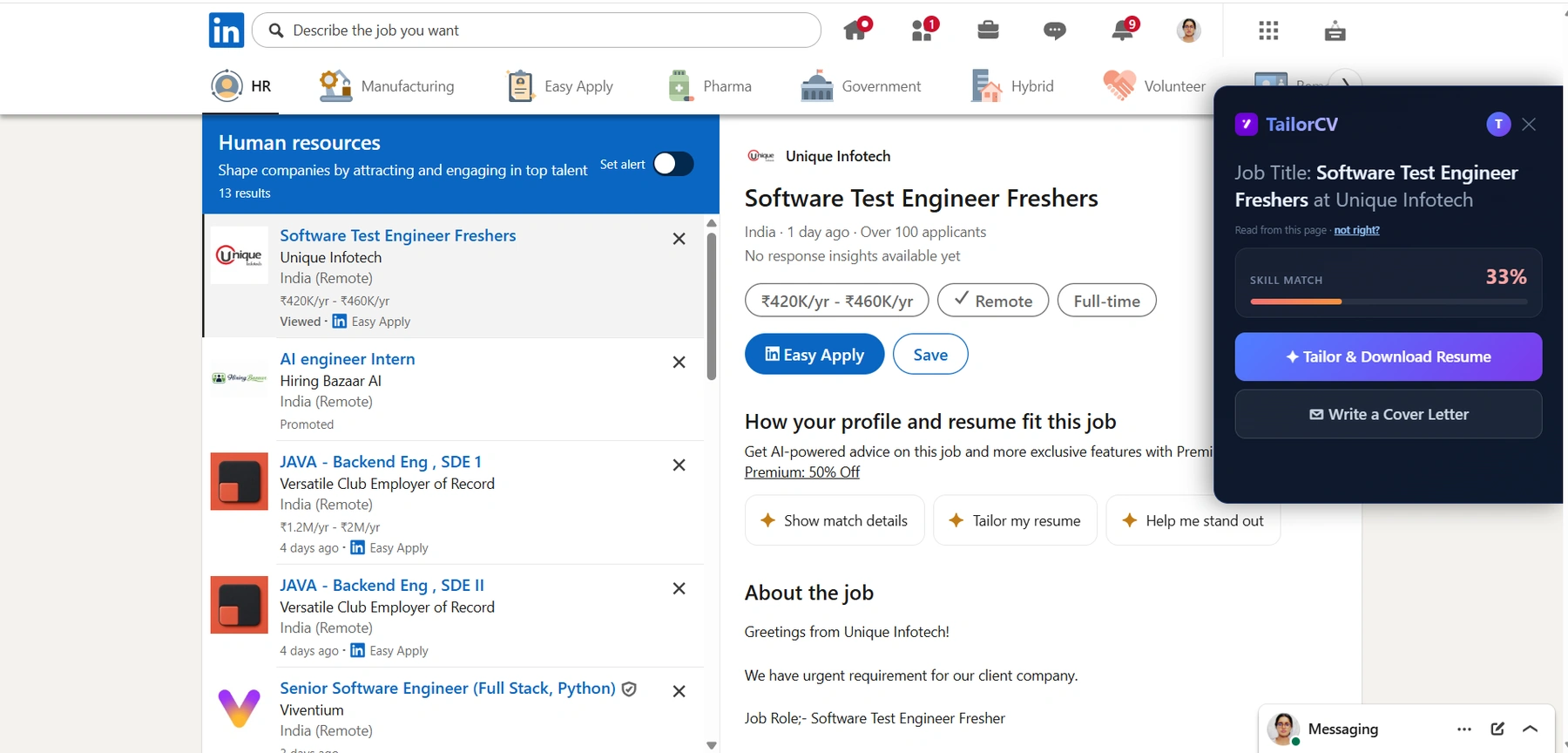
Rather than duplicating a resume in a builder and hand-editing it per job, the panel does the match check and the tailoring on the posting itself.
Ours opens beside the job. LinkedIn, Indeed, Naukri, Greenhouse, Lever, Workday, Ashby, Glassdoor, ZipRecruiter, Monster, SimplyHired, Dice, Wellfound — the panel reads the description straight off the page and shows your skill match against that role before you click anything. One click tailors your resume and downloads the PDF. Another writes the matching cover letter. Both save to your Job Tracker automatically, with the score and the job attached.
Fifteen boards work out of the box, and the panel opens on any site from the toolbar, because plenty of good roles live on company career pages nobody has built an adapter for.
Why this matters: with a builder, tailoring means opening the site, duplicating your resume, editing it by hand, re-downloading, and renaming the file. Ten minutes, minimum, per job. Nobody does that eighty times. So people build one Zety resume and send it everywhere — which is exactly the behaviour that fails. More on the extension here.
Round 6: Everything After the Resume
TailorCV wins on breadth.
Zety is a builder with a cover letter tool attached. Fine — focused products are legitimate.
We cover what comes next: cover letters matched to the same posting, AI mock interviews with role-specific questions and instant feedback, interview prep generated from the actual job, a portfolio website builder that turns your resume into a live link, and a Job Tracker that fills itself in.
Zety offers none of these.
What Zety Does Genuinely Well
We would rather be useful than pretend Zety is bad software. It is not — the criticisms above are about the pricing model, not the product.
- The builder is genuinely good for a first resume. The guided flow and content suggestions beat a blank page decisively.
- The templates are polished and generally parseable, which is not universal in this category.
- Their content library is excellent. Zety's guides on resume writing are genuinely useful and free, and they rank for everything for a reason. You can learn a lot from them without paying anything.
- The annual plan at $71.40 is fair — roughly our price. If you want a builder, buy that plan and not the $1.95 trial.
If you are writing your first resume from scratch and you want structure, Zety earns its place. Just go in knowing the download costs money.
A Ten-Minute Test That Settles It
Before you pay anyone — including us — find out what your actual problem is.
Step 1: Pick a job you genuinely want. Copy the full description.
Step 2: Score your current resume against it with a free ATS score. Unlimited, no card, real result.
Step 3: Read it honestly.
- 80% or above? Your resume is well matched. You do not need a new one. Do not let a builder sell you a rebuild you do not need.
- 55–75%? The dangerous middle, and where most people land. Your resume is fine — a builder would make it prettier, not more matched — and it is losing anyway. This is the tailoring gap.
- Below 55%? You are being filtered before anyone reads you. A better template will not fix that. The words have to change.
Step 4: Ask the honest question. Is your problem "my resume looks bad" or "my resume is not matching the job"? A builder fixes the first. Only tailoring fixes the second. Most people have the second problem and buy a solution to the first.
Why "Free Resume Builder" Is the Most Oversold Phrase Online
It is worth understanding the business model here, because Zety is not unusual — it is simply the most successful example of a pattern that runs through this entire industry, and once you see it you will recognise it everywhere.
Search "free resume builder" and you will get dozens of results. Almost none of them are free in the way you mean. What they mean is one of:
| Reason | What it gets you |
|---|---|
| Free to build, paid to download | Zety's model. You do the work, then pay to take it with you |
| Free with branding | you can download, but the tool's logo is on your resume |
| Free trial | genuinely full-featured, for seven days, then it renews |
| Free tier with a hard cap | one resume, or five scans, or ten tracked jobs |
Each of these is a legitimate business decision, and software costs money to run — we charge for things too. The issue is not that these tools want to be paid. It is that the word "free" is doing enormous marketing work in the search result, and the actual terms only surface after you are invested.
The sunk cost is the product. An hour into building your resume, having chosen a template and written every bullet, you are not a rational shopper anymore. You are someone with an application due tomorrow and a finished document trapped behind a button. The $25.95 does not feel like a purchase; it feels like a rescue. That is not an accident of design — it is the design.
The tell is when the price appears. A tool confident in its value shows you the price before you invest. A tool relying on sunk cost shows it after.
We are not innocent of pricing pressure — we want you to buy Pro. But our free tier is built around a principle we would defend in any room: the diagnosis is free, forever, unlimited, in every region, with a real PDF download. You should never have to pay to find out whether you have a problem. Paying to fix it is a fair trade. Paying to learn about it is not.
So when you evaluate any tool in this category — including this article's recommendation — ask one question: what does it cost to find out if I even need this? If the answer involves a card, a countdown, or a .txt file, you have learned something about the company.
What Actually Happens When You Apply
The mechanics explain why a beautiful template does not save a generic resume.
When you submit through a portal — Workday, Greenhouse, Taleo, iCIMS, or a Naukri listing — your PDF is parsed into structured fields. The system extracts your skills, titles, dates and education and stores them as data. A recruiter, or an automated filter, then searches that data using terms lifted straight from the job description they wrote.
Two things follow, and Zety only addresses one of them.
First, formatting can sink you before content matters. Tables, columns, text boxes, headers and graphics confuse parsers. A resume that looks immaculate in the builder can arrive as scrambled nonsense. Zety is genuinely good here — their templates are conventional enough to parse cleanly, which is more than can be said for a lot of designer templates. Our ATS-friendly resume guide covers the specifics.
Second, the filter matches language, not meaning. This is the one Zety does not touch. If the posting says "stakeholder management" and your resume says "worked with clients and teams", a human calls those the same thing. The parser does not. It is doing string matching, not comprehension. It will not infer that your "led a team of four" satisfies their "team leadership", or that "built dashboards in Tableau" answers "data visualisation experience".
So you can have a perfectly parseable, professionally built, beautifully templated resume that gets rejected in forty seconds — and no email will ever tell you why. That is the gap between a builder and a tailoring tool, and it is the whole reason we exist. If you are weighing builders generally, online CV maker vs resume builder is worth a read. Our ATS keywords guide goes deeper on which terms actually carry weight.
Frequently Asked Questions
Is Zety actually free? The builder is free. The download is not — free accounts get a .txt file with all formatting stripped. To download a PDF or Word file you must pay. Many people discover this after finishing their resume.
How much does Zety really cost? The $1.95 is a 14-day trial that auto-renews at $25.95 every four weeks — thirteen cycles a year, about $337/year. Their annual plan is $71.40/year, which is much better value if you want Zety.
Is TailorCV free? The ATS score is free and unlimited in every region, and you get real PDF downloads — not .txt. Pro ($59.99/year globally, ₹1,999/year in India) unlocks unlimited tailoring, cover letters and mock interviews.
Does Zety tailor my resume to a job description? Not in the way we mean. It builds a good general resume. It does not score against a specific posting or rewrite your bullets to match it.
Can I upload my existing resume to TailorCV? Yes. Upload the PDF you already have — no retyping into a builder to get a score or a tailored version.
Will the AI invent experience I do not have? No. Tailoring is constrained to what is genuinely on your resume. It rephrases and re-emphasises your real work; it will not fabricate employers, projects or skills.
Can I use both? Yes, and it is a reasonable combination — build the resume in Zety if you are starting from zero, then tailor it per job with us. Just be aware you will pay Zety to get the PDF out.
Putting It All Together
Zety and TailorCV are not really the same kind of product, and the honest way to choose is to ask what you are missing.
If you are missing a resume — you have never written one, you do not know the structure, you are staring at a blank page — Zety's builder is genuinely good and their free guides are worth reading regardless. Just buy the $71.40 annual plan, not the $1.95 trial, and know that the download costs money.
If you are missing replies — you have a resume, it looks fine, you have sent it to thirty companies and heard nothing — then a builder is not your answer. Rebuilding a resume that is already well-written just makes it prettier. The reason it is failing is that it is not matched to the jobs you are sending it to, and no template fixes that.
The difference costs nothing to find out. Run a free ATS score against a job you actually want. Real PDF, no .txt, no card, no five-scan ceiling, no trial that quietly becomes $25.95 every four weeks. If it comes back at 85%, you did not need either of us. If it comes back at 55%, you have just found where your search has been dying.
You can also compare us against the rest of the field on our comparisons hub.
Comparing other tools? We have honest breakdowns of TailorCV vs Jobscan, vs Teal, vs Careerflow and vs Enhancv — plus a four-way roundup and the best free ATS checkers compared.
Sources: Zety pricing and free-plan limits verified July 2026 from Zety's pricing page and independent 2026 reviews including Zety Resume Builder Pricing & PDF Download Costs (PitchMeAI) and Zety Review 2026 (ResuFit). TailorCV pricing from our own pricing page. Prices change — check current pages before subscribing.
See what tailoring is worth on your resume
Score your current resume against a real job description before you change a word.
Drop your resume here or choose a file
PDF only. Max 2 MB.
We never share your data or use it to train AI models.

Start from a template that tailors well
Clean structure means swapping keywords per job takes minutes, not a re-layout every time.
Was this guide useful?
Be the first to rate it.