 SS
SS
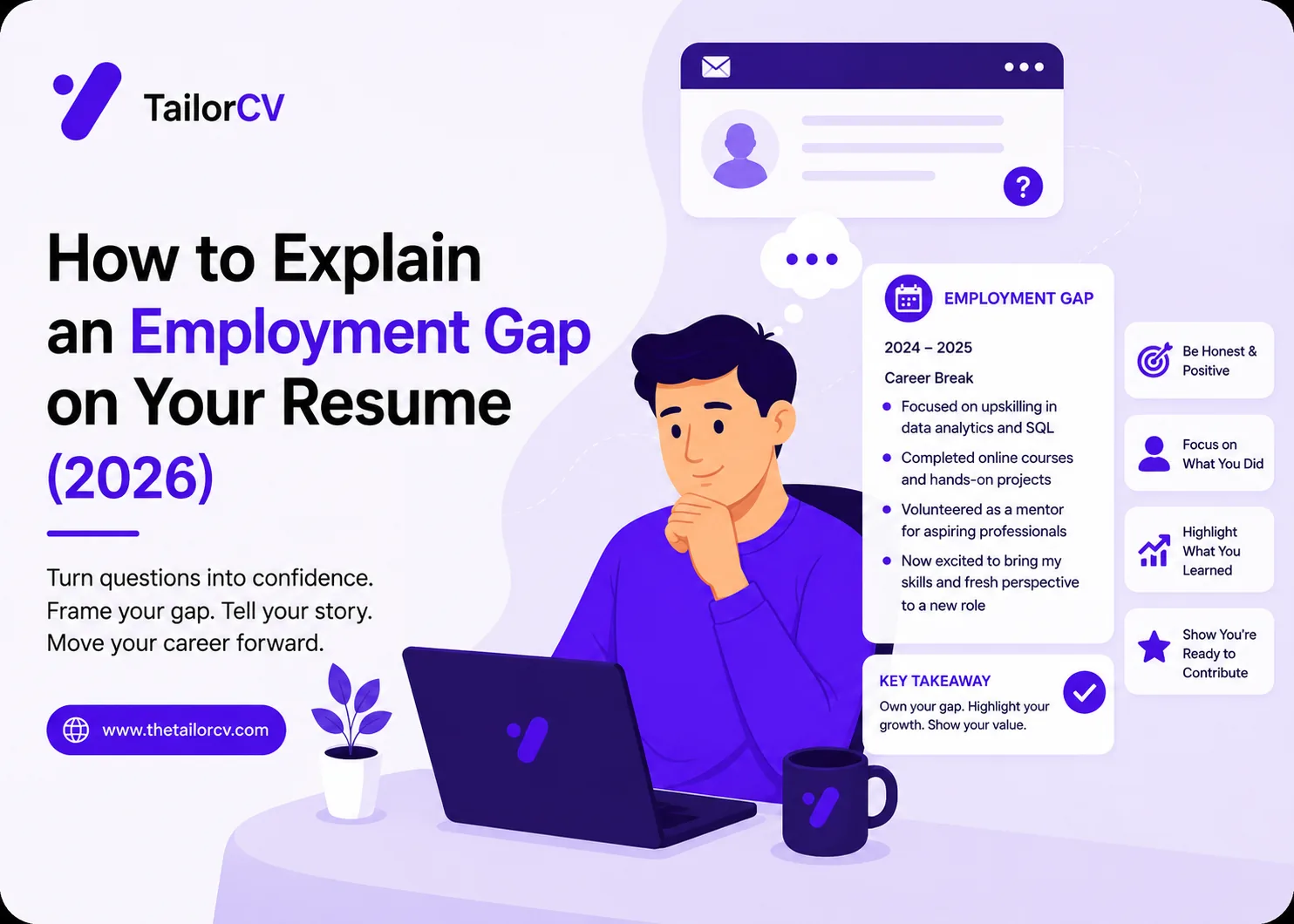
Key Takeaways
- A gap is only a problem if you leave it unexplained. One honest line usually closes it.
- Use years, not months, in your date formatting when a short gap would otherwise stand out.
- Frame the gap around what you did or learned, not an apology.
- Put the explanation on the resume only if the gap is long (12+ months); short gaps belong in the cover letter or interview.
Why Recruiters Care About Gaps
Recruiters do not reject gaps. They reject uncertainty. An unexplained six-month hole makes a hiring manager invent the worst-case story. A single factual line replaces that story with a real one, and the objection disappears. The goal is never to hide the gap; it is to control the sentence a recruiter reads.
Where to Put the Explanation
- Short gap (under a year): Switch to year-only dates (
2024 – 2025instead ofMar 2024 – Jan 2025). Many short gaps vanish entirely. - Long gap (12+ months): Add a short dated entry in your experience section so the timeline has no blank space.
- Cover letter: One sentence, forward-looking, never defensive.
Wording That Works
Add a real, dated line to the experience section for a long break:
Career Break — Full-Time Caregiver (2024 – 2025) Managed household logistics and part-time freelance design work; completed Google UX certification.
Notice it has a title, dates, and one line of substance. It reads like a role, not an excuse.
For a layoff, the cause was the company, not you — say so plainly in the cover letter:
"My role was eliminated in a company-wide restructuring in 2024. Since then I have completed two freelance analytics projects and a SQL certification."
For health or personal reasons, you owe no medical detail:
"I took a planned break in 2024 for personal reasons and am now fully focused on returning to a backend engineering role."
Fill the Gap Retroactively
If the break is still recent, you can add genuine, verifiable activity: freelance work, a certification, open-source contributions, volunteering, or a course. One real line of upskilling turns "did nothing" into "stayed sharp."
What Not to Do
- Do not fabricate dates to cover the gap. It surfaces in background checks and reference calls.
- Do not apologize. "Unfortunately I was unable to find work" invites doubt.
- Do not over-explain. Two sentences maximum; the interview is for detail.
How TailorCV Helps
When you tailor a resume to a job, the ATS scan reads your dates and structure first. Keeping a clean, gap-free timeline with year-based dates means the parser sees continuous employment, and the recruiter sees a candidate who is in control of their own story.
Your resume after optimization
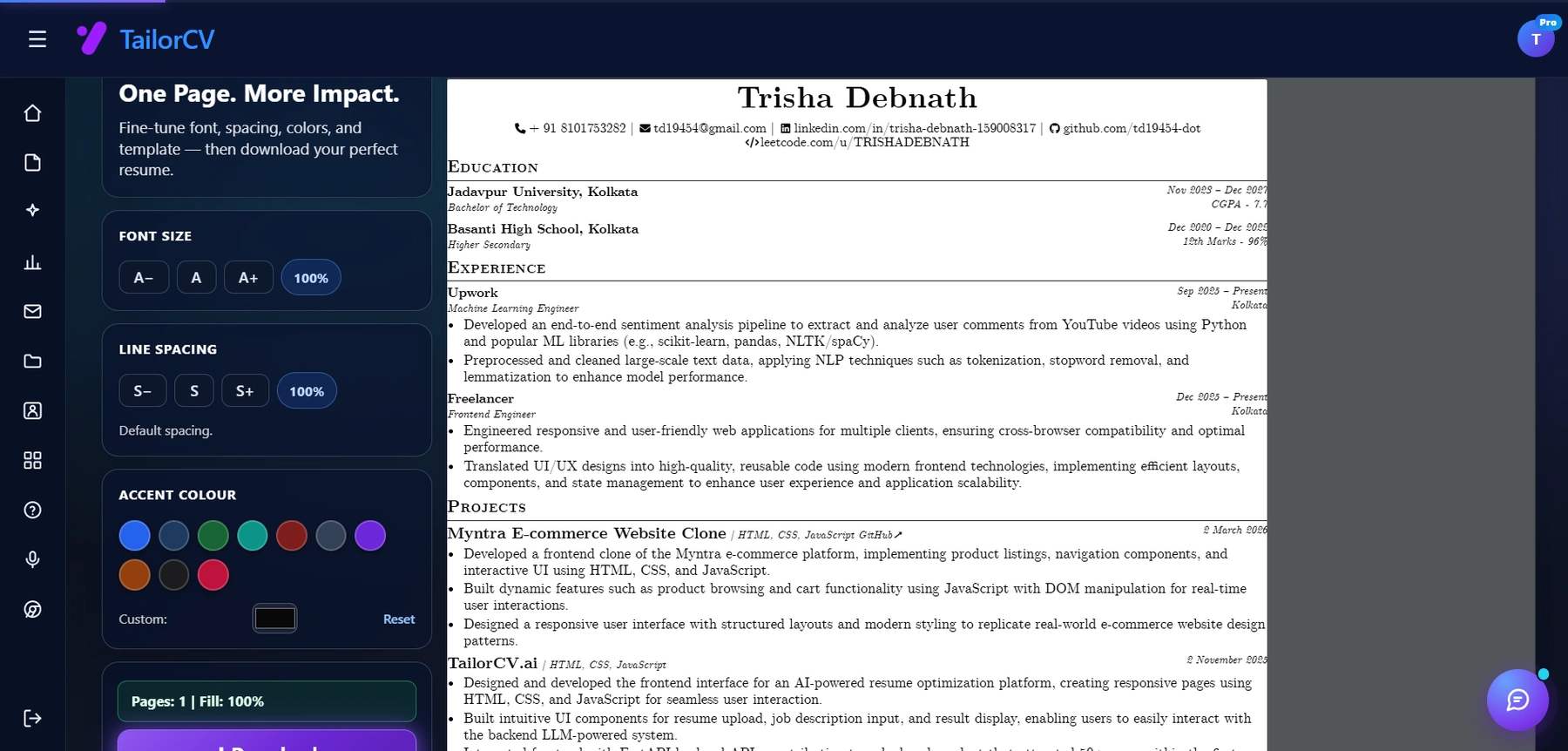
Font size, spacing, accent colour and template are all adjustable, with a live page counter.
A Gap-by-Gap Playbook
Not all gaps are the same, and the right move depends on the cause. Here is how to handle the most common ones.
The Layoff or Redundancy
This is the easiest gap to explain because the cause was external. Restructurings, budget cuts, and whole-team layoffs are so common that no recruiter blinks at them. State it once, factually, and pivot immediately to what you did next. The mistake people make is sounding wounded. "My role was eliminated" is neutral and true; "I was let go" carries a shadow that "eliminated in a restructuring" does not.
The Caregiving Break
Whether you cared for a child, a parent, or a partner, this gap is nothing to hide — millions of strong candidates have one. Give it a real title on the resume ("Career Break — Family Caregiving") so the timeline stays intact, and if you did anything to stay current (a course, freelance work, volunteering), add one line. Employers in 2026 are far more comfortable with caregiving breaks than they were a decade ago, and many have explicit returnship programs.
The Health Break
You owe no medical detail, ever. "I took a planned break for health reasons and am now fully recovered and focused on returning to work" is a complete answer. Do not over-share; a specific diagnosis invites bias you cannot control. Keep it forward-looking and brief.
The Study or Reskilling Break
This is arguably the strongest gap of all, because it shows initiative. Frame it as an investment: "Completed a full-time data analytics bootcamp" or "Earned AWS Solutions Architect certification while studying full time." A study gap is not a hole; it is a credential.
The "I Was Just Job Searching" Gap
The hardest one, because there is no external cause and no obvious activity. The fix is to create activity retroactively and going forward: take on a freelance project, contribute to open source, volunteer your skills for a nonprofit, or complete a certification. Even a modest, real project converts "unemployed and searching" into "kept building while looking."
How to Talk About the Gap in an Interview
The resume gets you in the room; the interview is where the gap is actually discussed. Prepare a 20-second verbal version of your explanation and practice it until it is calm and unbothered. The single most important variable is your tone. If you sound defensive or ashamed, you teach the interviewer that the gap is a problem. If you state it plainly and move on, they follow your lead.
A simple structure works: what happened, what you did during it, and why you are ready now.
"My role was eliminated in a restructuring in early 2024. I used the time to complete a cloud certification and take on two freelance projects, and I'm now looking for a full-time backend role where I can go deeper on infrastructure."
Notice it is three sentences, ends on the future, and never apologizes. Rehearse it out loud — the words matter less than the ease with which you say them.
A Quick Comparison: Hide vs Explain
| Approach | What the recruiter sees | Result |
|---|---|---|
| Leave the gap blank | An unexplained hole, worst-case assumptions | Doubt, often a skip |
| Fake the dates to cover it | A clean timeline that collapses in a background check | Rejection, possibly rescinded offer |
| Year-only dates (short gap) | A continuous-looking timeline | Gap effectively disappears |
| Dated "Career Break" entry | An honest, accounted-for period | Neutral to positive |
| Explain + show upskilling | A candidate who stayed sharp | Often a net positive |
The pattern is clear: honesty plus framing wins, concealment loses.
Update Your LinkedIn to Match
Recruiters cross-check your resume against LinkedIn, and a mismatch in dates is a genuine red flag. LinkedIn now supports "Career Break" as a formal entry type with categories like caregiving, health, and layoff. Use it. A gap that is openly labeled on LinkedIn and matched on your resume reads as transparent; a gap that appears on one and is hidden on the other reads as evasive.
Step by Step: Reworking Your Timeline
If you are staring at a resume with an obvious hole, here is the exact sequence to fix it without lying.
- List every real date first. Write out your actual start and end dates for each role. You cannot decide how to present a timeline you have not seen clearly.
- Measure the gap. Under six months rarely needs anything beyond a formatting tweak. Six to twelve months usually needs one line somewhere. Over twelve months needs a dated entry.
- Switch to year-only dates if it closes the gap. If you left a job in March 2024 and started looking, then landed a contract in November 2024,
2024 – 2024erases the visual gap entirely and is completely honest. - Add a dated bridge entry for long gaps. Give the period a title, dates, and one real line of substance — freelance, study, caregiving, or volunteering.
- Mirror it on LinkedIn. Make the two profiles agree.
- Draft your 20-second verbal version. You will need it the moment an interview is scheduled.
Following this order stops you from making the classic panic move — fudging dates — which is the one thing that actually gets offers rescinded.
Industry-Specific Examples
The right framing shifts slightly by field. Here are dated bridge entries that read naturally in different industries.
Tech:
Independent Projects & Upskilling (2024 – 2025) Built two full-stack side projects in React and Node; completed AWS Solutions Architect Associate certification; contributed bug fixes to an open-source CLI tool.
Marketing:
Freelance Marketing Consultant (2024 – 2025) Ran SEO and email campaigns for three small e-commerce brands; grew one client's organic traffic 60% in four months.
Finance / Operations:
Career Break & Professional Development (2024 – 2025) Completed CFA Level I preparation; managed family investment planning; volunteered as treasurer for a local nonprofit managing a $30K budget.
Healthcare:
Career Break — Family Caregiving (2024 – 2025) Full-time caregiver; maintained licensure and completed 20 hours of continuing education credits.
In every case the entry has a title, dates, and one line of verifiable substance. That structure is what turns a blank into a believable chapter.
The Cover Letter Angle
For a long or unusual gap, a single sentence in the cover letter pre-empts the question before the recruiter can turn it into a doubt. Place it near the end, framed forward:
"You may notice a break in my timeline through 2024 — I stepped away to care for a family member and used part of that time to complete a data analytics certification. I am now fully focused on returning to an analyst role, and everything I learned has only sharpened that goal."
One calm sentence does more than three defensive paragraphs. The cover letter is optional real estate, but for a big gap it is the cheapest insurance you can buy.
Red Flags That Actually Hurt You
The gap itself is rarely the problem. These reactions to it are:
- Fudged dates. The fastest way to lose an offer at the background-check stage.
- Vagueness. "I was dealing with some things" invites the imagination to fill in the worst.
- Defensiveness. Over-explaining signals that you think the gap is disqualifying, which teaches the interviewer to think so too.
- Inconsistency. A resume that says one thing and a LinkedIn or interview answer that says another.
- A gap with genuinely nothing in it. If the break is recent, add one real activity now — a course, a small freelance job, a volunteering stint — so the answer is never "nothing."
Frequently Asked Questions
Does a gap hurt my ATS score?
No. Applicant tracking systems parse keywords and dates, not the emotional weight of a gap. A gap only matters to the human who reads the parsed result, which is why the wording matters more than the gap itself.
Should I explain a gap from years ago?
Usually not. A gap from five years and two jobs ago is rarely asked about. Focus your explanation on the most recent gap.
How long is too long to leave unexplained?
Anything past about six months starts to draw a question. Past twelve months, add a dated entry so the timeline is never blank.
Should I mention the pandemic or economic conditions as a reason?
If your gap lines up with a widely understood downturn or mass layoff period, a brief mention is fine and relatable. But do not lean on it as the whole explanation — pair it with what you did during the time, which is the part a recruiter actually weighs.
Will a gap stop me from getting past the ATS?
No. Applicant tracking systems screen for keywords, titles, and parseable structure — not for continuity of employment. A gap only becomes visible when a human reads the parsed timeline, which is why clean formatting and calm framing matter more than the gap's existence.
Is a "Career Break" entry seen as padding my resume?
Not when it is honest and specific. A dated entry with a real title and one line of genuine activity reads as accounting for your time, not inflating your experience. What reads as padding is a vague entry with no substance behind it.
How do I handle multiple gaps?
Address the most recent and longest gap directly, since that is what a recruiter focuses on. Older, shorter gaps from several jobs ago rarely come up. If you have a pattern of short gaps, year-only dates often smooth the whole timeline at once.
Putting It All Together
A gap is a formatting-and-framing problem, not a character problem. Measure it, present the timeline cleanly with year-based dates or a dated bridge entry, keep your resume and LinkedIn in agreement, and rehearse a short, calm verbal version for the interview. Do that, and the gap stops being the story. The story becomes what you did, what you learned, and why you are the right hire now — which is exactly where you want a recruiter's attention.
When you run your resume through TailorCV, the ATS scan reads your dates and structure the way a real parser does, so you can see immediately whether your timeline reads as continuous before a human ever opens it.
What is your resume scoring right now?
Scan it against a job description and get your ATS match score in about a minute.
Drop your resume here or choose a file
PDF only. Max 2 MB.
We never share your data or use it to train AI models.

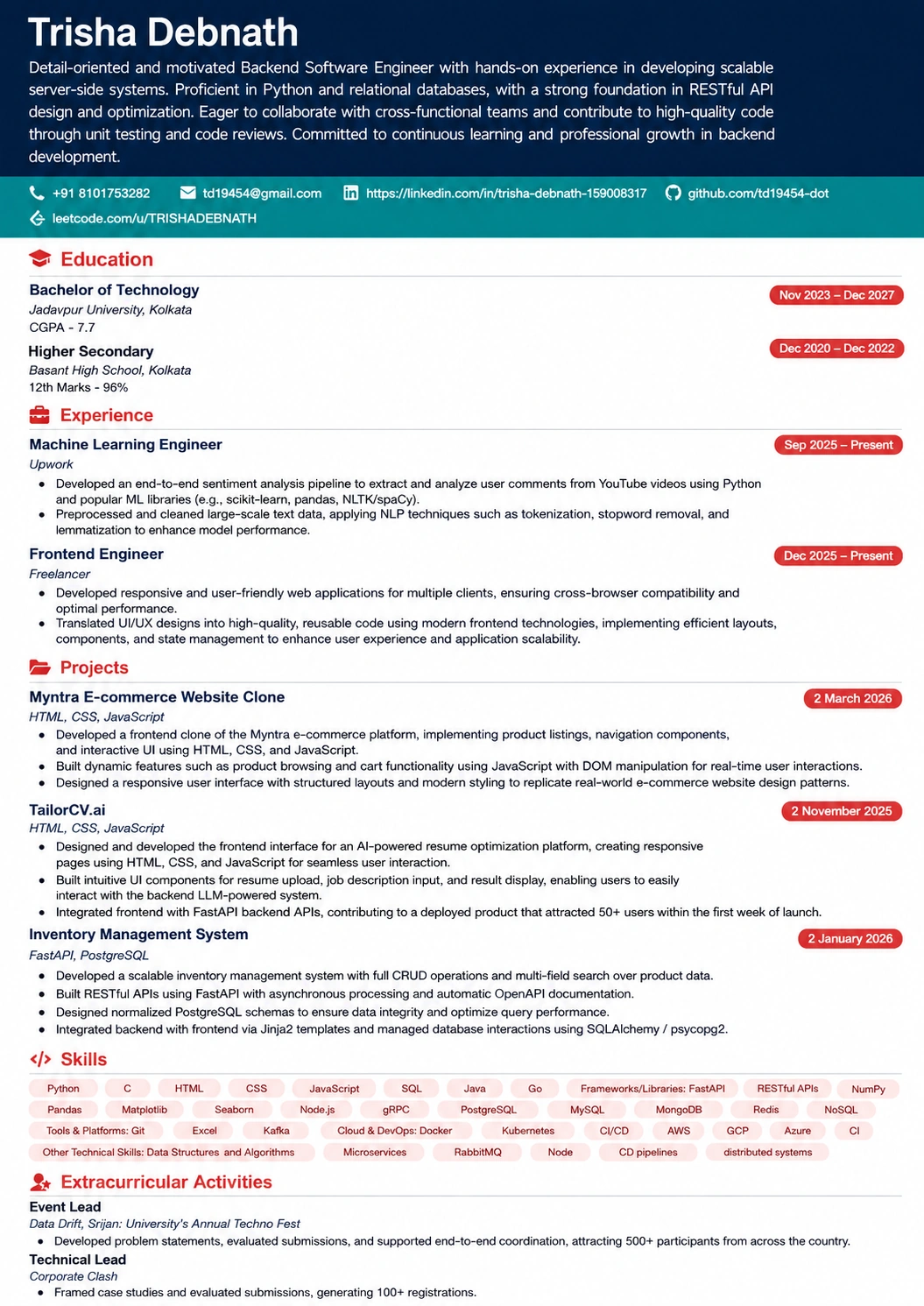
Templates that keep this structure intact
This template is ATS-tested — start from it and the formatting rules in this guide are already handled.
Was this guide useful?
Be the first to rate it.