 TD
TD
Key Takeaways
- Keywords significantly impact your ATS score, accounting for 30-40% of the total score.
- Identify relevant keywords by closely reading job descriptions and prioritizing repeated terms.
- Use a tool to check your resume against the job description for missing keywords.
- Integrate keywords naturally into your resume, focusing on context and quantifiable achievements.
- Avoid common pitfalls like keyword stuffing and using inconsistent terminology to enhance readability and ATS compatibility.
Keywords are the single biggest factor in your ATS score. Get them right and your resume rises to the top of the ranking; get them wrong and even a qualified resume gets filtered out. This guide shows you how to find the right ATS keywords and add them naturally to boost your score.
See your keyword gaps instantly with the free ATS score checker.
Why Keywords Drive Your ATS Score
When an employer sets up a role, the ATS is configured to look for specific skills, tools, and qualifications. Your resume is scored on how many of those it contains - and in what context. Keyword and skills match typically accounts for 30-40% of the total score, the largest single factor.
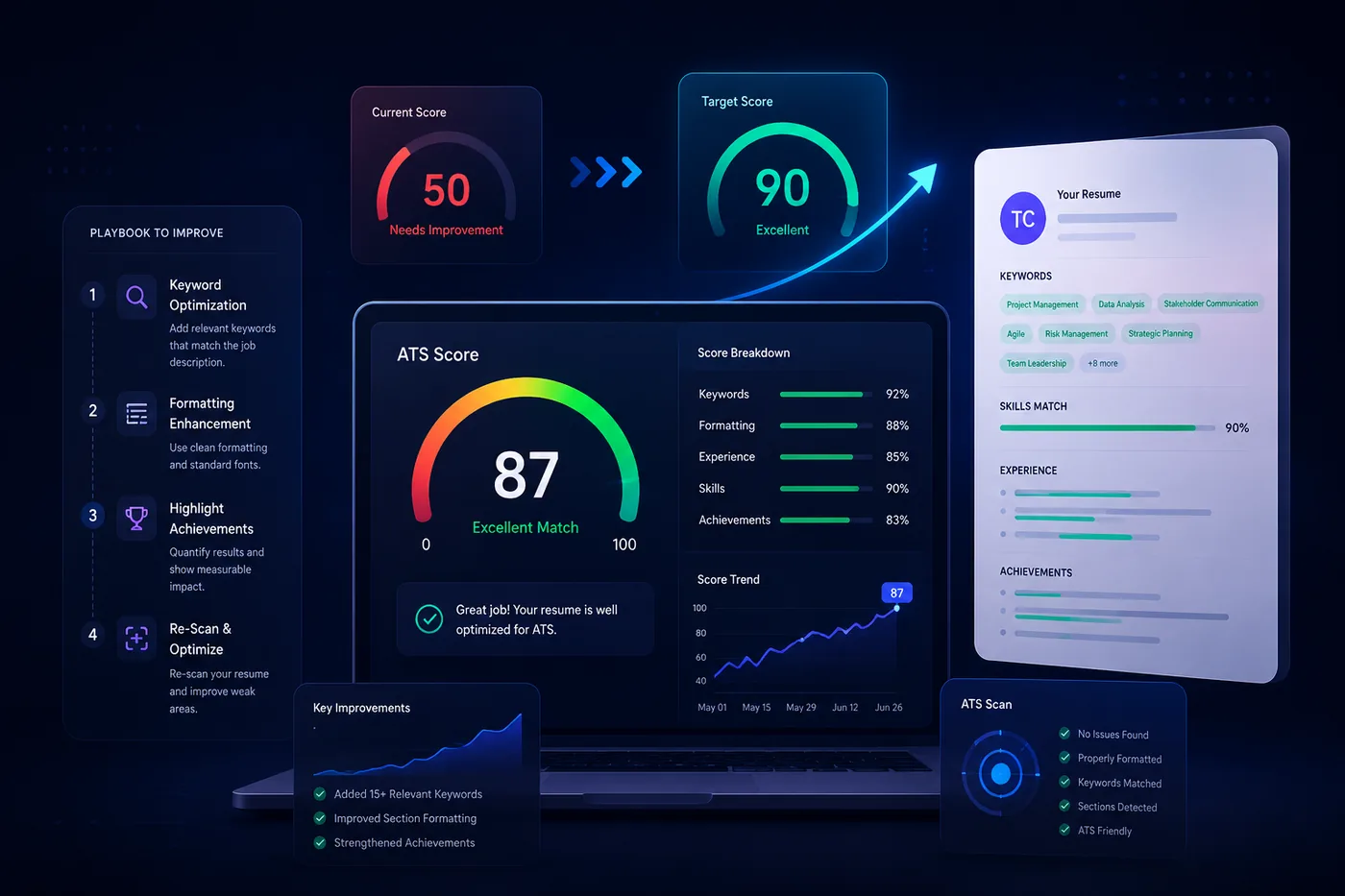
What an ATS score report actually shows you

Passed and failed checks are listed individually, so you can see exactly which part of the resume is costing you points.
That is why two equally qualified candidates can score very differently: one mirrored the job's language, the other didn't.
Types of ATS Keywords to Look For
| Keyword Type | Examples |
|---|---|
| Hard skills | Python, SQL, financial modeling, SEO |
| Tools & software | Excel, Salesforce, AWS, Figma, Jira |
| Certifications | PMP, AWS Certified, CFA, Scrum Master |
| Job titles | Data Analyst, Project Manager |
| Methodologies | Agile, Scrum, Lean, Six Sigma |
| Soft skills | Stakeholder management, communication |
How to Find the Right Keywords (Step by Step)
1. Read the Job Description Closely
The posting is your keyword source. Highlight every skill, tool, qualification, and repeated phrase.
2. Prioritize Repeated and "Required" Terms
Words that appear multiple times, or under "Requirements" and "Must-have," carry the most weight.
3. Compare Multiple Postings for the Same Role
Scanning a few similar listings reveals the keywords that show up consistently across the industry.
4. Separate Must-Haves From Nice-to-Haves
Make sure every must-have keyword you genuinely possess appears on your resume.
5. Let a Tool Find the Gaps
The fastest method: upload your resume to the ATS score checker with the job description. It lists exactly which keywords you are missing.
How to Add Keywords Naturally
Adding keywords is not about stuffing - it is about weaving real terms into real accomplishments.
Put Keywords Where They Count
- Professional summary - your top 3-5 keywords
- skills section - a clean list of tools and competencies
- Experience bullets - keywords inside quantified results
Use Both Acronyms and Full Terms
Write "Customer Relationship Management (CRM)" so you match either form the ATS is looking for.
Keep It in Context
- Weak: "SEO, SEO, SEO, content"
- Strong: "Grew organic traffic 45% through SEO and content strategy"
For the difference between smart usage and stuffing, read ATS keyword mistakes and the full resume keywords guide.
Keyword Mistakes That Hurt Your Score
- Keyword stuffing - flagged and unreadable for humans
- Only acronyms or only full terms - missed matches
- Keywords with no evidence - listing a skill you never used
- Ignoring the exact wording - "Client Relations" when the posting says "Customer Success"
A Quick Before-and-After
Before (score 61): "Handled marketing campaigns and social media."
After (score 84): "Managed paid and organic marketing campaigns across Google Ads and Meta; used SEO and analytics to grow engagement 47%."
Same experience - the second version mirrors the job's keywords and quantifies impact.
Common ATS Keyword Pitfalls: What to Avoid
While optimizing your resume with ATS keywords is crucial, it's equally important to recognize common pitfalls that can hinder your efforts. Here’s a list of mistakes to avoid:
-
Overstuffing Keywords: Using the same keyword excessively can make your resume read awkwardly and may raise red flags for both ATS and human readers. Aim for a natural flow.
-
Ignoring Synonyms: Relying solely on one term can limit your chances. For example, if the job description mentions "project management," also consider including "project coordination" or "project oversight."
-
Using Uncommon Abbreviations: Unless a job description specifically uses an abbreviation, spell out terms to ensure clarity. Instead of "SEO," use "Search Engine Optimization" unless the job specifically refers to it as "SEO."
-
Neglecting Soft Skills: While technical skills are often emphasized, soft skills like "communication" or "teamwork" can also be essential keywords. Be sure to include a balance of both.
-
Failing to Tailor for Each Application: Sending the same resume for multiple applications can lead to missed opportunities. Customize your keywords based on the specific job description for each application.
Real-World Example: Keyword Integration in Action
To illustrate how to effectively integrate keywords, let’s consider a job listing for a Digital Marketing Manager. Here’s a brief analysis of how to identify and incorporate relevant keywords:
Job Description Snippet
- "We are seeking a Digital Marketing Manager with expertise in SEO, SEM, and content marketing. The ideal candidate should have strong analytical skills and experience with Google Analytics and social media platforms."
Identifying Keywords
From the job description, the keywords include:
- Digital Marketing Manager
- SEO (Search Engine Optimization)
- SEM (Search Engine Marketing)
- Content Marketing
- Analytical Skills
- Google Analytics
- Social Media Platforms
Resume Integration
When crafting your resume, weave these keywords naturally into your experience and skills sections. For example:
- Experience Section:
- "Managed a team of 5 in developing and executing SEO strategies that increased organic traffic by 30%."
-
"Utilized Google Analytics to analyze campaign performance, leading to a 20% improvement in conversion rates."
-
Skills Section:
- "Proficient in SEO, SEM, content marketing, and analytics tools including Google Analytics."
This method ensures that your resume is tailored to the job while maintaining readability.
Mini Checklist for ATS Keyword Optimization
Before submitting your resume, use this checklist to ensure you’ve effectively integrated ATS keywords:
- unchecked: Tailored Keywords: Did you customize your keywords based on the job description?
- unchecked: Natural Flow: Do your keywords fit naturally within the context of your sentences?
- unchecked: Variety of Terms: Have you included synonyms and variations of key terms?
- unchecked: Soft Skills Included: Are essential soft skills represented alongside technical abilities?
- unchecked: Avoided Overstuffing: Have you kept keyword usage in moderation to maintain readability?
- unchecked: Proper Formatting: Is your resume formatted simply, avoiding complex layouts that ATS might misinterpret?
Scenarios: When Keywords Make a Difference
Scenario 1: Applying to Different Roles
If you apply for a role as a "Data Analyst" and later a "Business Analyst," the keywords you use should differ. For the Data Analyst position, focus on terms like "data visualization" and "statistical analysis." For the Business Analyst, integrate keywords like "requirements gathering" and "stakeholder communication." Tailoring your keywords for each role can significantly enhance your ATS score.
Scenario 2: Industry-Specific Terms
For a job in the tech industry, using industry-specific jargon and acronyms is crucial. If a job description emphasizes "Agile methodology," ensure you include that in your resume. Conversely, for a role in healthcare, focus on terms like "patient care" and "healthcare compliance." Understanding the nuances of industry language can set your application apart.
By being aware of these aspects and actively working to improve your keyword strategy, you can enhance your chances of passing the ATS and landing an interview. For further insights, check out How to Check Your ATS Score for Free (2026 Guide) and What Is a Good ATS Score? Benchmarks and Targets for 2026.
Frequently Asked Questions
How many keywords should I add?
There is no fixed number. Include every must-have keyword you genuinely have, used naturally. Quality and context beat quantity.
Where do I find ATS keywords?
In the job description itself. For speed, the ATS score checker extracts the missing ones for you.
Is keyword stuffing bad?
Yes. It can be flagged by modern AI-based ATS and always hurts readability for recruiters. Use keywords in real sentences.
Do keywords alone guarantee a high score?
They are the biggest factor, but formatting, achievements, and job-title fit also matter. See how to increase your ATS score and learn about ATS mistakes experienced professionals make.
Related Guides
- How to Check Your ATS Score for Free
- Resume Keywords Guide
- ATS Keyword Mistakes
- Why Is My ATS Score So Low?
- How to Make Your Resume ATS-Friendly
- ATS Resume Checker - How It Works and How to Pass (2026)
- ATS Score for Freshers - How to Pass With No Experience (2026)
- ATS Score vs Resume Score - What's the Difference? (2026)
- Does My Resume Pass ATS? A 12-Point Checklist (2026)
- Free ATS Resume Scan - Test Your Resume in 60 Seconds (2026)
- ATS Score Guide for 2026
- What is an ATS Score and Why Does It Decide Your Job Application Before Any Human Reads It
Make This Practical
Do not guess whether the resume is ready. Upload it to the free ATS score checker, compare the result with the ATS Score Guide, and fix formatting issues using ATS Resume Formatting Mistakes and ATS Resume Parser Friendly Format.
After the technical cleanup, improve relevance. Use Resume Matching With Job Description, strengthen keyword coverage with the Resume Keywords Guide, and avoid overdoing it by checking ATS Keyword Mistakes. If the layout itself is weak, rebuild with an ATS-friendly resume template.
Conclusion
Keywords are where most ATS scores are won or lost. Pull them straight from the job description, add them naturally inside real accomplishments, and verify with a quick scan. Do that consistently and your score - and your interview rate - will climb.
Find your missing keywords for free
See which keywords you are missing
Scan your resume against the posting and get the exact terms it did not find.
Drop your resume here or choose a file
PDF only. Max 2 MB.
We never share your data or use it to train AI models.
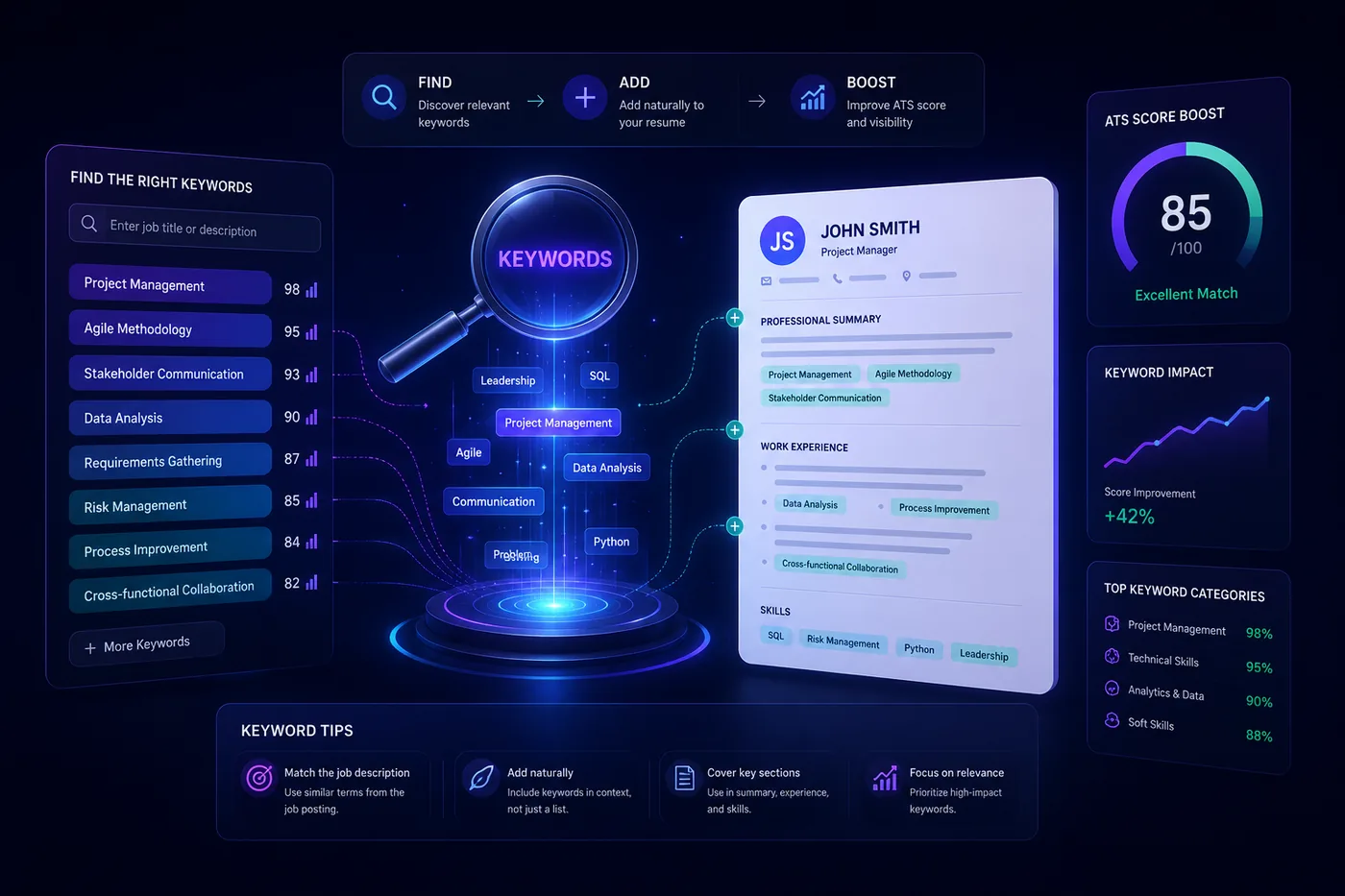
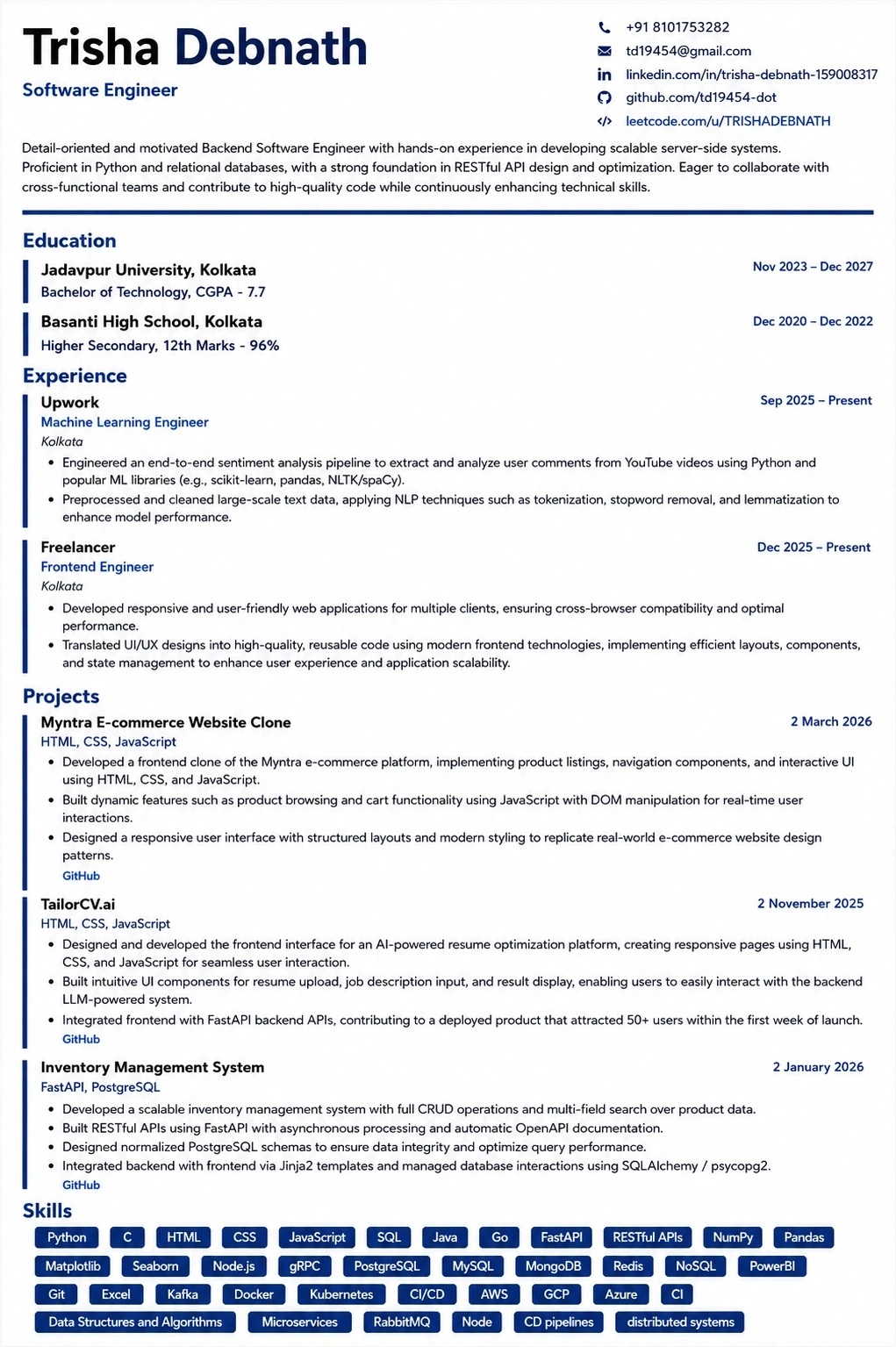
Where those keywords actually go
A layout with a real skills section gives the parser somewhere clean to find every term you just added.
Was this guide useful?
Be the first to rate it.