 SS
SS
Key Takeaways
- Following up after a job interview demonstrates professionalism and enthusiasm, reinforcing your candidacy.
- Send a thank-you email within 24 hours of the interview, personalizing it for each interviewer if applicable.
- Keep the thank-you email concise, under 150 words, including a genuine thank-you, a specific discussion point, and a brief restatement of interest.
- Avoid asking about the hiring timeline or seeking feedback in your initial thank-you email.
- A thoughtful thank-you note can positively influence hiring managers' perceptions of candidates.
Following up after a job interview is one of the most underused tools in the job search process. A well-timed, well-written thank-you email can reinforce your candidacy, address something you said poorly, and demonstrate professionalism. Not sending one is a missed opportunity. Sending a bad one can hurt you.
This guide covers when to follow up, what to say, how to handle silence, and the thank-you email templates you can adapt for any role.
Before your interview, make sure your resume is strong - use the TailorCV ATS score checker to optimize it. Then prepare your answers with the behavioral interview guide and full interview preparation guide.
Why Follow Up After an Interview?
Following up:
Keeping every tailored resume with its job
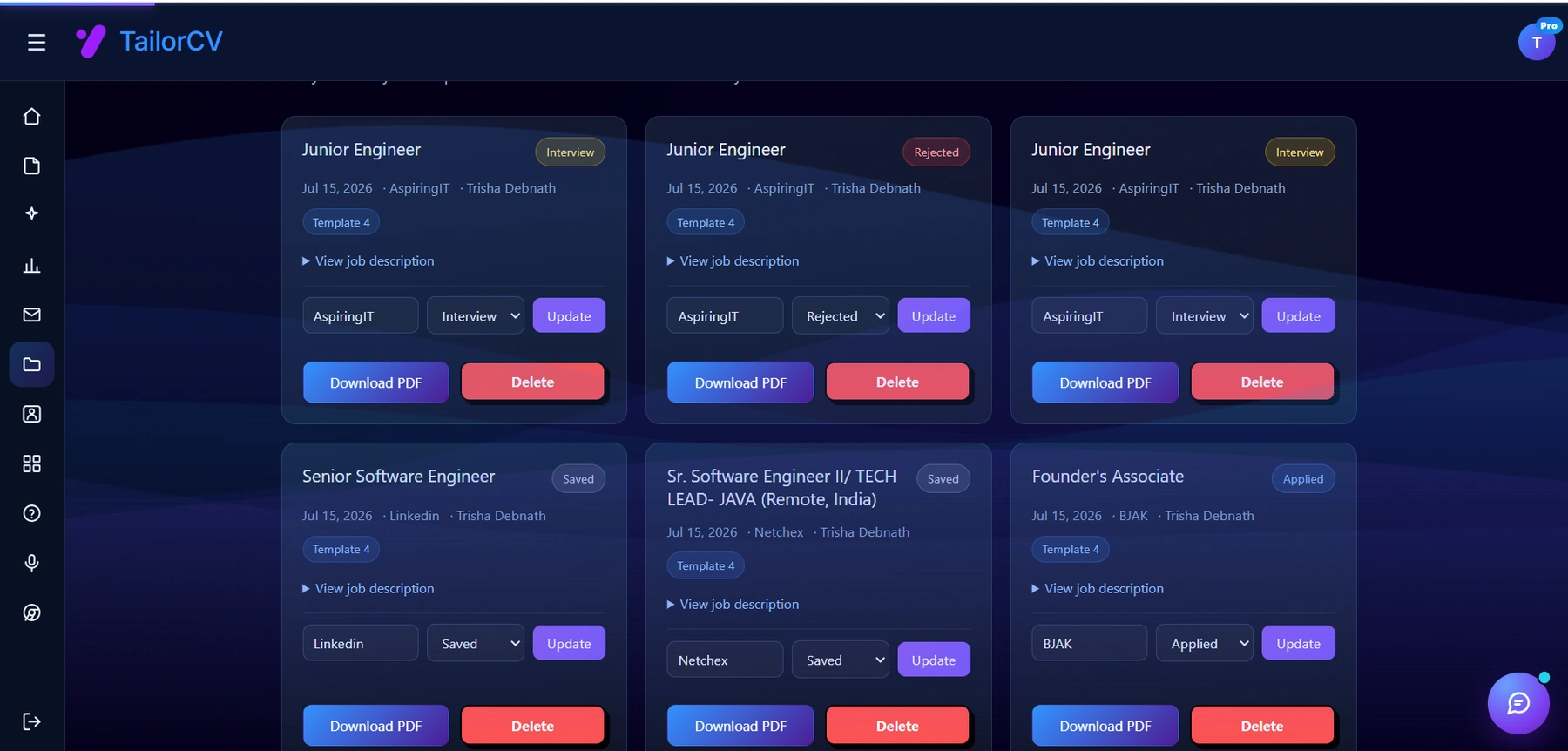
Every resume you tailor is saved against the job it was written for, with the company, the job description and a status you can move from Saved to Applied to Interview. That is the part a spreadsheet usually gets wrong - the tracker and the actual document drift apart, and you end up guessing which version you sent.
- Signals genuine enthusiasm and professionalism
- Keeps you top of mind after a busy hiring process
- Gives you a chance to reinforce a key point you made - or clarify something you could have said better
- Shows basic professional courtesy that many candidates skip
Research suggests that candidates who send a thoughtful thank-you note are viewed more favorably by hiring managers - and candidates who skip it sometimes create a negative impression simply by not following through.
When to Send a Thank-You Email
Send within 24 hours of your interview. Same day is ideal if you can write a thoughtful note, not a rushed one.
If you interviewed with multiple people - send individual notes to each. Not the same generic note - personalized to each conversation.
If you cannot send within 24 hours, still send one. A thank-you email that arrives 48 hours after is better than none. Beyond 72 hours, the impact fades significantly.
The Thank-You Email Structure
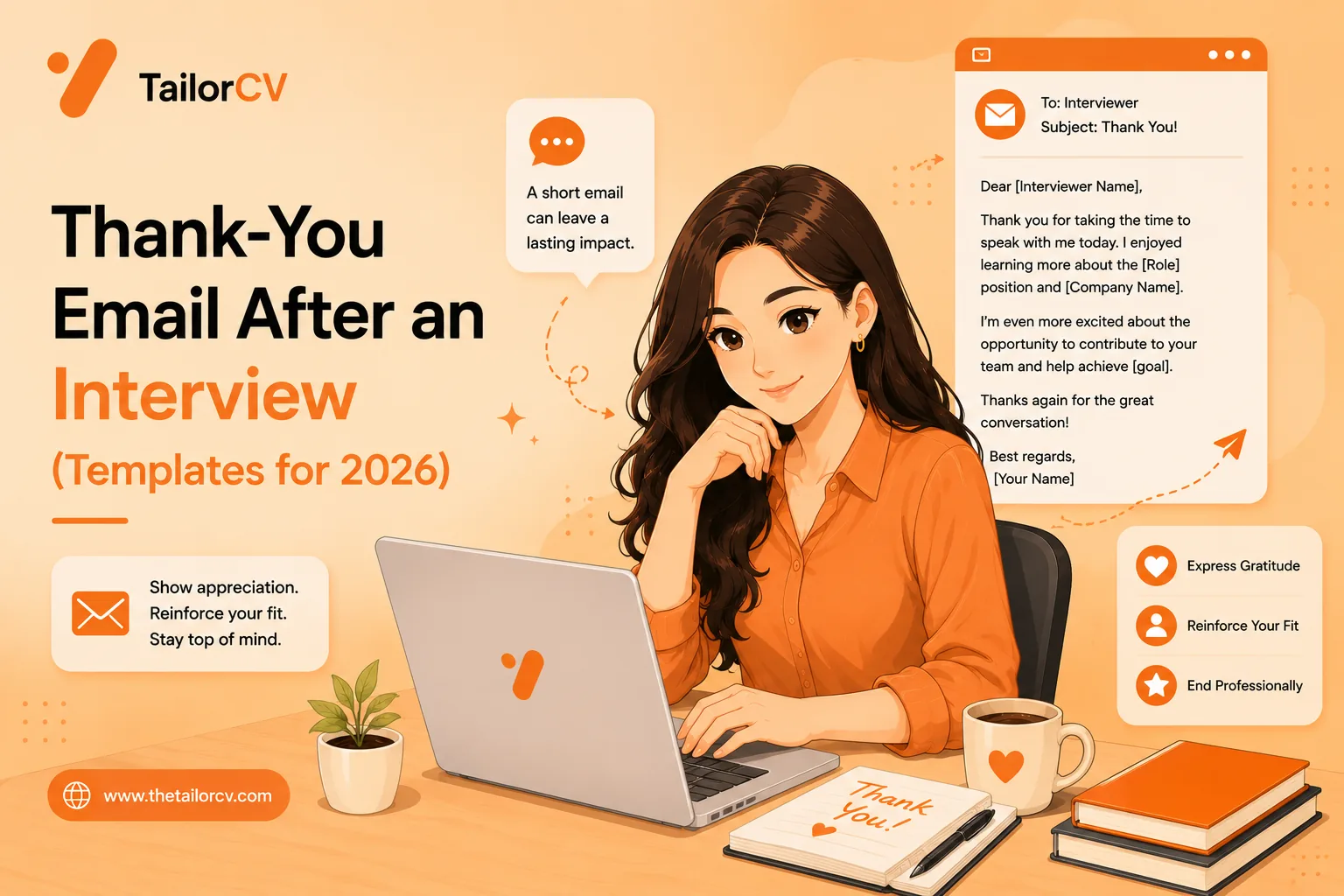
Keep it short. Under 150 words. Three parts:
- Genuine thank-you for the time
- One specific, memorable thing you discussed (proves you were engaged)
- Brief restatement of interest and a polite close
That's it. Do not ask about the timeline in the first thank-you email. Do not renegotiate your availability. Do not ask for feedback before you have an offer.
Thank-You Email Templates
Template 1 - General Technical Role
Subject: Thank You - [Role] interview, [Your Name]
Hi [Name],
Thank you for taking the time to speak with me about the [Role] position today. I really enjoyed our discussion about [specific topic - e.g., "your team's approach to observability" or "the upcoming migration to microservices"]. It reinforced why I'm excited about this opportunity.
I'm confident that my experience with [key skill] would contribute meaningfully to what you're building. Looking forward to hearing about the next steps.
Best, [Your Name]
Template 2 - Product or Business Role
Subject: Thank You - [Role], [Company]
Hi [Name],
It was a pleasure speaking with you today about the [Role] at [Company]. Our conversation about [specific challenge or topic discussed] was particularly interesting - it's clear this team is thinking carefully about [specific problem].
I came away even more excited about the opportunity and believe my background in [specific relevant experience] is well-aligned with where you're heading. I'd love the chance to contribute.
Thank you again for your time. I look forward to next steps.
Warm regards, [Your Name]
Template 3 - After Panel Interview (Multiple Interviewers)
Send a separate, personalized note to each interviewer. Reference something specific from each conversation.
To the technical interviewer: "Thank you for the interesting discussion about [system design problem or technical challenge]. The trade-offs you mentioned around [X] gave me a lot to think about. I look forward to hopefully working through similar problems with the team."
To the hiring manager: "Thank you for sharing your vision for the team's direction over the next year. The approach to [specific initiative] is exactly the kind of challenge I find most energizing. I'm excited about the opportunity."
Template 4 - If You Made a Mistake in the Interview
If you gave a poor answer to a question or blanked on something important, the thank-you email is your chance to briefly address it.
"One thing I wanted to add after reflection - when you asked about [question], I realize my answer didn't fully capture [what I should have said]. To clarify: [brief, strong answer]. I wanted to make sure I left you with an accurate picture of my experience in this area."
Do not be defensive or over-explain. One short paragraph is enough.
How to Handle Silence After an Interview
They said they would respond in one week. It has been 10 days. What do you do?
See it in action: a resume-based mock interview
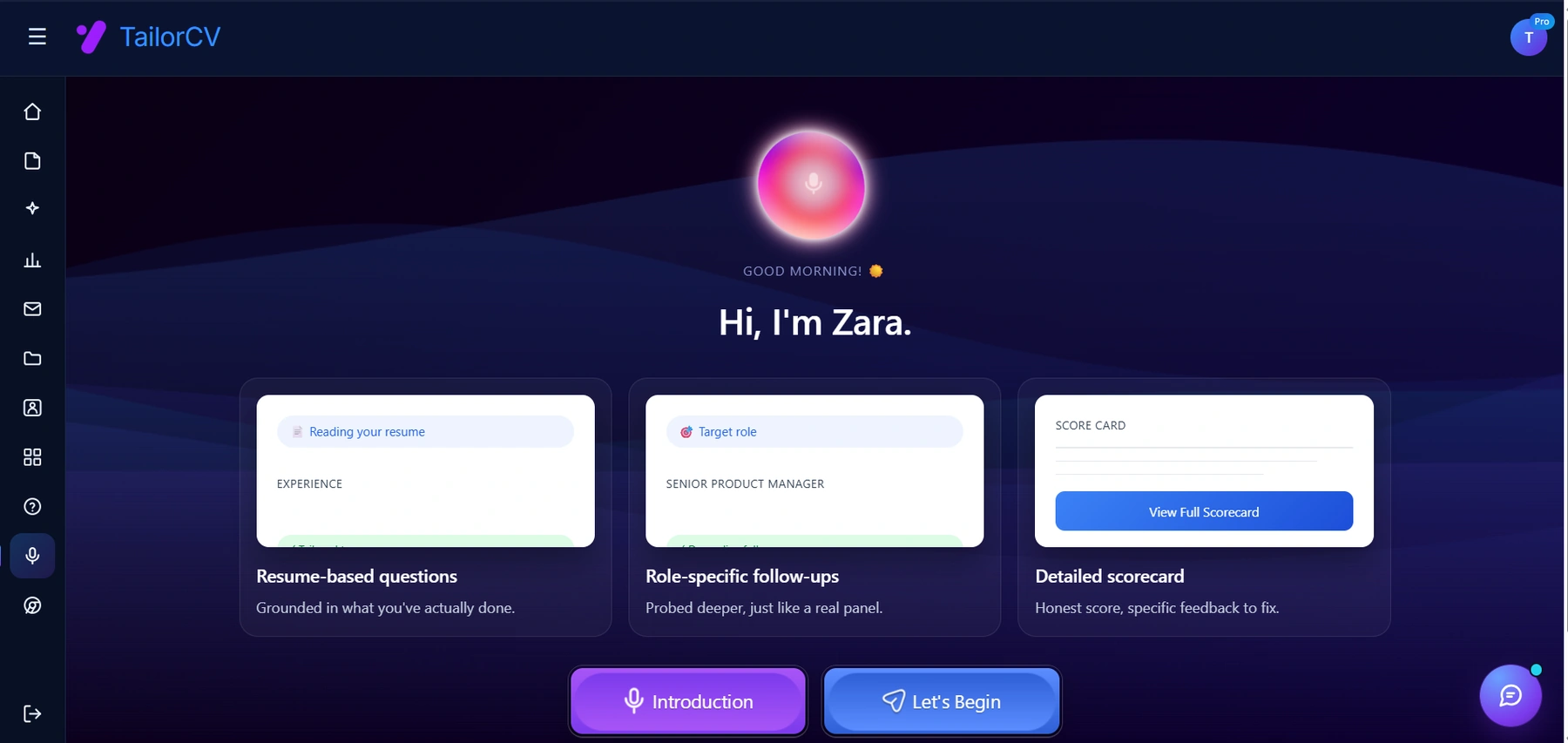
Practising out loud is the part most people skip. Here the session is built from your own resume and target role, and ends with a scorecard naming what to fix.
One follow-up is appropriate. Send it 2-3 business days after the stated timeline.
"Hi [Name], I wanted to follow up on our conversation from [date]. I'm still very interested in the [Role] and would welcome any update on the timeline. I'm happy to provide any additional information if helpful. Thank you for your time."
If you still hear nothing after 5 more business days, one more brief note is acceptable:
"Hi [Name], I hope you're well. I'm following up once more regarding the [Role] position. I remain very interested and would love to discuss any next steps. If the timing has shifted, I understand - please do keep me in mind."
After two follow-ups with no response, move on. Continue applying elsewhere. Do not send a third message - it crosses from professional follow-through to pressure.
What Not to Do
- Do not send a follow-up the same day, immediately after the interview - it can seem impulsive
- Do not ask for feedback before you have received an offer decision
- Do not demand a timeline or express frustration at the delay
- Do not use the thank-you email to renegotiate anything
- Do not send a generic copy-paste email - personalization is the entire point
Following Up After a Rejection
If you receive a rejection, it is professional (and sometimes surprisingly effective) to send a gracious response:
"Thank you for letting me know. I genuinely enjoyed learning about [Company] and the role, and I have a lot of respect for what your team is building. If a relevant position opens in the future, I'd welcome the chance to reconnect."
This leaves a positive final impression. Companies sometimes come back to runner-up candidates when circumstances change - and being remembered well costs you nothing.
Related Guides
- Behavioral Interview Questions and Answers
- 20 Common Interview Mistakes to Avoid
- How to Answer "Tell Me About Yourself"
- How to Prepare for a Job Interview
- How to Research a Company Before Your Job Interview
- Best Questions to Ask in a Job Interview
- Virtual Interview Tips
- Group Discussion Tips
- How to Decline a Job Offer Professionally
- How to Handle Job Rejection
- How to Write a Cold Email to a Recruiter
- Why Am I Not Getting Interviews for Jobs I'm Qualified For?
- How to Build a Professional Portfolio in 2026 - Guide for All Industries
- LinkedIn Profile Optimization Guide 2026 - Get Found by Recruiters
- Networking Tips for Job Search in 2026 - Even If You Hate Networking
- ATS Mistakes Experienced Professionals Make (And Why Your Resume Stops Working After 5+ Years)
- How to Explain Resume Gaps in 2026 - Honest Strategies That Work
- How to Negotiate a Salary Offer in 2026 - Tactics That Actually Work
- What to Bring to a Job Interview
Make This Practical
Use this advice as interview practice, not just reading material. Start a role-specific session with the AI mock interview tool, prepare your opening with How to Answer Tell Me About Yourself, and structure evidence-heavy answers with the STAR Method Interview Answers Guide.
Before the interview, make sure the resume that earned the call is still aligned with the role. Check it with the free ATS score checker, review Common Interview Mistakes to Avoid, and use How to Follow Up After an Interview once the conversation is over.
Conclusion
A thank-you email after an interview takes 10 minutes and is one of the highest-leverage low-effort actions in a job search. Send one within 24 hours, make it specific and genuine, and keep it short.
For the interview itself, prepare with the behavioral interview guide and the full interview preparation guide. For getting to the interview in the first place, use the TailorCV ATS score checker to optimize your resume, and use ATS-friendly resume templates.
Frequently Asked Questions
Why is it important to send a thank-you email after an interview?
Sending a thank-you email is crucial because it reinforces your interest in the position and demonstrates professionalism. It provides an opportunity to clarify any points from the interview or highlight aspects of your candidacy that you may not have fully addressed. Research shows that candidates who send thoughtful notes are often viewed more favorably by hiring managers, making it a simple yet effective way to improve your chances.
When should I send my thank-you email after an interview?
You should aim to send your thank-you email within 24 hours of your interview, with the same day being ideal if you can craft a thoughtful message. This timing keeps you fresh in the interviewer's mind and shows your enthusiasm for the role. If you met with multiple interviewers, remember to send individual notes to each person to personalize your follow-up.
What should I include in my thank-you email?
In your thank-you email, express gratitude for the opportunity, mention specific topics discussed during the interview, and reiterate your interest in the position. You can also clarify any points you felt needed more emphasis or highlight your relevant experiences. This will help you stand out and show that you are engaged in the hiring process.
How do I follow up if I haven't heard back after an interview?
If you haven't received a response after a week or two, it's appropriate to send a polite follow-up email asking for an update on your application status. This demonstrates your continued interest in the position and keeps the lines of communication open. If you're feeling particularly anxious about the silence, consider reading about recruiter ghosting to understand what it might mean and how to handle it.
Can a poorly written follow-up email hurt my chances?
Yes, a poorly written follow-up email can negatively impact your chances of getting the job. It may give the impression that you lack attention to detail or professionalism. To avoid this, take the time to draft a thoughtful message and consider using resources like the AI cover letter generator to help you structure your email effectively. Additionally, you might want to review common portfolio mistakes to ensure that all aspects of your application are polished.
Was this guide useful?
Be the first to rate it.