SS
SS
Key Takeaways
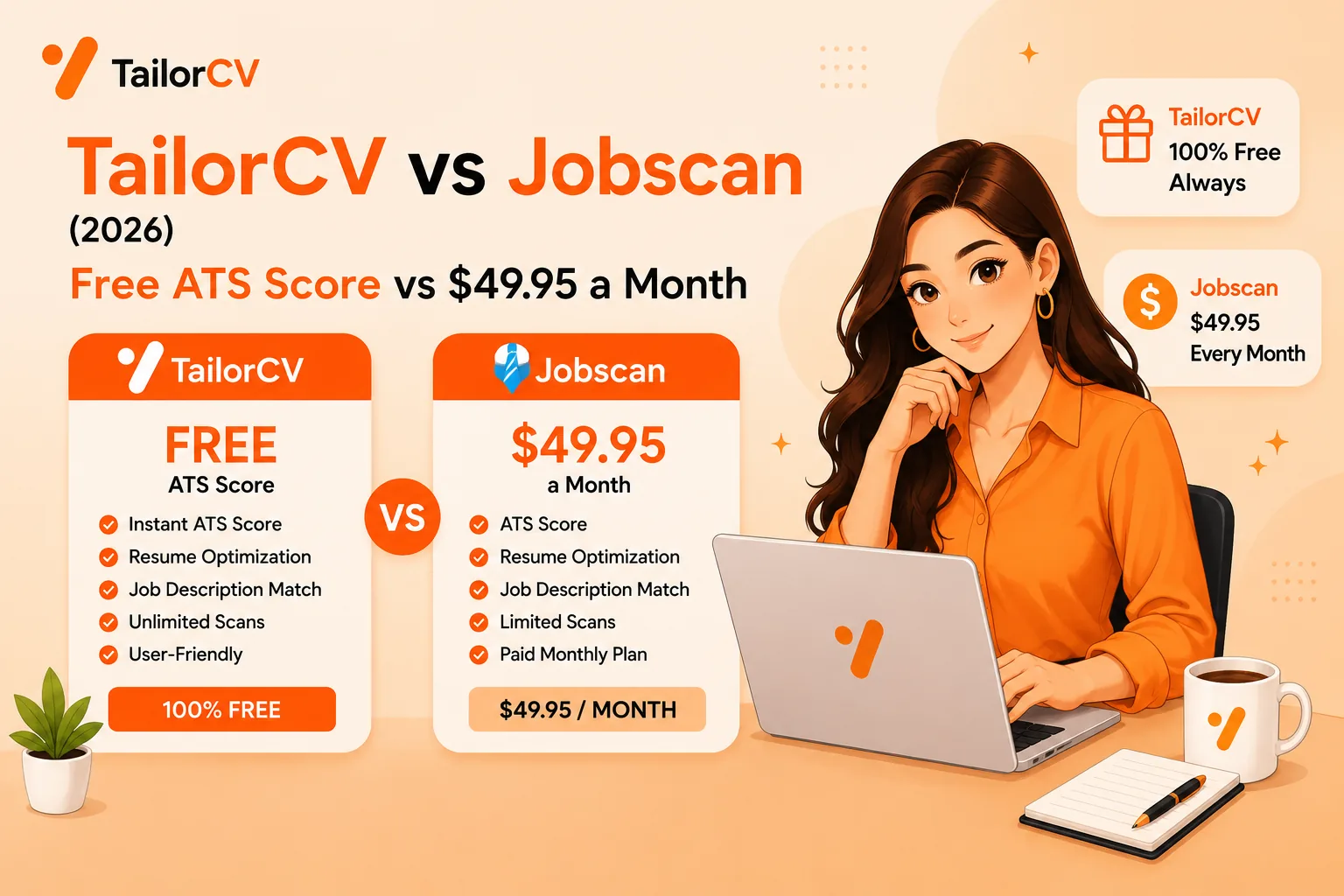
- Jobscan is an ATS scanner and has stayed close to that identity for years; TailorCV starts where it stops.
- Jobscan wins on depth of ATS analysis, and that should be said plainly.
- The five-scan ceiling on the free plan matters more than it sounds.
- The real divide is diagnosis versus treatment - a score tells you the gap, tailoring closes it.
- Jobscan is built for a working professional applying to a handful of senior roles; the economics differ for a student.
Jobscan is the most recognised name in ATS resume scanning, and it earned that. If you have searched "will my resume pass the ATS" in the last five years, you have seen it. It more or less defined the category.
TailorCV does something adjacent but different, and we should be upfront that we build it. Jobscan tells you what is wrong with your resume. TailorCV fixes it. That is the whole comparison in two sentences, and everything below is the detail. If you want it condensed, our Jobscan alternative page has the feature table without the essay.
The other thing you should know before reading further is the price gap, because it is not subtle: Jobscan Premium is $49.95 a month — about $599 a year. TailorCV Pro is $59.99 a year. We will show the arithmetic properly further down.
The 30-Second Verdict
| TailorCV | Jobscan | |
|---|---|---|
| What you get | The rewritten resume | The diagnosis |
| Free plan | Unlimited ATS scores | 5 scans/month |
| Paid price | $59.99/year (₹1,999 in India) | $49.95/month |
| Strongest at | Tailoring per job, breadth | Depth of keyword analysis |
| Mock interviews | Included | Not offered |
| Portfolio site | Included | Not offered |
| Best for | Students, freshers, high-volume searches | Senior roles where cost is irrelevant |
Choose Jobscan if you want the most rigorous keyword and formatting analysis available, you rewrite your own resume confidently, and $49.95/month genuinely does not register.
Choose TailorCV if you want the resume actually rewritten for each job, you want unlimited free scores instead of five a month, and $59.99 a year beats $599 a year.
What Jobscan Actually Is
Jobscan is an ATS scanner, and it has stayed close to that identity for years.
Paste your resume, paste a job description, get a match rate — a percentage — plus a breakdown of what the posting asks for that your resume does not contain. It separates hard skills from soft skills, checks job titles, flags education mismatches, and catches formatting that trips parsers.
It is genuinely good at this. The keyword extraction is more careful than most competitors. It distinguishes exact matches from variations. The reports are detailed and specific. Jobscan has been refining this longer than nearly anyone and it shows.
It has grown outward over the years — LinkedIn optimization, a resume builder, cover letter tools, a tracker. But the scanner is the product. Ask a hundred Jobscan users what they use and ninety-five will say the match rate.
What it does not do is fix your resume. It hands you a report and you do the work.
What TailorCV Actually Is
TailorCV starts where Jobscan stops.
Your resume after optimization
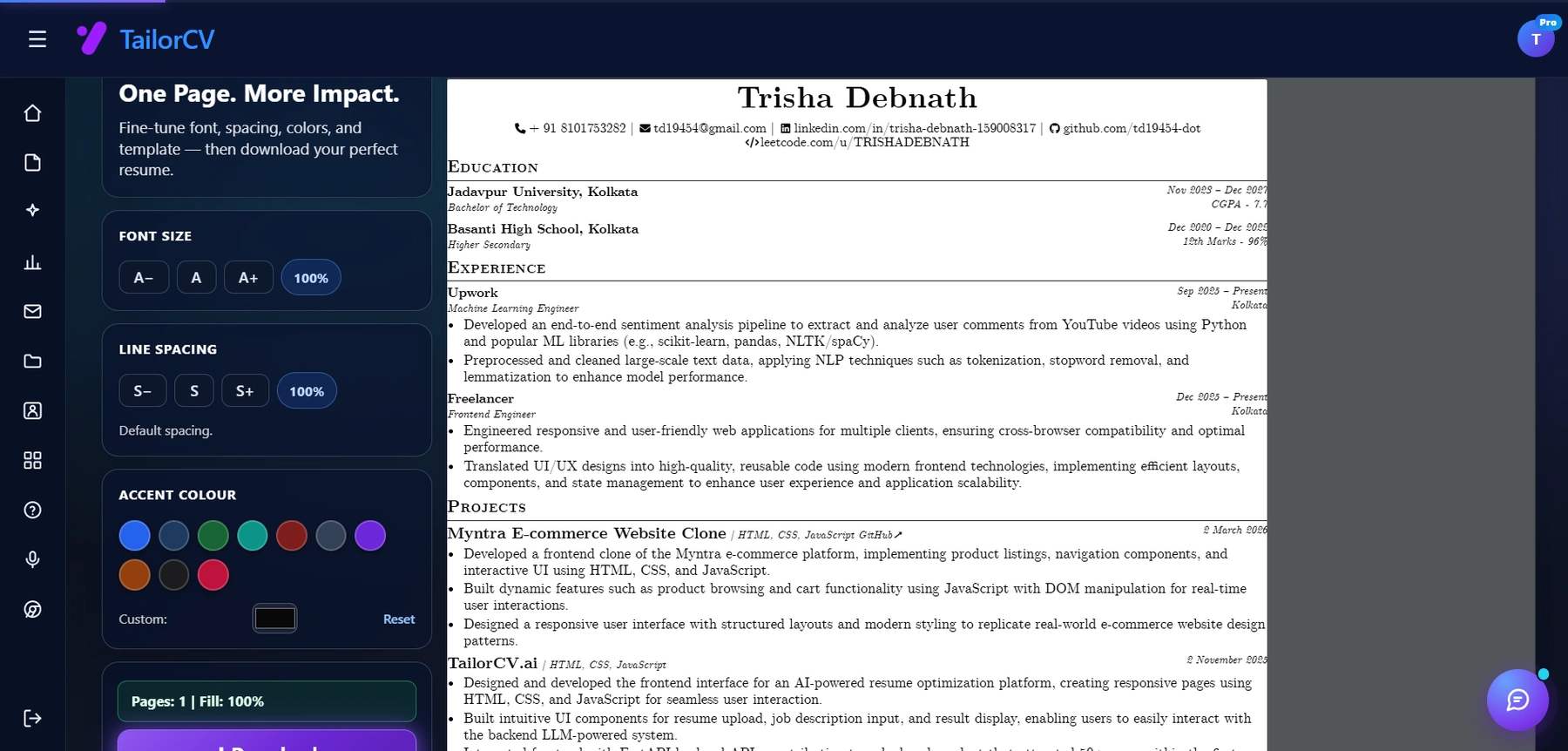
This is the optimized result, and it is usually how a spilling two-page draft gets back onto one page without deleting anything worth keeping.
Paste a job description and your resume. Get a free ATS match score — unlimited, not five a month — with the exact missing keywords. Then the AI rewrites your bullets so they carry the posting's language honestly, without inventing anything you did not do — keeping your own voice intact. Download the tailored PDF. Next job.
Around that loop: a matching cover letter, AI mock interviews for the specific role, interview prep, a portfolio website builder, and a Job Tracker that fills itself in — every tailored version saved with its score and the job it was written for.
The bet is simple: knowing you are missing eleven keywords is not the hard part. Putting them into your resume, honestly, eighty times, is the hard part.
Round 1: Pricing — Look at the Actual Numbers
Jobscan (2026):
- Free: 5 scans per month (permanent, not a trial)
- Premium: $49.95/month — unlimited scans
- Premium+: $89.95/month
- Quarterly: $89.95 per quarter (~$29.98/month)
- Annual: $299.40/year (~$24.95/month)
TailorCV (2026):
- Free: unlimited ATS scores, everywhere
- Pro: $59.99/year ($4.99/week or $7.99/month for shorter commitments)
Do the arithmetic. Jobscan Premium at $49.95/month is about $599 a year.
TailorCV Pro is $59.99 a year.
That is 10x. Even Jobscan's cheapest route — the annual plan at $299.40 — is still 5x our yearly price, and it asks someone who is currently unemployed to hand over $299.40 up front.
We also price by region, and we think that is simply honest. A student in Delhi and a senior engineer in Seattle do not have the same wallet, and charging them an identical number is a choice, not a law of physics. So TailorCV Pro is $59.99/year globally, $24.99/year in lower-income countries, and ₹1,999/year in India — about ₹5.5 a day. Same product; the price moves to meet you.
Jobscan charges $49.95/month to everyone on earth. For a senior professional applying to a few high-stakes roles, that maths works fine — one offer moves your income by far more than $599, and you will likely expense it anyway. We are not going to tell that person they are being foolish.
But for someone applying to thirty jobs a month with no income, $49.95/month for a percentage is not a subscription; it is a real decision about money. And that is why our ATS score is free and unlimited in every region — the thing that diagnoses your problem should never sit behind a paywall.
Round 2: Depth of ATS Analysis
Jobscan wins this. We should say so plainly.
Their keyword analysis has more years behind it than ours. The hard/soft skill split is cleaner, the formatting checks are more thorough, and the report explains why something matters rather than just flagging it. If your single question is "what exactly is wrong with this document", Jobscan gives the most rigorous answer in the category.
Ours is good and it is free and unlimited — but on pure depth of the report, they are ahead, and pretending otherwise would be the kind of claim you could disprove in one scan.
One caveat that applies to both of us: no third-party tool can perfectly replicate a specific employer's ATS. Workday, Greenhouse, Taleo and iCIMS parse differently, and every company configures them differently again. Any tool claiming to know exactly what a given employer's system will do is overselling. Scores are a relative signal — is this version better than that one — and a way to catch obvious misses. That is genuinely valuable. It is not prophecy. Our ATS score guide is honest about the limits.
Round 3: The Five-Scan Ceiling
TailorCV wins, and this one matters more than it sounds.
Five scans a month sounds reasonable right up until you are actually job hunting. A serious search is fifteen to thirty applications a month. Five scans covers a sixth of that.
Worse, it changes your behaviour in exactly the wrong direction. With five scans, you start rationing. You scan the "important" jobs and fire your generic resume at the rest — which are, of course, also jobs you would accept. The free plan is a demo. A good demo, honestly built, but a demo designed to show value and then meet you at a $49.95 paywall.
Our score is unlimited and free because tailoring only works if you do it every time. A tool that makes you ration the diagnostic is training you out of the habit that makes it work. Our how to increase your ATS score guide is built around scanning repeatedly, not sparingly.
Round 4: Diagnosis vs Treatment
TailorCV wins, and this is the actual reason we exist.
Here is the experience Jobscan leaves you with. Match rate: 61%. Missing: "stakeholder management", "Agile", "SQL", eight more. Accurate. Useful. Now what?
Now it is 11pm and you are in a Word document trying to work "cross-functional stakeholder management" into a bullet about your final-year project without lying and without sounding like a machine wrote it. Then tomorrow, a different job, different keywords, same 11pm.
By week three most people quit. They go back to one generic resume sent to eighty companies, and the reply rate collapses — the exact outcome the tool was bought to prevent. The gap between knowing and doing is where job searches actually die. Our tailored vs generic resume piece shows the difference in practice.
TailorCV closes that gap in about a minute per job, under a hard rule: the AI may only rephrase and re-emphasise what is genuinely on your resume. It will not invent an employer, a project, or a skill. A resume that lies gets you caught in the interview, which is worse than never getting one.
Round 5: What Else Is in the Box
TailorCV wins on breadth.
Jobscan is a scanner with satellites. TailorCV covers the steps that come immediately after the score:
- Cover letters matched to the same job description
- AI mock interviews with role-specific questions and instant feedback
- Interview question prep generated from the actual posting
- A portfolio website builder that turns your resume into a live link — useful for freshers whose one-page PDF undersells them
- A Job Tracker that fills itself in automatically
Jobscan offers no mock interviews and no portfolio builder. If you want those, they are separate subscriptions elsewhere — on top of $49.95.
Round 6: The Chrome Extension — Where the Five-Scan Ceiling Really Bites
TailorCV wins, and this is where the two products feel most different day to day.
What the extension looks like on a real posting
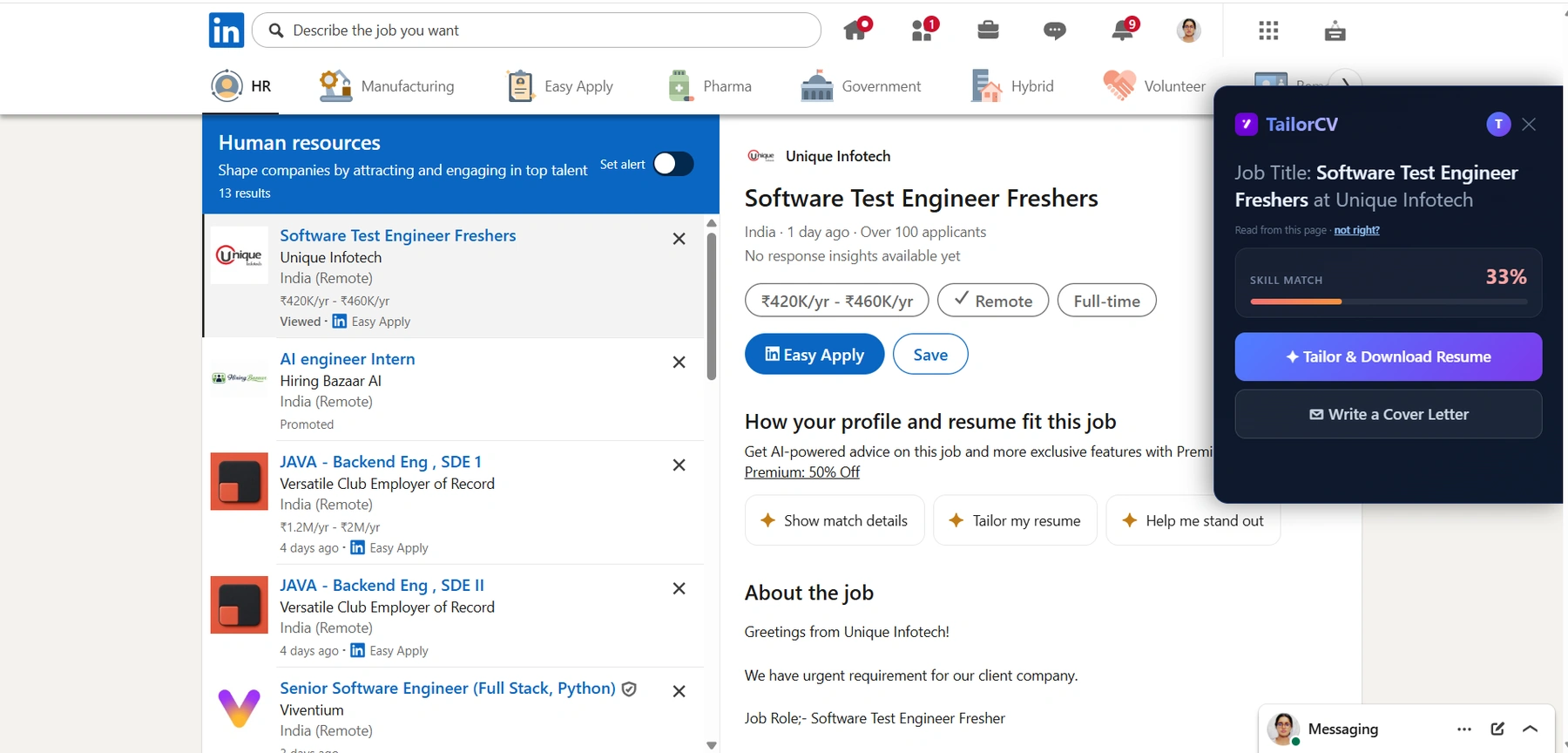
Rather than duplicating a resume in a builder and hand-editing it per job, the panel does the match check and the tailoring on the posting itself.
Both have an extension. Jobscan's fetches the job description so you can scan it — a real convenience, and it saves copy-pasting into their site.
Ours tailors the resume on the posting itself.
You are on a job — LinkedIn, Indeed, Naukri, Greenhouse, Lever, Workday, Ashby, Glassdoor, ZipRecruiter, Monster, SimplyHired, Dice, Wellfound — and the panel opens beside it. It reads the description straight off the page and shows your skill match against that role immediately, before you click anything. One click tailors your resume and downloads the PDF. Another writes the matching cover letter. Both save to your Job Tracker with the score and the job attached.
Fifteen boards work out of the box, and the panel opens on any site from the toolbar — because plenty of good roles live on company career pages nobody has built an adapter for. It reads a posting four different ways: structured job data when the site publishes it, site-specific rules where we have them, a content heuristic where we do not, and a manual paste box as the last resort. So it holds up on pages we have never specifically tested.
Now put that next to the five-scan ceiling. Jobscan's extension makes it easy to pull a job description — and then, on your sixth job this month, the free plan says no. The convenience runs straight into the paywall. Ours has no ceiling to run into: the score is unlimited and free, and the extension is built to make you use it on every posting rather than ration it across five.
This is the thing most people underestimate. Copy-pasting a job description takes ninety seconds. Trivial. But you pay it on every application, and it lands hardest at the end of a long day on the eleventh application — exactly when you think "close enough" and send the generic version. That is how tailoring dies. Not from disagreement, from friction.
Every tool in this category tells you to tailor for each job. Ours is built so it takes one click from the page you are already on. More on the extension here.
Round 7: Who It Is Built For
This is the honest heart of it. Jobscan is built for a working professional applying to a handful of senior roles, where one offer changes their income by tens of thousands and $600 a year is a rounding error. For that person, Jobscan is a good purchase and we would not argue.
TailorCV is built for someone applying to thirty jobs a month with no income, who needs the resume fixed rather than graded, and for whom ₹5.5 a day is the difference between using a tool and not.
Neither of those is the "right" customer. They are just different, and most comparison articles pretend there is one answer.
What Jobscan Does Genuinely Well
We would rather be useful than pretend Jobscan is bad software. It is not — it is the most established tool in this category for good reason.
- The keyword analysis is the most rigorous available. More years, more refinement, better explanations than ours.
- The formatting checks are thorough and catch real parser-breaking problems.
- It is honest about being a scanner. It does not pretend to be a full career platform, and there is integrity in that focus.
- The free tier is permanent, not a 7-day trial that quietly bills you. Five scans is tight, but it is genuinely free forever.
If depth of analysis is what you want and money is not a constraint, Jobscan is a defensible choice and we will not tell you otherwise.
What Actually Happens When You Apply
It is worth understanding the mechanics, because they explain why a score alone was never going to be enough.
When you submit through a portal — Workday, Greenhouse, Taleo, iCIMS, or a Naukri listing — your PDF is parsed into structured fields. The system reads out your skills, titles, dates and education and stores them as data. A recruiter then searches or filters that data, very often using the exact terms from the job description.
Two consequences follow. First, formatting can sink you before content matters. Tables, columns, text boxes, headers and graphics confuse parsers, and a resume that looks beautiful in Word can arrive as scrambled nonsense. Jobscan is genuinely good at catching this, and our ATS-friendly resume guide covers the specific things to avoid.
Second, and this is the important one: the filter matches language, not meaning. If the posting says "stakeholder management" and your resume says "worked with clients and teams", any human would call those the same thing. The filter will not. It is doing string matching, not comprehension.
That single fact is the entire case for tailoring — and it is also why the diagnosis-only model has a ceiling. Knowing you are missing eleven phrases does not put them into your resume in a way that is honest, specific and readable. Someone has to do that. The only question is whether it is you, at 11pm, eighty times over — or the tool. Our ATS keywords guide goes deeper on which terms actually carry weight.
A Ten-Minute Test That Settles It
Rather than trusting any comparison table — this one included — you can just find out. It costs nothing.
Step 1: Pick a job you genuinely want. Not a stretch, not a safety. One you would accept tomorrow. Copy the full description, requirements included.
Step 2: Score your current resume against it. Paste both into a free ATS score. No card, no five-scan ceiling. Read the number, and read the missing keywords list underneath it — that list is the actual information.
Step 3: Be honest about the result.
- 80% or above? Your resume is not your bottleneck. Neither tool will help much. Something else is wrong — probably visibility, or you are aiming at roles that do not match your background yet.
- 55–75%? This is where most people land, and it is the dangerous middle. Your resume is fine. It reads well. A human would say it is good. And it is losing to candidates who tailored, because "fine" does not rank against a specific posting. This is exactly the gap both Jobscan and TailorCV exist to close — Jobscan tells you the gap, we close it.
- Below 55%? You are being filtered before a human ever opens it. Every application you have sent this month was probably read by software and discarded. That is not a confidence problem or a market problem. It is a fixable problem.
Step 4: Now ask the real question. Not "which tool is more accurate" — but who is going to do the rewriting? If you genuinely will, cheerfully, thirty times a month, Jobscan gives you the better report and you should buy it. If you know yourself well enough to admit you will do it four times and then start sending the generic version again, then the report was never the missing piece.
That is the whole decision, and no comparison table can make it for you.
Frequently Asked Questions
Is Jobscan worth $49.95 a month? If you are a senior professional applying to a few high-stakes roles, easily — one offer pays for years of it. If you are a student or fresher applying broadly with no income, it is very hard to justify, and the 5-scan free tier will not carry a real search.
Is TailorCV free? The ATS score is free and unlimited — not five a month. You can also build a portfolio free. Pro ($59.99/year globally, ₹1,999/year in India) unlocks unlimited tailoring, cover letters and mock interviews.
Is TailorCV's ATS score as accurate as Jobscan's? Jobscan's report is deeper — we would rather say that than have you find out yourself. Ours identifies the missing keywords and scores the match reliably, and then it does the part Jobscan does not: rewrites the resume. Different value, honestly stated.
Can I use my existing resume? Yes. Upload the PDF you have. You never need to retype your history into a builder.
Will the AI make up experience I do not have? No. Tailoring is constrained to your real history — it rephrases and re-emphasises what is already there. It will not fabricate employers, projects or skills.
Do I really have to tailor for every job? Yes. A posting asks for specific things; a generic resume answers none of them specifically. It takes about a minute per job with a tool, and it is the highest-leverage habit in a search.
Can I use both? You can, though at $49.95/month the overlap is expensive. A more sensible split: use Jobscan's 5 free scans on your most important roles, and TailorCV's unlimited free scores for everything else.
Putting It All Together
Jobscan built this category and it is still the deepest scanner in it. That is a real thing and we are not going to take it away from them.
But a scanner answers one question — what is wrong? — and then hands the work back to you. If you are applying to five carefully chosen roles and you are comfortable rewriting your resume from a report, that is a fine trade, and $49.95 a month may be worth it to you.
If you are applying to thirty jobs a month, the trade breaks. Not because the diagnosis is wrong, but because nobody can execute it thirty times at 11pm and keep going. That is when people stop tailoring and start spraying, and that is when a search quietly dies.
$59.99 a year against roughly $599 a year is the other half of the sentence — and in India, ₹1,999 against ~₹50,000.
The way to decide costs nothing: run a free ATS score against a job you actually want. No card, no five-scan ceiling. If it comes back at 85%, you did not need either of us. If it comes back at 58% — now you know exactly where your search has been dying, and the only question left is who does the rewriting.
Comparing other tools? We have honest breakdowns of TailorCV vs Teal, vs Careerflow, vs Zety and vs Enhancv — plus a four-way roundup and the best free ATS checkers compared.
Sources: Jobscan pricing verified July 2026 from Jobscan's plan page and independent 2026 reviews including Jobscan Pricing 2026. TailorCV pricing from our own pricing page. Prices change — check current pages before subscribing.
See what tailoring is worth on your resume
Score your current resume against a real job description before you change a word.
Drop your resume here or choose a file
PDF only. Max 2 MB.
We never share your data or use it to train AI models.

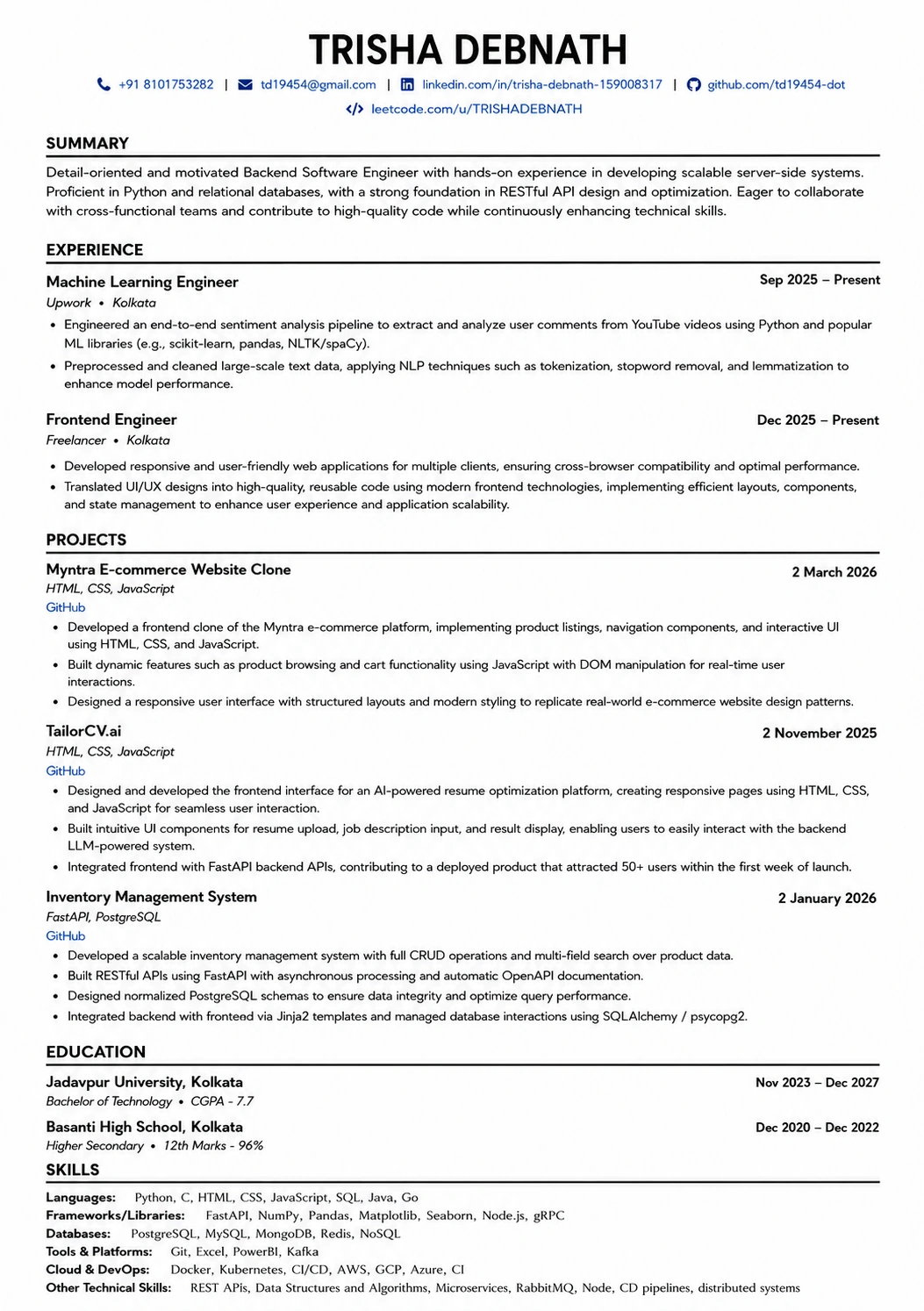
Start from a template that tailors well
Clean structure means swapping keywords per job takes minutes, not a re-layout every time.
Was this guide useful?
Be the first to rate it.