 SS
SS
Key Takeaways
- A resume summary is a 2-4 line statement that highlights your professional identity, key skills, and notable achievements, crucial for capturing a recruiter's attention.
- Use a summary instead of an objective, as it focuses on what you offer rather than what you seek, making it more relevant for most candidates.
- Follow the resume summary formula: [Role/Title] with [X years] of experience in [domain]. Include a quantified achievement, key skills, and optional targeting information.
- Strong summaries are specific, include measurable achievements, and relevant keywords, while weak summaries lack detail and clarity.
- The article provides 20 examples of effective resume summaries across various roles and experience levels to guide candidates in crafting their own.
The resume summary is the first thing a recruiter reads after your name. In the 6-10 seconds they spend scanning your resume, your summary either hooks them or loses them. A strong summary frames your entire resume; a weak or generic one wastes the most valuable real estate on the page.
This guide gives you the formula for a strong resume summary and 20 examples across different roles and experience levels.
Before finalizing your summary, run your resume through the ATS score checker to ensure your keywords match the job. Use ATS-friendly templates and read the resume optimization guide.
What Is a Resume Summary?
A resume summary is a 2-4 line statement at the top of your resume that summarizes your professional identity, key skills, and most impressive achievements. It is sometimes called a professional summary, profile, or summary statement.
It answers, instantly: Who are you? What are you good at? What value do you bring?
Resume Summary vs Objective
- Summary: Focuses on what you offer (best for most candidates, especially those with experience). "Backend Engineer with 4 years building scalable APIs..."
- Objective: Focuses on what you want (largely outdated; only useful for career changers or very entry-level candidates). "Seeking a role where I can grow..."
In 2026, the summary is preferred for almost everyone. Use an objective only if you are a career changer or have truly no experience - and even then, make it value-focused. Read resume summary with no experience for entry-level guidance.
The Resume Summary Formula
[Role/Title] with [X years] of experience in [domain/specialization]. [Most impressive achievement or core strength with a metric]. Skilled in [3-4 key skills]. [Optional: what you're targeting].
The keys:
- Lead with your professional identity
- Include at least one quantified achievement or differentiator
- Pack in role-relevant keywords (for ATS)
- Keep it to 2-4 lines
What Makes a Summary Strong vs Weak
Weak Summary
"Hardworking and dedicated professional seeking a challenging role in a reputable organization where I can utilize my skills and grow professionally."
Problems: no specifics, no role, no skills, no achievements, no value. This could apply to anyone.
Strong Summary
"Backend Engineer with 4 years of experience building distributed payment systems in Python and FastAPI. Reduced API latency by 60% and scaled services to 2M daily requests. Skilled in microservices, PostgreSQL, AWS, and system design. Targeting senior backend roles at high-scale product companies."
Why it works: specific role, quantified achievements, relevant keywords, clear direction.
20 Resume Summary Examples
Software Engineer (Experienced)
"Full Stack Engineer with 5 years building B2C web applications in React, Node.js, and PostgreSQL. Shipped 30+ features end-to-end and reduced page load times by 52%. Skilled in TypeScript, AWS, and CI/CD."
Software Engineer (Fresher)
"Computer Science graduate with strong foundations in data structures, algorithms, and full-stack development. Built 4 projects using Python, React, and PostgreSQL with 500+ combined GitHub stars. Seeking an entry-level software engineering role."
Data Analyst
"data analyst with 3 years of experience in e-commerce analytics. Built SQL reports and Power BI dashboards that reduced weekly reporting time by 6 hours and informed a $340K revenue recovery. Skilled in SQL, Python, and data visualization."
Data Scientist
"data scientist with 4 years building ML models for healthcare and fintech. Deployed a churn prediction model that reduced 90-day churn by 14%. Skilled in Python, PyTorch, SQL, and MLOps."
Product Manager
"product manager with 5 years in B2B SaaS. Led a self-serve onboarding redesign that improved 30-day retention by 22%. Skilled in user research, roadmapping, and data-driven prioritization."
UX Designer
"UX designer with 5 years designing SaaS dashboards and mobile apps. Led a checkout redesign that increased conversion by 23%. Skilled in Figma, user research, and design systems."
DevOps Engineer
"DevOps Engineer with 5 years managing AWS infrastructure for SaaS platforms serving 2M+ users. Reduced deployment time from 45 to 9 minutes and improved availability to 99.96%. Skilled in Terraform, Kubernetes, and CI/CD."
Marketing Manager
"Growth Marketing Manager with 4 years in B2B SaaS. Reduced CAC by 38% and grew MQLs 3.4x. Skilled in paid search, SEO, email automation, and marketing analytics."
Financial Analyst
"FP&A Analyst with 4 years in consumer goods. Owned the budget process for a $280M business unit and improved forecast accuracy from ±11% to ±4%. Skilled in financial modeling, Excel, and Power BI."
Sales Executive
"Account Executive with 4 years in B2B SaaS sales. Closed $2.8M in net new ARR at 118% of quota. Skilled in MEDDICC, enterprise deal cycles, and Salesforce."
Registered Nurse
"Registered Nurse (BSN) with 5 years of ICU experience in a tertiary care hospital. Maintained a 98% medication error-free record and ACLS/CCRN certified. Skilled in ventilator management and critical care."
Teacher
"High School English Teacher with 7 years of IB experience. Developed a PBL curriculum that raised average exam scores from 68% to 79%. Skilled in differentiated instruction and curriculum design."
Mechanical Engineer
"Mechanical Engineer with 6 years in automotive component design. Reduced part cost by 31% through DFM optimization. Skilled in SolidWorks, CATIA, FEA, and GD&T."
Project Manager
"Project Manager with 7 years delivering enterprise IT projects. Delivered 22 projects at 91% on-time and 95% on-budget rates. PMP and CSM certified."
Accountant
"Senior Accountant with 6 years in financial reporting and month-end close. Reduced close cycle from 8 to 5 days with zero material audit findings. CPA certified with strong GAAP knowledge."
HR Manager
"HR Manager with 6 years in tech and financial services. Reduced time-to-fill from 62 to 38 days and improved 90-day retention from 76% to 91%. SHRM-CP certified."
Cybersecurity Engineer
"Security Engineer with 5 years in application and cloud security. Conducted 40+ penetration tests and reduced critical finding remediation time from 28 to 9 days. OSCP certified."
Graphic Designer
"Brand Designer with 5 years creating visual identities for consumer brands. Designed 12 brand systems and 500+ campaign assets reaching 18M impressions. Skilled in Adobe Creative Suite and Figma."
Customer Service
"Customer Support Specialist with 5 years in SaaS. Maintained 96% CSAT across 1,400+ monthly tickets and reduced first response time from 9 hours to 2.1 hours. Skilled in Zendesk and de-escalation."
Career Changer
"Former financial analyst transitioning to data analytics, combining 4 years of business analysis experience with new SQL, Python, and Power BI skills. Built 3 analytics projects and Google Data Analytics certified."
Tips for Writing Your Summary
- Write it last - after your experience and skills sections, you'll know what to highlight
- Tailor it to each job - adjust keywords and emphasis per application
- Include at least one number - quantification makes you credible
- Match the job title - if you're applying for "Backend Engineer," use that term
- Keep it tight - 2-4 lines maximum
- Avoid clichés - no "hardworking," "team player," or "results-driven" without proof
Common Resume Summary Mistakes
Mistake 1: Being generic
A summary that could describe anyone describes no one. Be specific.
Mistake 2: Writing an objective instead
"Seeking a role where I can grow" centers you, not your value. Focus on what you offer.
Mistake 3: No metrics
Every strong summary has at least one quantified achievement or concrete differentiator.
Mistake 4: Too long
A 6-line paragraph is not a summary. Keep it to 2-4 lines.
Related Guides
- How to Write a Resume Headline
- 200 Best Action Verbs for Resume
- How to List Certifications on a Resume
- How to List Education on a Resume
- How to Quantify Resume Achievements
- Top Skills to Add to Your Resume
- Soft Skills for Resume
- What Not to Put on a Resume
- How to Explain Resume Gaps
- Ideal Resume Length
- First Time Resume With No Experience: Complete Guide for Freshers & College Students
- 35 Powerful Technical Skills in Resume for Freshers With No Experience (2026 Guide)
- How to Write a Resume with AI in 2026 - Smart Use Without the Risks
- How to Match Your Resume Summary to a Job Description in 2026
- Cover Letter Guide 2026 - How to Write a Cover Letter That Gets Read
- MBA Resume 2026 - Complete Guide with Examples
Make This Practical
Use this guide as part of a complete job-search workflow. Check your resume with the free ATS score checker, improve targeting with the Resume Optimization Guide, and choose a clean format from the ATS-friendly resume templates.
After the resume is ready, strengthen the rest of the application. Draft a targeted letter with the AI cover letter generator, practice interviews with the AI mock interview tool, and create a project-backed proof page with the portfolio website builder if you need a stronger online presence.
Conclusion
Your resume summary is prime real estate. Use the formula: role + experience + quantified achievement + key skills. Tailor it to each job, lead with your strongest credential, and keep it tight.
Run your resume through the TailorCV ATS score checker to verify keyword alignment. Strengthen your bullets with the quantify achievements guide and action verbs guide.
Frequently Asked Questions
What should I include in my resume summary?
Your resume summary should include a brief overview of your professional identity, key skills, and notable achievements. Focus on what you can offer to potential employers rather than what you want. For more tips on crafting impactful statements, check out our guide on how to write a resume headline.
How long should a resume summary be?
A resume summary typically ranges from 2 to 4 lines, succinctly capturing your professional essence. This length allows you to communicate your value clearly without overwhelming the recruiter. If you're unsure about the structure, consider using our resume section order guide for best practices.
What is the difference between a resume summary and a resume objective?
A resume summary focuses on what you can offer to an employer, highlighting your skills and experiences, while a resume objective expresses what you want from the job. In today's job market, especially in 2026, summaries are preferred for most candidates. For more details on when to use each, refer to our post on resume summary vs objective.
How can I make my resume summary stand out?
To make your resume summary stand out, use strong action verbs and quantify your achievements where possible. Tailor your summary to the specific job you’re applying for, incorporating relevant keywords from the job description. For a list of impactful verbs, check out our article on the 200 best action verbs for resume in 2026.
Should I use keywords in my resume summary?
Yes, using relevant keywords in your resume summary is crucial for passing Applicant Tracking Systems (ATS) and grabbing the attention of recruiters. Tailor your summary to align with the job description, and consider running your resume through our free ATS score checker to optimize your chances of being noticed.
What is your resume scoring right now?
Scan it against a job description and get your ATS match score in about a minute.
Drop your resume here or choose a file
PDF only. Max 2 MB.
We never share your data or use it to train AI models.

Templates that keep this structure intact
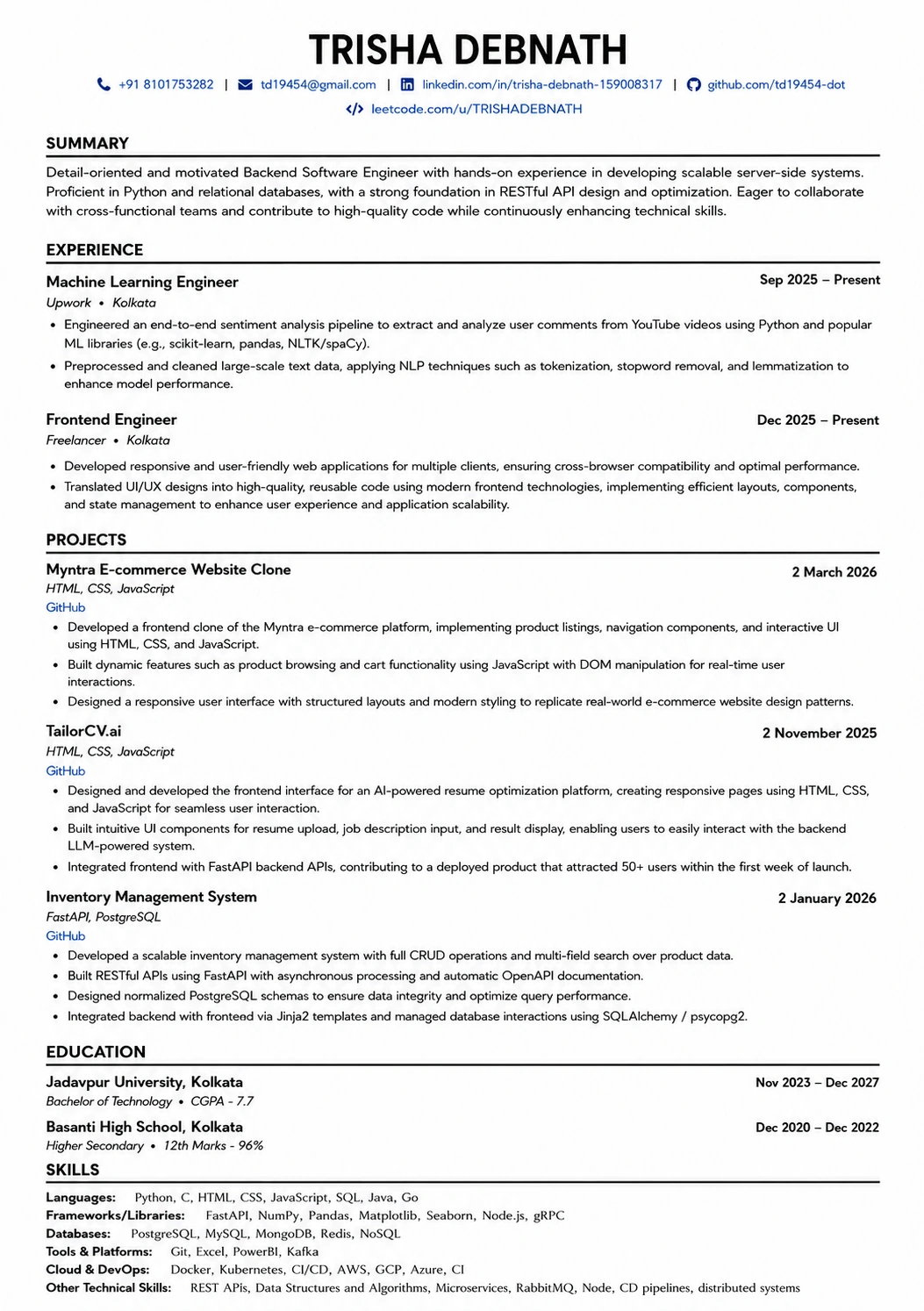
This template is ATS-tested — start from it and the formatting rules in this guide are already handled.
Was this guide useful?
Be the first to rate it.