 SS
SS
Key Takeaways
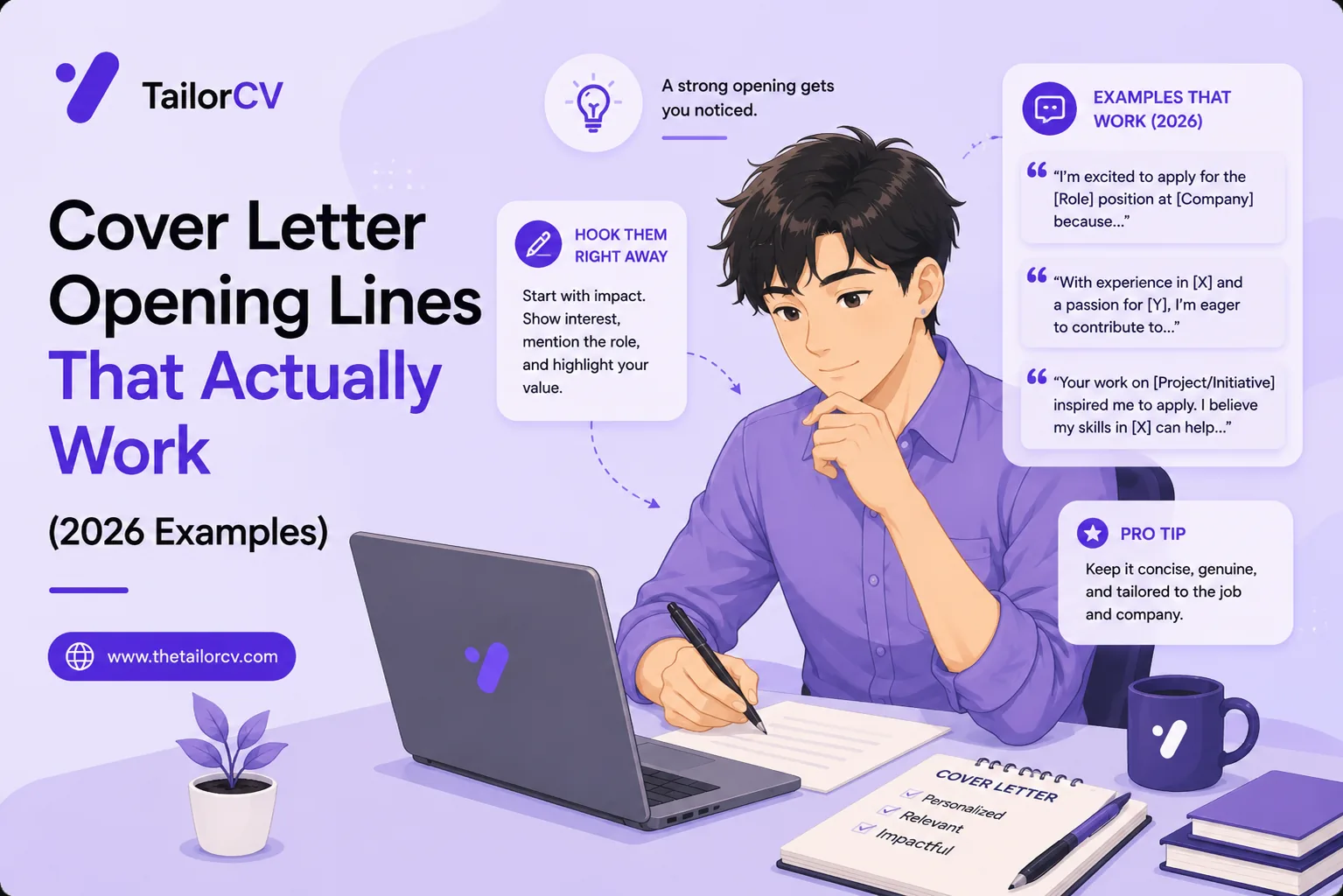
- "I am writing to apply for..." wastes the one line most likely to be read.
- Open with the company, a result, or a genuine point of connection — not with yourself.
- The first sentence should prove you understand the role, not just want it.
- Tailor the opener to the specific company; a generic hook is no hook at all.
Why the First Line Matters
A hiring manager reads dozens of cover letters. The opening line decides whether they read the second. "I am writing to express my interest in the Marketing Coordinator position" tells them nothing they did not already know from the subject line. A strong opener earns the next thirty seconds of attention.
The Formula
[Specific hook tied to the company or role] + [one credential that proves you can deliver it].
The hook shows you did your homework; the credential shows you can back it up.
Ten Openers by Situation
Lead with a result:
"Last year I took a stalled onboarding flow from a 40% drop-off to 12% — exactly the kind of retention problem your Growth PM posting describes."
Lead with the company:
"I have recommended [Company]'s app to three friends this year, so applying to build the feature I keep raving about feels less like a job search and more like a natural next step."
Lead with a shared mission:
"Your posting says you want engineers who care about accessibility. I rebuilt my last team's design system to WCAG AA, and it changed who could use the product."
Lead with a referral:
"[Name] on your data team suggested I reach out — she thought my work on churn modeling would fit what your Analytics role needs."
"After five years in teaching, I moved into UX because the problems rhymed: understand the person, then design something they can actually use."
"I built and shipped three side projects before I graduated, because I would rather learn by building than wait for permission — which is why your junior developer role caught my eye."
What to Avoid
- "To whom it may concern" — find a name.
- "I believe I would be a great fit" — show it, do not assert it.
- Restating your resume — the letter should add a story, not repeat bullets.
Let AI Draft, Then Make It Yours
An AI cover letter generator can produce a solid first draft from the job description in seconds — but the opener is where you should always edit by hand. Add the specific detail only you know: the friend who uses the product, the exact metric, the real reason you applied.
Generating the letter from a job description
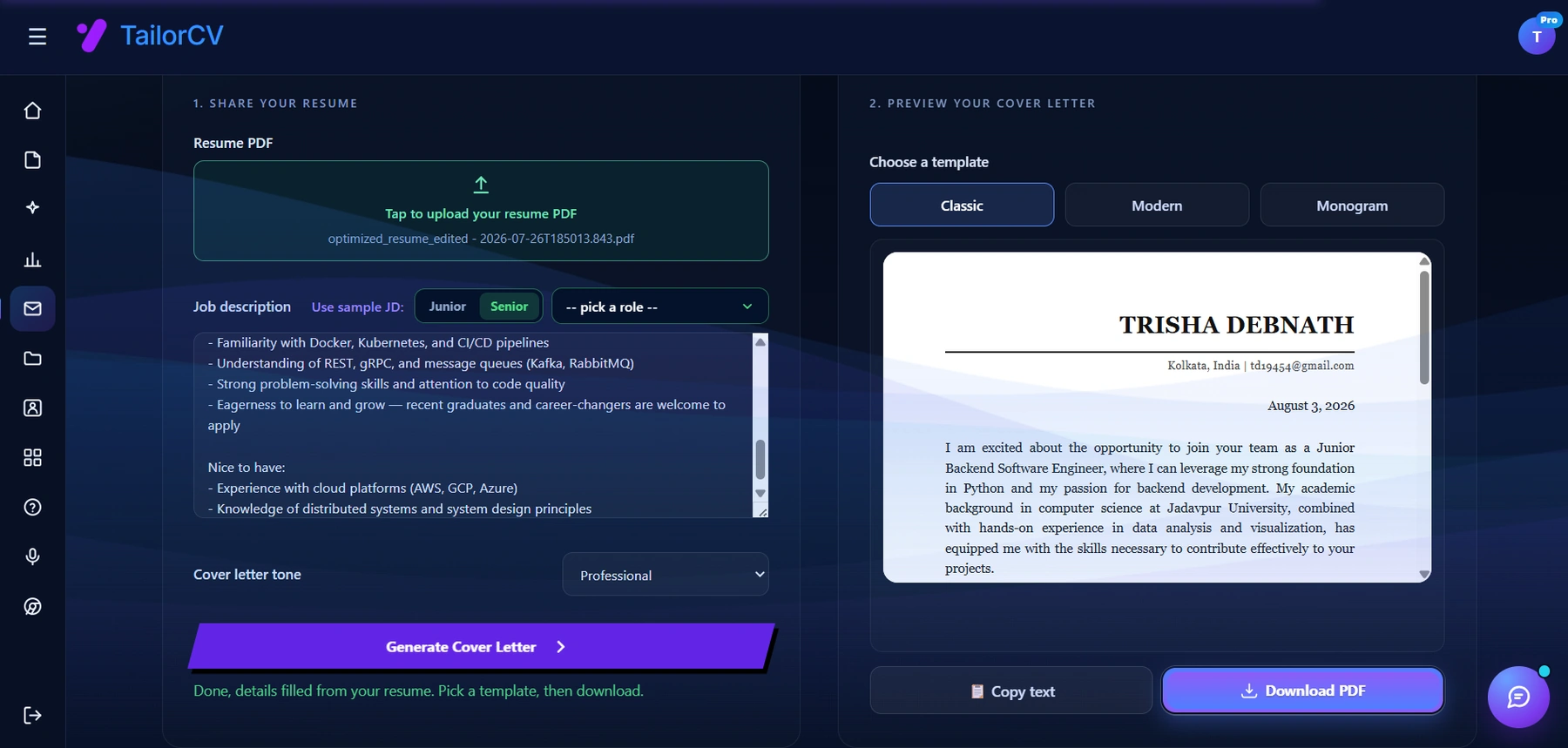
Having the preview beside the inputs is what makes this fast: change the tone or template and you see the result immediately.
The Anatomy of a Weak Opener vs a Strong One
Put two openers side by side and the difference is obvious.
- Weak: "I am writing to express my interest in the Marketing Coordinator position advertised on your website."
- Strong: "Your teardown of last quarter's failed campaign was the most honest marketing writing I read all year — so when I saw the Coordinator role, I applied before I finished the post."
The weak version states the obvious (you are applying) and centers the process. The strong version proves you did your homework, reveals genuine interest, and makes the reader curious about you. It also, crucially, could not have been sent to any other company — which is the real test of a good opener.
Five Ways to Research a Company Fast
A specific opener requires one specific, true detail. You can find one in under ten minutes:
- Read their most recent blog or changelog. Reference a launch, a decision, or a point of view.
- Check recent news or funding. A new market, a milestone, a pivot.
- Read the full job posting twice. The problems they describe are the problems you should speak to.
- Try the product if you can. One honest observation from actually using it is gold.
- Look at the team's public writing. An engineer's talk, a founder's thread, a designer's portfolio.
One real detail from any of these turns a generic hook into a specific one.
Matching the Opener to the Company's Tone
Read the room. A cover letter to a formal financial institution should open with a crisp, professional hook; a letter to an early-stage startup can be warmer and more personal. The BJAK-style startup that writes casually on its careers page is inviting a human opener; a large enterprise expects polish. Mirror the voice you see in their own writing, and your opener will feel native rather than imported.
Ten More Opening Lines to Adapt
- "I have opened your app almost every morning for two years — applying to help build it feels overdue."
- "Your job posting describes a retention problem I spent all of last year solving; here is what I learned."
- "I do not usually apply to roles this senior, but the specific work you described is exactly what I want to be doing for the next five years."
- "Three of my last four side projects were attempts to build something like what your team ships — so I would rather build the real thing."
- "The line in your posting about 'engineers who write' is why I am applying; I believe the two skills are the same skill."
- "I switched careers into data because of a problem that looks a lot like the one your Analytics role owns."
- "A former colleague described your engineering culture to me two years ago, and I have quietly wanted to work here since."
- "I read your entire documentation site before applying — partly to prepare, mostly because it was genuinely good."
- "Your product solved a problem I had been complaining about for a year; now I want to help solve it for everyone else."
- "I am early in my career, but I have shipped more side projects than some people ship jobs, and your role is exactly where I want to point that energy."
Adapt, never copy — the power is in the specific truth you attach to the pattern.
What to Do After the Opener
A great opening line buys attention; the rest of the letter has to keep it. Once your hook lands, the body should do three things across two short paragraphs: prove you can do the work with one specific, relevant achievement; connect that achievement to what the posting actually needs; and close with genuine, confident interest. The opener promises; the body delivers. A brilliant first line followed by three paragraphs of generic filler is worse than a plain opener followed by a specific, well-argued case — so treat the hook as the door, not the whole house.
How the Opener Fits the Whole Letter
Think of the cover letter as a three-part arc:
What the finished letter looks like
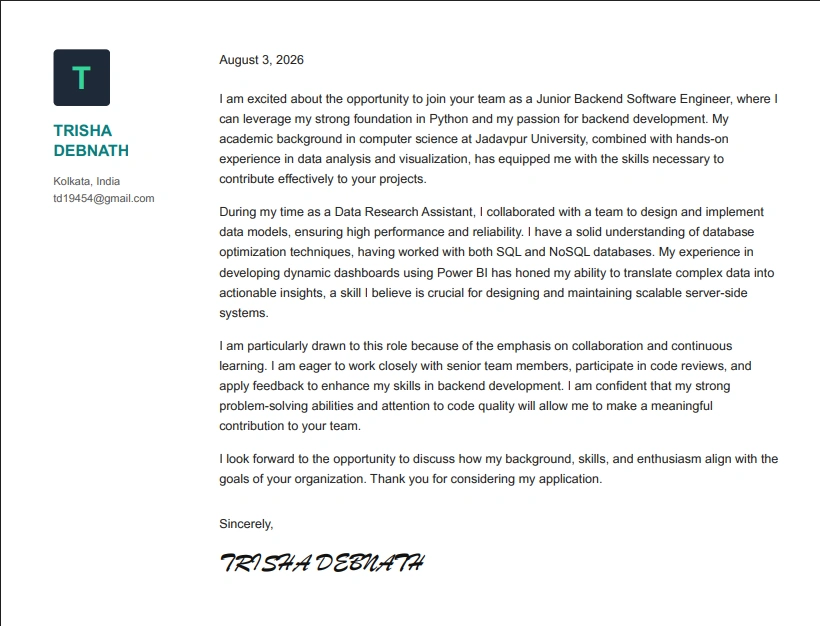
The same rules with a little more styling: the header is real text, not an image, so the layout stays readable to both a recruiter and a parser.
- The hook (opening line): earns the next thirty seconds with a specific, true detail about the role or company.
- The proof (middle): one concrete achievement that maps directly to the posting, showing rather than asserting your fit.
- The close: reaffirms interest, signals you understand what the role needs, and invites a conversation.
Each part sets up the next. A hook that mentions the company's retention problem sets up a proof paragraph about the churn work you did; a close that references the same theme ties the whole letter together. When the three parts echo one clear idea, the letter reads as deliberate and memorable instead of a list of disconnected claims.
Draft With AI, Then Own the Opener
The fastest way to a strong letter is to let an AI cover letter generator produce a first draft from the job description — it will give you a solid structure and a competent body in seconds. But the opener is the one part you should always rewrite by hand, because AI does not know the specific, true detail that makes your hook land: the friend who uses the product, the exact metric from your last role, the real reason this company caught your eye. Let the tool handle the scaffolding; you supply the sentence only you could write. That division of labor gives you a polished letter with a genuinely human opening — the combination that actually gets read.
Frequently Asked Questions
How long should the opening paragraph be?
Two to three sentences. The hook plus one credential is enough; save the detail for the body.
Should I mention the company by name in the first line?
Whenever you can do it specifically. Naming the company is good; naming something true about the company is better.
Is it okay to be a little bold?
Yes, if it is honest and relevant. A confident, specific opener beats a safe, generic one nearly every time.
What if I can't find anything specific about the company?
Then lead with a specific result of your own that maps to the role. A concrete achievement ("cut churn from 38% to 12%") is a strong hook even without a company detail — it proves you can do the work.
Should the opener mention the job title?
Yes, somewhere early, so a recruiter juggling many roles knows which one you mean. Just do not let the title be the entire first sentence, which wastes the hook.
How do I open a cold or unsolicited application?
Lead with genuine, specific admiration plus a clear reason you are reaching out: "I know you're not advertising a data role right now, but after seeing [specific work], I wanted to make the case anyway." Specific and low-pressure beats generic and pushy.
Is humor okay in a cover letter opener?
A light, genuine touch can work if it fits the company's tone and never comes at the reader's expense. When unsure, warmth beats jokes — being specific and human lands more reliably than being funny.
Should the opener be different for a formal industry versus a startup?
Yes. Mirror the tone you see in the company's own writing — crisp and professional for a bank or law firm, warmer and more personal for an early-stage startup. A hook that fits the culture feels native; one that clashes with it feels off, no matter how clever.
How many times can I reuse a good opener?
Reuse the structure freely, but never the exact sentence — the specific detail that makes an opener work has to be true for each company. A hook that could be pasted, unchanged, into another application has failed the specificity test and will not land.
Openers to Avoid at All Costs
Just as important as knowing what works is recognizing the openers that quietly sink a cover letter. "I am writing to apply for the [position] I saw on [job board]" restates what the reader already knows and wastes the one line most likely to be read. "To whom it may concern" signals you did not bother to find a name. "My name is [Name] and I am a [job title]" is information already on your resume. "I believe I would be a great fit for this role" asserts the very thing you are supposed to prove. "I am the perfect candidate for this position" is empty confidence with nothing behind it. And any opener that could be pasted, unchanged, into an application for a completely different company has failed the specificity test by definition. If your first line survives a find-and-replace of the company name without becoming false, it is too generic to earn attention.
Testing Your Opener Before You Send
Before you commit to an opening line, run it through three quick checks. First, the swap test: could this exact sentence open a letter to a different company? If yes, add the specific, true detail that makes it yours. Second, the so-what test: does the line give the reader a reason to keep reading, or does it merely announce that you are applying? Third, the honesty test: is every claim in it genuinely true — the metric real, the admiration sincere, the connection actual? An opener that passes all three is specific, compelling, and credible, which is exactly the combination that buys you the next thirty seconds. If you drafted the letter with an AI cover letter generator, this is the moment to rewrite the machine's competent-but-generic opener into one only you could have written.
Putting It All Together
The opening line is the most valuable sentence in your cover letter, and most people waste it on "I am writing to apply." Spend ten minutes finding one true, specific detail about the role or company, pair it with one credential that proves you can deliver, and match the company's tone. Do that, and you buy the next thirty seconds of the recruiter's attention — which is all a cover letter is really trying to win.
Was this guide useful?
Be the first to rate it.