 TD
TD

Key Takeaways
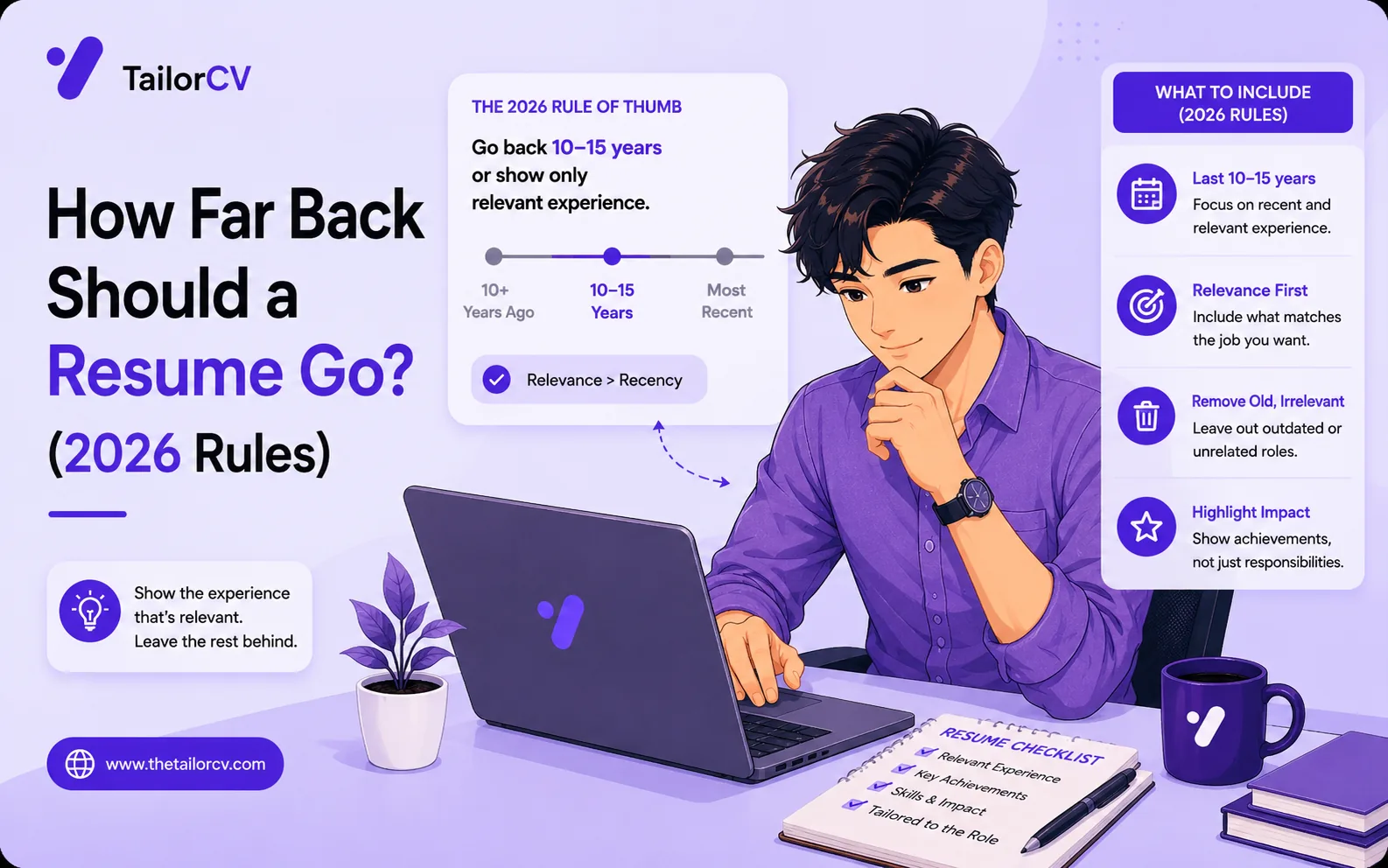
- Show full detail for roughly the last 10-15 years; beyond that, condense to one line per role or a single "Earlier career" line.
- Let the role decide the window, not a fixed rule. If the posting asks for 12 years in a field, show at least 12 years of it.
- Older experience that directly matches the job should stay, even from 20 years ago - just shorter and lower on the page.
- Removing graduation years and very old dates reduces age signals, but do it consistently and never alter dates you do list.
- Freshers and early-career candidates should show everything relevant, including internships and projects - there is no "too far back" at that stage.
- The real constraint is attention, not years: the top half of page one should cover what the posting needs most.
You have 18 or 25 years of experience and your resume is three pages long. Or you have five years and wonder whether that first internship still belongs. The practical answer: detail the last 10-15 years, condense anything older to a line, and stretch the window only when older work matches the posting better than recent work does.
The rest of this guide shows how to set the window for your level, how to handle older roles that still matter, and how to trim without creating gaps or dating yourself.
Why the 10-15 Year Window Exists
The window is not about hiding age or experience. It is about attention and relevance.
Recruiters read recent roles most closely
In a quick skim, most attention goes to your current and previous role. By the fourth or fifth entry, readers are checking dates and titles, not reading bullets. Detailed bullets from 2006 are rarely read, and they push recent evidence down.
Old tools and methods date quickly
A 2008 bullet about "Lotus Notes administration" or "Flash development" says more about when you worked than what you can do now. In fast-moving fields, work older than a decade often describes a different job, even under the same title.
Resume length has a ceiling
Two pages is the practical ceiling for most mid and senior resumes; the post on one page or two explains why. A 25-year career in full detail cannot fit, so something has to be condensed - and the oldest material is usually least relevant.
Setting Your Window by Career Stage
| Career stage | Detail window | What to do with older experience |
|---|---|---|
| Student / fresher (0-2 years) | Everything relevant | Include internships, projects, part-time jobs, college roles |
| Early career (2-5 years) | All jobs; internships if relevant | Drop school-level activities; keep 1-2 strong college items |
| Mid-career (5-12 years) | All professional roles | Condense early roles to 1-2 bullets; drop internships |
| Senior (12-20 years) | Last 10-15 years in detail | One line per older role, or an "Earlier career" summary |
| Executive (20+ years) | Last 10-12 years in detail | Single "Earlier career" line; keep only standout older achievements |
These are defaults. The next section explains when the posting should override them.
Freshers: include more, not less
At the start of your career, the problem is too little, not too much. Final-year projects, internships, hackathons and part-time work all belong if they show skills the posting asks for. See fresher resume projects that get interviews.
Early career: drop school, keep college selectively
Once you have two or three years of work, school achievements and most college clubs can go. Keep a college item only if it shows a skill your jobs do not - leading a 40-person fest committee, for instance, if you are applying for a first management role.
When the Posting Should Change Your Window
The role you are applying for matters more than any rule.
The posting asks for more years than your window shows
If a senior role asks for "15+ years in treasury," and your resume only details the last 10, you are hiding qualifying experience. Extend the window to show at least the years they ask for - condensed if needed, but visible with dates.
Your most relevant work is old
A candidate returning to an earlier field, or a senior person whose deepest domain expertise is from 15 years ago, should keep that work - lower down and shorter, with the summary pointing to it. The layout options for this are in reordering your work history.
The posting values a specific old credential
Some roles care about where you trained - a Big Four audit start, a specific engineering programme, military service, a well-known graduate scheme. If the posting or industry values it, keep the line even if the role is old.
| Signal in the posting | Adjust your window? |
|---|---|
| "15+ years of experience in..." | Yes - show at least 15 years of that field |
| "Background in [field you left years ago]" | Yes - keep older roles in that field |
| "Big Four / top-tier firm experience preferred" | Yes - keep that early role as a line |
| "Fast-paced startup, modern stack" | Tighten - recent work matters most |
| No experience threshold mentioned | Use your stage default |
| "Early-career" or "2-4 years" role | Tighten - long history can signal overqualification |
For the last row, see applying below your level.
How Fast Experience Ages in Different Fields
The window also depends on how quickly your field changes. Ten-year-old experience means very different things in software and in law.
| Field | How fast detail ages | Practical window |
|---|---|---|
| Software, digital marketing, data | Fast - tools turn over every few years | 8-10 years in detail |
| Product, design, growth | Fast to medium | 10 years in detail |
| Finance, consulting, operations | Medium | 10-15 years in detail |
| Law, medicine, engineering (licensed) | Slow - credentials and case history stay relevant | 15+ years; list qualifications regardless of age |
| Academia and research | Very slow - publications stay citable | Full record, usually in a CV rather than a resume |
| Government and public sector | Slow, and forms often require full history | Follow the application's own format |
Fast-moving fields
In software or performance marketing, a 2014 bullet about the tools of the day can actively hurt you, because it suggests your knowledge is from that era. Keep old roles as one-liners and put the spotlight on the current stack.
Slow-moving and credentialed fields
A lawyer's early cases, a surgeon's training hospital or an engineer's chartership remain relevant for decades. In these fields, condense the bullets but keep the entries. Government applications frequently require complete employment history regardless of what your resume shows - see resumes for government jobs.
How to Show Older Experience Without Clutter
Three formats, from most to least detail.
Format 1: One line per role
Finance Manager - Tata Motors, Pune, 2009-2013 Senior Accountant - Deloitte, Mumbai, 2006-2009
Title, employer, location, dates. No bullets. The timeline stays complete and verifiable.
Format 2: One line plus one standout bullet
Use this when an older role contains a result that still impresses.
Finance Manager - Tata Motors, Pune, 2009-2013 - Led the ERP migration for a 1,200-supplier payables function, closing month-end two days faster.
Format 3: An "Earlier career" summary line
Earlier career: Accounting and audit roles at Deloitte and Tata Motors, 2006-2013.
This compresses everything before your window into one line. Include the date range or not - both are common, and the next section covers the trade-off.
Dates, Age Signals and Honesty
Age discrimination is real, and many experienced candidates worry that a 1998 start date will be held against them. You can reduce age signals, but there are limits.
What you can reasonably do
- Drop graduation years from education if you graduated more than 10-15 years ago. This is common and accepted.
- Omit dates on an "Earlier career" line. "Earlier roles at Deloitte and Tata Motors" without years is fine.
- Remove very old roles entirely, as long as doing so does not create a gap inside the period you do show.
- Refresh your skills list so it shows current tools, not only long-standing ones.
What you should not do
- Change dates on any role you list. Dates are verified in reference and background checks.
- Hide a qualifying degree the posting requires. You can drop the year; keep the degree.
- Claim fewer years than you have in a way that contradicts your LinkedIn or application form.
The line between framing and misrepresenting is set out in tailoring without lying. For more on age signals specifically, see resume tailoring over 50.
Worked Example 1: A Senior Engineer With 22 Years
Situation: Suresh is applying for a principal engineer role. His resume is three and a half pages, starting from a 2004 role writing C++ for telecom switches.
Before: every role since 2004 with four to six bullets, including detail on CORBA, Solaris administration and a 2007 migration to SVN.
After:
- 2014-present: full detail across three roles (cloud architecture, platform leadership, the current principal-level role).
- 2008-2014: one line per role, with one bullet on the role where he designed a system handling 50,000 transactions a second - still impressive and still relevant.
- 2004-2008: "Earlier career: C++ systems development in telecom, Ericsson and Nokia Siemens Networks."
Old skills line: C, C++, CORBA, Solaris, Perl, SVN, Java, AWS, Kubernetes, Go
Tailored skills line: Go, Kubernetes, AWS, distributed systems design, C++ (systems), observability (Prometheus, Grafana)
Two pages, a continuous timeline, and the reader's attention on the last decade.
Worked Example 2: A Returner Whose Relevant Work Is Old
Situation: Lakshmi worked in pharmaceutical regulatory affairs from 2008 to 2016, then spent eight years in general operations management. She is applying for a regulatory affairs manager role.
Cutting at 10 years would remove all her regulatory experience - the one thing the posting needs.
Approach:
- Use a field-named section: "Regulatory Affairs Experience (2008-2016)" first, with full bullets on submissions she led.
- "Operations Experience (2016-present)" second, condensed, emphasising compliance and audit work.
- Summary: "Regulatory affairs professional with eight years leading drug submissions to CDSCO and the EMA, returning after eight years in operations management."
Here the older experience is the relevant experience, so the window moves to fit it.
Worked Example 3: An Early-Career Candidate Deciding What Stays
Situation: Rohan has three years as a marketing executive. His resume still lists his school debating captaincy, a college fest role and two internships.
Before: 12 entries across work, internships, college and school, two pages.
After: Two jobs in full detail, one internship condensed to a line (the one at a digital agency, relevant to his performance marketing target), college fest role kept as one bullet under Education showing a ₹4 lakh sponsorship he raised. School debating removed.
One page, every line earning its place. For how the summary should change at this stage, see two years in and applying for a mid-level role.
Worked Example 4: A Mid-Career Candidate Who Kept Too Little
Situation: Deepa has 14 years in HR and is applying for an HR director role that asks for "12+ years of progressive HR experience, including employee relations and HR operations." Following the "10-year rule" strictly, her resume starts in 2016 - and the employee-relations and HR operations work she did from 2012 to 2016 is gone.
The result: her resume shows 10 years, the posting asks for 12, and the employee-relations experience the posting names is missing entirely.
Fix: extend the window to cover what the posting asks for, in condensed form.
HR Manager - Manufacturing company, Chennai, 2012-2016 - Handled employee relations for a 1,100-person plant, including 3 union negotiations; set up the HR operations team and its payroll and attendance processes.
One entry with one strong bullet adds four years of qualifying, directly named experience. Her resume is still two pages because she condensed the 2016-2019 role instead. The lesson: the window follows the posting, not a fixed rule. For where to trim instead, see cutting irrelevant experience without creating a gap.
Edge Cases and Exceptions
Your only relevant experience is old and short
A single relevant year from long ago can still anchor an application - put it in a field-named section and use the summary to connect it to transferable recent work.
You have had one employer for 20 years
Long tenure at one company is usually several jobs under one name. Show the progression: group the titles under the employer and give detail to the most recent two or three roles.
The posting asks for "recent" experience
"Recent experience with X" usually means the last three to five years. If your X experience is older, show it honestly and add any current practice - a course, a project - that shows the skill is fresh.
Military or public service early in your career
These roles often carry lasting weight - leadership, discipline, clearances. Keep them as condensed lines even outside your window if the target employer values them.
Common Mistakes
Cutting qualifying experience to look younger
If the posting needs 15 years and you show 10, you may be filtered out for not meeting the threshold you actually meet. Show the years; control the detail.
Keeping outdated tools in the skills section
Old experience is fine; an outdated skills list is not. A skills line leading with technologies retired years ago tells the reader your knowledge stopped there. Put current tools first and drop obsolete ones. See resume skills section order.
Leaving education dates when experience dates are gone
If you remove dates from early roles but leave a 1996 graduation year, the attempt to reduce age signals fails. Be consistent.
Creating gaps inside your window
Trimming should happen at the old end of the timeline, not the middle. If you remove a 2017 role while keeping 2015 and 2019, you have created a gap. Read cutting irrelevant experience without creating a gap.
Detailed bullets on every old role "because it was important then"
Importance at the time is not relevance now. Keep an old bullet only if a reader of this posting would care about it today.
How This Comes Up in Interviews
Trimming your history rarely hurts in interviews, but a few questions come up.
| Question | Good answer |
|---|---|
| "What were you doing before 2012?" | A one-sentence summary of your early career, then back to the present |
| "Why isn't your first job listed?" | "I kept the resume to the last 12 years for length - happy to go through the earlier roles." |
| "Your skills section doesn't mention X, which you used early on." | Say you used it, and explain what you use now |
| "How current are your skills in Y?" | Point to recent projects or work, not years of experience |
Keep a full career timeline ready even though your resume only shows part of it. The interview story bank method is a good place to hold the older stories you might still want to tell.
How This Fits With Tailoring
Your window can change per application. A regulatory role might show 18 years; a startup operations role might show 8. That is normal tailoring, as long as dates on anything you list stay identical across versions.
Quick sequence
- Check the posting for years-of-experience thresholds and domain signals.
- Set the detail window: stage default, adjusted by the posting.
- Condense everything older to one line or an "Earlier career" summary.
- Keep any old role with a standout, still-relevant result as a one-bullet entry.
- Update skills to current tools.
- Check dates for gaps and consistency.
For keeping different windows organised across applications, see managing multiple resume versions. And for the quick check that recent evidence is what the reader sees first, the general sequence is in what to change when tailoring.
Test the result
Run the tailored version through the free ATS scan to confirm the parser reads your condensed roles and dates correctly - it takes about a minute. The AI resume optimizer can then reword your recent bullets toward the posting without touching your dates or employers.
Quick Checklist
- Does the posting set a years-of-experience threshold? Does your window meet it?
- Are the last 10-15 years (or your stage default) shown in detail?
- Are older roles condensed to one line or an "Earlier career" summary?
- Is any old but directly relevant role still visible?
- Does your skills list show current tools first?
- Are graduation and early-role dates handled consistently?
- Are there any gaps inside the window you are showing?
Frequently Asked Questions
How far back should a resume go?
For most mid and senior professionals, show detailed experience for the last 10-15 years and condense anything older. Freshers and early-career candidates should include all relevant experience, including internships and projects.
Is the 10-year rule for resumes real?
It is a guideline, not a rule. It exists because recruiters read recent roles most closely and older detail rarely affects decisions. Break it when older experience directly matches the posting or when the posting asks for more years than 10.
Should I include a job from 20 years ago?
Include it as a single line if it is inside the period needed to show a required number of years, or if it is directly relevant. Otherwise, fold it into an "Earlier career" line or remove it.
Should I remove my graduation year from my resume?
It is common and acceptable to omit graduation years once you are 10-15 years past graduation. Keep the degree itself, especially if the posting requires it, and be consistent about removing other old dates too.
Does leaving off old jobs count as lying?
No. A resume is a selection of your history, not a complete record. It becomes misleading only if you change dates or employers, or contradict what you state on an application form or background check.
What if the job requires more years than I show?
Extend your window. If the posting asks for 15 years and your resume only covers 10, you are hiding qualifying experience. Add the older roles as one-line entries with dates.
How many jobs should I list on my resume?
There is no fixed number. List every role within your detail window and condense or group older ones. Most two-page senior resumes end up with three to five detailed roles and a few one-line entries.
Should old experience go in a separate section?
Only if it is more relevant than your recent work, as with career returners. Otherwise, keep one chronological section and condense older roles at the bottom. See reordering your work history.
Should I include my first job on my resume?
Only if it is within your detail window, directly relevant, or needed to show the years a posting asks for. Otherwise, fold it into an "Earlier career" line or leave it off.
How many years of experience should a two-page resume show?
Most two-page resumes show 10-15 years in detail, with older roles condensed. The page limit matters less than keeping the reader's attention on your most recent, relevant work.
What to Do Now
Look at your resume's oldest entries and ask: would a reader of this specific posting care about this today? If not, condense it to a line or fold it into an "Earlier career" summary. Then check the posting for years thresholds and make sure your window meets them.
When the trimming is done, spend the freed space on your two most recent roles - that is where the reader's attention actually goes. Next, read cutting irrelevant experience without creating a gap for the mid-timeline cases, and how much tailoring is too much to know when to stop editing.
What is your resume scoring right now?
Scan it against a job description and get your ATS match score in about a minute.
Drop your resume here or choose a file
PDF only. Max 2 MB.
We never share your data or use it to train AI models.

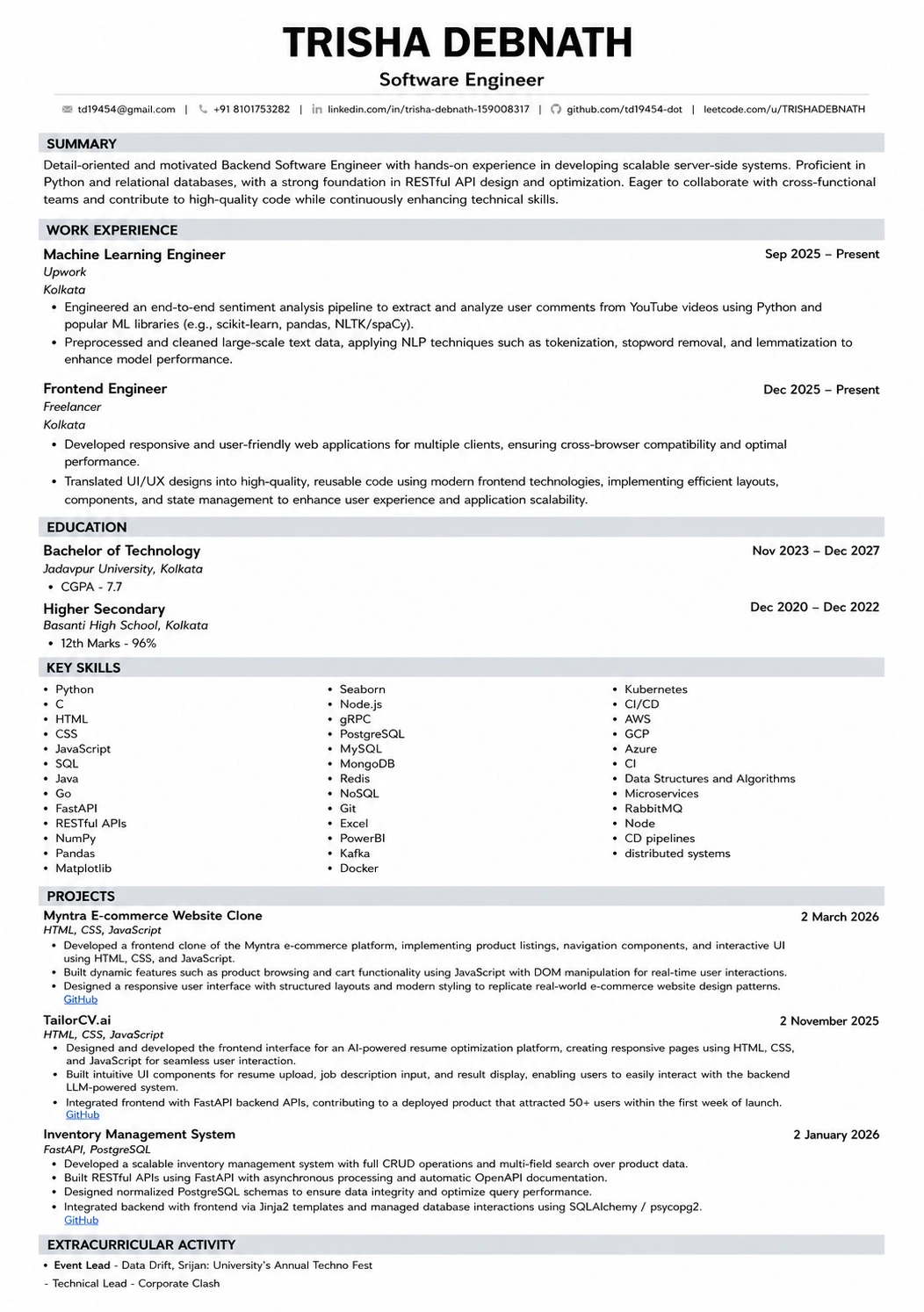
Templates that keep this structure intact
This template is ATS-tested — start from it and the formatting rules in this guide are already handled.
Was this guide useful?
Be the first to rate it.