 SS
SS
Key Takeaways
- Most candidates accept the first salary offer, often leaving significant money on the table; negotiation can yield a 10-20% increase.
- Always negotiate unless in fixed pay roles, hourly positions with collective agreements, or if you're already at the top of your market range.
- The best time to negotiate is after receiving a written or verbal offer, not during initial interviews.
- Research your market value using multiple sources to establish a target salary range and understand your negotiation leverage.
- Use a structured negotiation script: express enthusiasm, clearly state your desired salary, and then remain silent to create pressure on the employer.
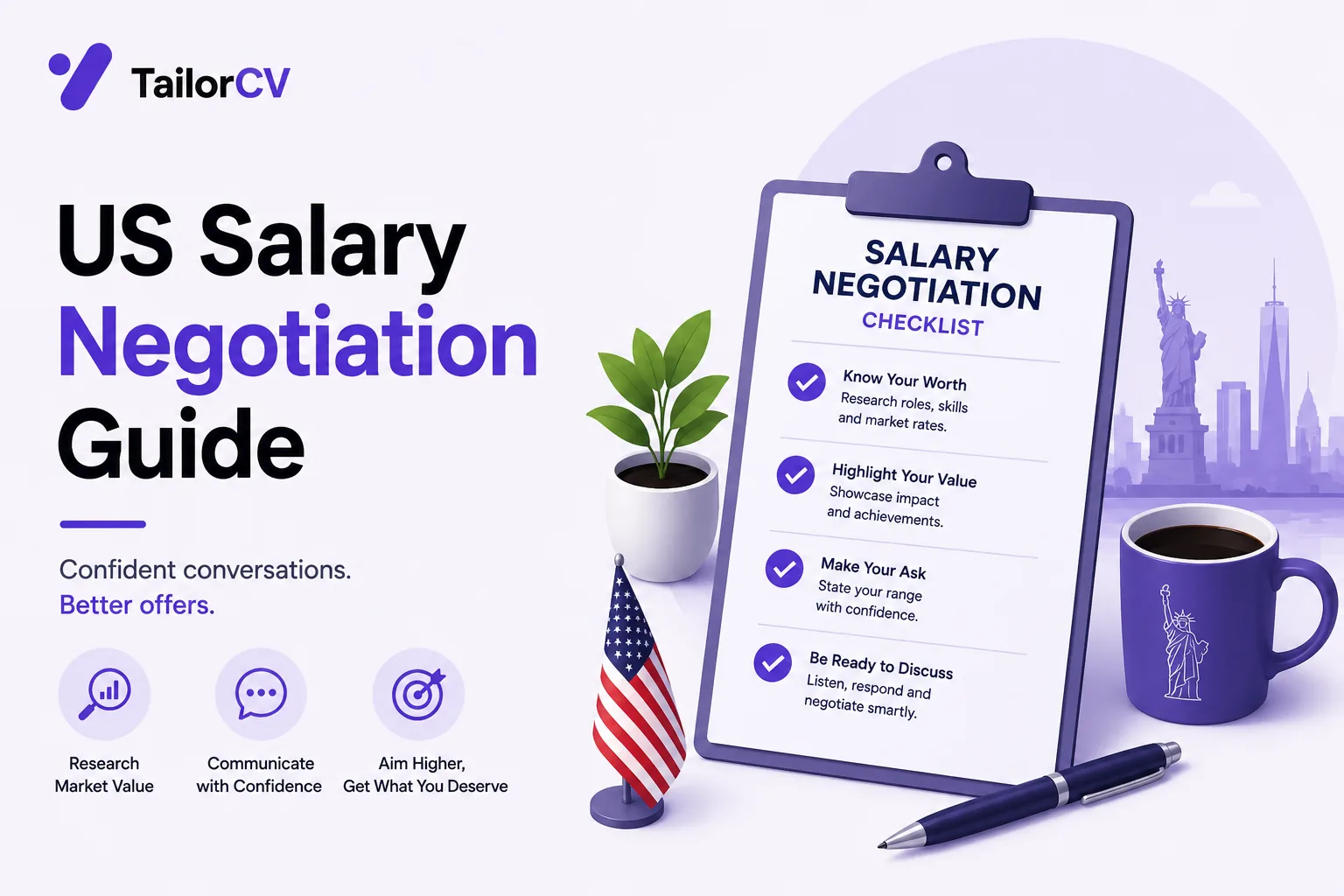
Most people accept the first salary offer they receive. Most of those people leave money on the table. Studies consistently show that salary negotiation works - employers expect candidates to negotiate, and the vast majority of initial offers have room.
This guide covers when to negotiate, how to research your market value, what to say, and how to handle every common employer response.
Before negotiating, your resume needs to demonstrate the value you are asking for. Use the TailorCV ATS score checker to optimize your resume before applying, and read the resume optimization guide to make sure your accomplishments are clearly quantified.
Should You Always Negotiate?
Almost always, yes. Here are the exceptions where you might not:
- Government or civil service roles with fixed pay scales (no room to negotiate)
- Hourly or union positions with collective bargaining agreements
- You are already at the very top of your market range and know it
For all other roles - corporate, startup, tech, finance, healthcare, consulting - the answer is almost always yes, negotiate.
When to Negotiate
The right time to negotiate is after you have a written or verbal offer. Not during the first interview. Not when asked "what are your salary expectations" early in the process.
If asked early about salary expectations, defer:
"I'd love to learn more about the full scope of the role before discussing compensation. Could we revisit this after we've established mutual fit?"
If they push for a number, give a researched range:
"Based on my research and experience, I'm targeting the $85,000-$95,000 range, but I'm open to discussing the full package."
How to Research Your Market Value
Never negotiate blind. Research first.
Sources to use:
- Glassdoor - Company and role-specific salary reports
- Levels.fyi - Essential for tech roles (software engineer, PM, data scientist)
- LinkedIn Salary - Broad market data by title and location
- PayScale - Skill and experience adjusted estimates
- Blind (Teamblind) - Candid peer salary sharing in tech
- Industry surveys - Many professional associations publish annual salary benchmarks
Build a range from at least 3 sources. Look at:
- Your title and level (junior, mid, senior)
- Your city or metro area (cost of living matters)
- Company size (startup vs. enterprise)
- Your specific skills and years of experience
Know your: target number, minimum acceptable number, and BATNA (Best Alternative to a Negotiated Agreement - i.e., what you do if they say no).
The Negotiation Script
Here is a proven script for responding to an offer:
Step 1 - Express genuine enthusiasm first
"Thank you so much for the offer. I'm genuinely excited about this role and the team. I've been really impressed by [specific thing about the company]."
Step 2 - State your ask clearly
"After reviewing the offer and doing some market research, I was hoping we could discuss the base salary. Based on my experience with [X, Y, Z] and the scope of this role, I was targeting something closer to [number]. Is there flexibility there?"
Step 3 - Stop talking
After you state your number, be quiet. Silence creates pressure that makes negotiators fill the gap. If you keep talking, you undermine your own position.
What to Say in Different Scenarios
Scenario 1: They come back with a higher number
"That works for me. Thank you for working with me on this."
Done. Do not push again unless you have a specific reason to - you have already won.
Scenario 2: They say they cannot move on base salary
"I understand. Is there flexibility in other parts of the package - signing bonus, equity, additional PTO, remote work flexibility, or professional development budget?"
Benefits and bonuses often have more flexibility than base salary because they are classified differently in budget planning.
Scenario 3: They say the offer is final
"I appreciate you checking. Could I have a few days to think it over?"
Take the time. Do not accept or decline on the spot if you feel uncertain. Evaluate the full offer against your alternatives.
Scenario 4: They ask you to justify your number
"I'm basing this on market data from Glassdoor, Levels.fyi, and LinkedIn Salary for [title] roles at [company size] in [city]. Combined with my [X years of experience and specific skills], I believe the [number] range reflects my market value accurately."
What Can You Negotiate Beyond Base Salary?
Many candidates only negotiate base salary. The full compensation package includes:
| What to include | Why |
|---|---|
| Signing bonus | Often has more flexibility than base salary. Companies can call it "non-recurring" which is easier to approve |
| Equity / Stock Options / RSUs | For tech and startup roles, the equity cliff and vesting schedule matter enormously |
| Start date | More time to mentally transition, finish freelance projects, or take a break |
| Remote work flexibility | Fewer commute days = thousands of dollars in time and transport saved |
| Title | Sometimes easier to move than salary, and impacts future offers |
| Annual review timing | Ask if you can have a performance and salary review at 6 months rather than 12 |
| Professional development budget | Conferences, certifications, courses |
| PTO / vacation days | Especially valuable if the standard offer is low |
Common Negotiation Mistakes
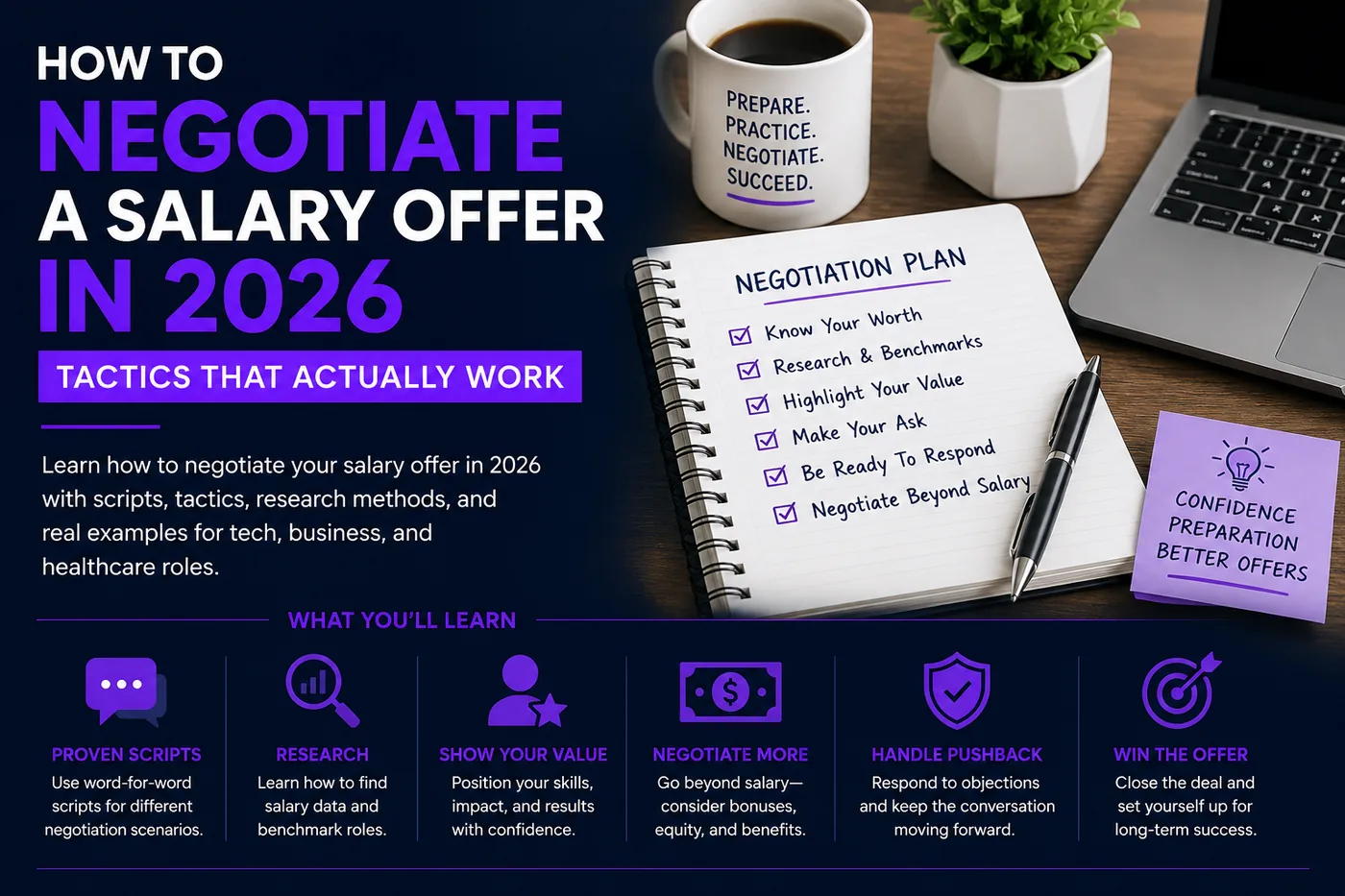
A 10-20% increase from negotiation is common. For a mid-level role paying $80,000, that is $8,000-$16,000 per year - more than most people would save by switching to a cheaper coffee. And that difference compounds over years as future raises and offers are often percentages of your current salary.
Mistake 1: Apologizing for negotiating
"I'm sorry to ask but..." You have nothing to apologize for. Negotiation is professional and expected. Never apologize.
Mistake 2: Revealing your current salary first
In many places it is illegal for employers to ask. Even where it is not, you do not have to share it. Your current salary should not anchor your next one.
Mistake 3: Giving a range that starts too low
If you say "$75K-$85K," they will hear "$75K." If you need $85K, say $88-90K and let them negotiate you to $85K.
Mistake 4: Making it personal
Do not say "I need more because my rent went up." Negotiate based on market value and your skills - not personal financial need. Employers pay for value, not need.
Mistake 5: Accepting verbally before you have it in writing
Always get the final offer in writing. Do not give notice at your current job until you have a signed offer letter.
Salary Negotiation for Freshers and Entry-Level Candidates
Many entry-level candidates feel they have no leverage. You have more than you think.
- You have competing job searches (even if informal - you are a resource other companies want)
- You have skills the employer needs right now
- You have done research and know your market value
For entry-level tech roles, negotiating base salary up by 5-10% is very common and rarely costs you the offer. The worst they can say is no. In a decade of hiring, the rate of offers being rescinded due to polite salary negotiation is essentially zero.
Related Guides
- How to Decline a Job Offer Professionally
- How to Get a Job With No Experience
- Remote Job Search Guide
- How to Ask for a Raise
- How to Build a Professional Portfolio
- How to Handle Job Rejection
- How to Use LinkedIn for Job Search
- How to Write a Cold Email to a Recruiter
- LinkedIn Profile Optimization Guide
- Networking Tips for Job Search
- Cover Letter Guide
- Freelancing vs Full-Time Employment
- How to Explain Resume Gaps in 2026 - Honest Strategies That Work
- Work-Life Balance Tips for Professionals in 2026 - Practical Guide
- Data Analyst vs Data Scientist in 2026 - Which Career Is Right for You?
- How to Follow Up After a Job Interview in 2026 - What to Send and When
Make This Practical
Turn the career advice into a stronger application system. Start by checking your resume with the free ATS score checker, align it with the role using How to Tailor Your Resume for Every Job, and keep your profile consistent with LinkedIn Resume Tailoring Sync.
When you are ready to apply, build the supporting pieces around the resume. Use the AI cover letter generator for targeted outreach, practice with the AI mock interview tool, and review Why Your Resume Gets No Responses if applications are not converting.
Conclusion
salary negotiation is a professional skill, not an aggressive act. The employer made an offer because they want you. Your job is to make sure the offer reflects your market value.
Research your number, express enthusiasm, state your ask clearly, then stop talking. Most negotiations are over in two emails.
Once your compensation is sorted, make sure you continue to build your value through strong resume documentation. Run your resume through the TailorCV ATS score checker before your next application cycle. For interview preparation, use the interview guide and practice behavioral questions with the free AI mock interview tool.
Frequently Asked Questions
Should I negotiate my salary if I receive a low offer?
Yes, you should almost always negotiate your salary, especially if the offer is below your expectations. Employers often expect candidates to negotiate, and there is usually room for improvement in the initial offer. To prepare effectively, consider researching your market value and leveraging resources like our Salary Negotiation Guide for strategies that work in 2026.
What are some effective tactics for salary negotiation?
Effective tactics include doing thorough market research to understand industry standards, practicing your negotiation script, and being ready to articulate your value. It’s also important to remain flexible and open to discussion. For more detailed strategies, check out our guide on Negotiating Multiple Job Offers to maximize your salary negotiation outcomes.
When is the right time to negotiate my salary?
The best time to negotiate your salary is after you have received a formal job offer, whether written or verbal. Avoid discussing salary during the initial interview or when asked about salary expectations early in the process. For tips on how to navigate these conversations, refer to our Salary Negotiation After a Job Interview.
How do I respond if an employer says the salary is non-negotiable?
If an employer claims the salary is non-negotiable, consider asking for other benefits or compensation options, such as bonuses, flexible working conditions, or professional development opportunities. It’s essential to express your interest in the position while remaining firm about your worth. For guidance on discussing salary expectations without underselling yourself, see our How to Answer Salary Expectations.
What should I do if I have multiple job offers?
If you find yourself with multiple job offers, it’s an excellent opportunity to negotiate for a better salary or benefits package. Communicate openly with each employer about your situation, but be respectful and professional. To craft effective communication, explore our resources on Negotiating Multiple Job Offers for scripts and email templates that can help you maximize your offers.
What is your resume scoring right now?
Scan it against a job description and get your ATS match score in about a minute.
Drop your resume here or choose a file
PDF only. Max 2 MB.
We never share your data or use it to train AI models.

Was this guide useful?
Be the first to rate it.