TD
TD
Key Takeaways
- "Tell me about yourself" is a common interview question that requires a concise, controlled narrative rather than a lengthy life story.
- The ideal response should take 90 seconds to 2.5 minutes and should demonstrate clear communication, relevant experience, self-awareness, and chemistry with the interviewer.
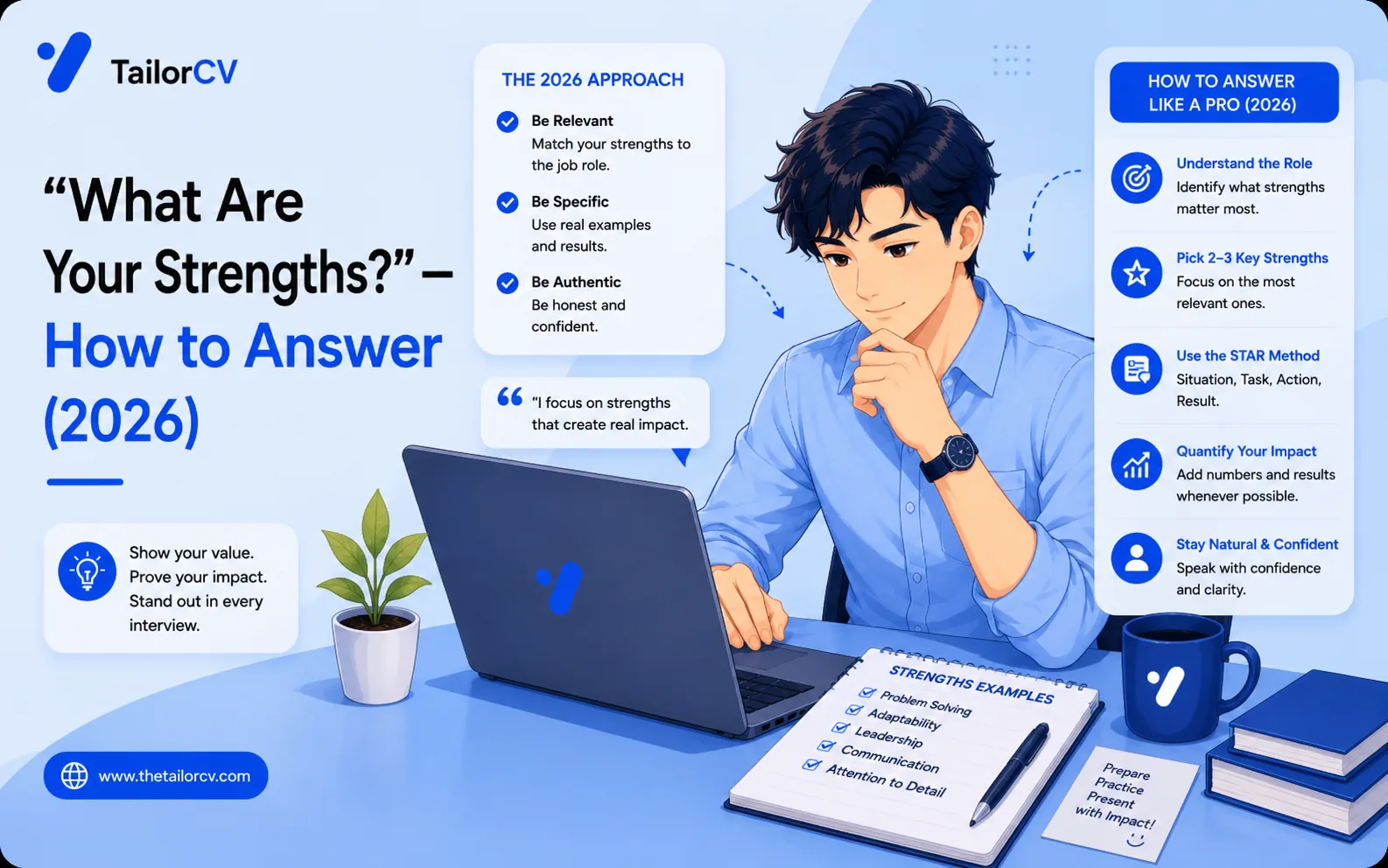
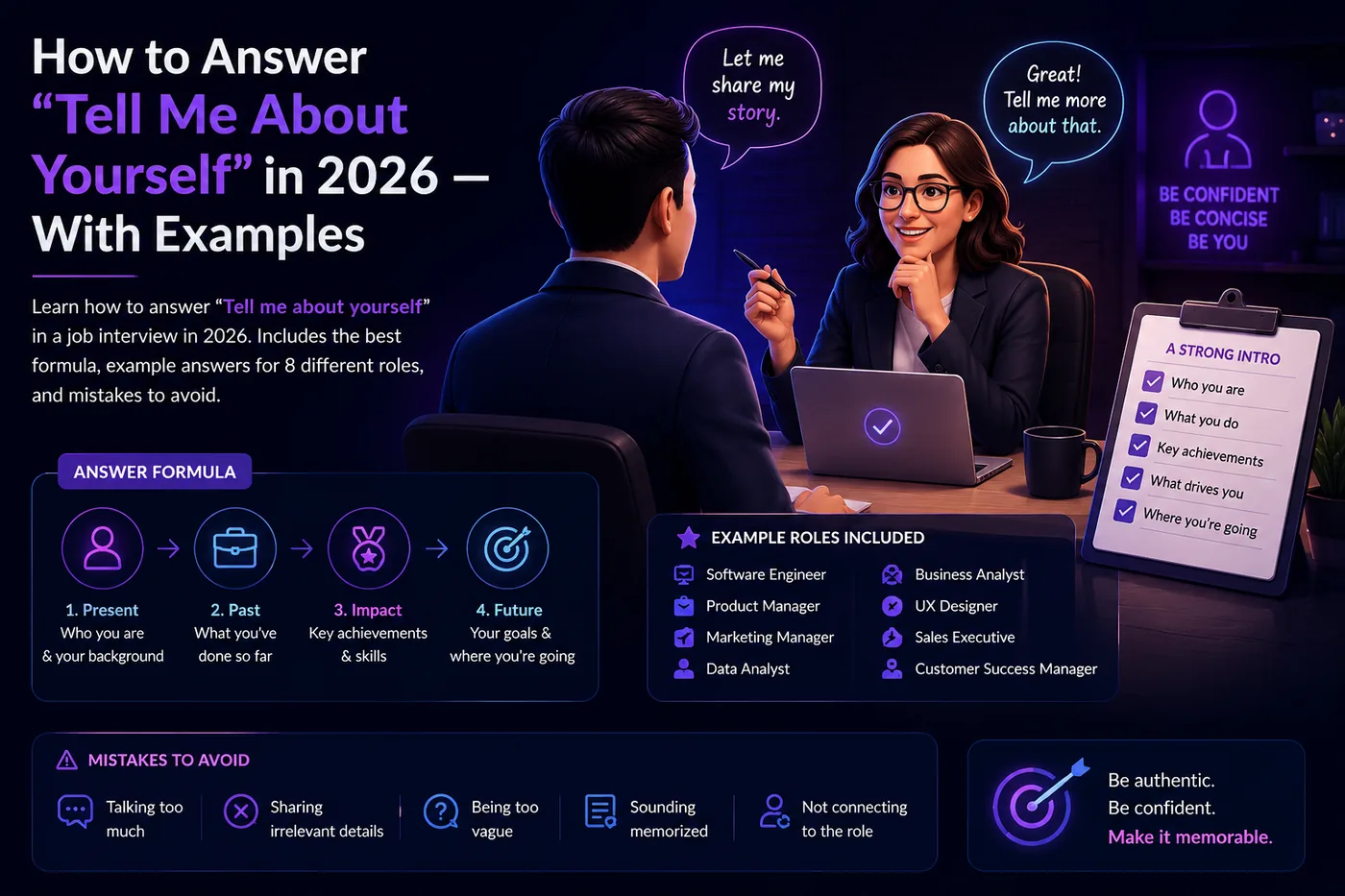
- Use the Present, Past, Future formula to structure your answer: describe your current role, relevant past experiences, and your future aspirations related to the position.
- Tailor your response to the specific role you are applying for, highlighting relevant accomplishments and interests that align with the company's goals.
"Tell me about yourself" is the first question in almost every job interview - and one of the most mishandled. Most candidates either ramble for 5 minutes covering their entire life story or give a flat summary that adds nothing to what is already on the resume.
A great answer to this question sets the tone for the entire interview. It is your controlled narrative. You decide what gets emphasized, what order the story goes in, and where you want the interviewer's attention to be.
This guide covers the best formula, why it works, and example answers for 8 different role types.
Before your interview, make sure your resume is ready. Use the TailorCV ATS score checker to optimize it. Then prepare your other interview answers using the behavioral interview guide and the full interview preparation guide. Practice with the free AI mock interview tool.
What Interviewers Are Actually Evaluating
When an interviewer asks "tell me about yourself," they are not asking for your autobiography. They are asking:
- Can this person communicate clearly and concisely?
- Is their experience relevant to this role?
- Are they self-aware about what they are good at?
- Do they seem like they have thought carefully about this opportunity?
- Is there chemistry here?
Your answer should take 90 seconds to 2.5 minutes. No longer.
The Best Formula - Present, Past, Future
Present - What you do now and what you are best at. Past - The experiences that made you excellent at it. Future - Why this role at this company is the right next step.
This formula works because it is: immediately relevant, evidenced, and forward-looking. It also naturally leads into your most impressive accomplishments.
Tell Me About Yourself - By Role Type
Software Engineer
"I'm a backend software engineer with 4 years of experience building distributed API systems - most recently at FinTech Corp, where I owned the development of a payment reconciliation service handling 1.8 million daily transactions.
Before that, I was at a logistics startup where I built my first microservices architecture and became very interested in distributed systems and performance - which is what led me to join FinTech and take on more complex infrastructure work.
I'm excited about this role because [Company] is building exactly the kind of large-scale, reliability-critical backend systems I want to work on next. The engineering blog post about your distributed transaction handling was genuinely interesting to me."
Data Scientist
"I'm a data scientist with 3 years of experience building machine learning models for healthcare and fintech applications. At my current company, I built a patient readmission risk model that's now used by 12 hospitals to support discharge planning - it achieved 79% recall on high-risk patients.
Before that, I studied statistics and machine learning in graduate school and did my thesis on Bayesian methods for survival analysis, which gave me a really strong theoretical foundation.
I'm at a stage now where I want to work on systems that go beyond model building - end-to-end ML platforms with real production impact. That's exactly what drew me to this role at [Company]."
Product Manager
"I'm a product manager with 5 years of experience working on B2B SaaS products - most recently at an HR tech company where I owned the self-serve onboarding flow. I redesigned it end-to-end and reduced time-to-first-value from 11 days to 3 days, which improved 30-day retention by 22%.
Before product management, I was actually in engineering - I was a software developer for 3 years - which gives me a different perspective when I'm working with technical teams. I'm comfortable going deep into system architecture conversations.
I'm looking to move to a company with a more complex product surface and a strong data culture. What attracted me to [Company] specifically was [product reason] - I've been a user for 2 years and I have real opinions about what I'd love to work on."
UX Designer
"I'm a product designer with 4 years of experience designing B2C mobile apps and SaaS dashboards. My current focus is on data-heavy interfaces - helping users make sense of complex information through clear visual hierarchy and interaction patterns.
Most recently I led a complete redesign of a healthcare patient portal used by 180K patients - which reduced support ticket volume by 34% and improved task completion rates significantly.
I got into design from a visual arts background, which I think still shows in how I approach visual problem-solving. But over time I've become very research-driven - I rarely propose solutions before doing at least some user research first.
I'm excited about [Company] because your product touches [specific domain] and I think there's a real design opportunity in how users [specific task] - I actually sketched some ideas about this before the interview."
Data Analyst
"I'm a data analyst with 3 years of experience in e-commerce and retail analytics. I specialize in SQL-heavy reporting and Power BI dashboards - basically turning messy data from multiple sources into decision-ready information for business stakeholders.
In my current role, I've automated 9 manual weekly reports and built dashboards that are now used daily by 3 different leadership teams. One of my dashboards directly fed a decision that drove a $340K revenue recovery by identifying a returns processing leak.
I'm looking for a role where I can grow into more strategic analysis - not just reporting but actual business decision partnership. The analyst role here looked like it has that dimension, and I'm particularly interested in the [specific domain] side of the business."
Marketing Manager
"I'm a growth marketing manager with 4 years of experience in B2B SaaS. I've owned full-funnel demand generation - from SEO and content to paid search and email automation - with a particular focus on optimizing customer acquisition cost.
At my current company I took CAC from $1,240 to $760 in 18 months by improving channel mix, rebuilding our Google Ads campaigns, and building a better lead scoring system. That translated into 3.4x growth in monthly qualified leads.
I'm now looking for a role at a company in a more interesting technical space - I've been following [Company]'s growth for about a year, and the fact that you're scaling in [specific market] is exciting to me. I'd love to bring what I've learned to a team working on a genuinely differentiated product."
Registered Nurse
"I'm a registered nurse with 5 years of ICU experience, most recently in a 20-bed Medical ICU at City General Hospital. My specialty is critical care - specifically ventilated patients, sepsis management, and multi-vasopressor care.
I chose ICU nursing because I wanted the clinical depth and complexity. Over time I've also become passionate about the education side - I've preceptored 8 new graduate nurses over the last 2 years and found that really rewarding.
I'm applying here because [Hospital] is known for its advanced practice model and the level of clinical autonomy nurses have. I'm also interested in expanding into [specific area - e.g., ECMO or cardiac ICU] and I understand your unit has strong experience in that."
Teacher
"I'm a high school English teacher with 7 years of experience - currently at an IB school where I teach Grades 9 through 12 Language and Literature. I'm very interested in project-based learning and Socratic discussion as pedagogies - students engage more deeply when they're driving the inquiry.
One of the things I'm most proud of is developing a year-long thematic curriculum around identity and voice that raised average IB exam scores from 5.1 to 5.8 over 2 years. It also generated the highest student-reported engagement scores of any English class in the school.
I'm exploring this role because [School/Organization] has a reputation for [progressive pedagogy / academic rigor / innovative curriculum] and I think the environment here would push me to grow in ways my current role can't."
What Not to Say
- Your entire life story from birth
- "I'm a hard worker and team player" (say nothing, prove it)
- Salary or compensation details
- Complaints about your current employer
- "I don't really know what to say..."
- Anything that sounds memorized and robotic
How to Practice
Write your answer using the Present-Past-Future formula. Then record yourself saying it. Listen back. Does it sound natural? Is it under 2.5 minutes? Are you starting with something impressive?
Practice 3-5 times until it feels confident but not scripted.
Use the free AI mock interview tool to practice this question and get structured feedback on your delivery.
Conclusion
"Tell me about yourself" is a gift - it is the one question where you have complete control of the narrative. Use the Present-Past-Future formula, keep it under 2.5 minutes, and end with a specific reason you want this role at this company.
For all other interview questions, read the behavioral interview guide and the full interview preparation guide. Before your interview, ensure your resume is strong - use the TailorCV ATS score checker to optimize it.
Related Guides
- Behavioral Interview Questions and Answers
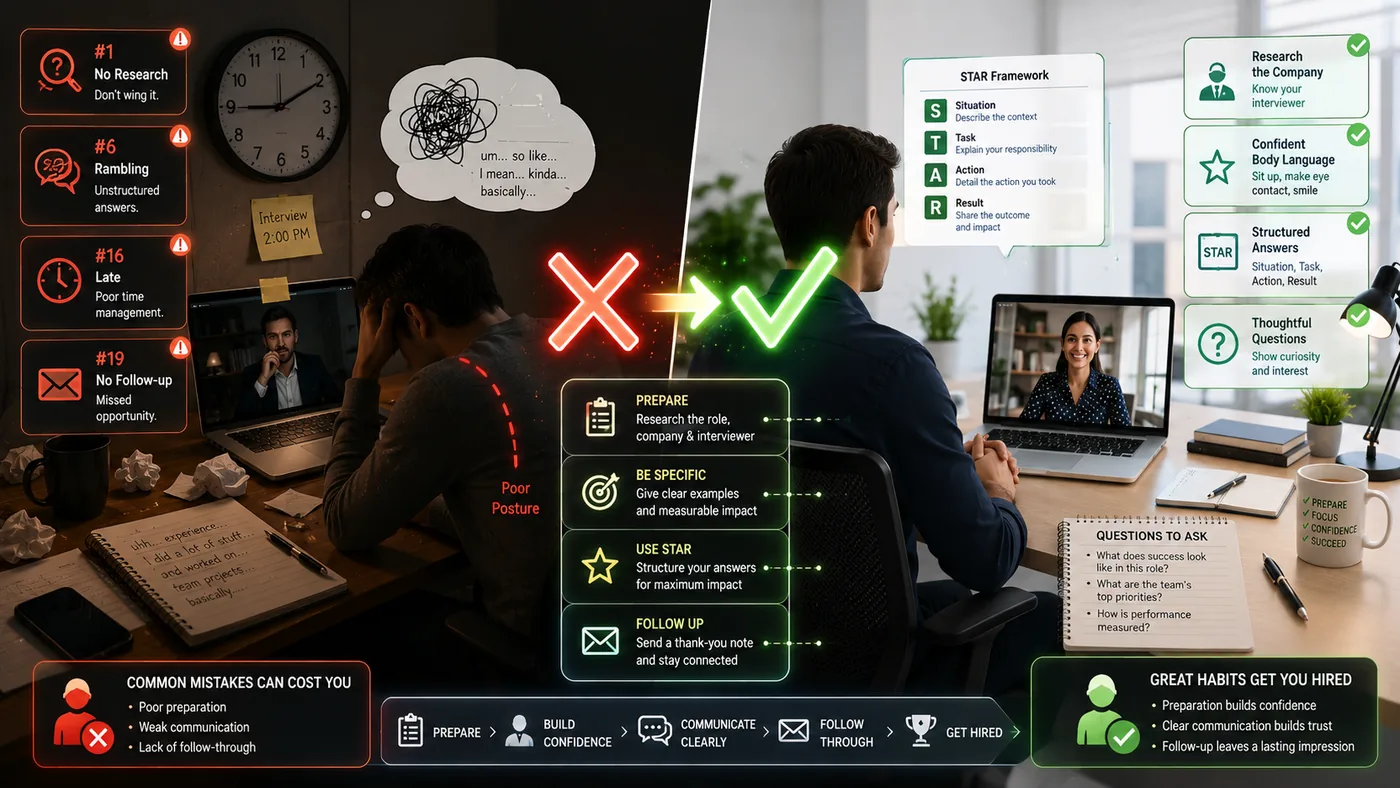
- 20 Common Interview Mistakes to Avoid
- How to Prepare for a Job Interview
- How to Research a Company Before Your Job Interview
- Group Discussion Tips
- How to Follow Up After a Job Interview
- Best Questions to Ask in a Job Interview
- Virtual Interview Tips
- Final Round Interview Tips
- Phone Interview Tips
- Why Am I Not Getting Interviews for Jobs I'm Qualified For?
- Coding Interview Preparation Guide
- System Design Interview Guide 2026 - Framework and Examples
- How to List Certifications on a Resume in 2026 - With Examples
- How to List Education on a Resume in 2026 - Complete Guide with Examples
- How to Prepare for Campus Placement in 2026 - Complete Guide
- How to Quantify Resume Achievements - With 50 Examples
- How to Write a Resume Headline in 2026 - With 30 Examples
Make This Practical
Use this advice as interview practice, not just reading material. Start a role-specific session with the AI mock interview tool, prepare your opening with How to Answer Tell Me About Yourself, and structure evidence-heavy answers with the STAR Method Interview Answers Guide.
Before the interview, make sure the resume that earned the call is still aligned with the role. Check it with the free ATS score checker, review Common Interview Mistakes to Avoid, and use How to Follow Up After an Interview once the conversation is over.
Comparing Weak vs. Strong Responses to "Tell Me About Yourself"
A well-structured response can make a significant difference in how you are perceived during an interview. Below are examples of weak and strong answers using the Present, Past, Future formula.
| Aspect | Weak Response | Strong Response |
|---|---|---|
| Clarity | "I've done a lot of things in my career." | "I currently manage a team of five in digital marketing." |
| Relevance | "I graduated from college and started working." | "I graduated with a degree in Marketing and have 5 years of experience in the tech industry." |
| Self-awareness | "I guess I'm pretty good at some things." | "I excel in data analysis and strategic planning, which have driven my team's success." |
| Thoughtfulness | "I just want a job." | "I'm excited about this role because it aligns with my passion for innovative marketing solutions." |
| Engagement | "I like to read and travel." | "In my free time, I enjoy reading about emerging technologies, which inspires my work." |
| Length | Over 3 minutes, too long. | 2 minutes, concise and focused. |
Frequently Asked Questions
How long should my answer to "Tell me about yourself" be?
Your answer should ideally take between 90 seconds to 2.5 minutes. This timeframe allows you to communicate your key experiences and skills effectively without overwhelming the interviewer. Keeping it concise ensures you maintain their attention and sets a positive tone for the rest of the interview. For more on what to avoid during interviews, check out our guide on common interview mistakes.
What should I include in my answer?
Your response should follow the "Present, Past, Future" formula: start with what you currently do, then summarize relevant past experiences, and finally, touch on your future aspirations related to the role. This structure helps you create a coherent narrative that highlights your qualifications and intentions, making it easier for interviewers to understand your fit for the position.
How can I practice my answer effectively?
To practice your answer, consider using the AI mock interview tool available on TailorCV. This tool allows you to simulate real interview scenarios and receive feedback, helping you refine your delivery and content. Practicing in a realistic setting can significantly boost your confidence and improve your performance during the actual interview.
Should I tailor my answer for different roles?
Absolutely! Tailoring your answer for different roles is crucial, as it allows you to emphasize the experiences and skills most relevant to each position. By customizing your narrative, you demonstrate that you've thought carefully about the opportunity and understand what the employer is looking for. For further insights on role-specific preparation, explore our final round interview tips.
What mistakes should I avoid when answering this question?
Common mistakes include rambling, providing irrelevant details, or sounding rehearsed. It's essential to stay focused on your professional background and how it relates to the role you're applying for. To ensure you avoid pitfalls, review our article on common interview mistakes for more detailed guidance.
Was this guide useful?
Be the first to rate it.