 SS
SS
Key Takeaways
- A first proper resume takes several hours, spread across sessions rather than done at once.
- Each tailored version afterwards takes fifteen to twenty minutes, not hours.
- Most of the time goes on recall, not writing, which is why a master document changes everything.
- Perfectionism is the main time sink, and it concentrates on formatting rather than content.
- Stop at good. Past a point, further editing changes nothing about the outcome.
A realistic first build
Where the hours actually go.
Gathering material takes the longest — reconstructing what you did, finding numbers, reviewing old documents. Expect a couple of hours and do it before writing anything.
Drafting the bullets takes about an hour if the material is gathered, considerably longer if you are recalling and composing at once.
The summary takes fifteen minutes and should be written last, once the rest exists to compress.
Formatting takes half an hour with a sensible template and consumes an entire evening without one.
Proofreading takes twenty minutes and should happen after a break rather than immediately.
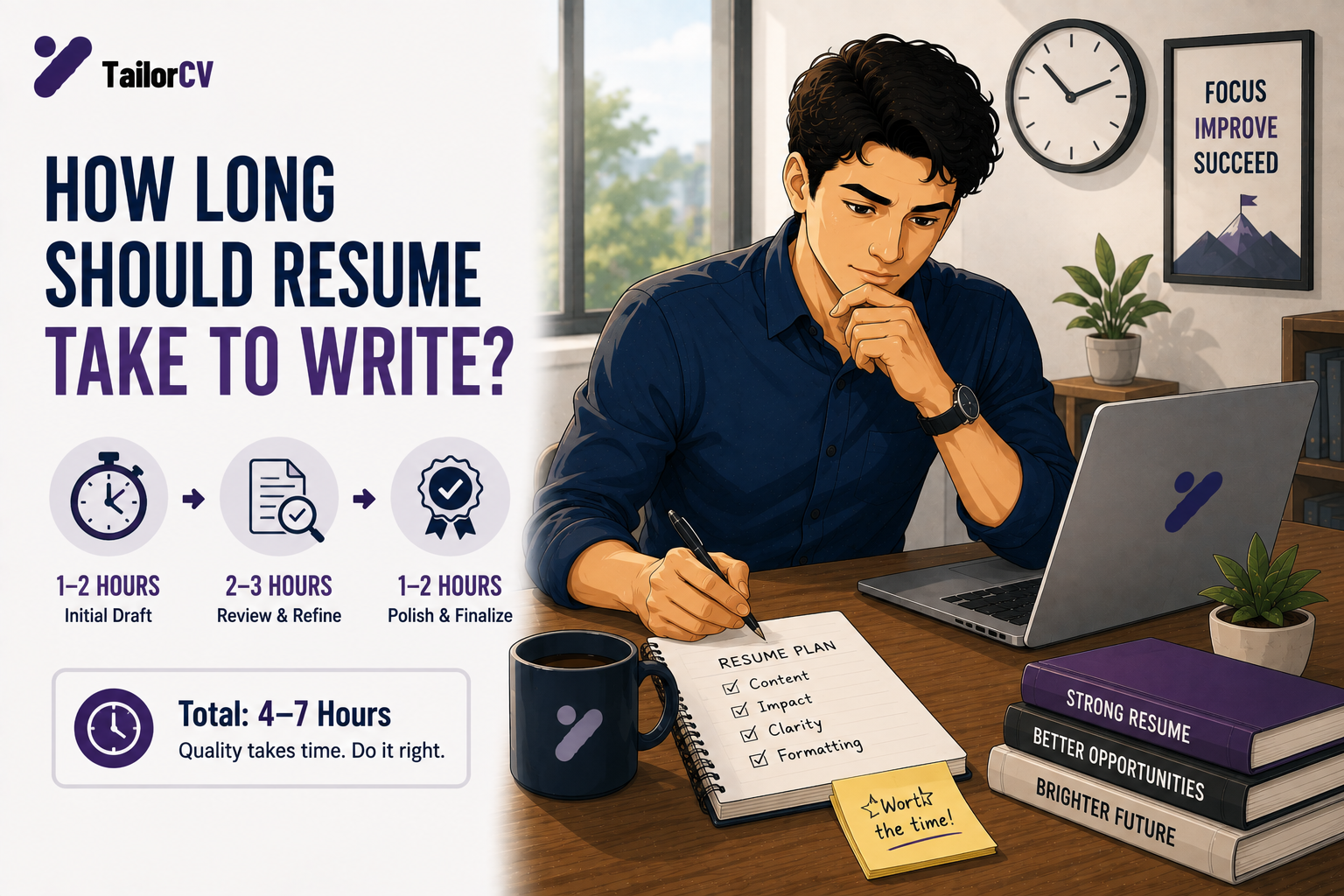
Total is around four hours of genuine work, best split across two or three sessions so that fresh reading catches what tired reading misses.
And this is a one-time cost. Everything afterwards is adjustment, provided you keep the master document.
Where the time is wasted
The activities that absorb hours and change nothing.
| Time sink | What it is worth |
|---|---|
| Choosing between similar templates | Almost nothing |
| Adjusting margins and spacing repeatedly | Very little past legible |
| Rewording a single bullet ten times | Diminishing after the second attempt |
| Comparing fonts | Nothing, provided it is readable |
| Adding colour and design elements | Nothing in most sectors |
| Reading advice instead of writing | Nothing after the first hour |
Formatting is where perfectionism lands because it feels productive and has visible output, while the content work that matters is harder and less satisfying.
Reading more advice is the subtlest trap. Past an hour it substitutes for the work rather than informing it, and the marginal article rarely changes anything.
And rewriting one bullet repeatedly usually means the underlying material is thin, which is a content problem that no amount of rewording solves.
The gathering session
The step that determines everything after it.
Set aside an uninterrupted hour and write down everything you did in each role, without editing or judging any of it.
Work role by role, most recent first, since recent memory is sharper and it warms you up for the harder recall further back.
Use prompts rather than memory alone — calendars, project folders, old performance reviews, message archives. Unprompted recall produces perhaps half of what prompted recall does.
Write in plain language. Resume vocabulary at this stage slows you down and produces worse material.
Capture numbers wherever they surface, even approximate ones you will verify later.
Do not filter for relevance yet. The item that seems irrelevant now is the one a posting asks for in three months.
And store all of it permanently, because this hour is the expensive part and repeating it every job search is the largest avoidable cost in the whole process.
Knowing when to stop
The judgement that saves the most time.
Stop when changes stop altering substance. Rewording an already clear line is editing for its own sake.
Stop when you cannot name what a change improves. If you cannot say why the new version is better, it probably is not.
Stop when you are working on appearance and the content has been settled for hours.
Stop when you have read it so many times that you no longer see it, which is the point at which fresh eyes are worth more than another pass.
Send it instead. Three applications produce more useful information about a resume than three more days of revision.
And accept that no resume is finished. It is a working document that improves with each round of real feedback, and treating it as a thing to perfect before use guarantees it is never used.
Mini checklist
- unchecked: Material gathered before drafting begins
- unchecked: Work split across sessions rather than one sitting
- unchecked: Summary written last
- unchecked: Template chosen once and not revisited
- unchecked: Formatting time capped deliberately
- unchecked: Proofreading done after a break
- unchecked: Master document created for future reuse
- unchecked: Tailoring time kept to twenty minutes per application
Scenarios
Scenario 1: You have been working on it for two weeks
You are almost certainly past the point of useful improvement. Send it to three roles and use the responses as feedback, which tells you more than another week of editing.
Scenario 2: You are starting from nothing
Give it four hours across two or three sessions, spending the first entirely on gathering material rather than writing. The recall step is what makes the writing fast.
Scenario 3: You need to apply tonight
Twenty minutes on match and summary, ten on the top bullets, five on checking. Accept the formatting as it is.
Tip: If a resume has taken more than a week, the constraint is no longer the document. Send it, and let real responses tell you what to change rather than guessing at it in isolation.
Do's and Don'ts
Do
- Gather material before writing
- Split the work across sessions
- Write the summary last
- Cap formatting time deliberately
- Build a master document once
- Send it and learn from responses
Don't
- Compose and recall simultaneously
- Compare templates for an hour
- Rewrite one bullet ten times
- Read advice instead of writing
- Restart from scratch each application
- Keep editing past the point of return
Common Mistakes
- Recalling while writing. It makes both slower.
- Formatting perfectionism. Visible effort, no effect.
- Endless advice reading. It substitutes for the work.
- No master document. Every application starts from nothing.
- Editing for weeks. Responses teach more than revision.
- One long session. Tired reading misses what fresh reading catches.
Related Guides
Keep building on this with the related guides in this series:
- How to Tailor Your Resume in 5 Minutes
- How to Rewrite Resume Bullet Points
- Resume Update Checklist Before Applying
- When the Deadline Is Tomorrow
- Why the Same Resume for Different Jobs Fails
You can also check your resume's ATS score for free, generate a tailored cover letter, or build a portfolio website in minutes.
Frequently Asked Questions
How long should writing a resume take?
Around four hours for a first proper build, split across two or three sessions. Each tailored version afterwards takes fifteen to twenty minutes.
Why does it take me so much longer?
Usually because you are recalling and composing at the same time. Gathering all the material before writing anything makes the writing itself fast.
How long should tailoring take?
Fifteen to twenty minutes for a posting you have already read — the summary, the skills order and the top few bullets. Anything longer suggests you are rewriting rather than adjusting.
When should I stop editing?
When further changes stop altering the substance. If a document has taken more than a week, send it and let responses guide the next revision.
What is the biggest time waster?
Formatting, because it feels productive and produces visible output while changing almost nothing about the outcome.
Do I need to start over for each application?
No. Build a master document once, then extract and adjust from it. Starting from scratch each time is the single largest avoidable cost in a job search.
What should the gathering session involve?
An uninterrupted hour writing down everything you did, role by role, using calendars and old reviews as prompts rather than memory alone. Do not filter for relevance and store all of it permanently.
When should I stop editing my resume?
When changes stop altering substance, when you cannot name what a change improves, or when you are working on appearance rather than content. Send it and let real responses guide the next revision.
What is your resume scoring right now?
Scan it against a job description and get your ATS match score in about a minute.
Drop your resume here or choose a file
PDF only. Max 2 MB.
We never share your data or use it to train AI models.

Was this guide useful?
Be the first to rate it.