SS
SS
Key Takeaways
- There is a threshold below which a good habit becomes automatic - ten minutes per application sits above it.
- The full path from posting to tailored PDF breaks into a handful of steps with honest timings.
- Fast and good sound like opposites, so it is worth being clear about why the quick version is not worse.
- Run the arithmetic across a whole search and the time saved compounds.
- The same flow holds on every board, because they all feed the same filter.
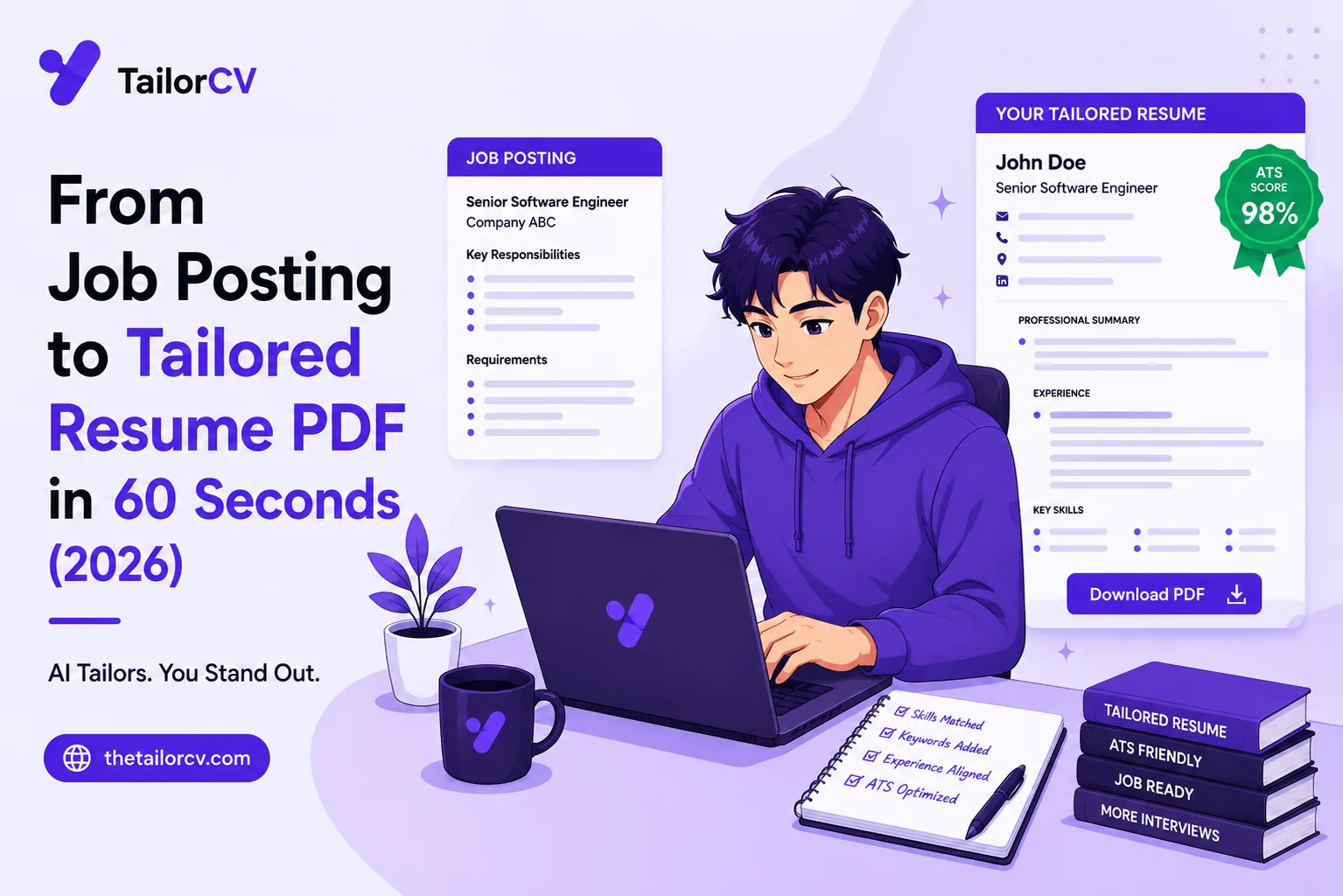
Ten minutes to tailor a resume is why most people stop tailoring. So the interesting question is not whether tailoring works — it does — but how far you can compress it without wrecking the quality. The honest answer in 2026 is about sixty seconds, from open posting to downloaded PDF, and this guide walks the exact flow, what happens in each second, and where the quality actually comes from.
Why 60 Seconds Is the Number That Matters
There is a threshold below which a good habit becomes automatic. Ten minutes per application sits above it — you weigh whether this job is "worth" tailoring for, and by application fifteen you skip it. One minute sits below it. At one minute you do not weigh anything; you just do it, every time, because there is nothing to decide.
That is why sixty seconds is not a vanity metric. It is the point at which tailoring stops being an effort and becomes a default — and defaults are what actually hold up across a real job search. The whole value is not the nine minutes saved on any one application; it is that the habit survives all twenty-five.
The 60-Second Flow, Step by Step
Here is the full path from posting to PDF, using an on-page tool like TailorCV's extension. The times are approximate but honest.
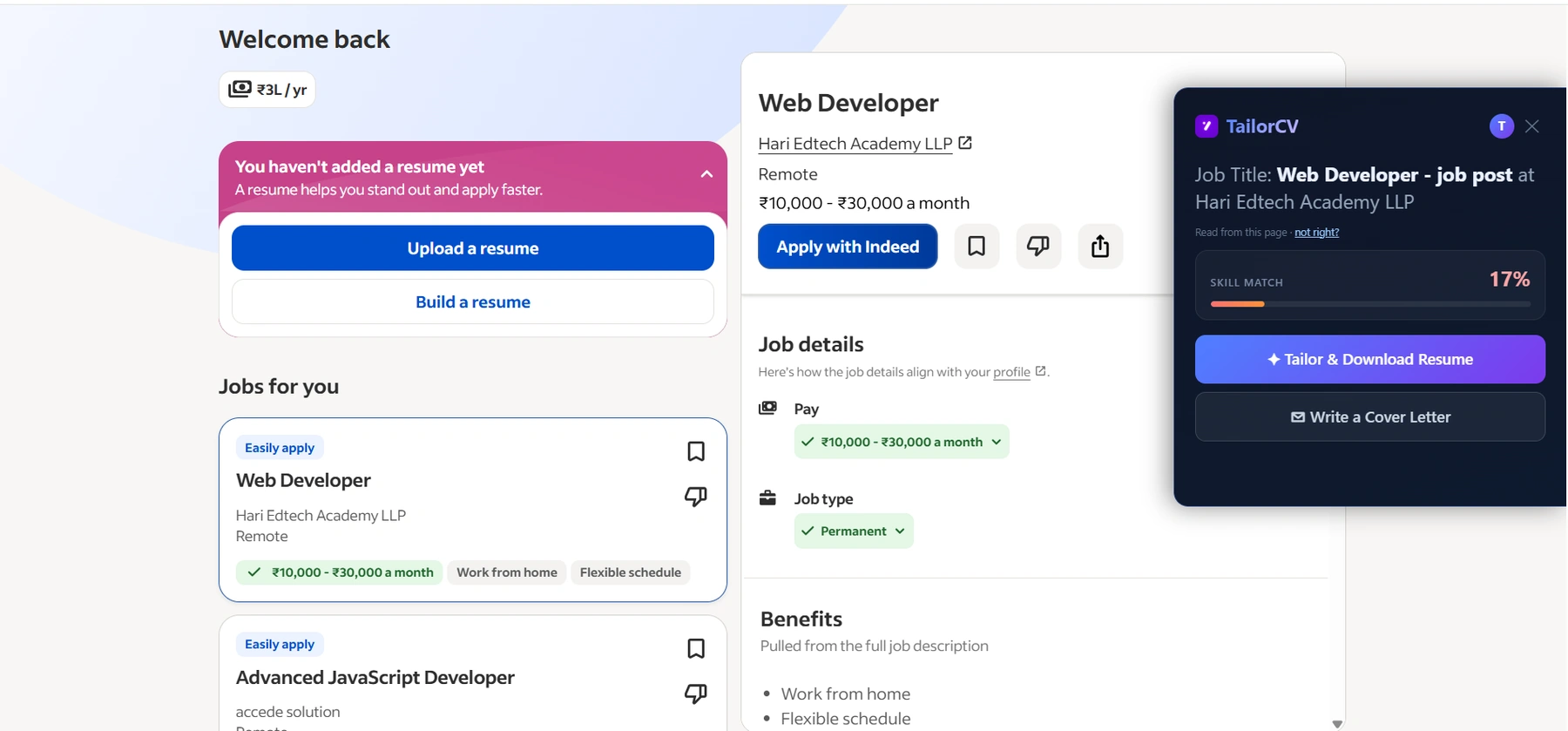
Seconds 0–5: Open the posting. You are already on the job — LinkedIn, Indeed, Naukri or an ATS board. You open the panel. It reads the job description off the page — no copy-paste, which is where most of the manual ten minutes actually goes.
Seconds 5–15: See the match score. The panel shows your skill-match score against this posting and the keywords you are missing. You now know, before doing anything, whether the resume is your problem for this role — the difference between an ATS score and a resume score.
Seconds 15–45: The rewrite. One click. The tool rewrites your bullets to carry the missing keywords — from your real experience, in your own voice, without stuffing or fabricating. It produces a parseable, ATS-friendly resume in a format that survives the filter.
Seconds 45–55: Read it. This is the step you never skip. Glance over the rewrite — does it read like you, sharper and matched? Adjust anything that feels off. The tool saved you the mechanical work; this is you keeping judgement in the loop.
Seconds 55–60: Download. The tailored PDF downloads, ready to submit, saved automatically to your library with its score and the job. Optionally, one more click writes the matching cover letter.
Sixty seconds, posting to PDF, and every second of it maps to something you would have done by hand — just without the file-duplicating, keyword-hunting, reformatting friction.
Where the Quality Comes From
Fast and good sound like opposites, so it is worth being clear about why the sixty-second version is not worse.
The manual ten minutes is not ten minutes of thinking. It is mostly mechanical: copy-pasting, duplicating files, hunting through the JD for keywords, reformatting, renaming. The actual judgement — is this bullet true, does it match the role — takes seconds. A good tool automates the mechanical part and leaves the judgement to you (that is the ten-second read step). So you are not removing the quality; you are removing the drudgery around it. The best keywords still land, the achievements stay quantified, and the honesty guardrail holds — you just did it in one minute instead of ten. The manual method and the fast method converge on the same output.
What 60 Seconds Does to a Whole Search
Run the arithmetic across a real search and the compression compounds.
Twenty-five applications a month at ten minutes each is over four hours of tailoring — the exact hours people do not have, so they skip it. At one minute each, it is twenty-five minutes total. That is not just time saved; it is the difference between tailoring every application and tailoring none by week three. The reply rate on twenty-five matched applications is a different universe from twenty-five generic ones, and our tailored vs generic resume piece shows the gap. Speed here does not trade against quality — it protects quality by keeping the habit alive.
The Objections, Answered Honestly
Fast anything invites suspicion, and some of it is fair. Here are the real objections and honest answers.
"Sixty seconds means it is shallow." The depth was never in the minutes — it was in whether the resume carries the right terms and reads true. A careful human spends most of ten minutes on mechanics (copy-paste, reformatting, file naming), not on the two decisions that matter. Automating the mechanics does not make the decisions shallower; it just stops you spending nine minutes on drudgery. The best keywords either land or they do not, regardless of how long it took.
"The output will sound robotic." It will if the tool is bad. A good one keeps your own voice and avoids the keyword-stuffing that reads as machine-written. This is exactly why the ten-second read step exists — you catch anything that sounds off before it goes out. Robotic output is a tool-quality problem, not a speed problem.
"It will make things up." A well-built tool is constrained to re-express your real experience and will not fabricate employers, projects or skills. But this is the objection to take most seriously, which is why you read the output — a lie on a resume surfaces in the interview, and that is worse than a slow resume.
"Recruiters can tell it was AI." They can tell a resume is generic or stuffed — not that a tool touched it. A resume that genuinely matches the role, quantified and in your voice, reads as a strong candidate however it was produced. The tell is genericness, not tooling.
The honest summary: speed is safe when the tool is honest and you read the result. Sixty seconds is not a shortcut around quality — it is a shortcut around tedium, with your judgement still in the loop.
The Same 60 Seconds Everywhere
The flow holds across boards and situations because they all feed the same filter. It is identical on every major board, and it holds for remote roles — where matching matters more and a remote cover letter helps — and for applying abroad, where conventions differ for the USA and Canada, including resume vs CV. Watch for job scams when moving fast, and note the startup vs enterprise difference. The full fast method is in matching your resume to a job description fast and how to increase your ATS score.
After the 60 Seconds
The tailored PDF gets you seen; the rest of the search still matters. Add the cover letter, send a follow-up after applying and after the interview. Before the interview, research the company, rehearse behavioural questions, tell me about yourself and why do you want this job, and run a mock interview; the full interview prep guide covers more. When one does not land, handle the rejection.
Freshers: your ATS score as a fresher, projects that get interviews, your first tech job, a job with no experience, campus placement, a portfolio site, and the right template.
Frequently Asked Questions
Can you really tailor a resume in 60 seconds? Yes, with an on-page tool that reads the posting for you and rewrites your resume in one click — plus about ten seconds for you to read the output. Most of the manual ten minutes is mechanical work (copy-pasting, reformatting, file management), which the tool removes; the actual judgement takes seconds and stays with you.
Is a 60-second tailored resume worse than a hand-tailored one? No, if the tool is honest and you read the output. The manual ten minutes is mostly drudgery, not thinking. A good tool automates the drudgery and leaves the judgement to you, so the result matches a careful hand-tailored resume — you just skipped the tedium.
Do I need to review the AI's output? Always glance over it — that is the ten-second read step. Check the rewritten bullets are true and sound like you. The click saves the mechanical work; it does not remove your responsibility to approve what you send.
Does it still produce an ATS-friendly PDF? A good tool outputs a single-column, parseable, ATS-friendly PDF by default. Speed does not mean sloppy formatting — the whole point is a ready-to-submit file that both the parser and a human can read.
Putting It All Together
Sixty seconds from posting to tailored PDF is not a gimmick — it is the threshold that turns tailoring from an effort you skip into a default you keep. The compression works because most of the manual ten minutes was never the valuable part; it was copy-pasting and reformatting. Automate that, keep the ten-second judgement read, and you get the same matched resume in a fraction of the time.
The payoff is not the nine minutes per application. It is that the habit survives the whole search — twenty-five matched applications instead of five matched and twenty generic. That is what actually changes your results.
Try it once: open a job you genuinely want, check your match score, tailor, read, download. If it took about a minute and reads like a sharper you, that is the whole idea — now do it on every job, because now you can.
See what tailoring is worth on your resume
Score your current resume against a real job description before you change a word.
Drop your resume here or choose a file
PDF only. Max 2 MB.
We never share your data or use it to train AI models.

Start from a template that tailors well
Clean structure means swapping keywords per job takes minutes, not a re-layout every time.
Was this guide useful?
Be the first to rate it.