 TD
TD
Key Takeaways
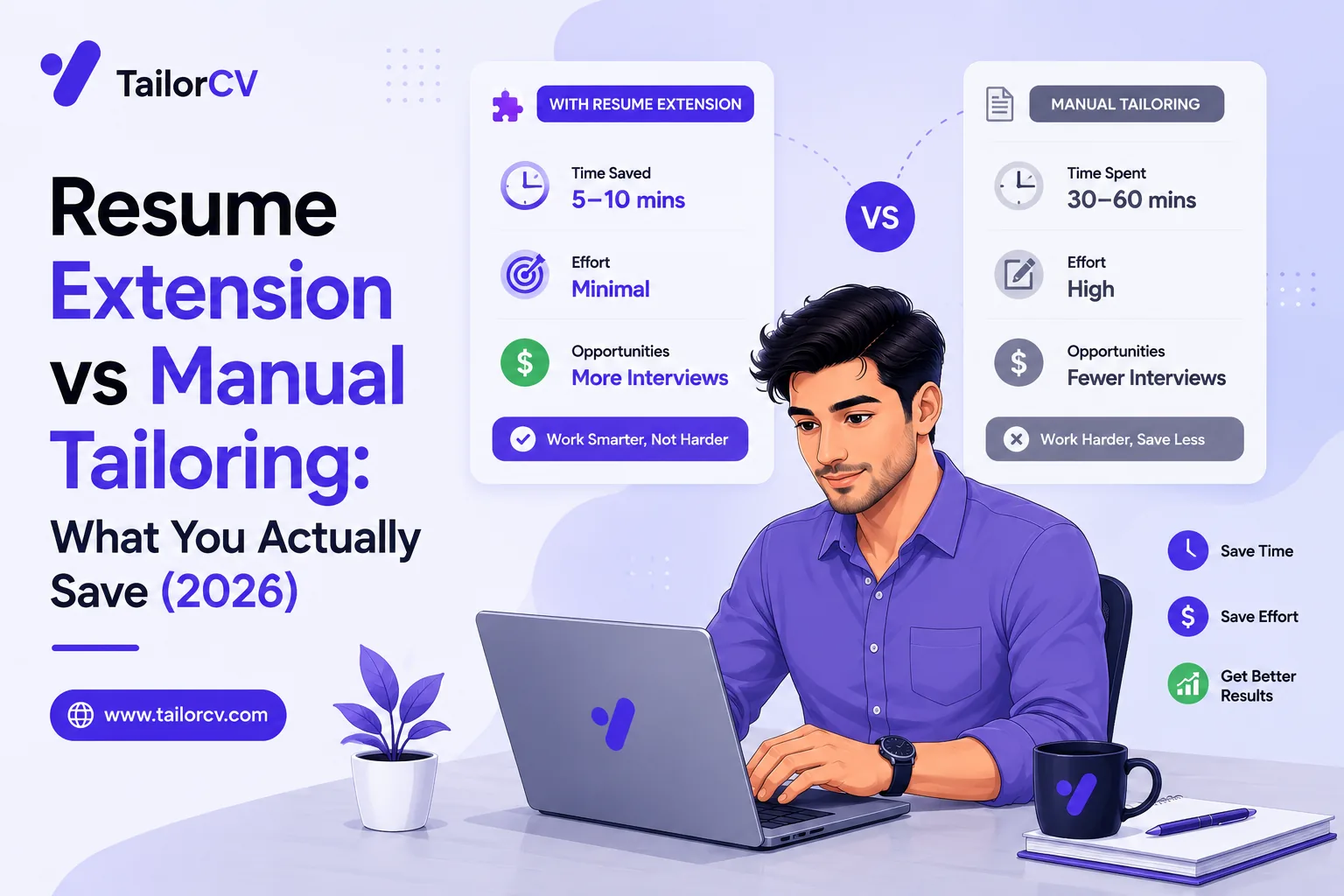
- A good extension and careful manual tailoring aim at the identical result - a resume matched to the specific posting.
- By hand, tailoring one resume to one posting takes about ten minutes of real work.
- The extension collapses those ten minutes to roughly one.
- Manual tailoring does not fail because it is bad - it fails because it degrades as the search wears on.
- There are situations where doing it by hand is genuinely better, and the honest answer is to do both in sequence.
You do not strictly need a tool to tailor your resume. You can do the whole thing by hand — plenty of people do, and done carefully it works. So the honest question is not "can I tailor manually" but "what does a Chrome extension actually save me, and is it worth it?" This guide answers that directly, including the cases where manual tailoring is genuinely the better choice.
First, They Do the Same Thing
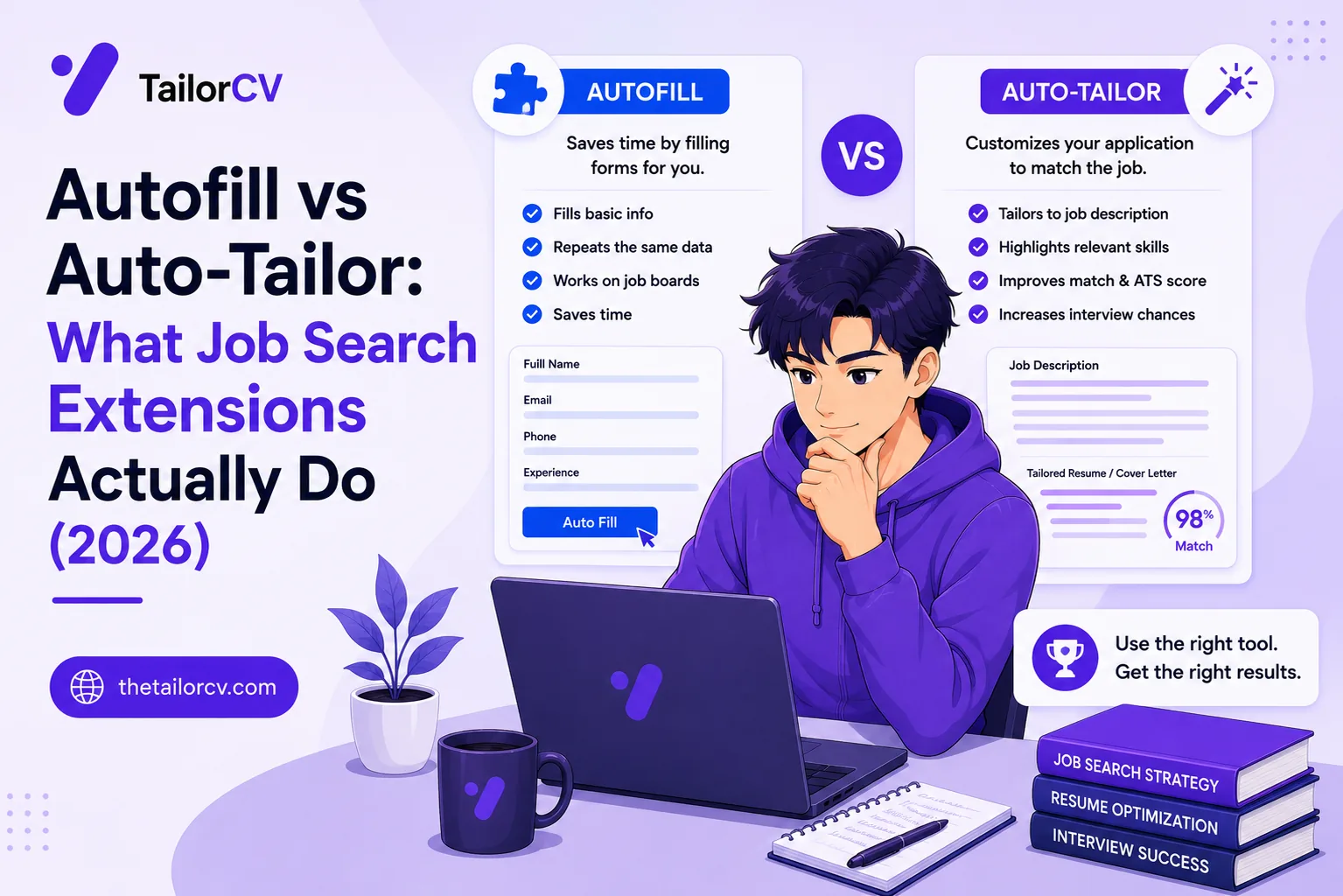
Let us be clear up front: a good resume extension and careful manual tailoring aim at the identical result — a resume matched to the specific posting. Both read the job description, find the required skills and phrases, work the ones you genuinely have into your bullets, reorder for relevance, and keep the resume parseable. The extension is not doing something different from what a careful applicant does by hand — it is doing the same thing faster and more consistently. The manual method and the tool converge on the same output.
So the comparison is not about what gets done. It is about time, consistency, and where each one wins.
What Manual Tailoring Costs
By hand, tailoring one resume to one posting looks like this: open the job description, read it closely, note the repeated skills and phrases, duplicate your resume file, work the missing keywords in honestly, reorder your skills section, rewrite your top bullets in your own voice, check it still passes ATS formatting, export to PDF, rename it sensibly, and upload.
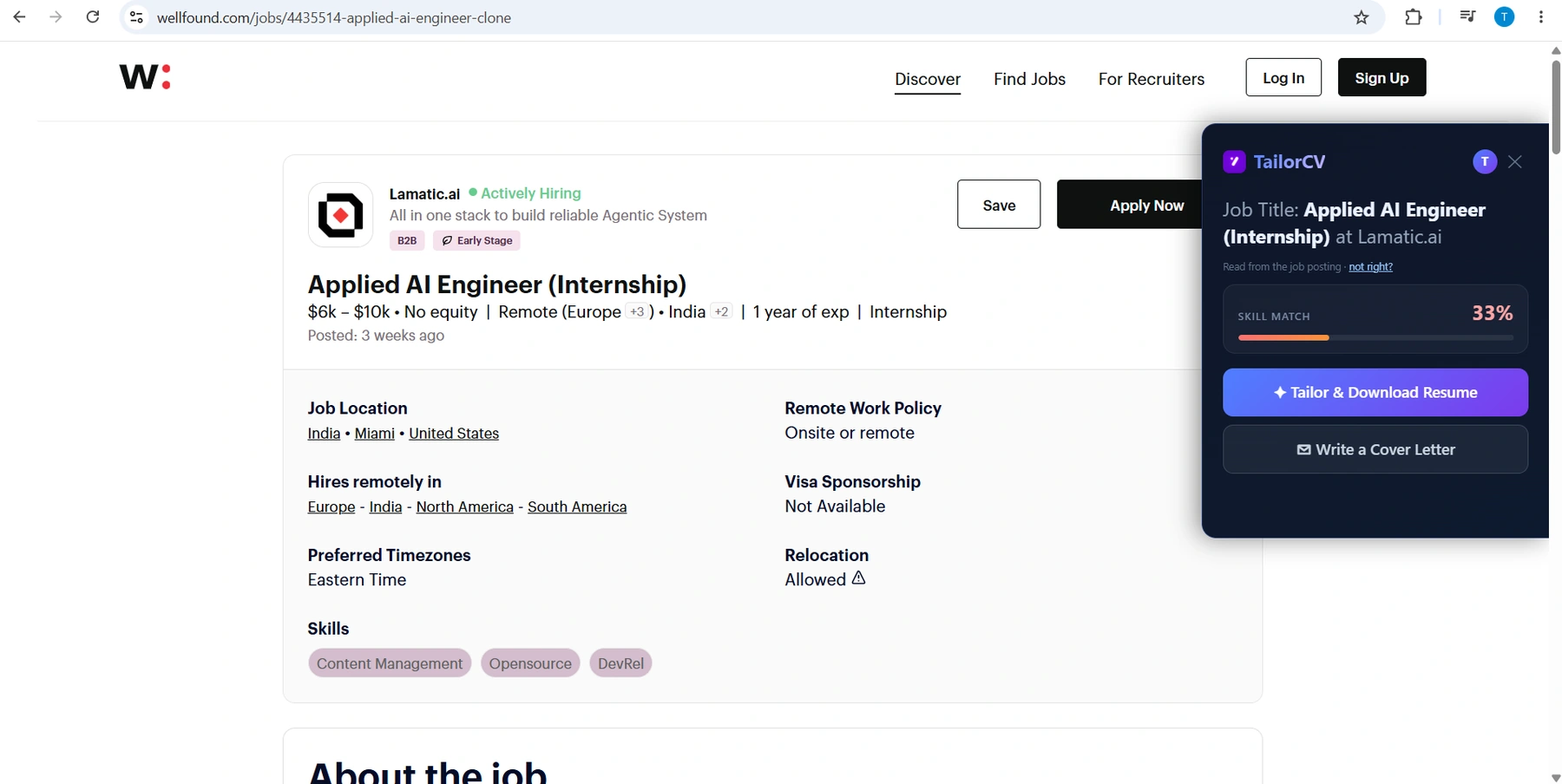
What it looks like on a LinkedIn job post
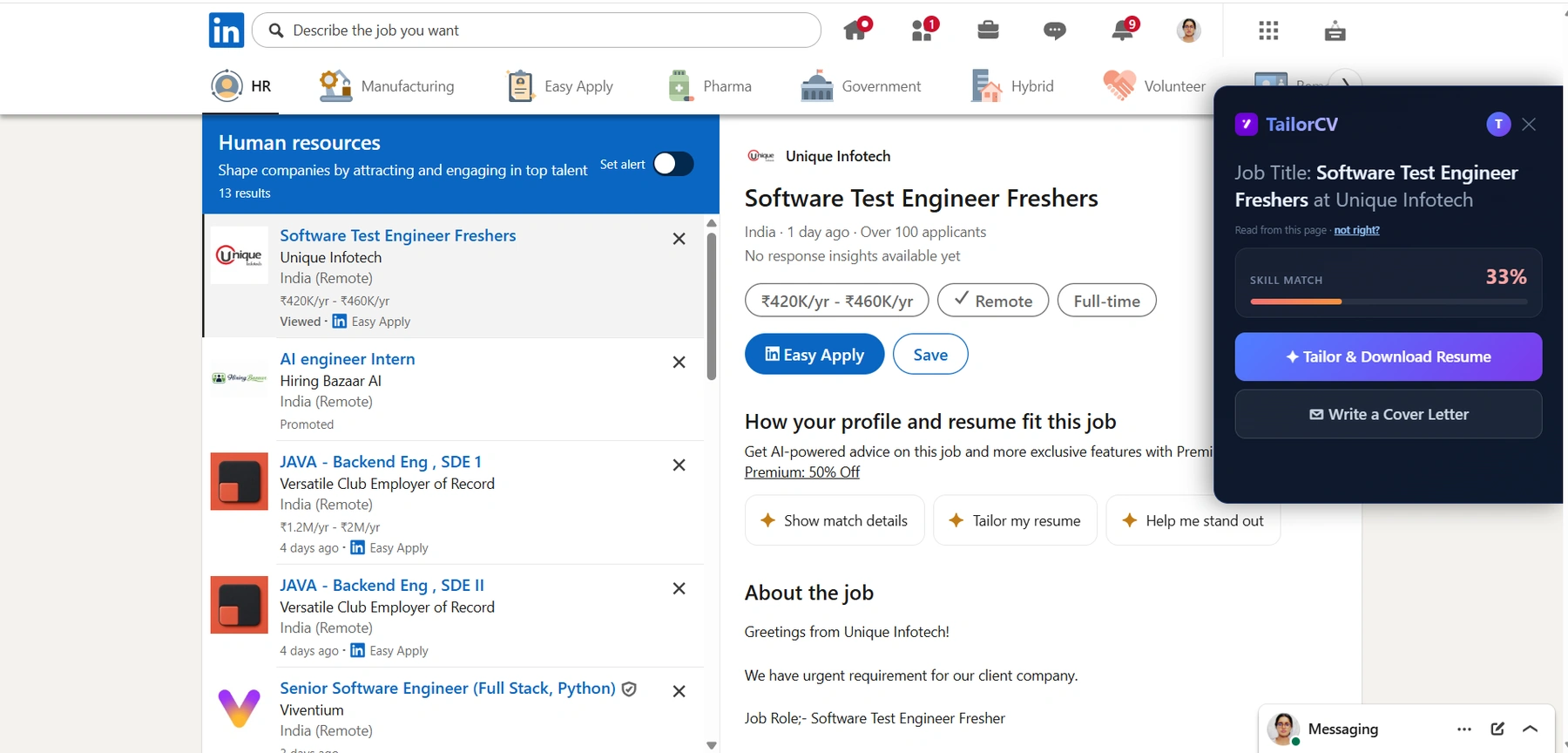
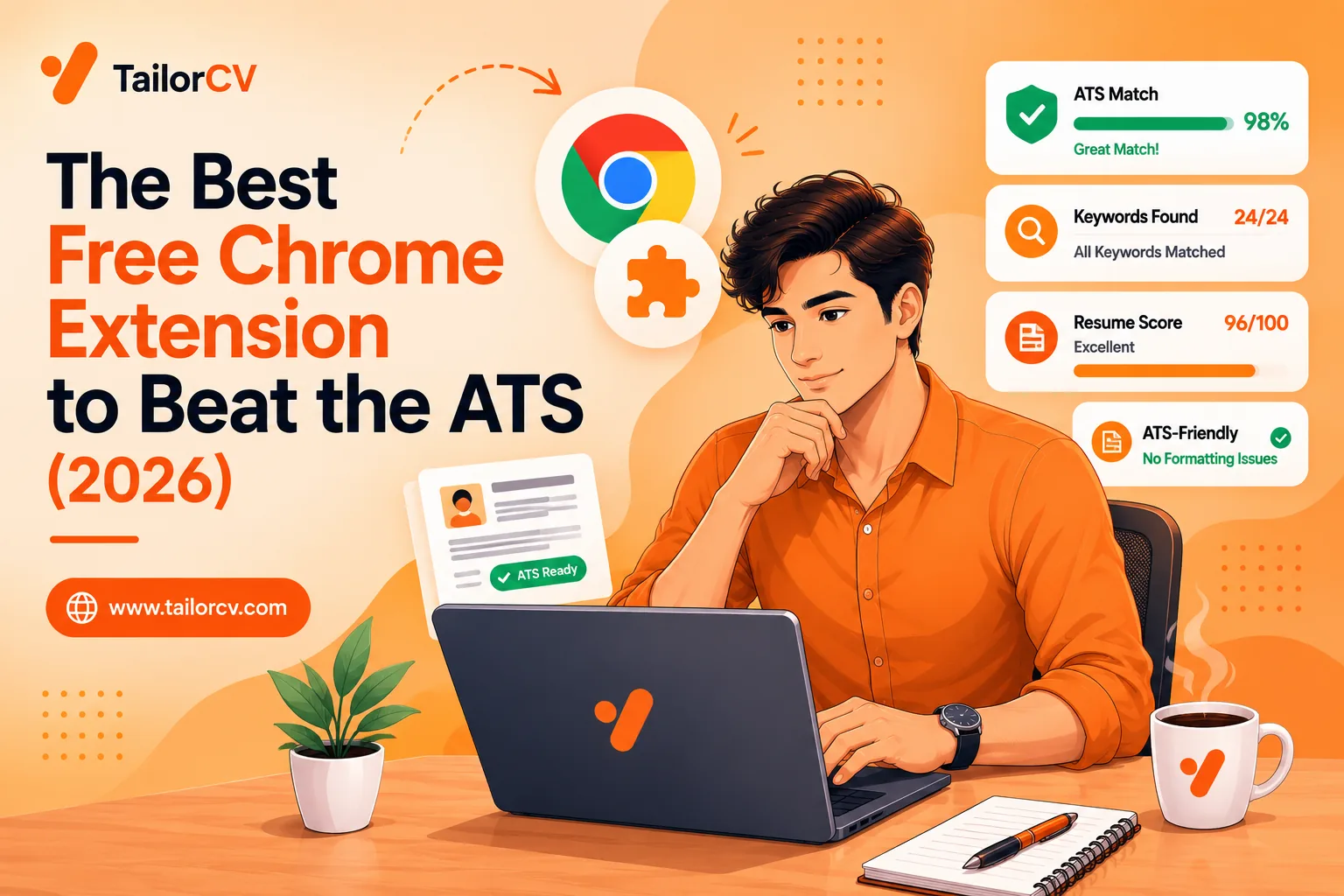
And the same on LinkedIn: the extension reads the posting off the page you are already on, so the match score arrives before you hit Easy Apply.
Done properly, that is about ten minutes. Our tailor in 5 minutes guide trims it with practice, but ten is realistic for most people doing it carefully. The skill itself is learnable and worth learning — understanding which keywords beat the ATS and how to quantify achievements makes you better at judging any resume, tool or no tool.
What the Extension Saves
The extension collapses those ten minutes to about one. Open the job, the panel reads the description off the page, shows your match score, and one click rewrites the resume and downloads the PDF — the flow TailorCV's extension is built around.
But raw time-per-application is not the real saving. The real saving is consistency, and it is bigger than the clock suggests.
The Consistency Problem (the Real Argument)
Here is the thing that decides it. Manual tailoring does not fail because it is bad — it fails because it degrades. You tailor beautifully on application one, carefully on application five, adequately on application ten, and by application fifteen, at 11pm, you tell yourself the resume is "close enough" and send the generic version. Not because you got worse at tailoring, but because willpower is finite and the friction is real.
So the honest comparison is not "great manual tailoring vs good tool tailoring on one resume." Over a real search of twenty-five-plus applications, it is "occasionally excellent, then increasingly generic manual tailoring" vs "consistently good tool tailoring, every time." And consistent-good beats excellent-then-generic across a whole search, because the applications that matter are spread across all of them — including the ones at 11pm you would have phoned in.
That is the real saving: not ten minutes per job, but the elimination of the moment where the habit collapses. The tool does application fifteen exactly as well as application one. This is why how many jobs to apply to per day is a quality question, and why consistency, not peak effort, wins job searches.
Where Manual Tailoring Is Genuinely Better
An honest comparison has to include this: sometimes you should do it by hand.
When the resume matters enormously and you have time. For a dream role you are applying to once, spend the twenty minutes and craft it yourself, tool-assisted or not. The stakes justify the care.
When you are learning. Doing it manually a few times teaches you what tailoring actually is — you learn to read a posting, spot the priorities, and see the difference between generic and matched. That skill makes you a better judge of any tool's output. We would genuinely recommend tailoring a few by hand before leaning on a tool, precisely so you can tell whether the tool's output is good.
When you distrust the output. A tool you cannot check is worse than doing it yourself. If an extension produces bullets you have not read and cannot vouch for, do not send them. The right use of a tool is a fast first draft you approve, not a black box you submit blind.
Where the Extension Is Genuinely Better
And the flip side, honestly:
At volume. This is the decisive case. Across a real search, the tool's consistency wins, full stop.
Late at night, tired, on the tenth application. Exactly when manual quality collapses and the tool does not.
On unfamiliar boards. A good extension reads the posting on LinkedIn, Indeed, Naukri and ATS boards without you hunting for the description, and it avoids the formatting mistakes that manual copy-paste often introduces.
When you want the record. Each tailored version saved to a library with its score and job, automatically.
The Honest Recommendation
Do both, in sequence. Tailor a handful by hand first to learn the skill and calibrate your judgement — read how to match your resume to a job description fast and try it. Then, once you know what good looks like, use the tool for volume, reading its output because you now can tell whether it is right. That gives you the skill and the sustainability, which is better than either alone.
The failure mode to avoid is leaning entirely on a tool you cannot evaluate. The tool is a force-multiplier on judgement you have, not a replacement for judgement you lack.
Across Situations
The choice holds across contexts. For remote roles, volume and competition push toward the tool; a remote cover letter helps. Applying abroad shifts conventions — the USA, Canada, and resume vs CV. Note the startup vs enterprise difference in emphasis. Whatever the context, the resume then needs a cover letter with a strong opening line, a follow-up after applying, and, once interviews come, prep — behavioural questions, tell me about yourself, why do you want this job, a mock interview, a follow-up after the interview, salary negotiation, and handling rejection when needed. Freshers: ATS score for freshers, projects, first tech job, a job with no experience, campus placement, the right template, and explaining a gap.
The Hidden Cost of "Free" Manual Tailoring
People call manual tailoring "free" because it costs no subscription. But it is not free — it costs time and willpower, and both are scarcer than money during a job search.
Count it honestly. Ten minutes per application, across twenty-five applications a month, is over four hours — of tedious, repetitive editing, done when you are already drained from scrolling listings and getting ghosted. That time has a cost: it is time not spent on interview prep, on networking, on building a portfolio, or on rest that keeps you sane enough to keep going. And the willpower cost is worse than the time cost, because it is what causes the habit to collapse — every manual tailoring session spends a little of the finite resource that keeps you applying at all.
So "free" manual tailoring often ends up more expensive than a tool, paid in the currency that actually runs out in a job search: energy. The question is not "can I avoid paying for a tool" but "where do I want to spend my limited hours and willpower" — and grinding the same keyword-matching task twenty-five times, badly by the end, is rarely the best answer. This is the same logic as applying to fewer jobs but tailoring each: spend the scarce resource where it changes the outcome.
Frequently Asked Questions
Is a resume tailoring extension worth it, or can I just do it by hand? You can absolutely tailor by hand, and it works. The extension saves about nine minutes per application and, more importantly, keeps the quality consistent across a whole search — manual tailoring tends to degrade by the tenth application. For volume, the tool wins; for a single high-stakes application with time to spare, by hand is fine.
Does a tool tailor better than a person? On a single resume, a careful person can match or beat it. Across twenty-five applications, the tool wins on consistency, because human quality drops as willpower runs out. The honest comparison is not one resume — it is a whole search.
Should I learn to tailor manually first? Yes, ideally. Tailoring a few by hand teaches you what good looks like, so you can judge whether a tool's output is any good. Use the tool for volume afterward, but read its output — the skill makes you a better user of the tool.
Will a tool fabricate experience I do not have? A good one will not — it re-expresses what is genuinely on your resume. But read the output regardless. The right use is a fast draft you approve, not a black box you submit unchecked.
Putting It All Together
Manual tailoring and a resume extension are not enemies — they are the same task at different speeds and different consistency. By hand, you get the skill and full control, at ten minutes a job that quietly degrades to zero by application fifteen. With a tool, you get one-minute consistency that holds across the whole search, provided you read the output.
The honest answer is to use both: learn by hand, scale with the tool, and never send bullets you have not checked. That combination — judgement plus consistency — beats either the purist grind or the blind-automation shortcut.
Try it on a job you actually want: check your match score, tailor it once by hand to feel the work, then once with a tool to feel the difference. Whichever you choose, the thing that matters is that every application is matched — and the tool exists to make sure that is still true at 11pm on application fifteen.
Check your match before you install anything
Same score the extension shows on a job page - run it here on any resume and job description.
Drop your resume here or choose a file
PDF only. Max 2 MB.
We never share your data or use it to train AI models.

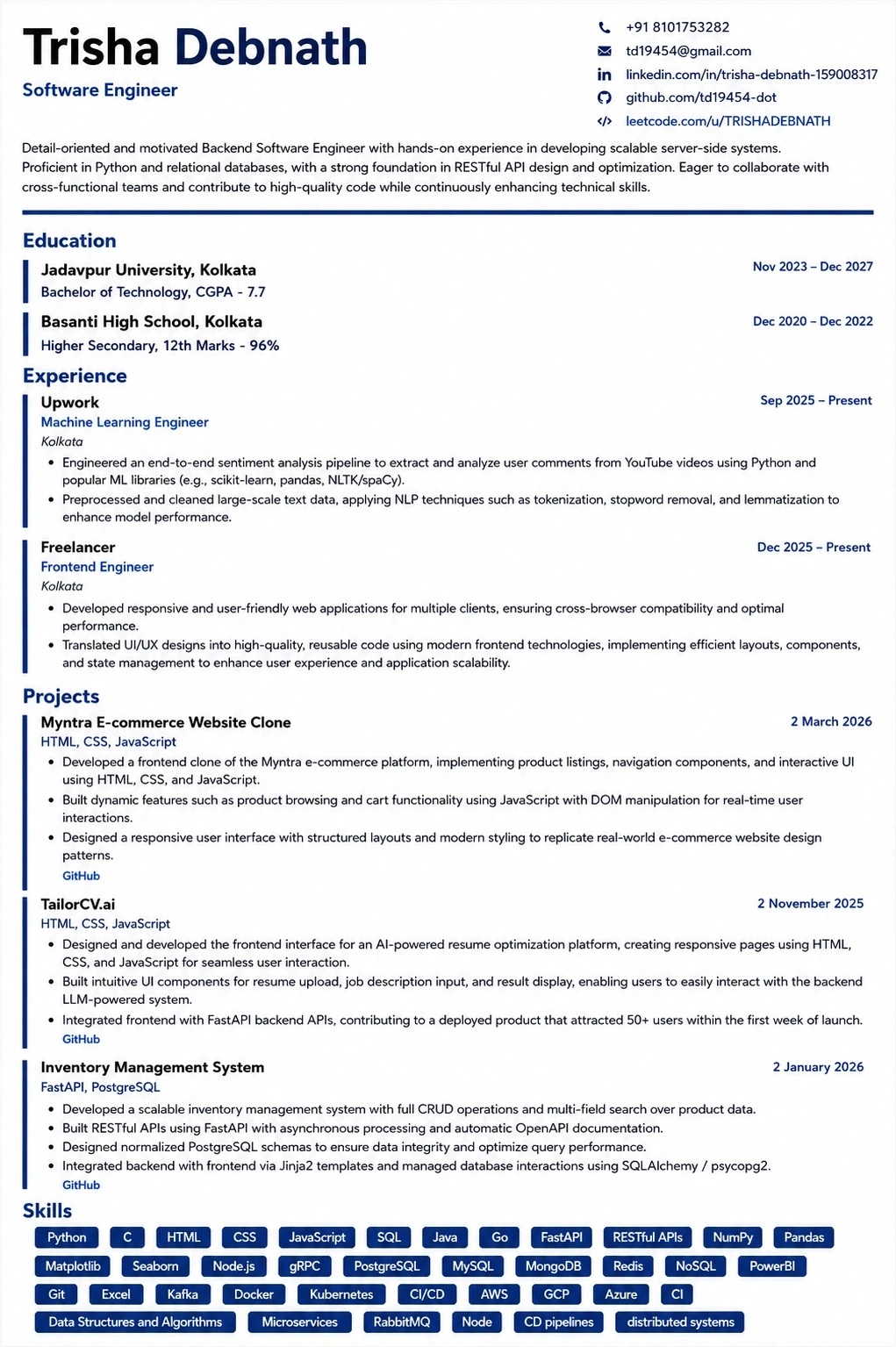
What the tailored resume looks like
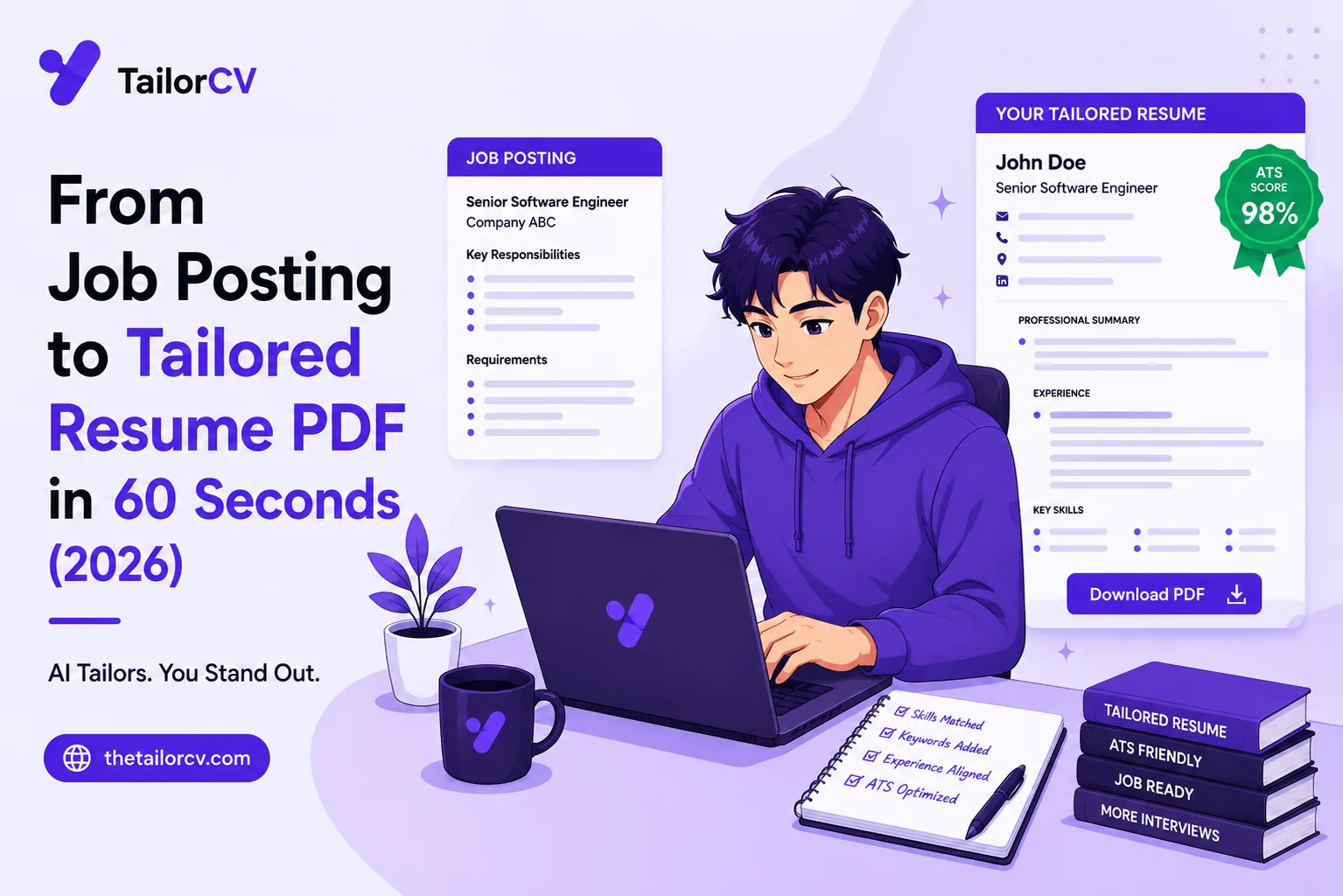
This is the format the extension exports to — ATS-tested, so the match score you saw survives the parser.
Was this guide useful?
Be the first to rate it.