TD
TD

Key Takeaways
- Speed and quality feel opposed because the slow part of a good application is tailoring the resume by hand.
- The fast-and-tailored workflow has three phases: prepare once, apply in batches, then follow up.
- The minutes hide in three places - reading the posting, tailoring the resume, and filling the form.
- The trade-off exists only because tailoring is slow manually; remove that and it dissolves.
- Watch for the trap of confusing activity with progress - it can waste months.
There is a trap at the centre of every job search: the two things you want — to apply faster and to apply better — feel like opposites. Speed pushes you toward one generic resume you can fire everywhere; quality pushes you toward slow, careful tailoring. Most people pick speed, send generic resumes, and wonder why nothing lands.
This guide is about escaping that trade-off — building a workflow that is genuinely fast and tailored, so you can apply to more jobs without the volume being wasted.
Why "Faster" Usually Means "Worse"
The reason speed and quality feel opposed is real. The slow part of a good application is tailoring the resume — reading the posting, matching the keywords, rewriting the top bullets. Do it by hand and it is ten minutes a job, so the obvious way to go faster is to skip it and send the same resume everywhere.
Except that generic resume is exactly what fails. When you apply through a portal, your resume is parsed and matched by exact language against the posting, and a generic one does not carry the specific terms it needs, so the filter drops it before a human looks. Our tailored vs generic resume piece shows the gap. So "faster" the naive way just means "more applications that were always going to fail" — you have optimised your throughput of rejections.
The real goal is not more applications. It is more matched applications per hour. That is a different target, and it changes everything about how you set up.
The Fast-and-Tailored Workflow
Here is a workflow that keeps both. It has three phases: prepare once, apply in batches, and follow up.
What optimizing actually does to your resume
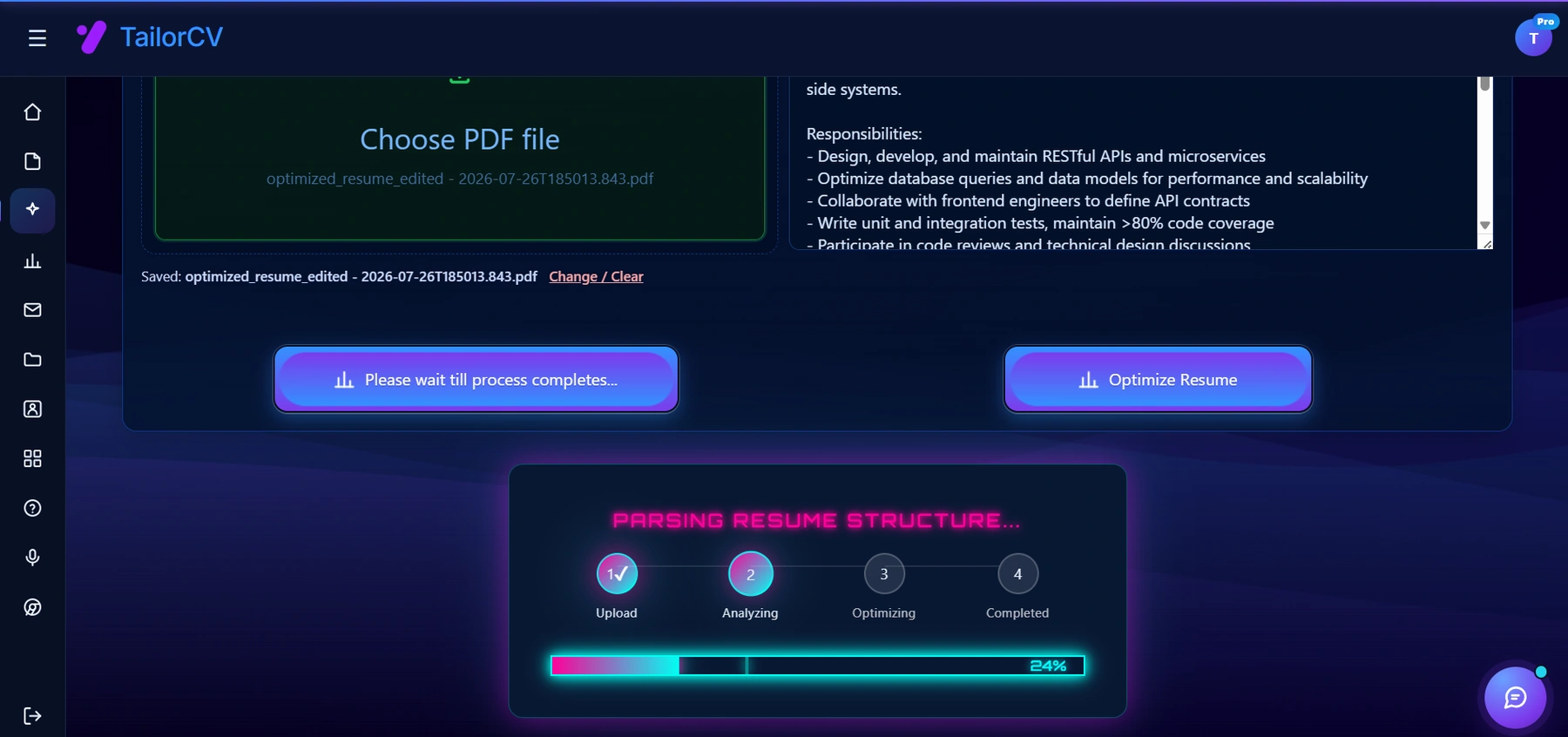
The tool parses your resume the way an ATS would before it changes anything, so the edits it suggests are grounded in the posting itself.
Phase 1 — Prepare once (60 minutes, one time). Get your base resume genuinely solid before you apply to anything, because every tailored copy inherits its quality. Run it through a free ATS score, fix the formatting so it parses, make sure it is ATS-friendly, and quantify your achievements. This hour is not overhead — it is the thing that makes every later application faster, because you are only ever adjusting a strong base, never fixing a weak one.
Phase 2 — Apply in focused batches. Do not apply reactively as you scroll. Set aside a block, gather five to ten roles you genuinely want, and work through them. For each: read the posting, tailor the resume to it, attach a matching cover letter, submit. Batching beats scattered applying because you stay in the same mental mode instead of context-switching, and it stops the endless-scroll that feels like searching but is not.
Phase 3 — Follow up. A short follow-up after applying and after the interview is something almost nobody does, which is exactly why it works. Keeping each tailored version in a saved resume library makes this trivial — you know exactly what you sent to whom.
Where the Time Actually Goes
If you time your own applications, you will find the minutes hiding in three places: reading the posting, tailoring the resume, and filling the form. Speeding up the search means attacking those three, in order of payoff.
Tailoring is the biggest and most compressible. Ten minutes by hand, and it is the part people skip. Compress this and you win the whole game — which is why matching your resume to a job description fast and tailoring in 5 minutes exist, and why an on-page tool matters most here.
Reading the posting you cannot fully skip, but a tool that extracts the requirements for you turns a careful read into a glance at a match score.
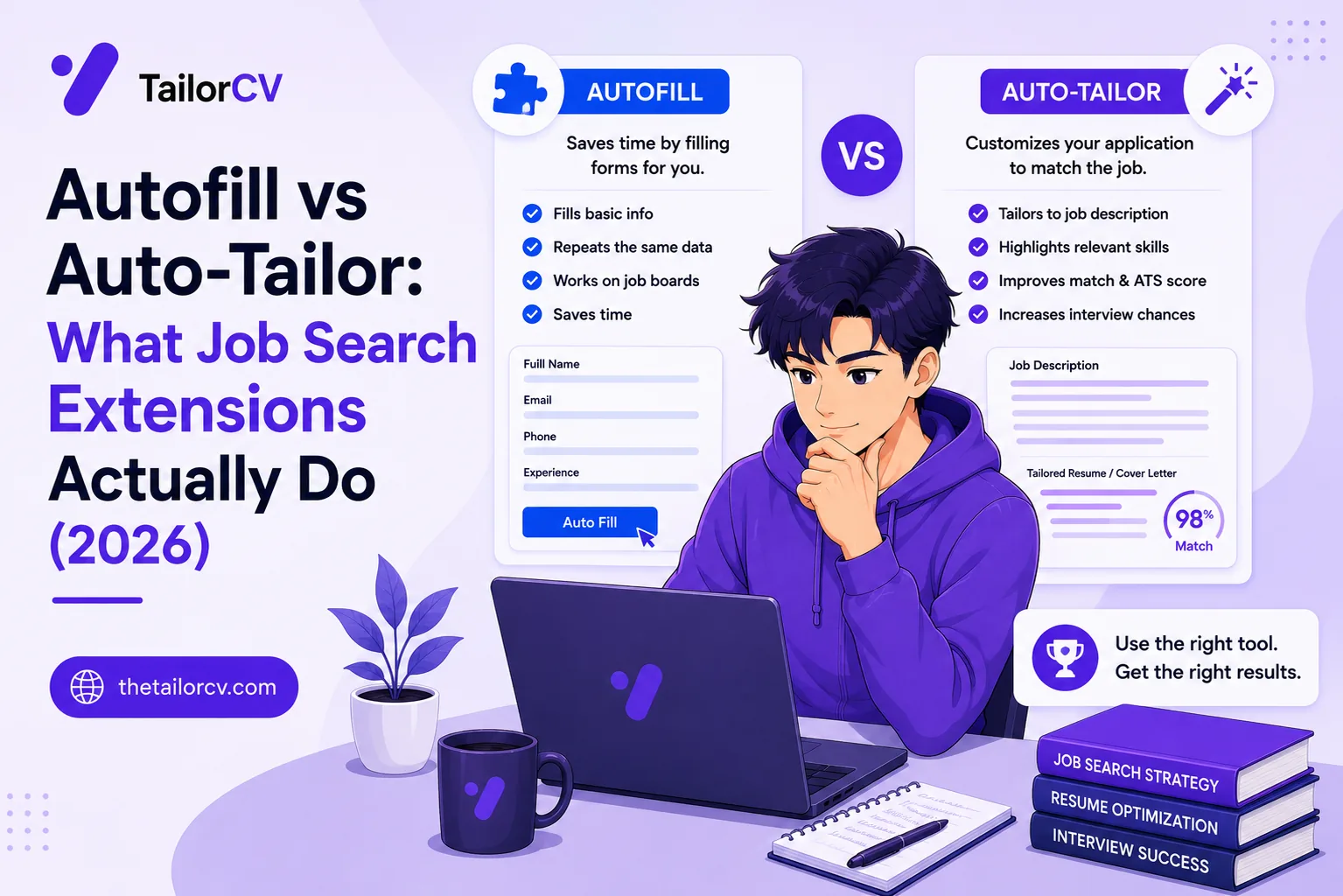
Form-filling is the least compressible honestly — an autofill extension helps, but be careful: autofill speeds up submitting a generic resume, which is the wrong thing to make faster. Fill forms faster, yes, but not at the cost of the tailoring that makes the application worth submitting.
The Tool That Collapses the Trade-Off
The reason the speed-versus-quality trade-off exists at all is that tailoring is slow by hand. Remove that, and the trade-off dissolves — which is exactly what TailorCV's Chrome extension is built to do.
Open any job on LinkedIn, Indeed, Naukri or an ATS board. A panel reads the description off the page and shows your match score instantly. One click tailors the resume to the posting — honestly, from your real experience, in your own voice — and downloads the PDF. A second click writes the cover letter. The tailoring that cost ten minutes now costs one, so you can be fast and matched at the same time. That is the whole point: you are not choosing between speed and quality anymore, because the slow part got fast.
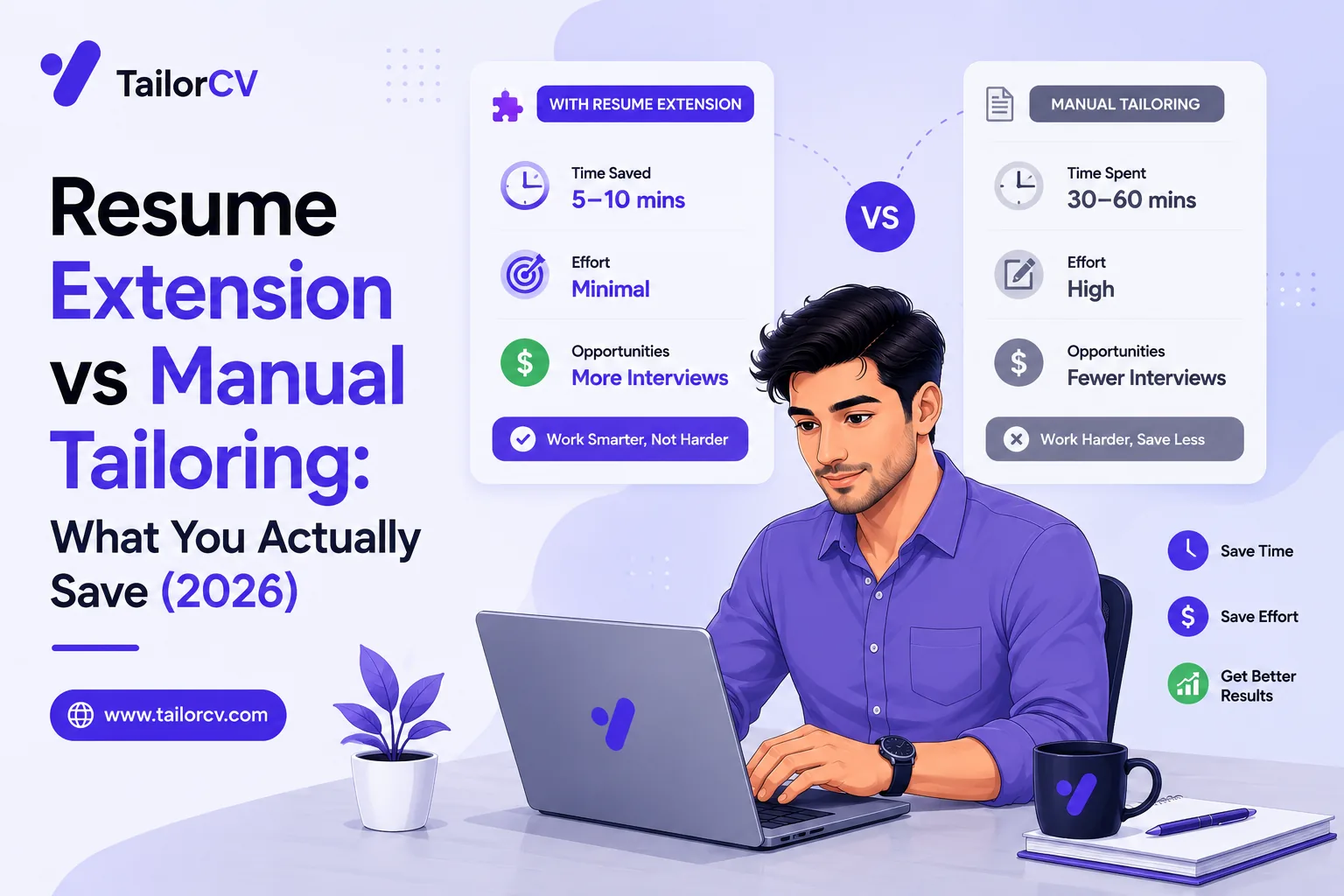
Do the arithmetic. If tailoring drops from ten minutes to one, an application that took twelve minutes now takes three. Over a batch of eight, that is over an hour saved — and every one of the eight is tailored, not generic. You applied faster and better, which the naive speed play could never deliver.
Speed Without Losing Honesty or Quality
Fast should never mean sloppy. A few guardrails keep the pace from degrading the applications.
Do not let speed push you into keyword-stuffing or generic-sounding bullets — a good tool avoids both, but read the output. Do not let a tool fabricate experience; tailoring re-expresses what is real. And do not confuse volume with progress — how many jobs you should apply to per day is fewer, tailored, than the number a spray-and-pray approach tempts you toward. Ten matched applications beat fifty generic ones, and they take less total time once tailoring is fast, because you are not wasting effort on applications that were dead on arrival.
Applying Faster Across Boards and Borders
The workflow travels. It is the same on every board because they all feed the same filter, and it holds for remote roles — where a remote cover letter helps and competition is global — and for applying abroad, where the USA and Canada differ, including whether you need a resume or a CV. Watch for job scams when moving fast — speed is exactly when people skip the checks. And note the startup vs enterprise difference in emphasis.
Tailoring without leaving the job board
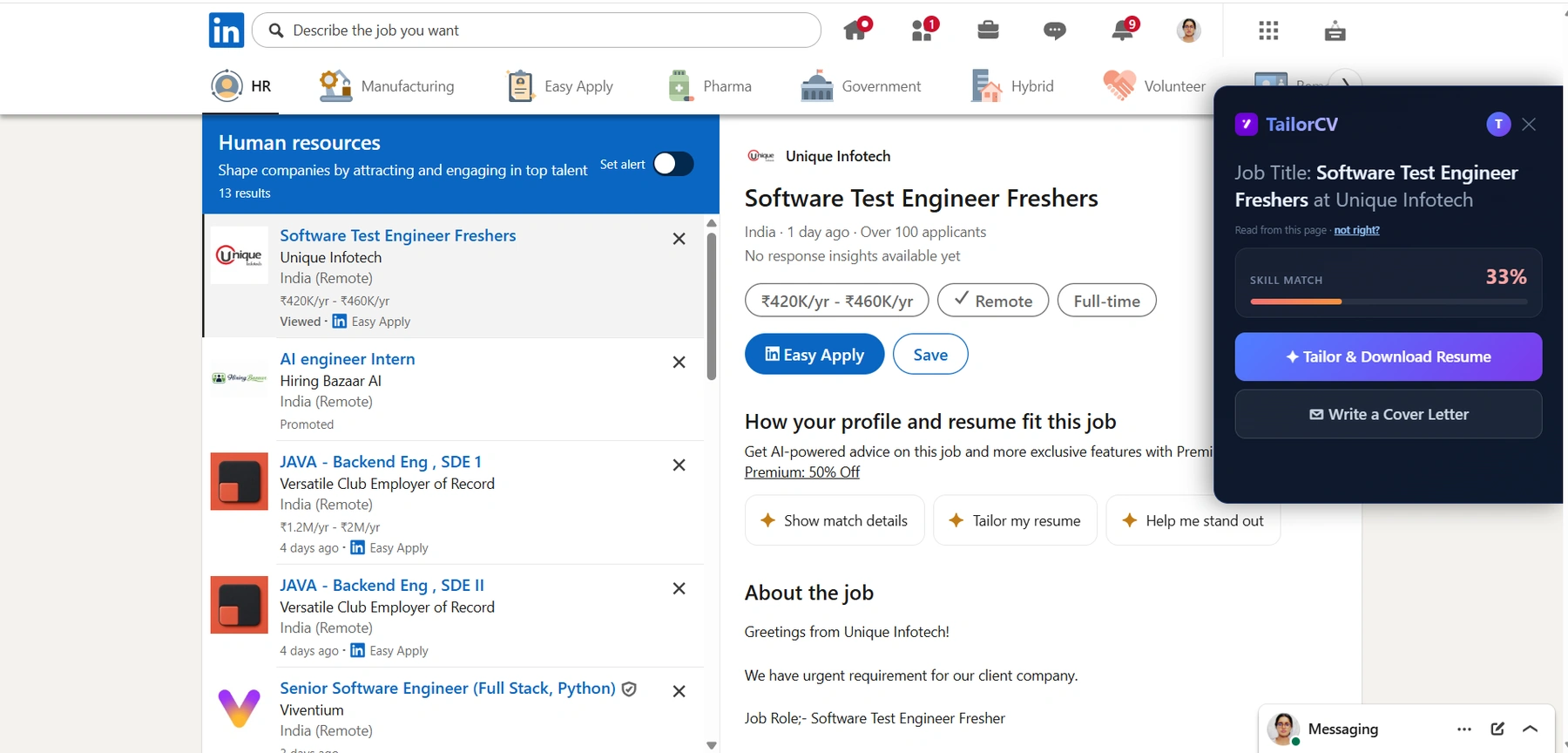
Whichever board you are on, the extension opens beside the listing, reads the description off the page and scores your resume against that role - so "tailor each application" takes a click rather than a detour.
Keeping every tailored resume with its job
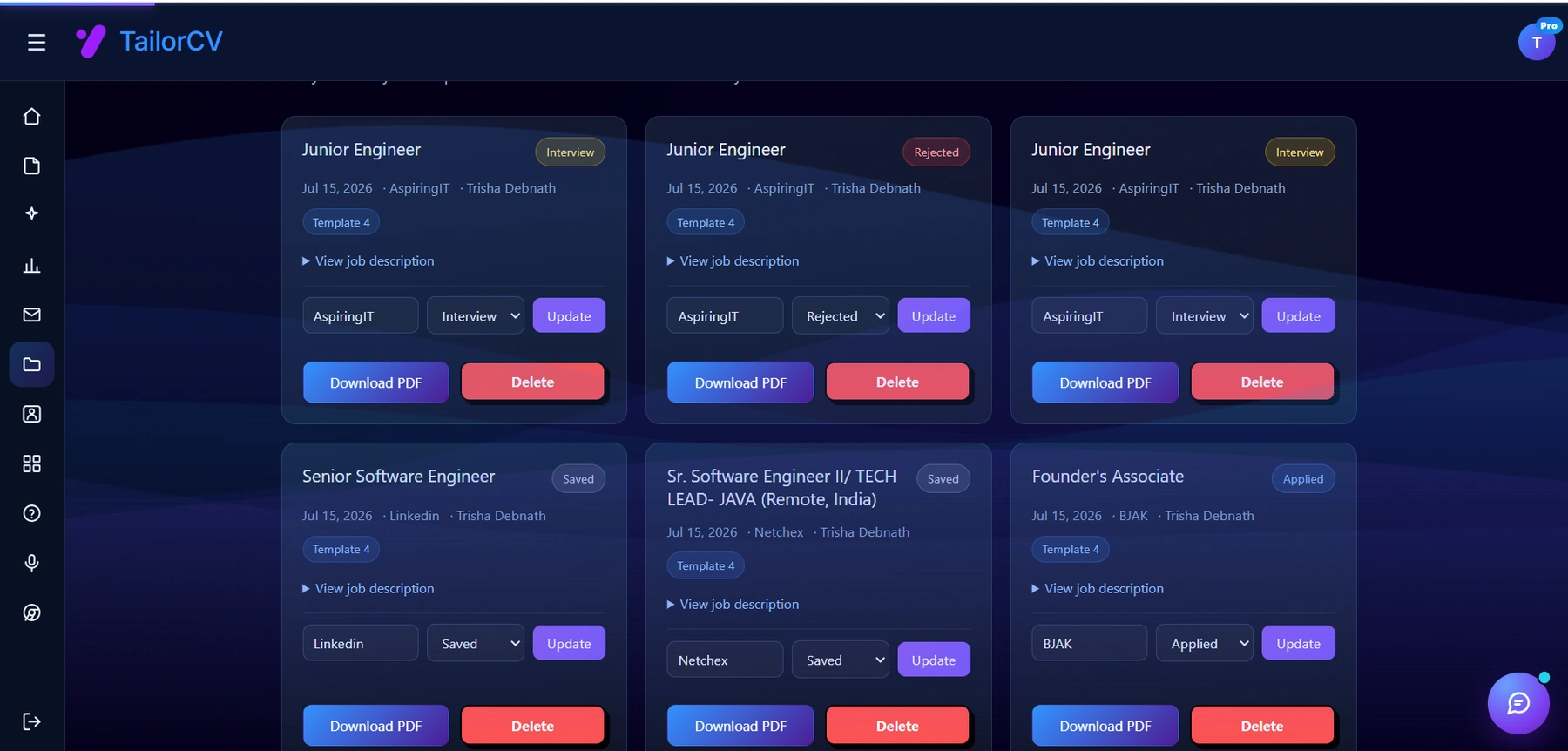
Every resume you tailor is saved against the job it was written for, with the company, the job description and a status you can move from Saved to Applied to Interview. That is the part a spreadsheet usually gets wrong - the tracker and the actual document drift apart, and you end up guessing which version you sent.
After the Applications
Speed getting you seen is only half the job. Before interviews, research the company, rehearse behavioural questions, tell me about yourself and why do you want this job, and run a mock interview; the full interview prep guide covers the rest. When an offer comes, negotiate the salary. When one does not land, handle the rejection.
Freshers: your ATS score as a fresher leans on projects that get interviews; see your first tech job, a job with no experience, campus placement, a portfolio site, and the right template.
The Trap of Feeling Busy
There is a subtle failure mode worth naming, because it wastes months: confusing activity with progress.
Scrolling listings, saving jobs, refreshing LinkedIn, firing off ten quick-applies — all of it feels like job searching, and at the end of the day you feel like you worked. But most of that motion produces nothing. Ten generic quick-applies that all get filtered out is not ten steps forward; it is a busy way of standing still. The feeling of productivity is real; the productivity is not.
Fast-and-tailored applying flips this. Because each application is matched, the smaller number you send actually move — they reach humans, they generate replies, they turn into interviews. You do less motion and get more result, which feels worse in the moment (fewer applications sent) and works far better in the outcome (more that land). Learning to measure your search by replies rather than applications-sent is one of the most useful mindset shifts in a job hunt, and it pairs with knowing how many jobs to apply to per day is a quality question, not a quantity one.
The practical tell: if you have sent fifty applications and heard nothing, do not send fifty more the same way. Slow down by one notch, tailor properly (fast, on the page), and watch whether the reply rate changes. It usually does — because the problem was never speed, it was that speed had made every application generic. A good match score on ten jobs beats a blur of fifty.
Frequently Asked Questions
How can I apply to jobs faster without sending the same resume? Get your base resume solid once, then compress the slow part — tailoring — with an on-page tool that reads the posting and rewrites your resume to match in one click. Apply in focused batches rather than reactively. This keeps every application tailored while cutting the time per application from ten-plus minutes to a few.
Is it better to apply to many jobs or few? Few, tailored, beats many, generic. A generic resume scores poorly against a specific posting and gets filtered out, so volume alone just multiplies rejections. Once tailoring is fast, though, you can have both — more applications that are each matched.
Does applying faster hurt my chances? Only if "faster" means "generic". If you speed up by compressing tailoring rather than skipping it, faster applications are just as strong — often stronger, because you are less burned out and more consistent across the batch.
What is the single biggest time sink in applying? Tailoring the resume, done by hand — about ten minutes a job, and the part people skip. Compressing it with an on-page tool is the highest-leverage speed-up, because it is both the slowest step and the one that decides whether the application lands.
Putting It All Together
The speed-versus-quality trade-off in job applications is not a law of nature — it is an artifact of tailoring being slow by hand. Skip tailoring to go fast, and you just send failures faster. Tailor carefully to go well, and you cannot keep the pace up. Neither wins.
The way out is to make the slow part fast: prepare a strong base once, tailor on the page in one click, apply in focused batches, and follow up. That workflow is genuinely quicker and every application is matched — the thing the naive speed play can never deliver.
Set up your base resume, pick a batch of roles you actually want, and check your match score on the first one. Tailor it, attach a real cover letter, submit, and move to the next. Fast and matched, every time — that is what turns a busy job search into a working one.
What is your resume scoring right now?
Scan it against a job description and get your ATS match score in about a minute.
Drop your resume here or choose a file
PDF only. Max 2 MB.
We never share your data or use it to train AI models.

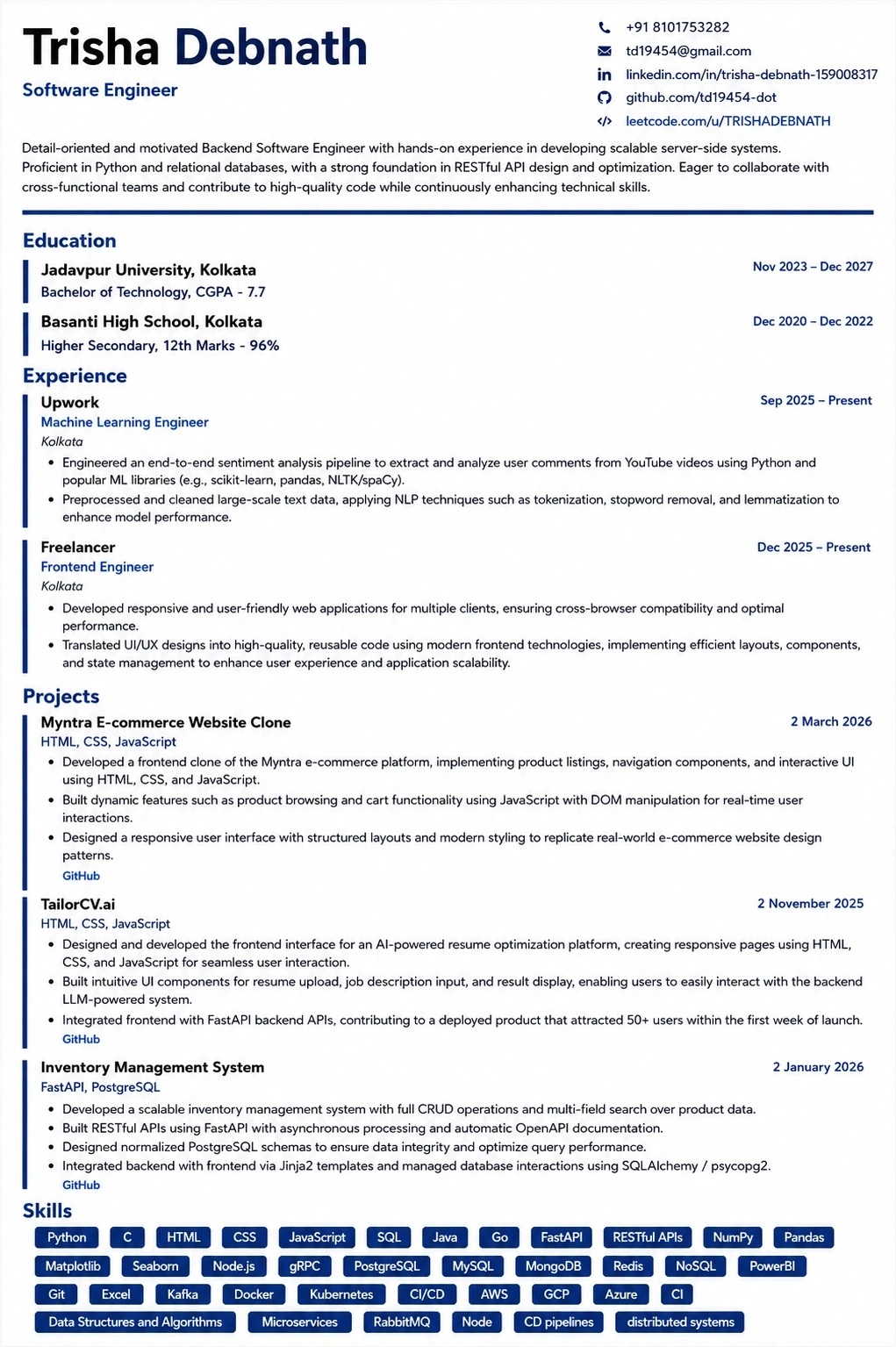
Templates that keep this structure intact
This template is ATS-tested — start from it and the formatting rules in this guide are already handled.
Was this guide useful?
Be the first to rate it.