TD
TD
Key Takeaways
- Cover letters matter sometimes - on a high-volume ATS-filtered application the letter may never be opened.
- A letter drawn from the specific posting, rather than a template, does four things a generic one cannot.
- By hand it means reading the posting closely, identifying its top priorities, and mapping your examples to them.
- Doing it on the page changes the equation, because the posting is already open in front of you.
- Whatever you draft it with, a strong letter follows a simple shape.
Most cover letters are written once, saved as "Cover Letter Final.docx", and pasted into every application with the company name swapped out — and recruiters can smell it instantly. A cover letter is only worth writing if it is built from the specific posting in front of you. The good news is that doing it properly no longer means starting from a blank page every time.
This guide covers what a cover letter actually needs to do in 2026, how to build one from a job posting, and how to generate a genuinely tailored letter in one click straight from the page you are applying on.
Do Cover Letters Even Matter Anymore?
Honestly, sometimes. On a high-volume ATS-filtered application, a bot reads the resume first and the cover letter may never be opened. But on a company career page, a referral, or a smaller employer, a human often does read it — and there, a specific, well-aimed letter can tip a close decision.
So the rule is simple: a generic cover letter is worthless everywhere, and a tailored one is valuable exactly where a human reads it. Since you cannot always tell which applications get human eyes, the sensible move is to attach a tailored letter whenever the form allows it — as long as tailoring it costs you almost nothing. That "almost nothing" is the whole point of doing it from the posting.
What a Cover Letter Built From a Posting Contains
A letter drawn from the specific job, rather than a template, does four things.
It names the actual role and why this company. Not "I am excited about this opportunity" but a concrete reason tied to the posting or the company. This is what a template can never fake.
It mirrors the posting's priorities. If the job description leads with "cross-functional collaboration" and "data-driven decisions", your letter should speak to those, in those words — the same keyword-matching logic that governs your resume, applied to prose. It should carry the terms that matter without stuffing them.
It proves one or two claims with specifics. A single quantified example that maps to the role's top requirement does more than three paragraphs of adjectives. It should read in your own voice, not generic filler.
It opens well. The first line decides whether the rest gets read — our guide on cover letter opening lines that work covers this, and the mistakes to avoid covers the rest. The full method is in the cover letter guide for 2026.
The Manual Way (and Why It Dies)
By hand, a tailored letter means: read the posting closely, identify its top two or three priorities, pick examples from your experience that map to them, draft three or four tight paragraphs in your voice, mention the company specifically, and proofread. Fifteen to twenty minutes done well — see the full cover letter guide and the ATS-friendly format.
Twenty minutes is fine for one application. It is impossible across a real search, which is exactly why people fall back on the generic template that recruiters ignore. The letter that would have helped never gets written, because writing it fresh each time is not sustainable.
The One-Click Way, From the Posting
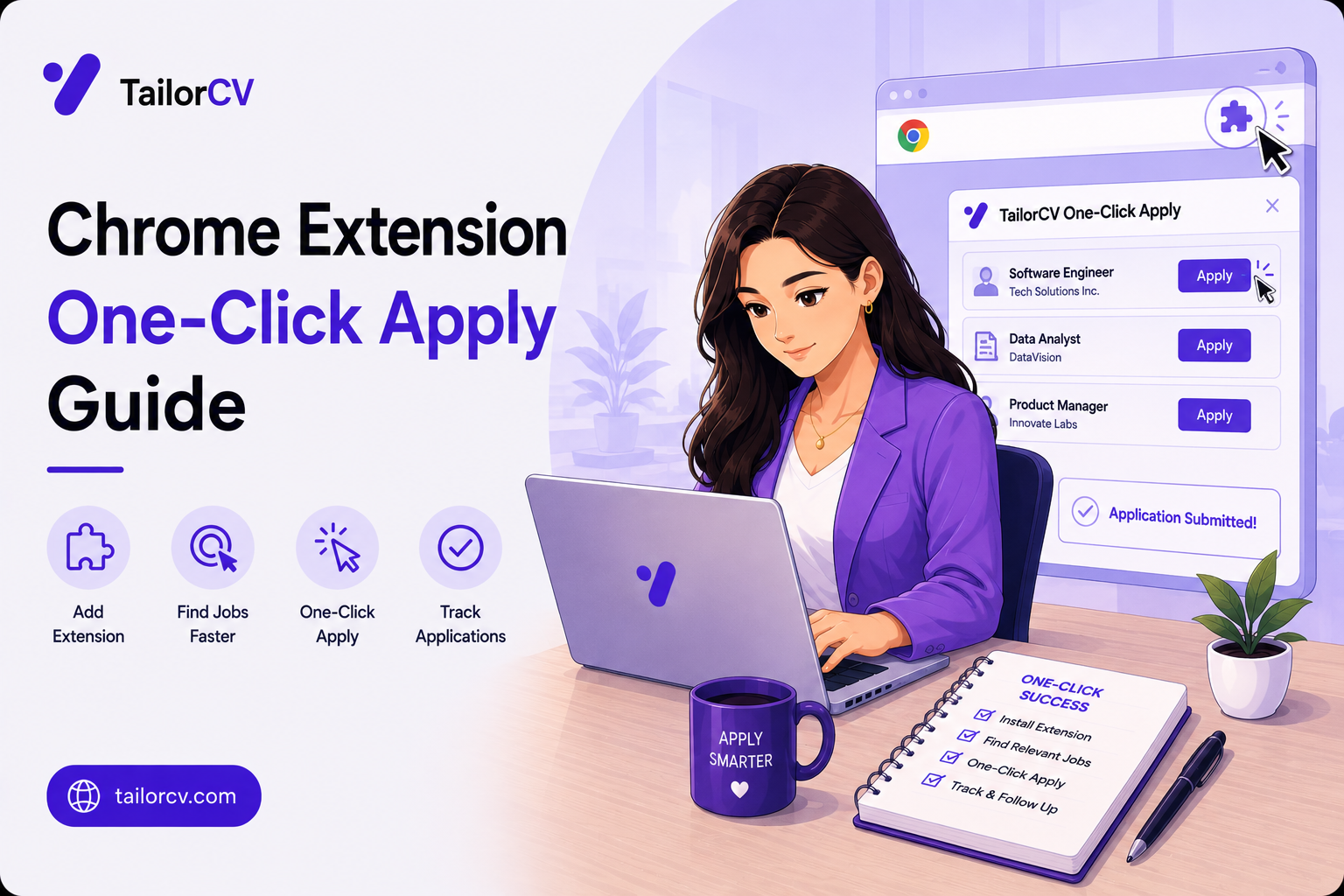
This is where doing it on the page changes the equation. TailorCV's extension reads the job description straight off the posting and generates a cover letter built from that specific job and your stored base resume — in the same panel where you tailor the resume.
Open any job — LinkedIn, Indeed, Naukri, Greenhouse, Lever, Workday and more. The panel reads the posting, and one click produces a letter that names the role, mirrors the posting's priorities, and draws real examples from your resume, in your voice. You read it, adjust anything you want, and attach it. Because it is built from the actual posting rather than a template, it says something specific — and because it takes a click, you actually include one every time a form allows it.
That combination — tailored and effortless — is what a generic saved letter can never be. It also pairs with the resume: on the same job, you tailor the resume and generate the matching letter together, both aimed at the same requirements.
Structure That Works
Whatever you use to draft it, a strong letter follows a simple shape.
What the finished letter looks like
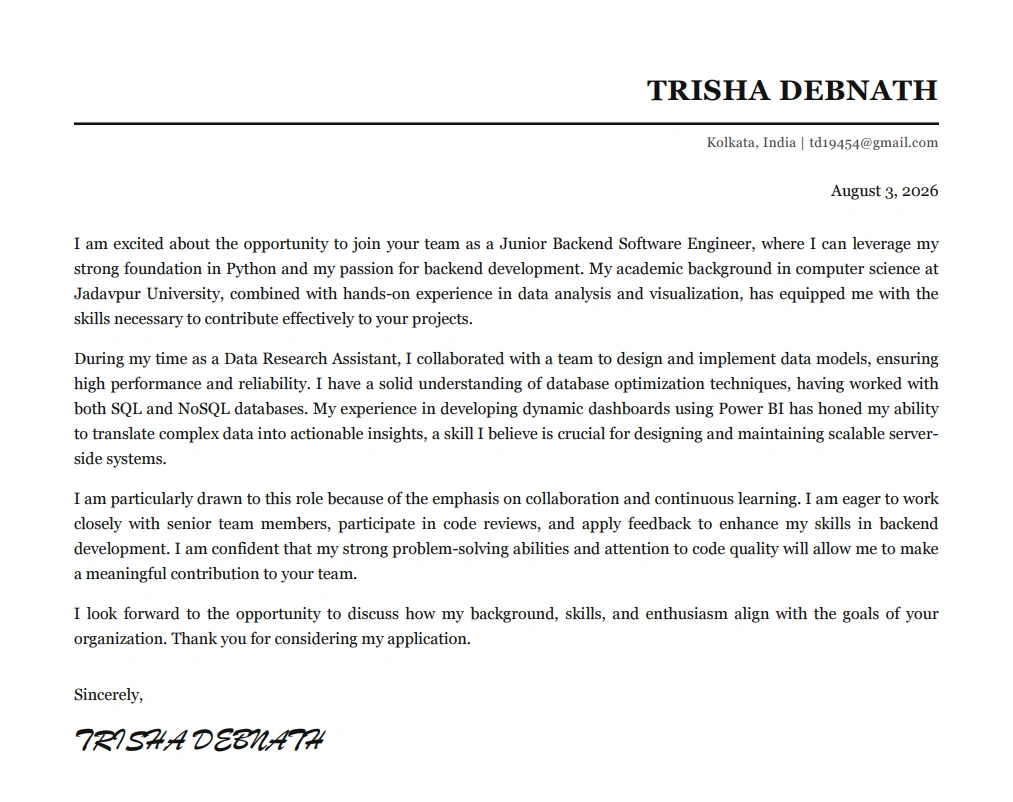
A format like this parses cleanly - one column, standard headings, everything the parser needs where it expects to find it.
Opening (1–2 sentences): a specific hook — why this role, why this company — not "I am writing to apply for". Body paragraph one: your strongest match to the posting's top requirement, with a concrete, quantified example. Body paragraph two: a second relevant proof point, or why you are drawn to the company specifically. Close (1–2 sentences): a confident, brief sign-off. Keep the whole thing under a page — three to four short paragraphs. Recruiters skim; a wall of text loses them.
Keep it ATS-friendly in format if it is going through a portal — plain text, no fancy layout — since the same parser rules and formatting mistakes can apply to letters too.
Cover Letters for Different Situations
The approach adapts to the situation, and the posting is still the anchor in every case.
Generating the letter from a job description
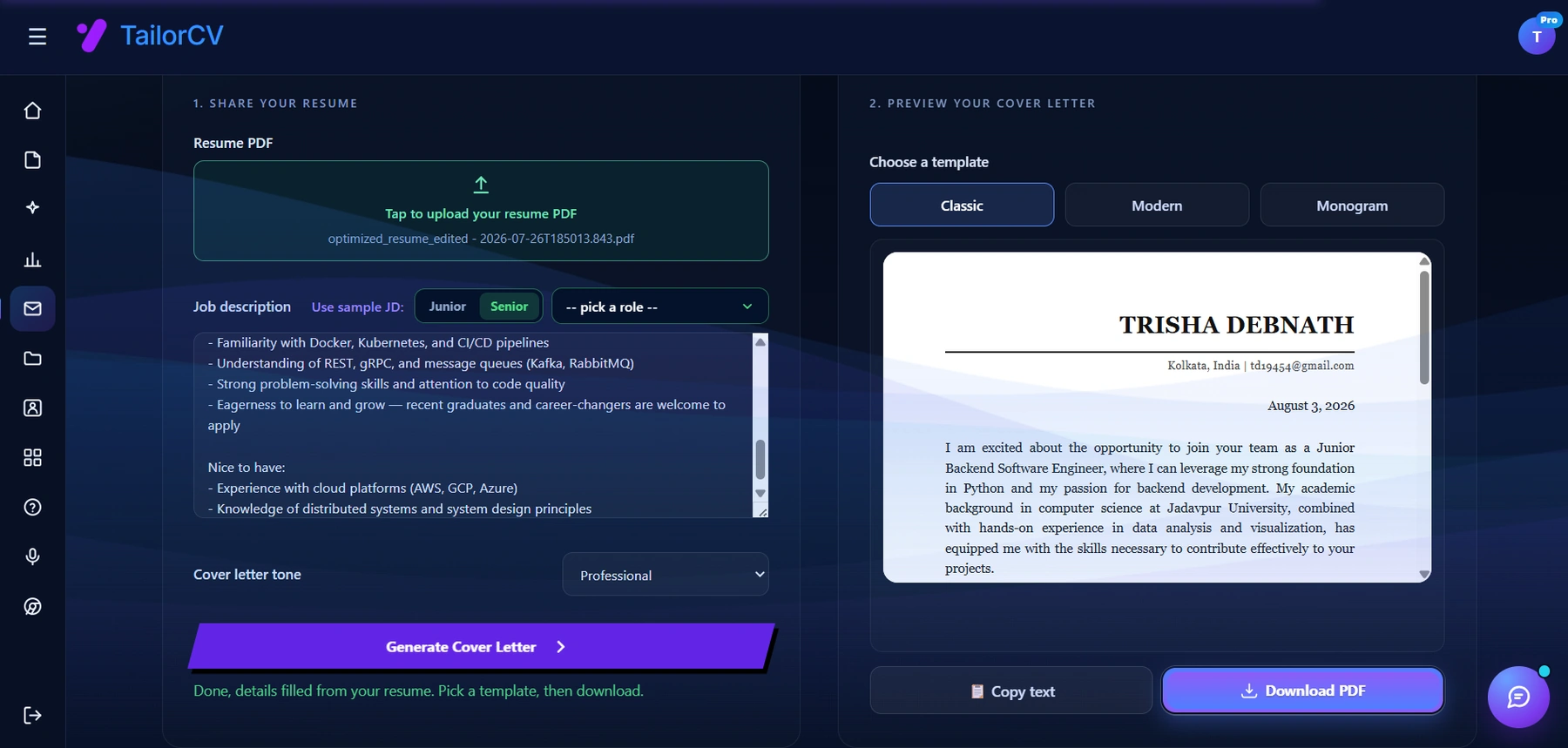
Details are pulled from your resume automatically, and the tone control decides how formal the letter reads before you download it.
For a career change, the letter does heavier lifting than usual — it is where you connect the dots the resume cannot, explaining why your background transfers to a role it does not obviously fit. For remote roles, address the remote-specific concerns directly: how you work independently, communicate across time zones, and stay accountable without an office. For an internal job application, the tone shifts again — you are known, so the letter is about ambition and fit for the new team, not introduction.
Applying abroad shifts expectations too. A cover letter for US jobs and a cover letter for Canadian jobs follow different conventions, and getting a job in the USA or in Canada starts with knowing whether you lead with a resume or a CV. Freshers with no experience — or none at all — lean on projects and genuine enthusiasm tied to the role, which connects to fresher projects that get interviews and landing a first tech job. Whatever the situation, an AI cover letter generated from the job description gives you a tailored starting draft rather than a blank page.
After the Cover Letter
The letter is one piece. Make sure the resume is tailored to the same posting and scores well against it — the difference between an ATS score and a resume score matters here too, and it should be built on a parser-friendly format with the keywords that beat the ATS. Then send a follow-up after applying and after the interview. Before the interview, research the company, rehearse behavioural questions, tell me about yourself and why do you want this job, and run a mock interview; the full interview prep guide covers more. When an offer comes, know how to negotiate the salary and the offer email; when one does not land, handle the rejection. And remember that a generic blast of applications is what a tailored letter counters — pace yourself per how many jobs to apply to per day.
The Real Reason Generic Letters Fail
It is worth being precise about why the copy-paste letter fails, because the reason is not that it is "low effort" in some moral sense — recruiters do not grade effort. It fails because it carries no information.
A cover letter's entire job is to tell the reader something the resume does not: why this role, why this company, and how your experience maps to their specific priorities. A generic letter, by definition, says none of that — it is interchangeable across a hundred applications, which means it adds zero signal to yours. The recruiter reads two sentences, recognises the template, and moves on, because there is nothing there that could not have been written by anyone about any job.
A letter built from the posting carries information in every line: it names their priorities, in their words, backed by your specifics. That is what makes it worth the reader's thirty seconds. The tailoring is not decoration — it is the content. This is the same principle that governs the resume: a generic resume fails for the same reason a generic letter does, because neither one answers the specific question being asked. Remove the friction of tailoring, and both become things you do by default rather than heroic exceptions.
Frequently Asked Questions
How do I write a cover letter for a specific job posting? Read the posting, identify its top two or three priorities, and write three to four short paragraphs that speak to those priorities using the posting's own language, backed by one or two concrete examples from your experience. Name the role and company specifically. You can do this by hand in about twenty minutes, or generate a tailored draft in one click from the posting with an extension.
Do recruiters still read cover letters in 2026? Sometimes. On high-volume ATS-filtered applications, often not. On company career pages, referrals, and smaller employers, frequently yes — and there a tailored letter helps. Since you cannot always tell, attach a tailored one whenever it is quick to produce.
Is an AI cover letter obvious to recruiters? A generic AI letter is obvious — the same way a generic human template is. A letter built from the specific posting, with real examples from your resume in your voice, reads as tailored because it is. The tell is genericness, not the tool.
How long should a cover letter be? Under a page — three to four short paragraphs. Recruiters skim, so lead with your strongest, most specific match and keep it tight.
Putting It All Together
The cover letter debate — do they matter, are they dead — misses the real answer: generic ones are dead, tailored ones are alive exactly where a human reads them. The only reason people send generic ones is that writing a fresh, specific letter for every application is too slow to sustain.
Remove that friction — build the letter from the posting in one click — and the calculation flips. Now you can attach a genuinely tailored letter to every application that allows one, at almost no cost, and reap the benefit on the subset that gets human eyes.
Open a job you actually want, tailor the resume, and generate the matching letter from the same posting. Read it, make it yours, and send it. A specific letter that took you a click will beat a generic one that took someone else twenty minutes — every time a human opens it.
Was this guide useful?
Be the first to rate it.