 TD
TD

Key Takeaways
- Remote hiring managers prioritize proof of self-management, asynchronous communication skills, and a dedicated home workspace in cover letters.
- Begin your cover letter by explicitly stating your fit for remote work and providing a specific example of independent project management.
- Mention familiarity with relevant communication tools and clarify your time zone to avoid potential mismatches.
- Avoid vague claims about being a self-starter; instead, provide concrete examples of remote work accomplishments and skills.
- Common mistakes include failing to address remote work directly, neglecting time zone considerations, and not mentioning relevant communication tools.
Remote hiring managers are screening for something office-based hiring often takes for granted: proof you can work independently, communicate clearly without face-to-face check-ins, and stay accountable with no one watching. A generic cover letter that never addresses "remote" specifically misses the entire point of the application.
Start by making sure your resume already signals remote readiness - see resume for remote developer jobs and how to match your resume to a remote job description - then draft your letter with the AI cover letter generator.
What Remote Hiring Managers Are Actually Screening For
- Self-management - can you prioritize and ship work without someone checking in hourly?
- Async communication - can you write clearly enough that people in other time zones understand you without a call?
- A real home setup - a stable, distraction-free place to work, even if it's just one sentence acknowledging it.
- Prior remote or distributed-team experience, if you have it - and if you don't, evidence of independent work like freelancing, side projects, or self-directed coursework.
The Structure
What the finished letter looks like
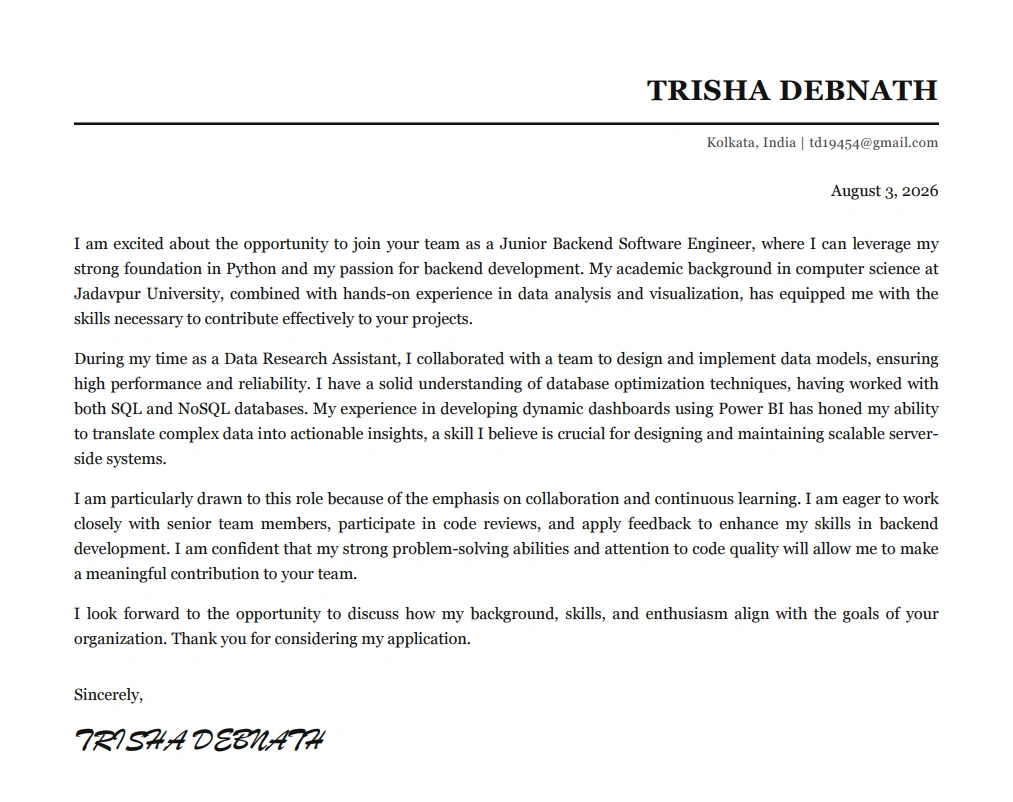
A format like this parses cleanly - one column, standard headings, everything the parser needs where it expects to find it.
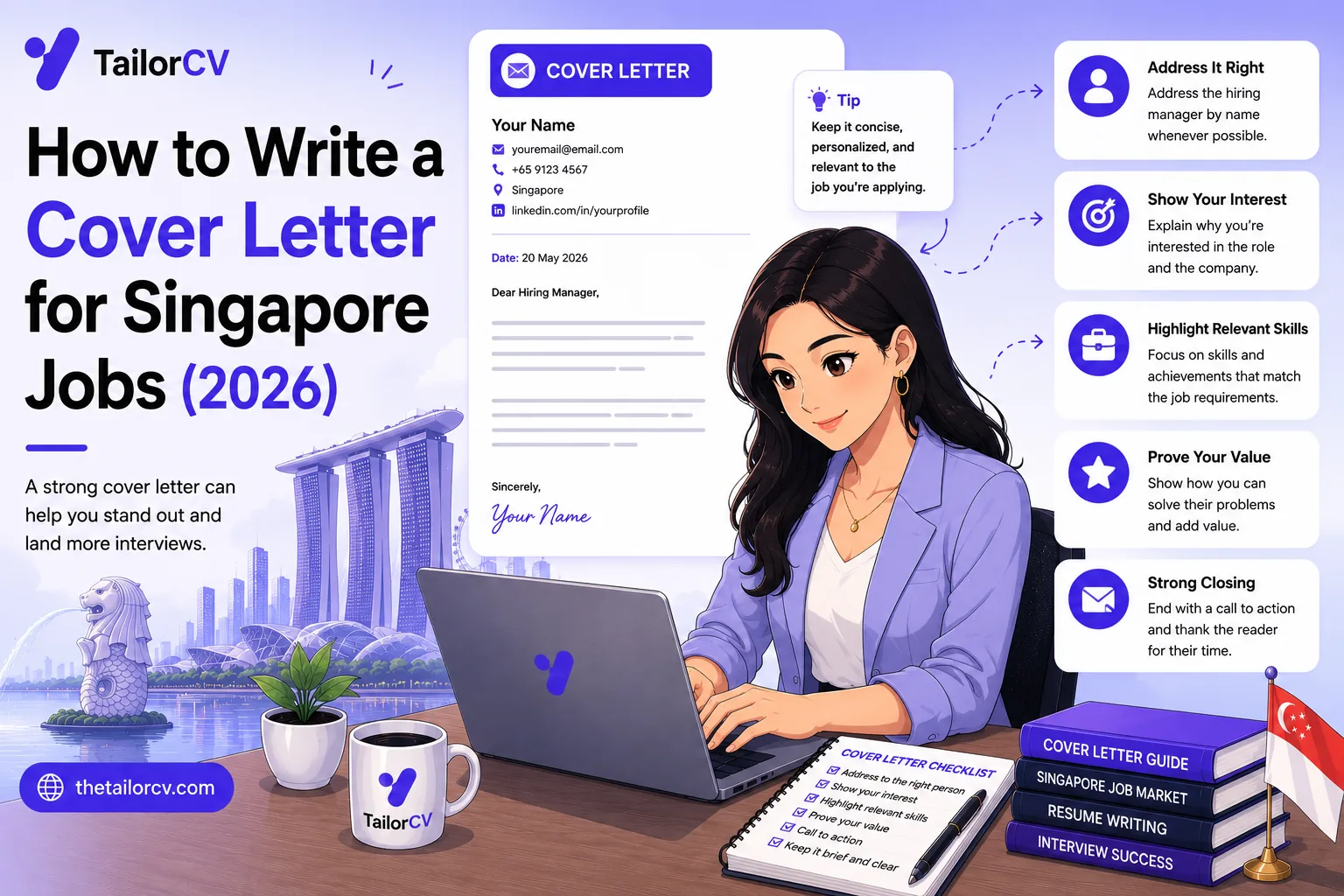
1. Open by Naming the Remote Fit Directly
Don't bury it. If the role is remote, say early why you thrive in that setup.
2. Prove Independence with a Specific Story
"In my last role, I managed a project end-to-end with teammates across three time zones, relying entirely on written updates and async check-ins to keep the work moving without a single missed deadline."
3. Address Communication and Tools
Mention specific tools you're fluent in (Slack, Notion, async video updates, project trackers) if the job description references them.
4. Close with Availability and Time Zone Clarity
Remote hiring managers often screen out candidates over time-zone mismatch alone - be upfront and make it a non-issue.
Full Template
Dear [Hiring Manager's Name],
Generating the letter from a job description
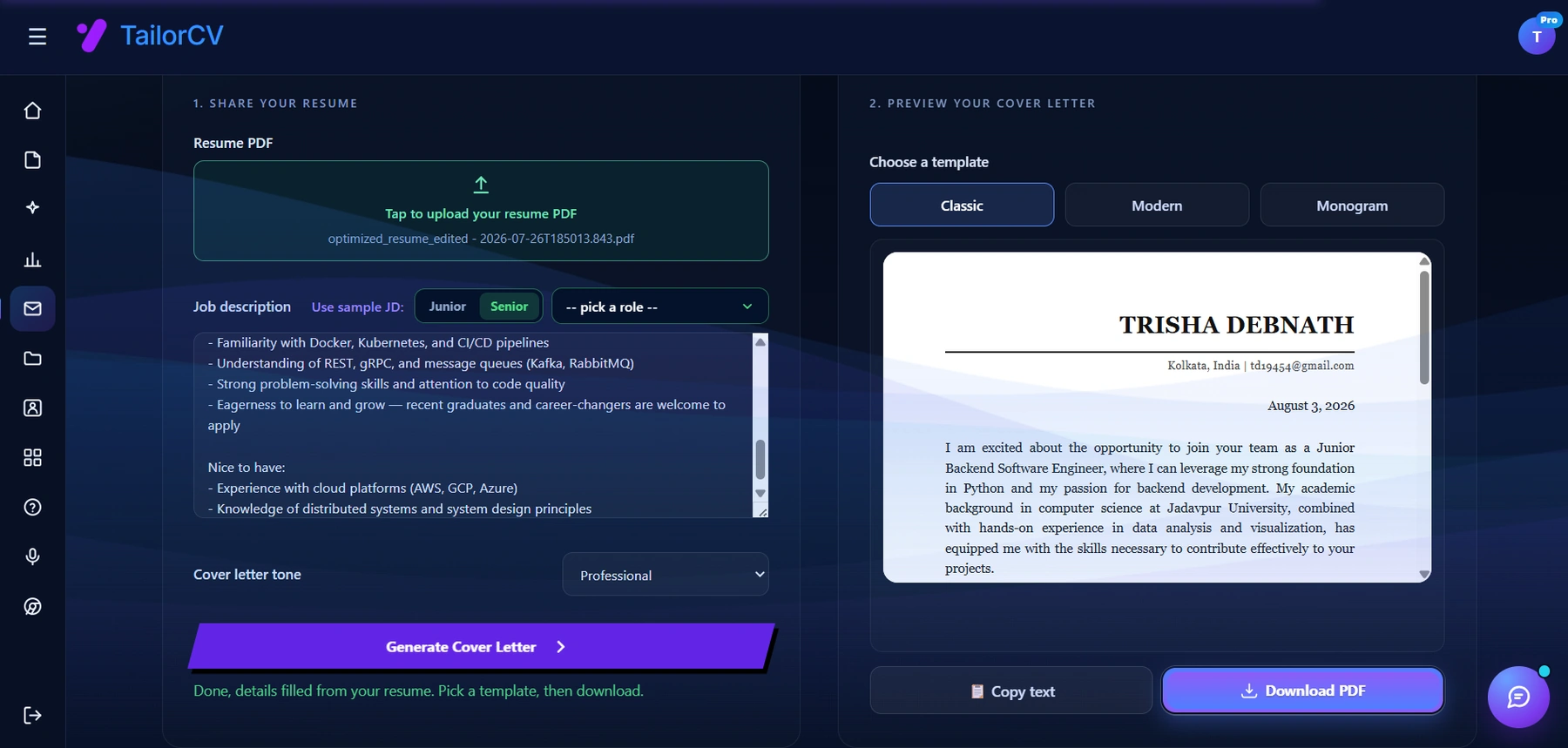
Details are pulled from your resume automatically, and the tone control decides how formal the letter reads before you download it.
I'm applying for the [Role] position at [Company], drawn specifically by the fully remote structure of the team. Remote work isn't new to me - in my current role, I [specific example of independent, asynchronous work with a measurable result].
I'm comfortable owning my schedule and communicating proactively rather than waiting to be asked for updates. I regularly use [relevant tools] to keep distributed teams aligned, and I default to over-communicating status rather than under-communicating it.
I'm based in [time zone] with [X hours] of overlap with your core team hours, and I have a dedicated, distraction-free home setup ready from day one.
I'd welcome the opportunity to bring that independence and communication discipline to [Company]. Thank you for considering my application.
Sincerely,
[Your Name]
Common Mistakes That Cost Remote Candidates the Interview
- Never mentioning remote work at all, as if the letter were for an in-office role.
- Vague claims like "I'm a self-starter" with no specific proof.
- Ignoring time zone overlap entirely, leaving the hiring manager to guess.
- Forgetting to mention communication tools relevant to distributed teams - see remote job search guide.
Additional Tips for Crafting a Winning Remote Cover Letter
Highlight Your Remote Work Skills
When applying for remote jobs, it's crucial to highlight your skills that are particularly relevant to remote work environments. Here are some key skills to consider:
- Time Management: Describe how you prioritize tasks and manage your time effectively while working independently.
- Adaptability: Share examples of how you've adapted to changing circumstances in a remote setting.
- Problem-Solving: Showcase your ability to troubleshoot issues without immediate assistance.
Use Concrete Examples
When drafting your cover letter, use specific examples that demonstrate your remote work capabilities. For instance:
- Project Management: "I successfully led a team project that resulted in a 30% increase in productivity by implementing clear communication guidelines and utilizing project management tools like Trello and Asana."
- Collaboration: "Collaborating with a diverse team in different time zones, I facilitated a weekly sync-up that ensured everyone was aligned and informed, resulting in a 15% reduction in project delays."
Incorporate Data Points
Adding data points can strengthen your claims and make your cover letter more persuasive. For example:
- "In my previous role, I increased customer satisfaction ratings by 25% through effective remote communication and timely responses."
- "I contributed to a project that saved the company $50,000 by streamlining our remote workflow."
Create a Checklist for Your Cover Letter
Before hitting "send," use this checklist to ensure your cover letter is ready for submission:
- unchecked: Did I address the remote aspect of the job directly?
- unchecked: Have I included specific examples of my remote work experience?
- unchecked: Did I mention relevant tools and technologies?
- unchecked: Is my time zone and availability clearly stated?
- unchecked: Have I proofread for any grammatical errors or typos?
Tailoring Your Cover Letter for Different Remote Roles
For Tech Positions
If you're applying for a tech role, emphasize your experience with coding languages, development methodologies, and any relevant tech tools. Mention specific projects where you utilized remote collaboration tools like GitHub or Jira to manage code repositories and issue tracking.
For Customer Service Roles
Highlight your communication skills and customer interaction experience. Describe how you've handled customer inquiries or issues remotely, focusing on tools like Zendesk or Intercom that facilitate customer support in a remote setting.
For Creative Positions
If you're in a creative field, showcase your portfolio and discuss how you’ve collaborated with clients or teams remotely. Mention tools like Adobe Creative Cloud or Figma that you use for design projects, emphasizing your ability to deliver high-quality work independently.
Examples of Effective Remote Cover Letters
Example 1: Software Developer
Dear [Hiring Manager's Name],
I am excited to apply for the Software Developer position at [Company]. The fully remote structure of your team aligns perfectly with my experience and work style. In my previous role at [Previous Company], I successfully developed and deployed an application that increased user engagement by 40%. This was achieved while collaborating with a remote team across three different time zones, using tools like Slack and GitHub for seamless communication and code management.
I thrive in a remote environment where I can manage my own schedule and prioritize tasks effectively. I am based in [Your Time Zone] and can offer [X hours] of overlap with your core working hours. My home office setup is equipped with all the necessary technology to ensure productivity from day one.
Thank you for considering my application. I look forward to the opportunity to contribute to [Company] and bring my remote work experience to your team.
Sincerely,
[Your Name]
Example 2: Marketing Specialist
Dear [Hiring Manager's Name],
I am writing to express my interest in the Marketing Specialist position at [Company]. The remote nature of the role is particularly appealing to me, as I have successfully executed multiple marketing campaigns while working remotely in my previous position at [Previous Company]. By leveraging tools like HubSpot and Mailchimp, I was able to achieve a 30% increase in lead generation over six months.
I excel at managing my time and communicating effectively with team members and stakeholders, ensuring that projects are completed on schedule. I am located in [Your Time Zone] and can easily adapt to the needs of your team.
I am excited about the possibility of bringing my skills to [Company] and contributing to your marketing initiatives. Thank you for considering my application.
Best regards,
[Your Name]
Conclusion
Crafting a compelling cover letter for remote jobs requires a focused approach that highlights your ability to thrive in a remote work environment. By addressing the specific needs of remote hiring managers, providing concrete examples, and tailoring your letter to the role, you can significantly enhance your chances of landing an interview. For further guidance, check out resources like our Cover Letter Guide 2026 and Cover Letter Mistakes to Avoid in 2026. Remember, a well-crafted cover letter can set you apart in the competitive remote job market.
Frequently Asked Questions
Do I need remote work experience to apply for a remote job?
No - freelance work, self-directed projects, or even coursework completed independently can demonstrate the same qualities. Frame it honestly using resume with no experience if you're early career. You can also refer to our remote job search guide for more insights.
Should I mention my home office setup?
One sentence is enough - it reassures the hiring manager without over-explaining. Skip it if the role doesn't require it (e.g., fully asynchronous roles with no video calls).
How do I prepare for a remote job interview specifically?
Practice with the remote job interview preparation guide and run a mock session with the AI mock interview tool, which can simulate video-call-style questions. Additionally, consider reviewing common cover letter mistakes to ensure your application stands out.
What if there's a big time zone gap?
Address it directly and propose a solution - partial overlap hours, flexible start times, or async-first workflows. Hiding it usually costs more trust than naming it upfront.
Make This Practical
Build your full remote application as one package: confirm your resume matches the role with the free ATS score checker, draft this letter with the AI cover letter generator, and rehearse remote-specific interview questions with the AI mock interview tool.
Conclusion
Remote hiring managers aren't just checking your skills - they're checking whether they can trust you unsupervised. Prove it with specifics, not adjectives, and the interview request follows.
Was this guide useful?
Be the first to rate it.