 TD
TD
Key Takeaways
- Indeed's volume makes the ATS filter unavoidable - when thousands apply, software parses every resume before a human sees one.
- Tailoring is not rebuilding your resume; it is four focused changes, and knowing them is what lets you move fast.
- A few things specific to Indeed catch people out.
- You can tailor by hand, and it is worth knowing that flow before deciding to automate it.
- The habit travels to every other board, because they all feed the same kind of filter.
Indeed is the biggest job board in the world, and that scale is exactly why applying there feels like shouting into a void. A popular posting can pull thousands of applicants, almost all of whom uploaded the same generic resume they use everywhere. The ones who get called are rarely the most qualified — they are the ones whose resume actually matched the posting.
This guide shows you how to be in that second group: what to change when you tailor a resume to an Indeed job, how to match the language that gets you past the filter, and how to do the whole thing in about a minute instead of ten.
Why Generic Resumes Disappear on Indeed
The volume on Indeed makes the ATS filter unavoidable. When thousands apply, no human reads every resume first — software parses each one into structured data and matches it, by exact language, against the job description. Recruiters then filter that data down to a shortlist.
Tailoring straight from an Indeed listing
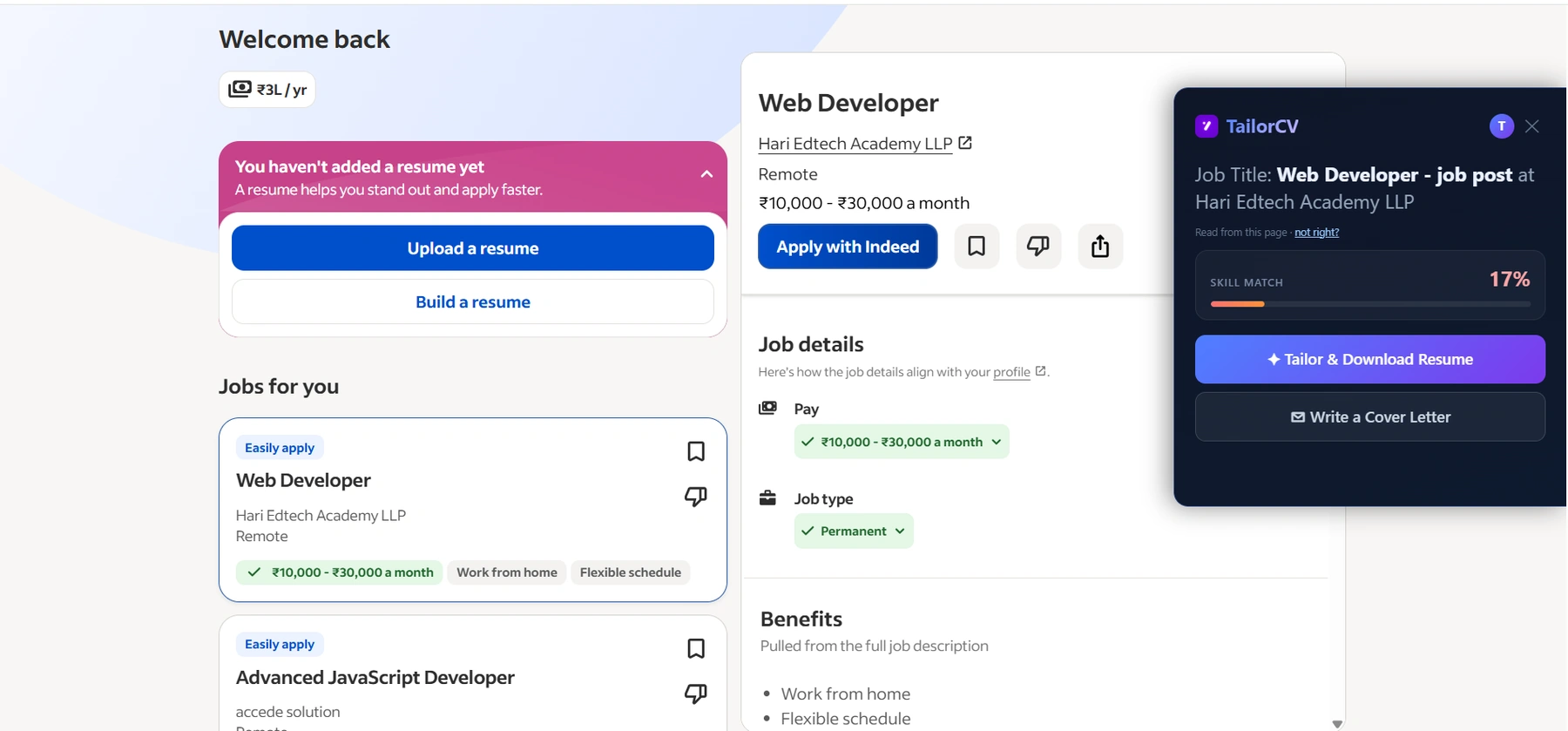
On Indeed the panel reads the posting off the page and shows the match before you hit Apply - 17% here, which is the kind of gap worth closing first rather than discovering through silence.
The catch that sinks most applicants is that the filter matches language, not meaning. If the posting asks for "inventory management" and your resume says "kept stock organised", a person would call those the same thing, but the software will not. Your genuinely relevant experience does not register, and you are filtered out in seconds — with no email to tell you why. Our tailored vs generic resume breakdown shows how wide that gap is, and how to pass the ATS in 2026 explains the mechanism.
So the instinct to blast the same resume at fifty Indeed jobs is precisely wrong. You send more and land less. The move that works is fewer applications, each actually matched — and if you have wondered how many jobs to apply to per day, that is the honest answer.
What to Change (and What Not To)
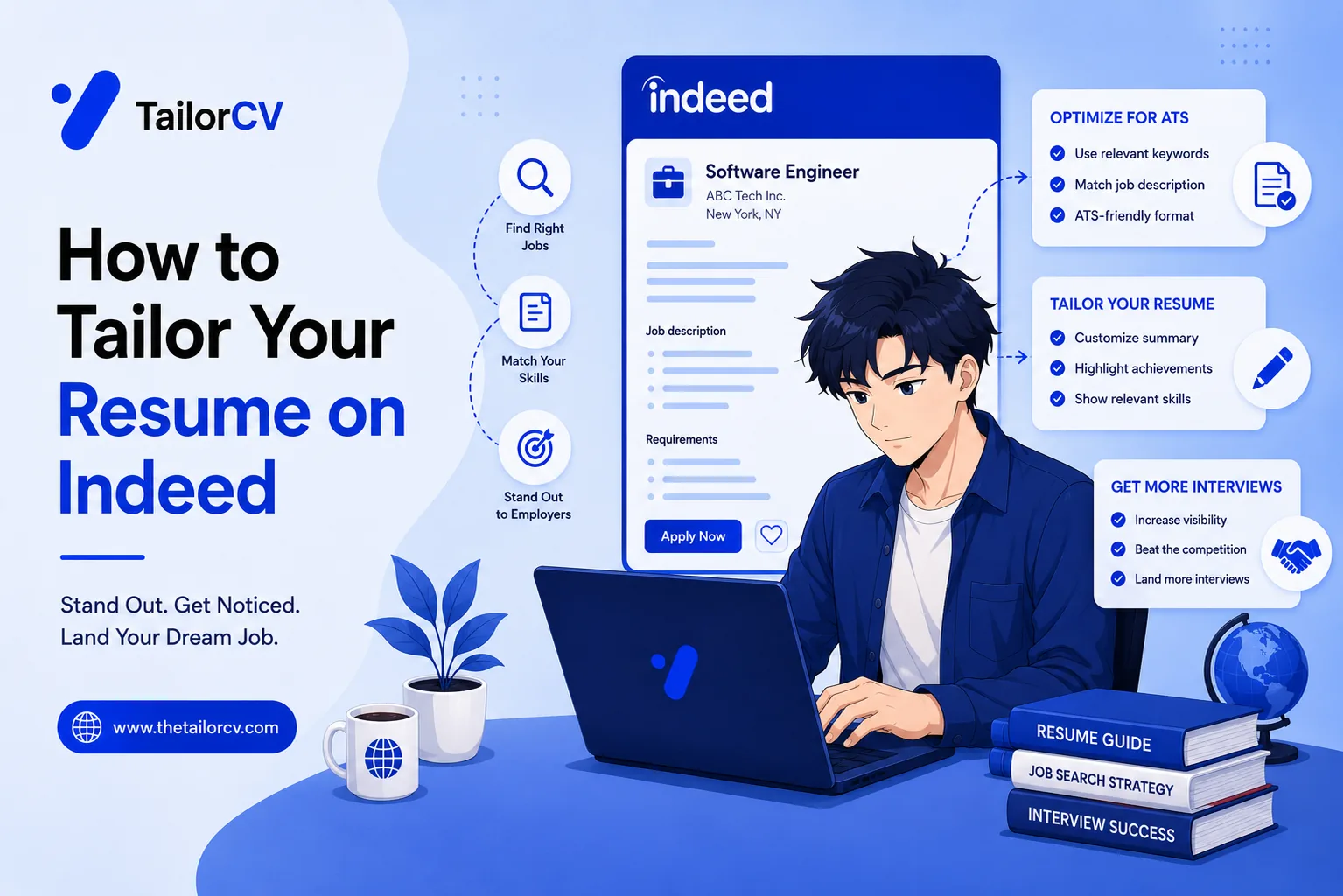
Tailoring is not rebuilding your resume for every job. It is four focused changes, and knowing them is what lets you move fast.
Match the keywords. Pull the specific skills, tools and phrases from the posting and work the ones you genuinely have into your resume, in the posting's own words. This is what the ATS weighs most — our guide on ATS keywords that boost your score and the best keywords to beat the ATS cover which ones matter. Do not overdo it: keyword-stuffing is a classic ATS keyword mistake that a human sees straight through.
Reorder for relevance. The most relevant skills and experience go near the top, ideally quantified. A recruiter scanning fast should see the match in the first few seconds.
Rewrite the top bullets. Your first bullets under each role should answer this posting, in your own voice rather than generic filler. Learning how to stop sounding generic is the difference between getting read and getting skipped.
Never fabricate. Re-emphasise what is genuinely there; do not invent it. A resume that lies gets caught in the interview, which is worse than not getting one.
The Indeed-Specific Traps
A few things about Indeed specifically catch people out.
Indeed's resume builder is not the same as a tailored PDF. The profile you build on Indeed is convenient, but it is one generic version. Uploading a resume tailored to the specific posting still beats the stored profile, because the profile cannot match every job at once.
Formatting still matters even on a big board. Indeed's parser, like any ATS, chokes on tables, columns, text boxes and graphics. A resume that looks fine can arrive scrambled — our guide on ATS formatting mistakes and making your resume ATS-friendly covers what to avoid, and a parser-friendly format is the safe baseline.
Speed tempts you into generic applications. Like LinkedIn Easy Apply, Indeed's quick-apply flow makes it frictionless to send the same resume everywhere — which is the exact habit that fails.
The Manual Way
You can tailor an Indeed resume by hand, and it is worth knowing the flow. Open the posting. Open your resume alongside it. Note the repeated skills and phrases. Duplicate the file. Work the missing keywords in honestly. Reorder your skills. Confirm it still parses cleanly. Export to PDF and upload.
Done properly, about ten minutes. Our tailor your resume in 5 minutes guide trims it and how to tailor for every job covers the full method. But ten minutes times the volume Indeed tempts you into is hours of draining work, and it collapses late at night on the tenth application — which is when people quit tailoring and go back to the generic PDF. The friction, not the method, is the enemy.
The One-Click Way, On the Indeed Page
This is where an on-page tool earns its slot, and it is why we built TailorCV's Chrome extension.
Open any Indeed job. A panel opens beside it, reads the description straight off the page — no copy-paste — and shows your skill-match score against that specific role before you touch anything. One click rewrites your resume to match, honestly, using only what is already on it, and downloads the ATS-ready PDF. A second click writes a matching cover letter. Then you upload and apply, still on Indeed.
A minute instead of ten — and because it lives on the page, tailoring survives the length of a real search instead of dying in week three. The same panel works on LinkedIn, Naukri, Greenhouse, Lever, Workday, Ashby, Glassdoor and more, plus any site from the toolbar.
Step by Step
Step 1 — Set your base resume once. Upload the resume you normally send; it becomes the starting point the tool rewrites from every time. If you are unsure it is even solid, run a free ATS score on it first.
Step 2 — Open an Indeed job you actually want. Not a stretch, not a safety. Load the full posting.
Step 3 — Read your match score. See how your current resume scores against this role and which keywords are missing. That number tells you whether the resume is your problem here — it is the difference between an ATS score and a general resume score.
Step 4 — Tailor. One click closes the keyword gap, grounded in your real experience. Download the PDF.
Step 5 — Cover letter. Most Indeed applicants skip it; a strong opening line on a tailored letter stands out. Avoid the usual cover letter mistakes.
Step 6 — Apply, then repeat. Each version is saved automatically with its score and job, so you always know what you sent where.
Beyond Indeed: The Same Habit Everywhere
Your search will not live on one board, and the tailoring habit travels because every board feeds the same kind of filter. It is identical on LinkedIn, Naukri, Greenhouse, Lever and Workday — the posting names requirements, the parser matches, generic loses. For remote roles the competition is global and the filter harsher, so a remote cover letter helps. Targeting a country changes conventions too — a job in the USA and in Canada each have norms, starting with whether you need a resume or a CV. Because big boards attract fraud, know how to spot a job scam. And note the startup vs enterprise difference: a small company may have no ATS while a large one filters hard.
After You Apply
Tailoring gets you seen; it does not finish the job. Send a follow-up after applying and after the interview — almost nobody does, which is why it works. Before the interview, research the company, rehearse behavioural questions starting with tell me about yourself, and run a mock interview; the full interview prep guide ties it together. When one does not land, handle the rejection and move on.
Freshers, a few extra reads: your ATS score as a fresher leans on projects that get interviews; see also your first tech job, a job with no experience, campus placement, a portfolio site, and the right template. Got a gap? How to explain an employment gap.
The Math on Time, and Why It Decides Everything
"Tailor every application" is advice everyone gives and almost nobody follows, and the reason is not laziness — it is arithmetic.
A serious Indeed search is easily twenty to forty applications a month, because the board makes applying so quick. Tailoring each one by hand is about ten minutes. Multiply it out and you are looking at four to seven hours a month of fiddly, repetitive editing — and that time is not evenly distributed. It lands in clumps, late in the evening, when you have already spent an hour scrolling listings and your willpower is gone. That is the exact moment the brain says "this one's close enough" and uploads the generic version.
So the failure is predictable and structural. Week one, you tailor everything and feel virtuous. Week two, you tailor the "important" ones. Week three, you are sending one resume to everything and telling yourself the market is brutal. The market may well be brutal, but the thing that broke was your tailoring habit, and it broke because the friction was too high to sustain.
This is the entire case for doing it on the page. When tailoring costs one click instead of ten minutes, the willpower question disappears — you do it every time because there is nothing to decide. The tool does not just save you time; it removes the moment where good intentions collapse. That is why an on-page tailoring tool matters more than a faster autofill: autofill makes a losing move quicker, while tailoring changes whether you win. If you want the deeper method behind it, how to match your resume to a job description fast walks through it.
Frequently Asked Questions
How do I tailor my resume for an Indeed job? Read the posting, pull the skills and phrases it repeats, and work the ones you genuinely have into your resume's bullets and skills section in the posting's own wording. Reorder so the most relevant experience is at the top. By hand it is about ten minutes; with an extension it is one click on the page.
Should I use Indeed's resume builder or upload my own? Uploading a resume tailored to the specific posting beats Indeed's stored profile, because one generic profile cannot match every job. Use the profile for convenience, but tailor and upload for roles you actually want.
Will tailoring get me flagged on Indeed? No. Tailoring is what recruiters want — it is answering the job's question, not gaming anything. The ATS rewards a genuine match with a higher score. What hurts you is unparseable formatting or hollow keyword-stuffing.
How many Indeed jobs should I tailor for? Every one you genuinely want. A generic resume scores poorly against a specific posting because the posting asks for specific things. Tailoring is the highest-leverage habit in a job search, and on-page tools make it sustainable at Indeed's volume.
Putting It All Together
Indeed's scale cuts both ways: enormous reach, and enormous competition that funnels through an ATS. Blasting one generic resume at fifty postings feels productive and produces silence, because none of those fifty resumes matched the job.
The fix is to tailor the four things that matter — keywords, order, top bullets, honesty — for the roles you actually want. By hand that is ten minutes; on the page it is one. A tailored resume sent to five Indeed jobs beats a generic one sent to fifty.
Start with a single role you want. Check your match score, close the gap, add a real cover letter, apply — then repeat, fast, on the page. That habit is what turns Indeed from a void into interviews.
See what tailoring is worth on your resume
Score your current resume against a real job description before you change a word.
Drop your resume here or choose a file
PDF only. Max 2 MB.
We never share your data or use it to train AI models.

Start from a template that tailors well
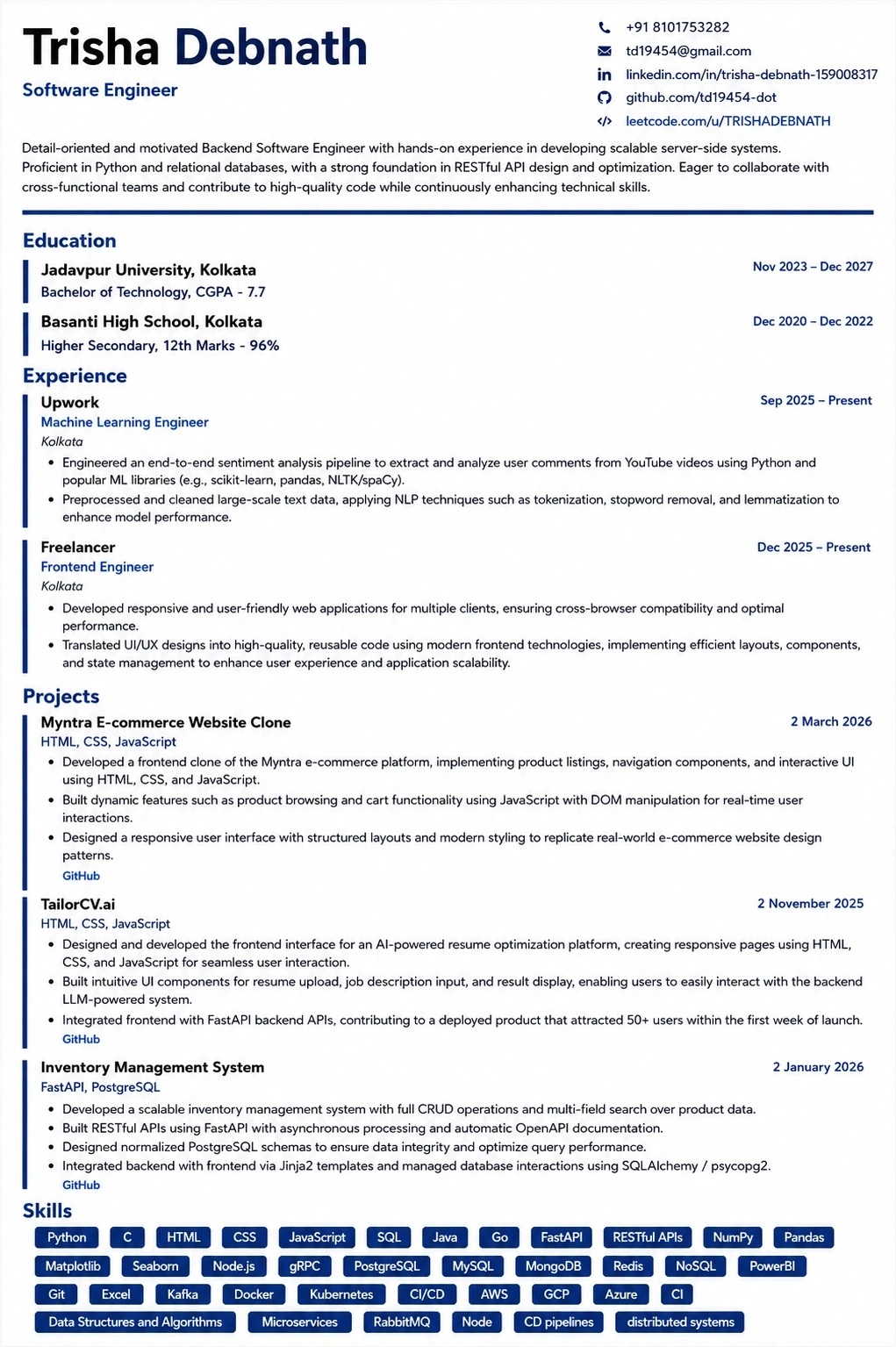
Clean structure means swapping keywords per job takes minutes, not a re-layout every time.
Was this guide useful?
Be the first to rate it.