 SS
SS
Key Takeaways
- On Naukri the filter is not abstract - recruiters literally search the resume database using keywords from the role they are hiring for.
- Tailoring is four focused changes, not a rewrite from scratch.
- A few points matter specifically on Naukri and nowhere else.
- Your standing Naukri profile does quiet work in the background, and most people leave it half-built.
- The habit travels to every other board, because they all feed the same filter.
Naukri is where most of India's job search happens, and it runs on a scale that makes the applicant tracking system unavoidable. A single posting for a common role — analyst, developer, sales, operations — can pull hundreds or thousands of applications. Recruiters do not read them all. They search and filter, and the resumes that surface are the ones that matched the posting's language. Everyone else is invisible.
This guide is about getting your resume into the visible group: what to change when you tailor to a Naukri posting, how to match the keywords that recruiters actually search, and how to do it in about a minute rather than ten.
How Naukri Recruiters Actually Find You
On Naukri, the filter is not abstract — recruiters literally search the resume database using keywords from the role they are hiring for. Your resume is parsed into structured data, and if it does not contain the terms they search, you never appear in their results.
Tailoring straight from a Naukri listing
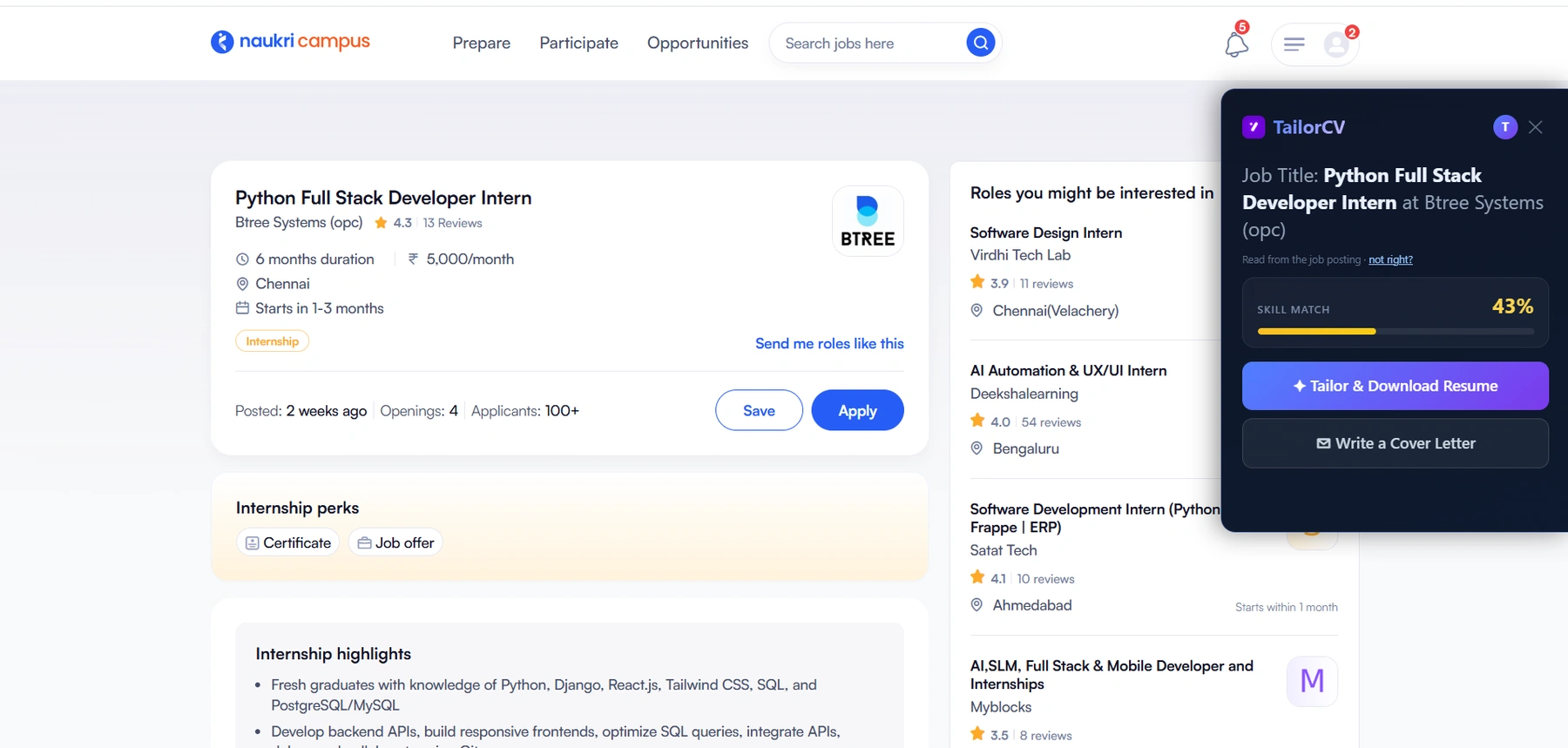
The extension reads the posting off the Naukri page you are already on, so you can check the match and tailor without copying the description into another tab.
This is why matching the posting's language matters so much. If the JD asks for "stakeholder management" and your resume says "coordinated with teams", a recruiter searching "stakeholder management" will not find you — a human would call them identical, but the search matches words, not meaning. Our tailored vs generic resume breakdown shows how much this costs.
So updating your Naukri profile once with a generic resume, then applying to everything with it, quietly guarantees you stay unfound. The fix is fewer, tailored applications — and if you have wondered how many jobs to apply to per day, that is the honest answer.
What to Change (and What Not To)
Tailoring is four focused changes, not a rewrite from scratch.
Match the keywords. Pull the skills, tools and phrases from the posting and work the ones you genuinely have into your resume in the posting's exact words — this is what recruiters search and what the ATS weighs. Our ATS keywords that boost your score and the best keywords to beat the ATS cover which matter. Avoid the common keyword mistakes — stuffing reads as robotic to the human who eventually opens it.
Reorder for relevance. Most relevant skills and experience near the top, quantified where you can.
Rewrite the top bullets. First bullets under each role should answer this posting, in your own voice, not generic filler.
Never fabricate. Re-emphasise, never invent. A resume that lies gets caught in the interview.
The Naukri-Specific Things to Know
A few points matter specifically on Naukri.
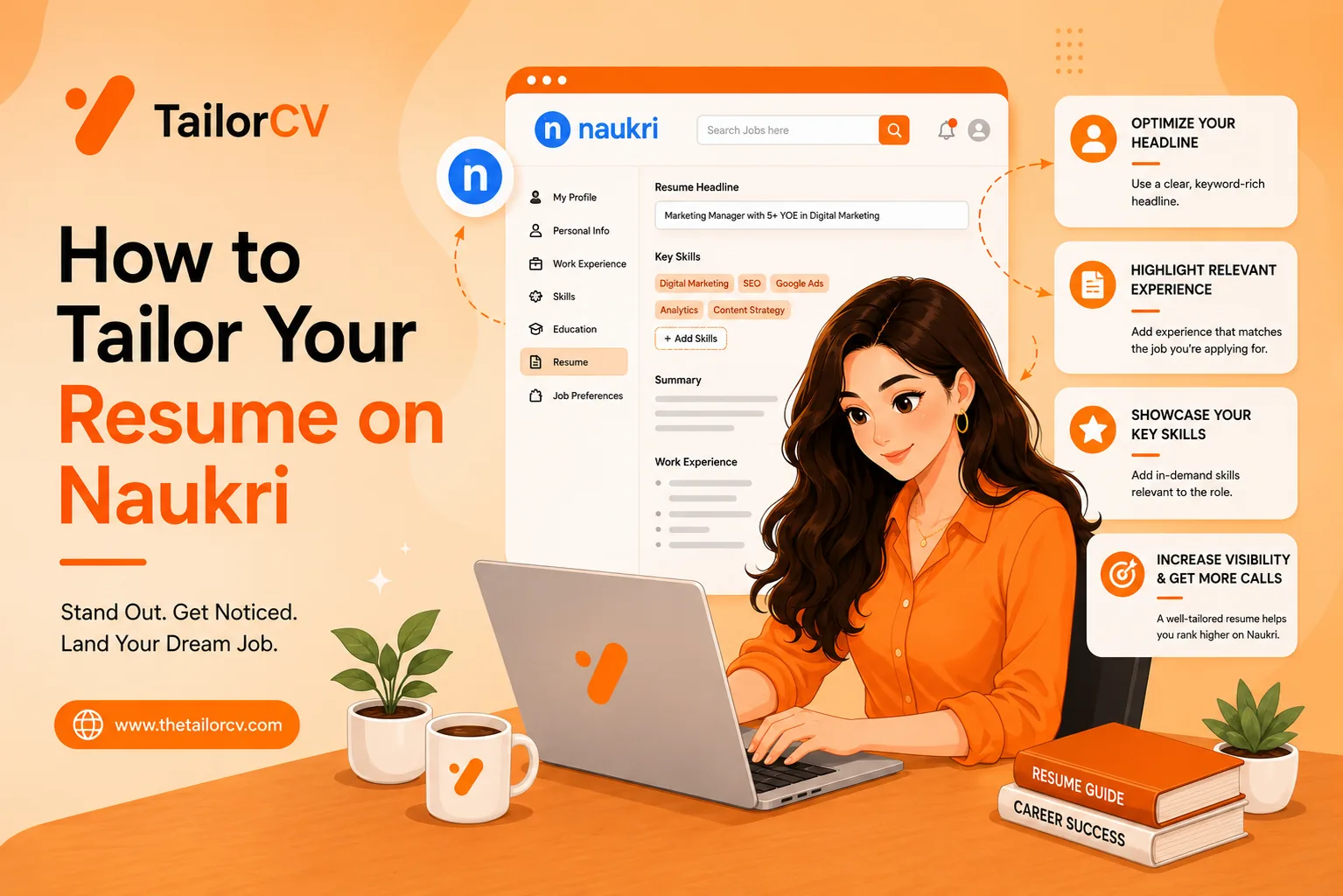
Your headline and key skills are searchable fields — use them. Naukri surfaces your resume headline and skills prominently to recruiters. Make sure they carry the terms for the roles you actually want, not a vague "hardworking professional".
Formatting still has to parse. Naukri and the companies pulling from it use ATS software that breaks on tables, columns and graphics. A resume that looks polished can arrive scrambled — see ATS formatting mistakes, making your resume ATS-friendly, and the safe parser-friendly format.
One master resume will not cut it across sectors. A "Data Analyst" role at a startup and at a bank ask for different things. Tailoring per posting is what separates the resumes that get found from the ones that do not.
Optimising Your Naukri Profile Itself
Before the per-job tailoring, your standing Naukri profile does quiet work in the background, and most people leave it half-built.
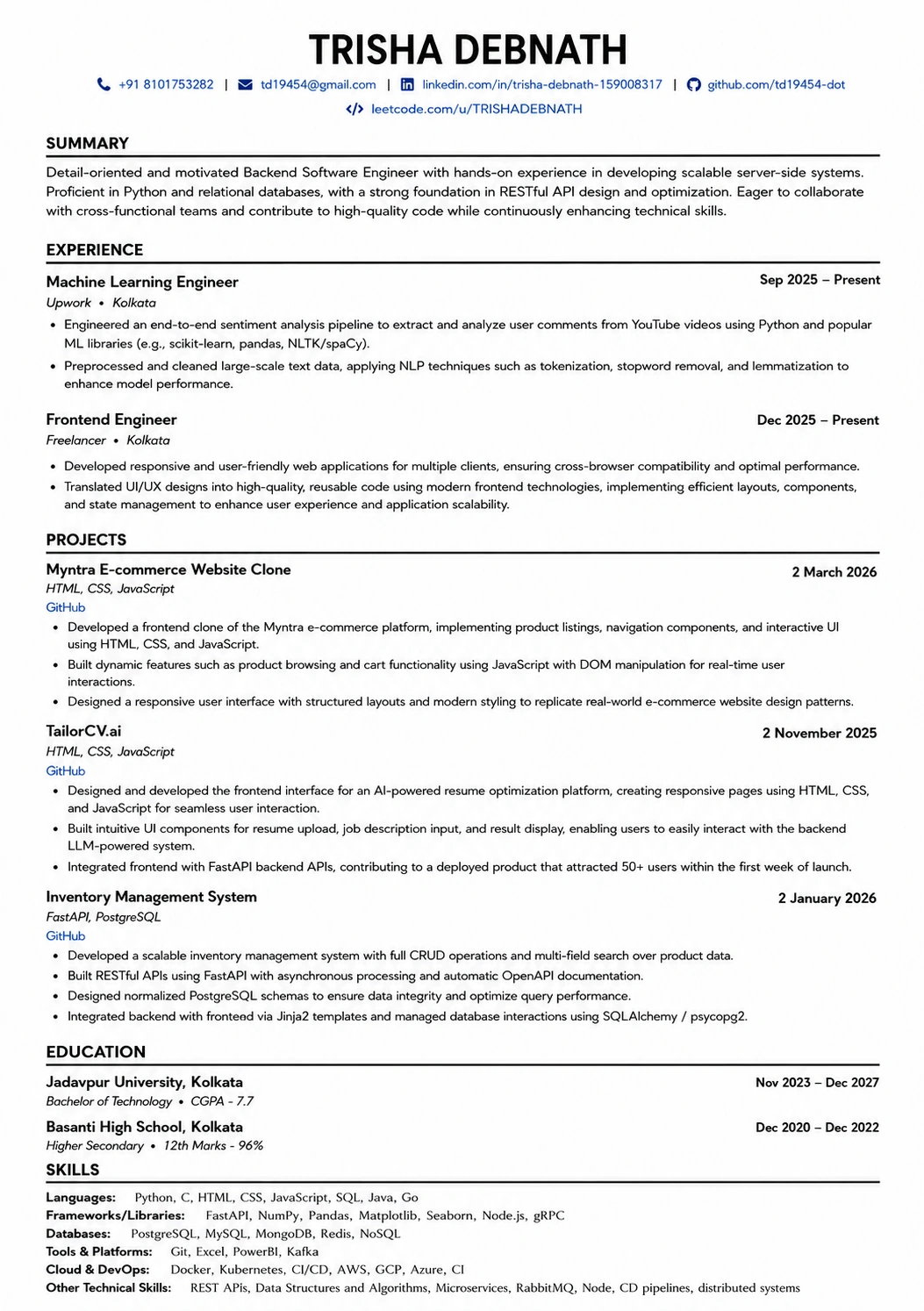
Your resume after optimization
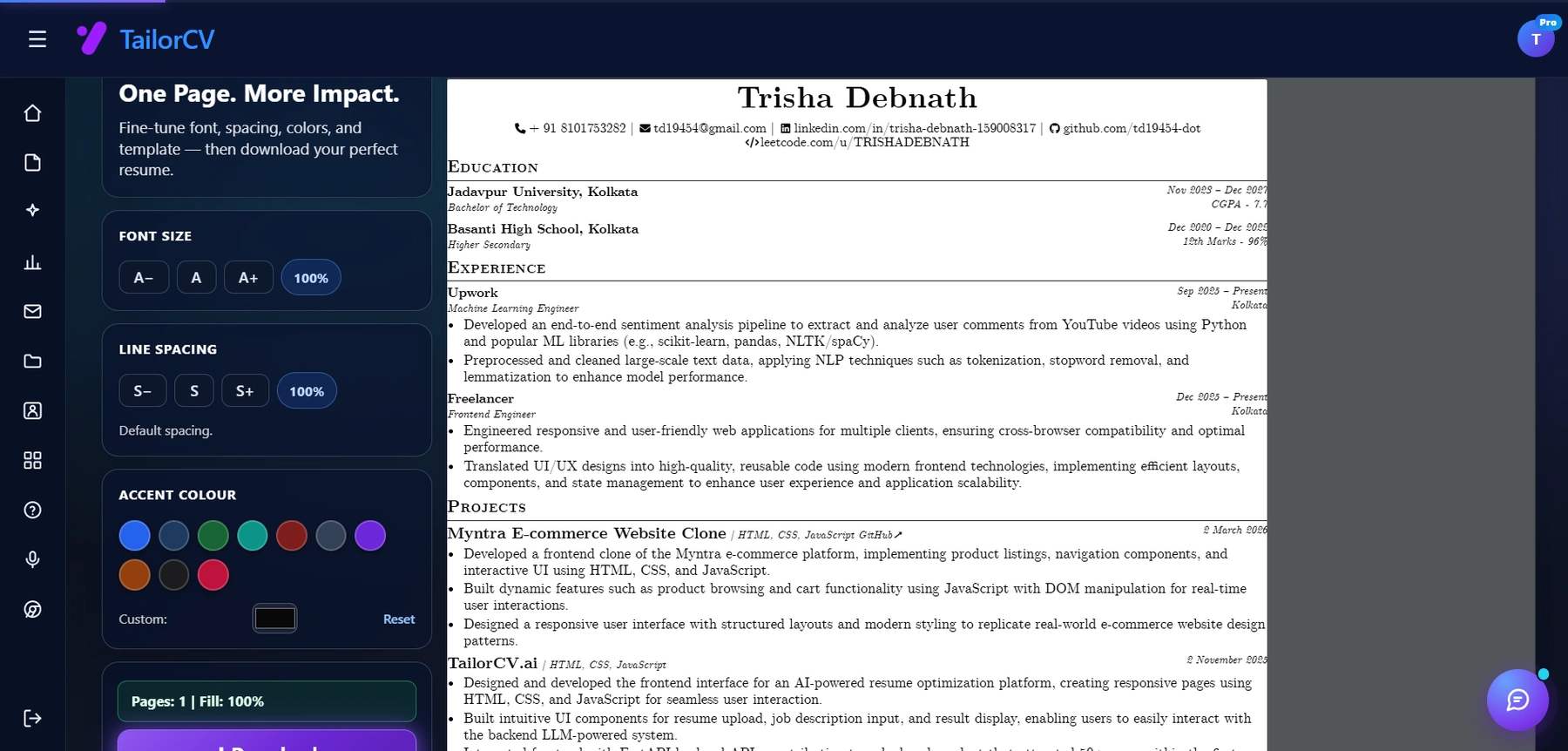
This is the optimized result, and it is usually how a spilling two-page draft gets back onto one page without deleting anything worth keeping.
Two fields matter more than the rest. Your resume headline is one of the first things a searching recruiter sees, and a vague line like "Experienced professional seeking opportunities" carries none of the terms they filter by. Rewrite it to name your role and two or three of your strongest, most searchable skills. Your key skills section is literally a set of search tags — fill it with the exact terms used in the roles you want, not adjacent approximations.
Then keep the profile fresh. Naukri surfaces recently active and recently updated profiles higher in recruiter searches, so a profile you touch weekly outperforms an identical one left stale for months. None of this replaces per-job tailoring — the profile gets you found, the tailored resume gets you shortlisted — but a weak profile means the tailored resume never gets seen in the first place. Think of it as two layers: the profile is the net, the tailored resume is the catch.
One more thing worth doing once: run your base resume through a free ATS score so you know it is fundamentally sound before you start tailoring copies of it. There is no point tailoring a resume that fails on formatting or structure — fix the base first.
The Manual Way
By hand: open the posting, open your resume, note the repeated skills, duplicate the file, work the keywords in honestly, reorder, check it parses, export and upload. About ten minutes done well — our tailor in 5 minutes and tailor for every job guides trim it. But ten minutes across a real search is hours, and it collapses late at night on the tenth application, which is when people give up and send the generic version.
The One-Click Way, On the Naukri Page
This is where an on-page tool pays for itself, and why we built TailorCV's Chrome extension. Naukri's page structure changes often, so a good extension reads the description robustly rather than relying on brittle selectors.
Open any Naukri job. A panel opens beside it, reads the JD off the page, and shows your skill-match score against that role before you do anything. One click rewrites your resume to match, honestly, using only your real experience, and downloads the ATS-ready PDF. A second click writes a matching cover letter. Then upload and apply.
A minute instead of ten — and because it lives on the page, the habit survives the whole search. The same panel works on LinkedIn, Indeed, Greenhouse, Lever, Workday, Glassdoor and more.
Step by Step
Step 1 — Set your base resume once. Upload the resume you normally send. Unsure it is solid? Run a free ATS score first.
Step 2 — Open a Naukri job you actually want. Load the full posting.
Step 3 — Read your match score and the missing keywords — the difference between an ATS score and a resume score.
Step 4 — Tailor. One click closes the gap, grounded in your real experience. Download the PDF.
Step 5 — Cover letter. A strong opening line on a tailored letter stands out; avoid the usual mistakes.
Step 6 — Apply and repeat. Each version saves automatically with its score and job.
Beyond Naukri: The Same Habit Everywhere
Your search will span boards, and the habit travels because every board feeds the same filter. It is identical on LinkedIn, Indeed, Greenhouse, Lever and Workday. For remote roles the filter is harsher and a remote cover letter helps. Applying abroad changes conventions — a job in the USA, in Canada, and whether you need a resume or a CV. Watch for fraud: how to spot a job scam. And mind the startup vs enterprise difference.
After You Apply
Send a follow-up after applying and after the interview. Before the interview, research the company, rehearse behavioural questions starting with tell me about yourself, and run a mock interview; the full interview prep guide covers the rest. When one does not land, handle the rejection.
Freshers and campus candidates: your ATS score as a fresher leans on projects that get interviews; see your first tech job, a job with no experience, campus placement prep, a portfolio site, and the right template. Got a gap? How to explain an employment gap.
Why the Habit Breaks (and How to Keep It)
Everyone knows they should tailor. Almost nobody sustains it, and the reason is arithmetic, not laziness.
A real Naukri search runs to twenty or thirty applications a month. At ten minutes of manual tailoring each, that is hours of repetitive editing, and it piles up late at night when your energy is already spent. That is the exact moment you tell yourself the current job is "close enough" and send the generic version — and once you have done it twice, it becomes the default. Week one you tailor everything; week three you are firing one resume at everything and blaming the market.
The market is genuinely competitive on Naukri, but the thing that usually breaks first is your own tailoring habit, and it breaks because the friction is too high to keep paying. This is why doing it on the page matters: when tailoring costs one click instead of ten minutes, there is no willpower moment to lose. You tailor every application because there is nothing to decide. A tool that removes that decision point is worth more than one that merely makes a generic application faster — the deeper method is in how to match your resume to a job description fast.
Frequently Asked Questions
How do I tailor my resume for a Naukri job? Read the posting, pull the skills and phrases it repeats — especially the ones recruiters would search — and work the ones you genuinely have into your headline, key skills and bullets in the posting's own wording. By hand it is about ten minutes; with an extension it is one click on the page.
Why do recruiters never find my Naukri profile? Usually because your resume and headline do not contain the exact terms they search. Recruiters search the database by keyword; if your resume says "coordinated with teams" and they search "stakeholder management", you do not appear. Tailoring fixes this directly.
Does Naukri use an ATS? Yes, in two senses: Naukri's own recruiter search works on keywords, and the companies hiring through it run ATS software. Both reward a resume that matches the posting's language and parses cleanly.
How many Naukri jobs should I tailor for? Every one you genuinely want. A generic resume scores poorly and stays unfound. Tailoring is the highest-leverage habit, and on-page tools make it sustainable at Naukri's volume.
Putting It All Together
On Naukri, being qualified is not enough — you have to be found, and recruiters find you by searching the exact language of the role. A generic resume, updated once and fired at everything, keeps you invisible no matter how good your experience is.
The fix is to tailor the four things that matter — keywords, order, top bullets, honesty — for the roles you actually want, so your resume carries the terms recruiters search. By hand that is ten minutes; on the page it is one. A tailored resume across five roles beats a generic one across fifty.
Start with a single Naukri job you want. Check your match score, close the gap, add a real cover letter, apply — then repeat, fast, on the page. That habit is what turns a silent Naukri inbox into interview calls.
See what tailoring is worth on your resume
Score your current resume against a real job description before you change a word.
Drop your resume here or choose a file
PDF only. Max 2 MB.
We never share your data or use it to train AI models.

Start from a template that tailors well
Clean structure means swapping keywords per job takes minutes, not a re-layout every time.
Was this guide useful?
Be the first to rate it.