 SS
SS

Key Takeaways
- Tailor your resume for startups and enterprises as they seek different qualities: startups value scrappiness and speed, while enterprises prioritize process and consistency.
- For startup resumes, lead with impact and specific achievements rather than job titles, showcasing ownership and results.
- Use language that resonates with startups, such as "built from scratch" and "cross-functional," to reflect the fast-paced environment.
- Highlight a broad skill set and diverse experiences, demonstrating versatility rather than deep specialization for startup roles.
- Keep startup resumes to one page, as hiring managers typically make quick decisions based on concise information.
You are applying to two jobs this week.
One is at a 30-person startup backed by Series A funding. The other is at a Fortune 500 company with structured hiring, multiple interview rounds, and an ATS that filters 80% of applicants before a human sees them.
You send the same resume to both.
That is the mistake.
Startup recruiters and enterprise hiring managers are looking for completely different signals. The tailored vs generic resume debate is never more relevant than here - the same resume cannot speak to both audiences. Not well.
This guide breaks down exactly how to tailor your resume - language, format, emphasis - for each type of company.
Why Startup and Enterprise Resumes Are Fundamentally Different
Startups are building something. They need people who can figure things out fast, wear multiple hats, and thrive in chaos.
Tailoring straight from a Wellfound listing
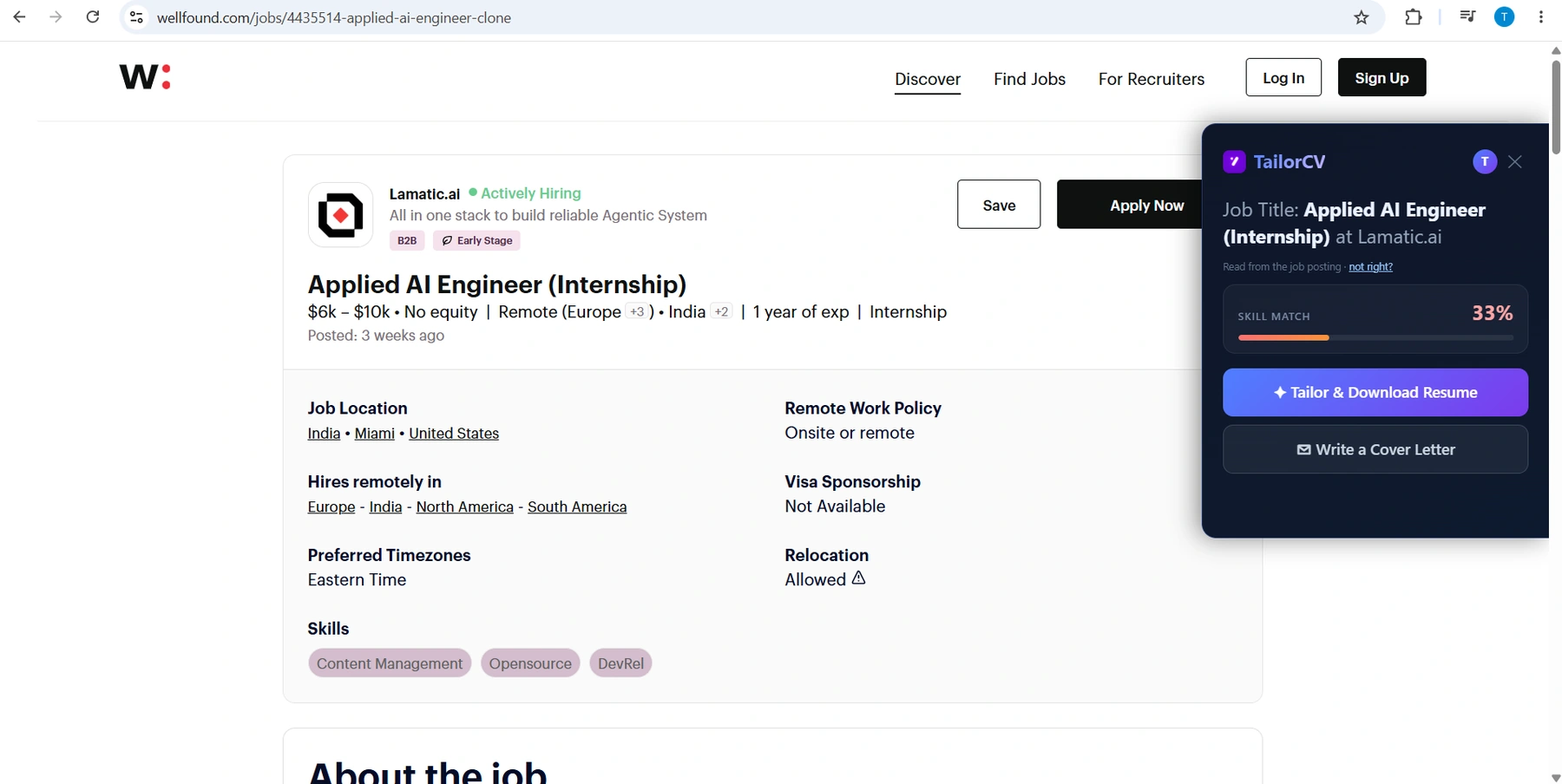
Startup boards work the same way - the extension reads the Wellfound listing you are already on, so the match check happens before you apply rather than after a rejection.
Enterprises are operating something. They need people who can work within structure, follow process, and scale what already exists.
These are different jobs. Even if the title says "product manager" at both companies, what they actually need from you is different.
Your resume has to reflect that. Understanding how recruiters read resumes at each type of company is the first step to getting this right.
| Signal | Startup | Enterprise |
|---|---|---|
| What they value | Scrappiness, speed, ownership | Process, consistency, specialization |
| Resume length | 1 page preferred | 1-2 pages acceptable |
| Metrics | Revenue impact, user growth, shipped features | Cost reduction, compliance, team scale |
| Skills | Broad generalist toolset | Deep specialist expertise |
| Language | Action, initiative, "built from scratch" | Methodology, governance, stakeholder alignment |
| ATS use | Sometimes, often lightweight | Almost always, enterprise-grade |
Tailoring Your Resume for a Startup
Your resume after optimization
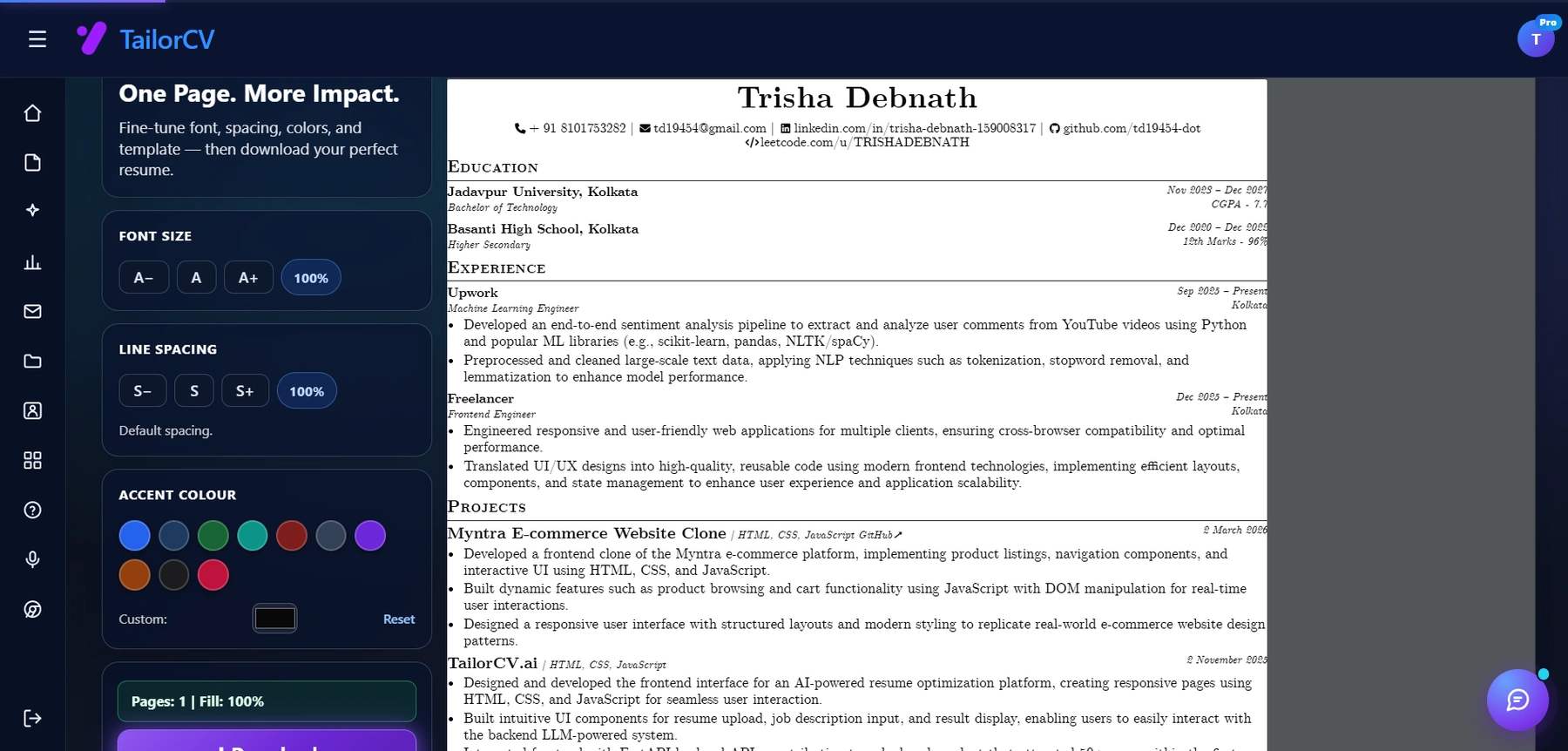
This is the resume after optimization - the tailored content is already in place, and these controls are how you fit it: font size, spacing, accent colour, template, with a live page counter.
1. Lead With Impact, Not Title
Startups do not care about your company name as much as what you did there.
Your resume summary should show ownership from day one.
Generic (fails for startups):
"Marketing professional with experience in digital campaigns and brand strategy across multiple industries."
Tailored for startup:
"Growth marketer who built and scaled a content engine from 0 to 80k monthly visits in 14 months. Comfortable owning strategy, writing copy, running A/B tests, and reporting directly to the CEO."
Startup founders and hiring managers want to see that you can do, not just oversee.
2. Use Startup Language
Certain words resonate at startups:
- "built from scratch"
- "0 to 1"
- "shipped"
- "owned end-to-end"
- "cross-functional"
- "wore multiple hats"
- "fast-paced environment"
- "early-stage"
Use these naturally where they reflect real experience. Review action verbs for your resume to find the right startup-facing language.
3. Show Breadth, Not Depth
At a startup, a data analyst who also set up the reporting system, trained the team, and presented to investors is more valuable than someone who only runs queries.
Show the full scope of what you did - even if it was outside your job title. Make sure your skills section matches the breadth the startup is looking for.
4. Highlight Speed and Results
Startups move fast. They want to see that you move fast too.
Lead every bullet point with a result, not a responsibility. And always quantify your achievements - startup founders love concrete numbers.
Responsibility (weak): Responsible for managing social media channels. Result (strong): Grew Instagram following from 3k to 41k in 8 months through organic content strategy, increasing referral traffic by 120%.
5. Keep It to One Page
Startup hiring managers are not reading two pages. They are deciding in 15 seconds.
Check ideal resume length guidance - for startups, one strong page beats two mediocre pages every time.
Tailoring Your Resume for an Enterprise Company
1. Signal Process and Scale
Enterprise companies want evidence that you can work within large, complex structures. Avoid the ATS formatting mistakes that get enterprise applications rejected before they reach a person.
Your bullets should show:
- Scale of teams or systems you worked with
- Process improvements and methodologies
- Cross-departmental collaboration
- Risk management and compliance awareness
- Stakeholder management
Weak for enterprise: Built a pipeline to process customer data. Strong for enterprise: Designed and implemented a customer data ingestion pipeline processing 15M+ records daily, compliant with GDPR and SOC 2 standards, in collaboration with legal, IT security, and product teams.
2. ATS Matters Much More
Enterprise companies use sophisticated Applicant Tracking Systems. Your resume will be parsed and scored before any human sees it.
Match the exact keywords from the job description. Use formal section headers (Experience, Skills, education - not "My Background" or "What I've Built").
Use TailorCV's ATS optimizer to check your score before applying to any enterprise role. It identifies the exact keywords you are missing and tells you where to add them.
3. Use the Right Certifications and Credentials
Enterprise job descriptions often list specific certifications. PMP for project management. CPA or CFA for finance. AWS Certified or Azure for cloud roles. CISSP for security.
If you have them, list certifications prominently. If you are working toward them, mention it.
4. Quantify at Scale
Enterprise hiring managers are impressed by numbers - but enterprise-scale numbers.
- "Led a 12-person cross-functional team" (not just "led a team")
- "Managed a $2.4M annual budget" (not just "managed budget")
- "Supported 3,000+ enterprise customers across 14 countries"
5. Use Structured Formatting
Enterprise ATS systems prefer clean, simple formatting. No columns. No tables in the body. No graphics or logos. Standard fonts.
Review resume fonts and formatting before finalizing your enterprise application. If you are unsure whether your resume will parse correctly, use one of TailorCV's ATS-friendly templates as your base - they are designed to pass enterprise ATS without losing your visual identity.
The Master Resume Strategy
You should not rewrite your resume from scratch every time.
Instead, build a master resume with everything - all roles, all bullets, all skills, all certifications.
Then create two tailored versions:
- Startup version - tighter, impact-first, broader skills, scrappier tone
- Enterprise version - structured, process-focused, ATS-optimized, credential-forward
For each new application, you adjust from the relevant base version.
This cuts your tailoring time from 40 minutes to under 10.
Read how to manage multiple resume versions to set up this system properly. You can also use the resume customization checklist to make sure each version is fully tailored before you send.
Language Comparison: Startup vs Enterprise
| Your experience | Startup version | Enterprise version |
|---|---|---|
| Managed a product launch | Shipped [product] from idea to launch in 6 weeks as sole PM | Managed end-to-end product launch lifecycle across product, engineering, QA, and marketing teams |
| Improved a process | Cut manual reporting time by 70% by building a custom automation | Implemented process automation to reduce operational overhead by 35%, aligned with ISO 9001 compliance requirements |
| Led a team | Built and led a 4-person team from scratch | Managed cross-functional team of 12, providing strategic direction and performance oversight |
The experience is the same. The language is tuned for the audience.
Common Mistakes
Sending a startup resume to an enterprise ATS It will likely fail keyword matching. Informal language, missing certifications, unconventional formatting - all hurt your enterprise ATS match score.
Sending an enterprise resume to a startup It reads as slow, bureaucratic, and overly formal. Founders want people who move, not people who manage processes. This is why your resume gets no responses from startups when you are using an enterprise-style document.
Using the same summary for both The summary is the first thing read. It needs to resonate with the specific audience immediately.
Ignoring ATS keyword mistakes Even startup applications increasingly use lightweight ATS. Always check your keyword match before applying.
How TailorCV Speeds This Up
Switching between startup and enterprise applications is the most time-consuming part of a job search.
TailorCV's resume optimizer reads the job description and tells you exactly which keywords and signals are missing from your resume for that specific role.
Paste the startup JD - get a startup-optimized version. Paste the enterprise JD - get an ATS-matched, credentialed-forward version.
The same resume, intelligently adapted. If you are also managing a LinkedIn profile, consider keeping it aligned with whichever job type you are prioritizing in your current search.
Make This Practical
Do not guess whether the resume is ready. Upload it to the free ATS score checker, compare the result with the ATS Score Guide, and fix formatting issues using ATS Resume Formatting Mistakes and ATS Resume Parser Friendly Format.
After the technical cleanup, improve relevance. Use Resume Matching With Job Description, strengthen keyword coverage with the Resume Keywords Guide, and avoid overdoing it by checking ATS Keyword Mistakes. If the layout itself is weak, rebuild with an ATS-friendly resume template.
A similar shift happens between consulting and industry roles - see tailoring for a consulting firm vs an industry role.
FAQ
Should I have two entirely different resumes for startups and enterprises?
Not entirely different. A shared base with two tailored versions (startup and enterprise) is the right approach. The experience is the same - only the emphasis and language change.
Do startups use ATS?
Some do, especially Series B and later. But earlier-stage startups often rely on direct review. Still optimize for readability and relevance. Check out our resume keyword density for more tips on optimization.
What if the job description doesn't say startup or enterprise?
Look at company size, funding stage (Crunchbase), and how the JD is written. "Move fast and break things" vs "work within established frameworks" tells you which mode to apply in. You can also learn how to read between the lines of a job description to find hidden keywords.
Can I mention startup experience on an enterprise resume?
Yes - frame it around scale, results, and transferable process skills. Enterprise employers like that startup candidates are resourceful. Consider syncing your LinkedIn profile with your tailored resume for better visibility. You might also explore our resume templates to enhance your presentation.
Related Guides
- How to Tailor Your Resume for Every Job
- Resume Matching with Job Description - Complete Guide
- ATS Resume Formatting Mistakes
- How to Manage Multiple Tailored Resume Versions
- How to Write a Resume Summary
- Resume Keywords Guide
- ATS Score Guide 2026
- How to Match Resume Keywords to Job Description
- Tailored vs Generic Resume
- Resume Optimization Guide
Conclusion
Your experience does not change. Your resume should.
A startup wants a builder. An enterprise wants a system.
Show each one what they are actually looking for - not a generic version of you, but the most relevant version.
Read the JD like a signal. Tune your language. Check your ATS score. Then apply with a resume that fits the company, not just the role.
Tailor My Resume for This Company - Free
See what tailoring is worth on your resume
Score your current resume against a real job description before you change a word.
Drop your resume here or choose a file
PDF only. Max 2 MB.
We never share your data or use it to train AI models.

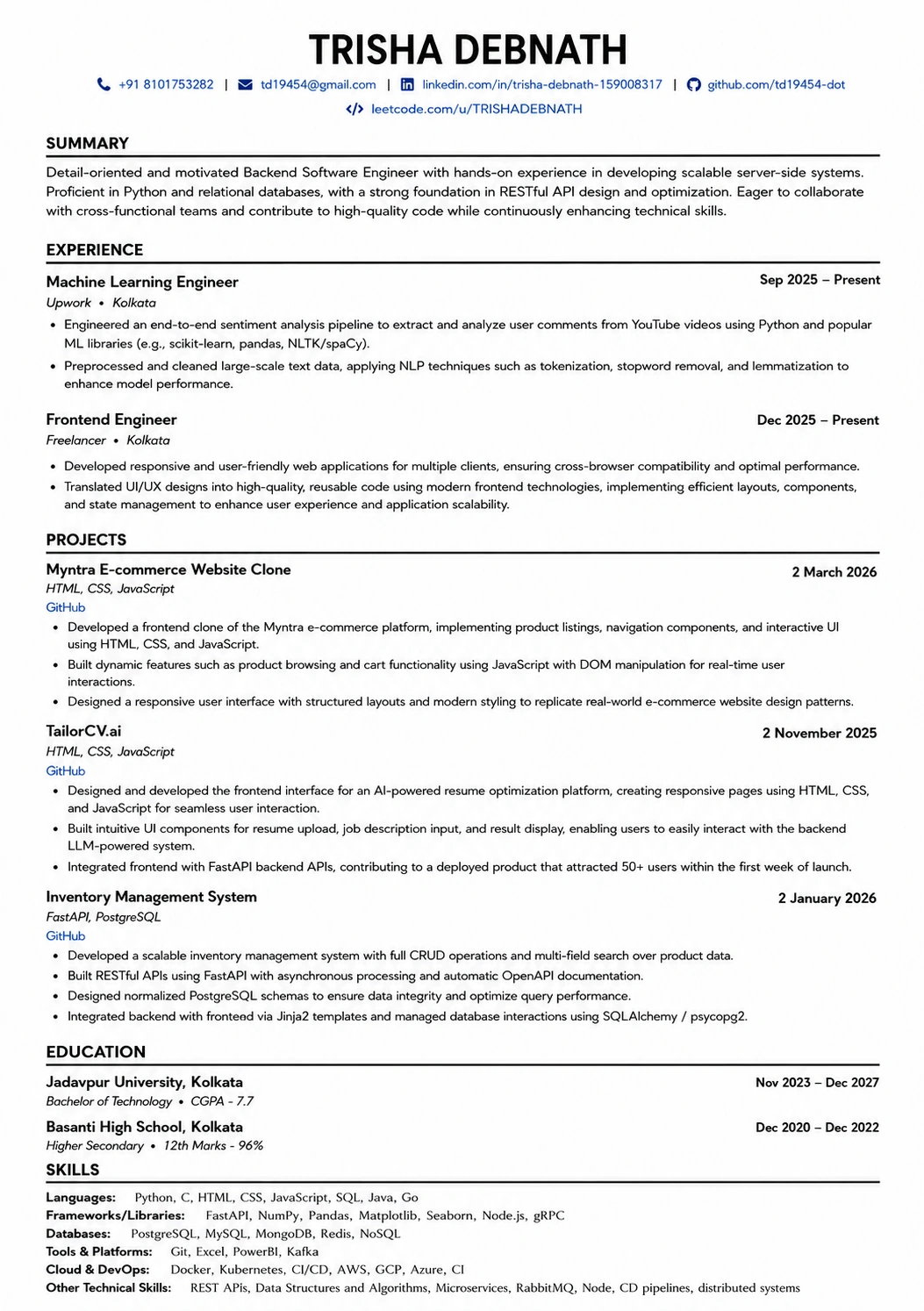
Start from a template that tailors well
Clean structure means swapping keywords per job takes minutes, not a re-layout every time.
Was this guide useful?
Be the first to rate it.