 TD
TD
Key Takeaways
- The maths is lopsided in a student's favour: you apply to far more roles with a far thinner resume, so tailoring pays back most.
- Not every job-search tool matters equally when you are starting out - tailoring comes first, everything else after.
- On a student budget, check what "free" actually means; some tools let you do the work free and then charge to export it.
- Campus placement compresses many applications into a short window, so it needs its own preparation.
- The error that sinks most student searches feels like the opposite of a mistake: applying to more roles with the same untailored resume.
Students and freshers face a specific version of the job-search problem: you are applying to more roles than an experienced candidate, with a thinner resume, and often with no idea why your applications vanish. The right browser extension helps disproportionately here — more than it does for a mid-career applicant — precisely because your situation demands more tailoring over less material. This guide covers what actually helps a student job hunt, and what to skip.
Why Extensions Help Students Most
The math is lopsided in your favour. An experienced candidate applies to a handful of targeted roles with a resume full of relevant experience. A student applies broadly — many roles, many companies, many sectors — because you are still figuring out what fits, and your resume is short, so every posting needs more adaptation to look like a match.
That means more tailoring, more often, over a resume where each change matters more. And tailoring by hand is exactly what a busy student — juggling classes, projects, maybe a part-time job — does not have time for. So the friction that stops everyone from tailoring stops students hardest, which is why an on-page tool that makes tailoring take one click instead of ten minutes helps you more than almost anyone. The ATS filter does not go easy on freshers; if anything, it is where your applications are quietly dying.
What a Student Actually Needs
Not every job-search tool matters equally when you are starting out. In priority order:
1. A free ATS score. Before anything, you need to know whether your resume is even the problem. A free, unlimited match score tells you — and "free and unlimited" matters enormously on a student budget, because a tool that charges or limits the diagnosis is one you cannot actually use across a real search. Your ATS score as a fresher works a little differently, leaning on projects and coursework.
2. On-page tailoring. The tool that closes the gap the score reveals, in one click, on the posting. This is the highest-leverage thing for a student because you tailor so often.
3. A cover letter generator. Freshers benefit from cover letters more than experienced candidates, because a letter with no work experience is where you sell projects, enthusiasm and potential — the things a thin resume cannot fully show.
4. A portfolio. Not strictly an extension, but for students it is often the single biggest differentiator — a portfolio site shows real work when your resume is still short, and linking it gives recruiters something to actually look at.
What you do not need yet: heavy autofill (student applications are often shorter forms), or LinkedIn-influencer tooling. Keep your toolbar lean.
Why Free Matters (and What "Free" Should Mean)
On a student budget, "free" is not a nice-to-have — it is the whole question. But be careful what free means. Some tools let you do the work free and then charge to download the result. Others give you five checks and then a paywall right when your search heats up. Neither is genuinely usable for a real student search.
The honest version: the diagnosis should be free and unlimited, because you should never pay to find out whether you have a problem. TailorCV's extension gives students unlimited free ATS scores and a free portfolio builder; the AI tailoring is on a paid plan, and we price it by region — genuinely affordable for a student in India, and reasonable globally — precisely because our users are largely students and freshers. Whatever tool you choose, apply the same test: is the thing that tells me my problem free, and is the pricing something a student can actually justify?
The Student Tailoring Workflow
Here is the flow that works when you are early-career and applying broadly.
What it looks like on a LinkedIn job post
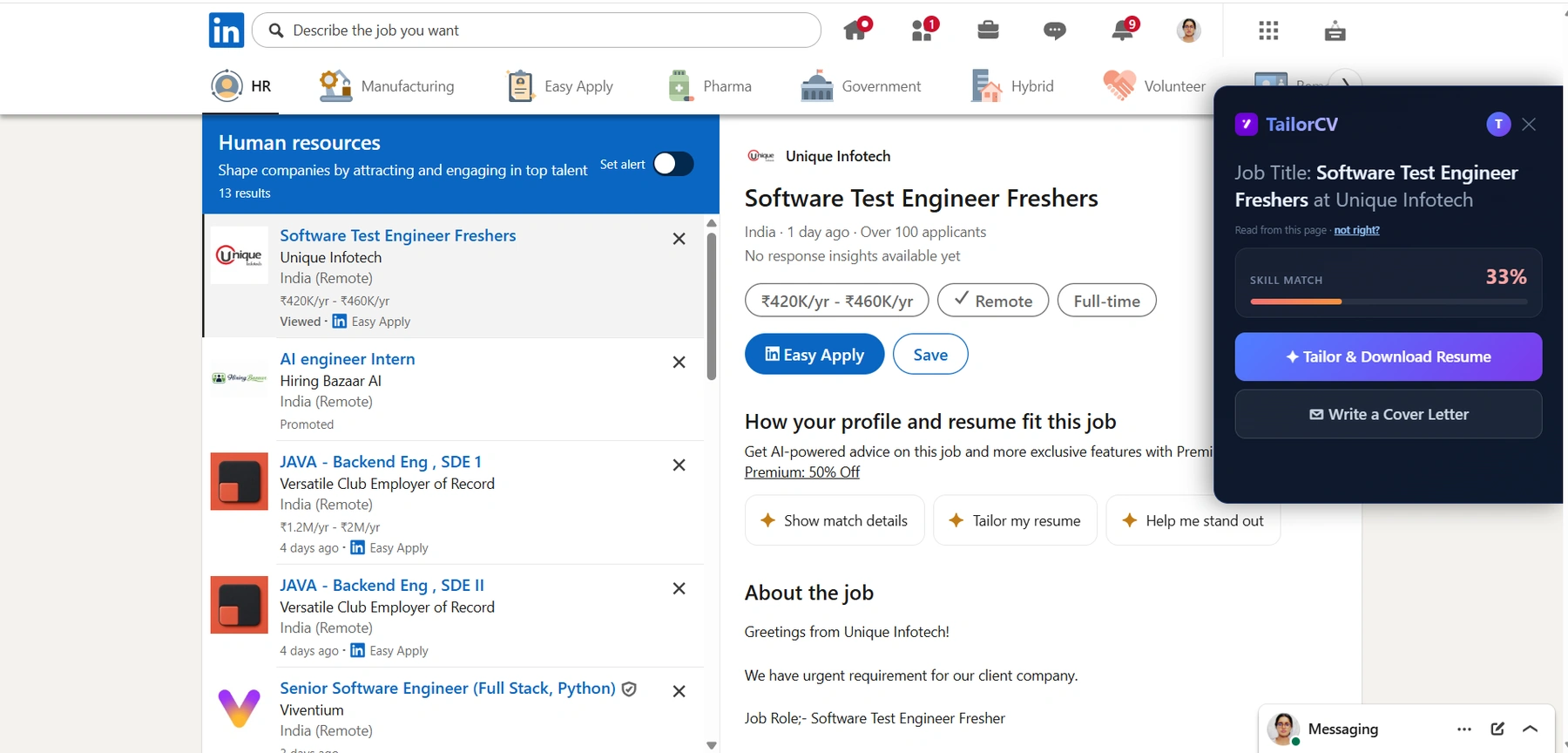
And the same on LinkedIn: the extension reads the posting off the page you are already on, so the match score arrives before you hit Easy Apply.
Get your base resume solid once. With a thin resume, every word counts — quantify your projects, keep it ATS-friendly and parseable, and lean on fresher projects that get interviews. Do not sound generic.
Tailor every application on the page. Open the job on LinkedIn, Indeed, Naukri or a campus/company portal, see your match score, tailor in one click, add a cover letter. The best keywords matter as much for you as anyone, and matching is a translation of your real experience, not invention.
Prepare for the specific interviews. As a fresher you will get asked predictable questions — practice them.
Special Cases for Students
A few student-specific situations deserve their own approach. Campus placement compresses many applications into a short window — preparing for campus placement covers it, and tailoring fast is exactly what a placement season demands. First tech job with no professional experience — strategies that actually work and getting a job with no experience. Internships are your resume-builders — treat them like real roles. And if you are applying abroad after graduation, conventions differ for the USA and Canada, including whether you need a resume or a CV. Students are also targeted by job scams more than most — know the signs.
After You Apply
Getting past the filter is the start. Send a follow-up after applying and after the interview — few students do, so it stands out. Before the interview, research the company, rehearse behavioural questions, tell me about yourself and why do you want this job, and run a mock interview; the full interview prep guide covers more. When one does not land — and some will not — handle the rejection; early-career searches involve a lot of it, and resilience matters. Pace yourself: how many jobs to apply to per day is about quality, and the difference between a tailored and generic resume is the whole game.
The Mistake Most Students Make
There is one error that sinks more student job searches than any other, and it is worth naming because it feels like the opposite of a mistake: applying to as many jobs as humanly possible with one resume.
It feels productive — a hundred applications must beat ten, surely. But a hundred generic applications to a thin resume that does not match is a hundred near-certain rejections, and it burns the time and morale you needed for the applications that could have worked. Students fall into this harder than anyone because the pressure is real — placement season, graduation looming, peers getting offers — and volume feels like control. It is not. It is a busy way of getting filtered out a hundred times.
The students who do well invert this. They apply to fewer roles, tailor each one (fast, on the page), and put real effort into the cover letter and interview prep. Ten matched applications with tailored resumes beat a hundred generic ones, and they cost less total effort once tailoring is one click. The lesson every early-career job seeker learns eventually — usually the hard way — is that a job search is won on match quality, not application count. Learn it early and you save yourself months.
The second most common mistake is treating projects as an afterthought. For a student, projects are your experience — they are what a thin resume leans on, and a portfolio site showing real work often does more than another line of coursework. Build one, link it, and let it do the talking a short resume cannot.
Frequently Asked Questions
What is the best Chrome extension for students job hunting? Prioritise one that gives you a free, unlimited ATS score and tailors your resume on the job page in one click, ideally with a cover letter generator and an affordable price. Students tailor more often over a thinner resume, so on-page tailoring helps you most. TailorCV's extension is built with students and freshers in mind, with free unlimited scoring and region-based pricing.
Are these extensions free for students? Some are. The important thing is that the diagnosis — the ATS score — is free and unlimited, so you can actually use it across a whole search. Be wary of tools that charge to download your result or cap your free checks. Affordable, region-based pricing on the paid features matters on a student budget.
Do freshers even need to tailor their resume? Yes — arguably more than experienced candidates. With a thin resume, you rely on matching every posting closely to look like a fit, and you apply to more roles across more sectors. Tailoring is what makes a short resume read as relevant to each specific job.
What matters most for a student job search? A solid, ATS-friendly base resume; tailoring every application; a cover letter that sells your projects and potential; and a portfolio that shows real work your resume cannot. Get those four right and you are ahead of most early-career applicants.
Putting It All Together
Students get the hardest version of the job search — more applications, thinner resume, less time, and no clear feedback on why things fail — which is exactly why the right browser tool helps you most. The lever is tailoring: with a short resume, matching each posting closely is what makes you look like a fit, and doing that by hand for every application is impossible while you are also studying.
Keep your toolbar lean and your priorities clear: a free ATS score to find your gap, on-page tailoring to close it, a cover letter to sell your potential, and a portfolio to show your work. Free where it counts, affordable where it does not.
Start now, with one role you actually want: check your match score against it. If it is low, you have just learned why your applications have been vanishing — and exactly what to fix, on every job, without the ten-minute grind that a student's schedule cannot spare.
Check your match before you install anything
Same score the extension shows on a job page - run it here on any resume and job description.
Drop your resume here or choose a file
PDF only. Max 2 MB.
We never share your data or use it to train AI models.

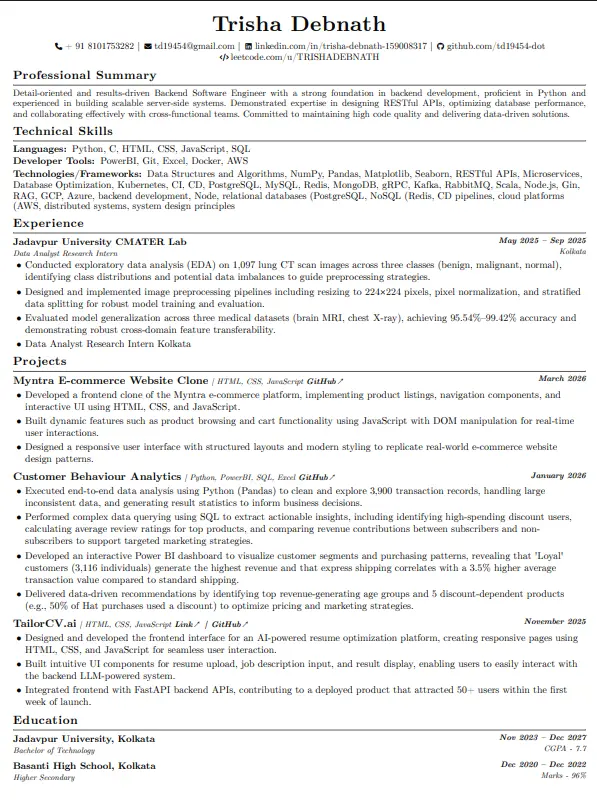
What the tailored resume looks like
This is the format the extension exports to — ATS-tested, so the match score you saw survives the parser.
Was this guide useful?
Be the first to rate it.