 SS
SS
Key Takeaways
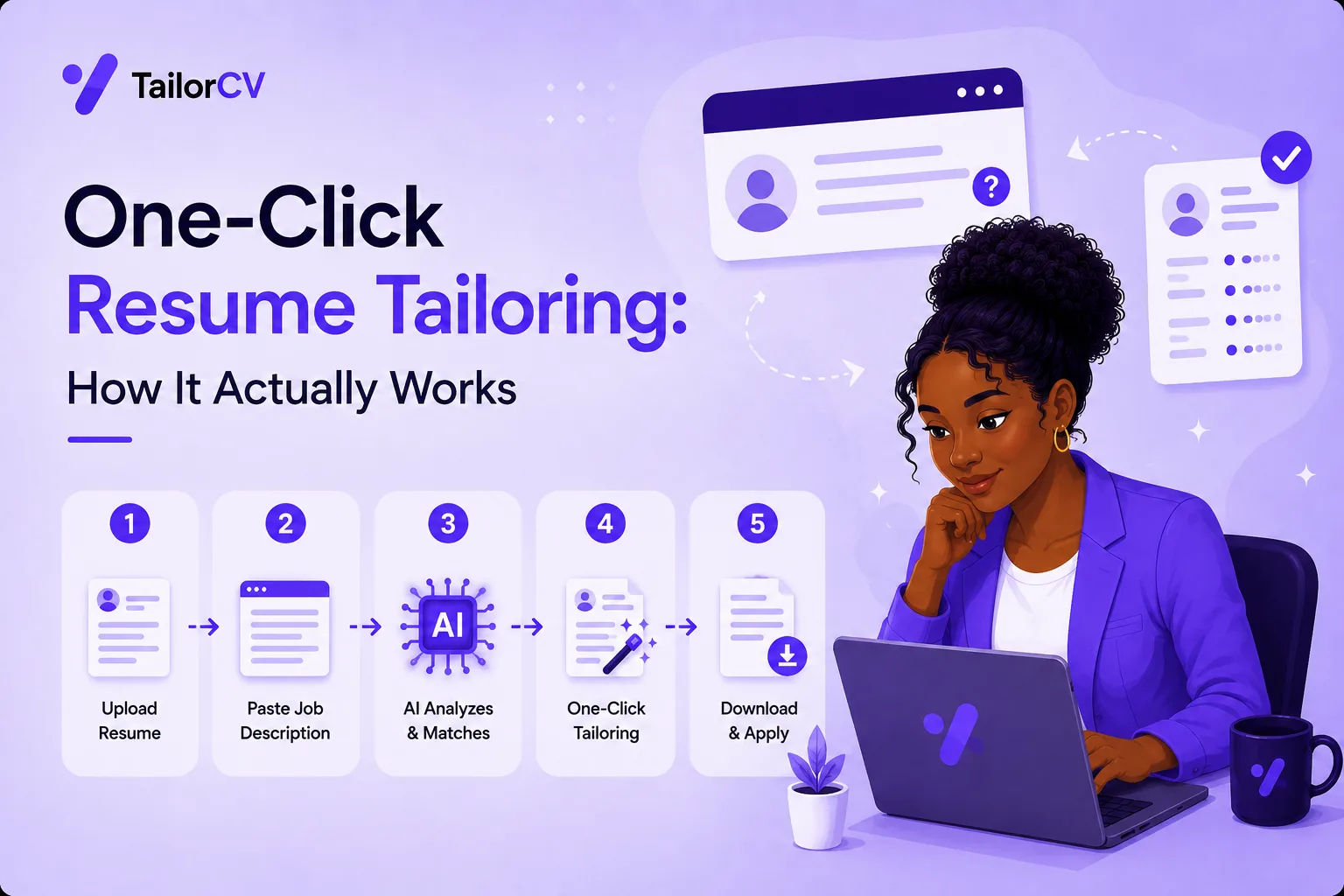
- When you apply through a portal your resume is parsed and matched by exact language, which is the problem this solves.
- The tool first reads the posting, pulling the job description straight off the page you are already on.
- Before changing anything it scores your existing resume against the posting's requirements.
- The rewrite step carries guardrails, because a careless tool here produces garbage or worse, lies.
- A rewrite is useless if the output does not parse, so the result has to stay single-column with standard headings.
"Tailor your resume in one click" sounds like marketing until you understand what is actually happening in that click — and once you do, you can judge whether it produces a resume worth sending or just a keyword-stuffed mess. This is an honest look under the hood: what one-click tailoring reads, what it changes, what it deliberately will not do, and why the good version genuinely works.
The Problem It Is Solving
Start with why anyone wants this. When you apply through a portal, your resume is parsed into structured data and matched, by exact language, against the job description. A generic resume that does not carry the posting's specific terms gets filtered out before a human reads it, because the filter matches language, not meaning. Our guide on passing the ATS in 2026 covers the mechanism.
So tailoring is not optional if you want replies. But doing it by hand is ten minutes a job, which is why people stop after week two. One-click tailoring exists to remove that friction — to make the thing everyone knows they should do actually sustainable. The question is whether it does it well.
Step 1: Reading the Job Description
The first thing the tool does is read the posting. A good on-page tool, like TailorCV's extension, pulls the job description straight off the page you are viewing — no copy-paste — using several methods so it works even on sites it has never seen: structured job data when the site publishes it, site-specific rules where they exist, and a content heuristic otherwise.
Then it extracts the requirements: the hard skills, tools, certifications and phrases the posting emphasises. This is the same raw material you would identify by hand if you read the JD carefully, just done in a fraction of a second and without missing the buried ones. It is essentially building the checklist that the best keywords to beat the ATS describes, automatically, for this specific role.
Step 2: Scoring the Match
Before it changes anything, the tool compares those extracted requirements against your existing resume and produces a match score — how many of the posting's requirements your resume already carries, and which are missing.
This step is doing something important: it is telling you the truth about where you stand before any editing, so you can see the gap. A resume at 82% needs light touching; one at 54% needs real work. Understanding the difference between this match score and a general resume quality score matters — the match score is specific to this one job, which is the entire point of tailoring.
Step 3: The Rewrite — and Its Guardrails
This is the step people worry about, and rightly, because a careless tool here produces garbage or, worse, lies.
Good one-click tailoring rewrites your bullets so they carry the posting's language — but under a hard constraint: it may only re-express what is genuinely on your resume. It rephrases "worked with clients and teams" into "managed stakeholder relationships across teams" if your experience supports that; it does not invent a project, an employer, or a skill you never had. This guardrail is the whole difference between a tool worth using and one that gets you caught in the interview.
Within that constraint, three things happen. It works the missing keywords in where your real experience backs them, so the language matches. It keeps your own voice rather than flattening everything into corporate mush, because a resume that reads like a machine wrote it fails the human stage even if it passes the filter. And it avoids the keyword-stuffing mistakes that a good tool is specifically designed not to make — cramming terms with no substance behind them is exactly what sounds generic to a recruiter. Where it can, it quantifies using numbers already in your history.
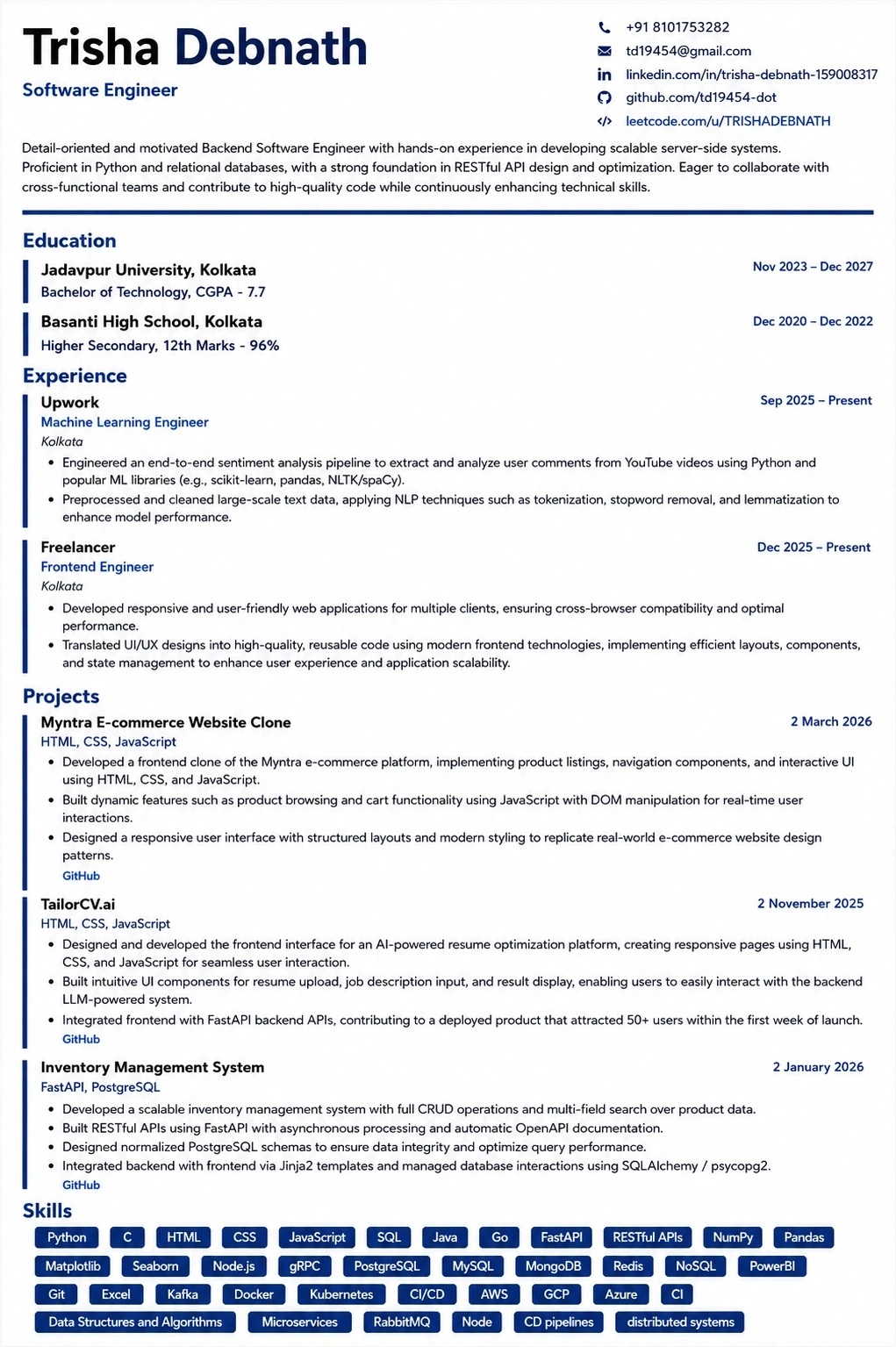
The result is not a new resume. It is your resume, re-emphasised and re-worded to answer this specific posting — which is precisely what tailoring by hand aims at, done in a click. The manual version of exactly this is in how to tailor your resume for every job and in five minutes.
Step 4: Formatting That Survives the Parser
A rewrite is useless if the output does not parse. Good tailoring produces a resume in a parser-friendly format — single column, standard headings, no tables or text boxes that scramble in an ATS. This is the ATS-friendly formatting baseline, and it avoids the formatting mistakes that sink otherwise-strong resumes. The PDF you download is ready to submit, not something you have to reformat.
Your resume after optimization
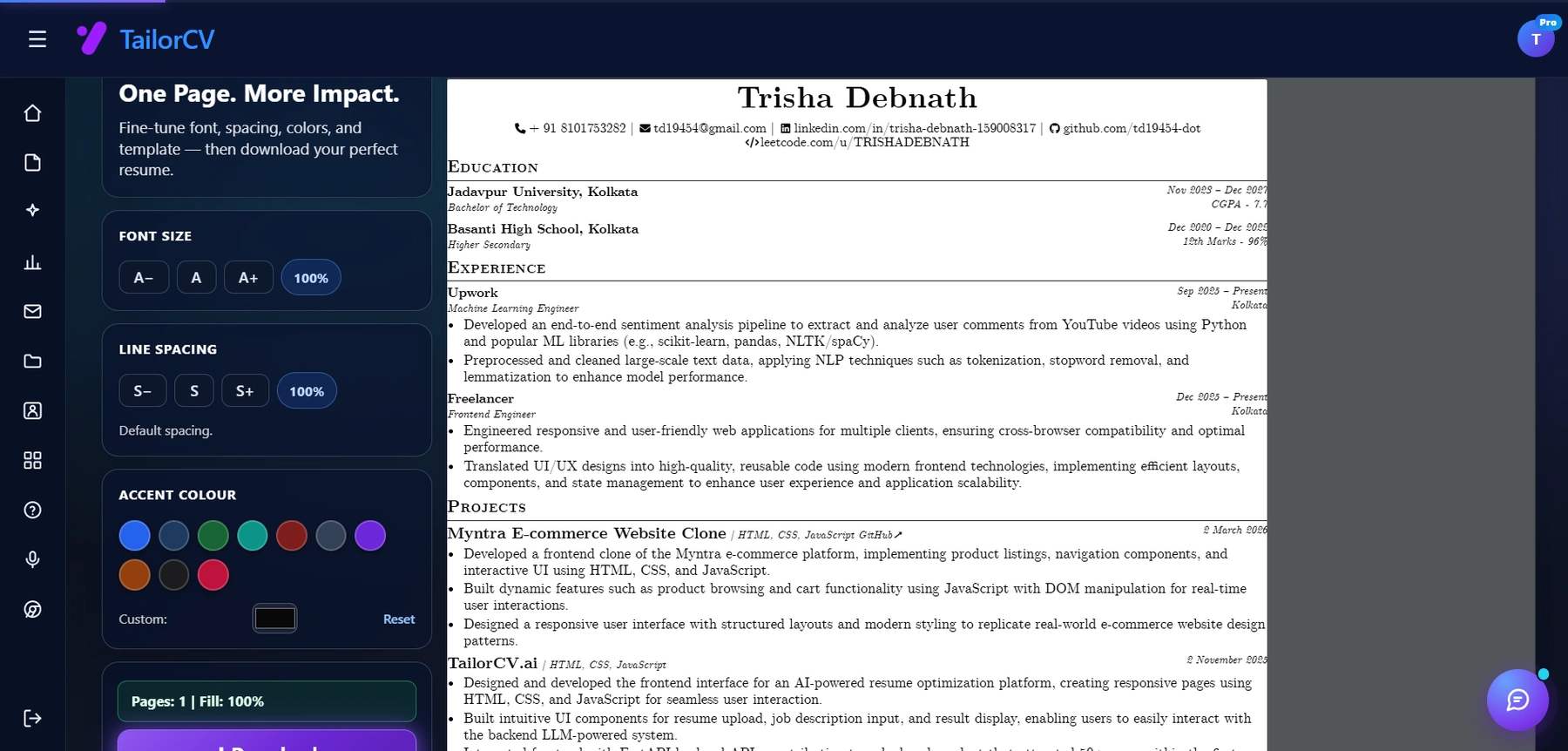
The optimized resume renders live beside the controls, so you see the page count change as you adjust.
Step 5: The Cover Letter and the Record
The better tools do not stop at the resume. In the same flow you can generate a matching cover letter built from the same posting and the same base resume, with a strong opening line and without the usual mistakes. And each tailored version is saved automatically with its score and the job it was written for, so you have a record of exactly what you sent where — useful weeks later when a recruiter calls about a role you barely remember applying to.
Why It Works Better Than Manual — Even at the Same Quality
Here is the counterintuitive part: even if a careful human could tailor slightly better than the tool on any single resume, the tool wins over a real search. The reason is not quality per application; it is consistency across applications.
Manual tailoring degrades. You do it well on application one, adequately on application eight, and not at all by application fifteen, because willpower runs out. A tool does application fifteen exactly as well as application one, at 11pm, every time. Over a search of twenty-five applications, consistent good-enough tailoring beats occasional excellent tailoring and mostly-generic the rest — which is what actually happens by hand. This is why the on-page, one-click form matters more than a marginally smarter tool you have to open in a separate tab: it removes the moment where the habit collapses. If you have wondered how many jobs to apply to per day, consistency is why fewer-but-tailored wins.
Where It Works
The same one-click flow works across boards, because they all feed the same kind of filter — LinkedIn, Indeed, Naukri, and the ATS boards behind company career pages. For remote roles it matters more because competition is global; conventions differ for the USA and Canada, including whether you need a resume or a CV. The startup vs enterprise emphasis shifts too, and if you want the fastest manual path alongside the tool, matching your resume to a job description fast and how to increase your ATS score cover it.
After the Tailored Resume
Tailoring gets you seen; the rest of the search still matters. Send a follow-up after applying and after the interview. Before the interview, research the company, rehearse behavioural questions and tell me about yourself, and run a mock interview; the full interview prep guide covers the rest. When one does not land, handle the rejection.
Freshers: your ATS score as a fresher leans on projects that get interviews; see your first tech job, a job with no experience, campus placement, a portfolio site, the right template, and explaining an employment gap.
What It Cannot Do (Being Honest)
No tool is magic, and it is worth being clear about the limits so you use it well.
It cannot make you a fit for a job you are not remotely qualified for. If a posting needs five years of a skill you have never touched, tailoring re-expresses what you have — it does not conjure the missing experience, and it should not, because a resume that lies gets you caught in the interview. When the match score stays low even after honest tailoring, that is real information: you may be reaching too far, and it is better to learn that from a score than from three weeks of silence.
It also cannot replace judgement on the output. A good tool produces a strong draft, but you should read it — check that a rephrased bullet still reads true, that nothing was over-claimed, that it sounds like you. The click saves you the ten minutes of mechanical work; it does not remove the thirty seconds of reading. Think of it as a very fast, very consistent first draft that you approve, not a black box you submit blind. Used that way — matched to each job, honest, and read before sending — it does exactly what careful manual tailoring does, without the friction that makes manual tailoring collapse.
Frequently Asked Questions
Does one-click tailoring just stuff keywords into my resume? A bad tool might. A good one rewrites your bullets to carry the posting's language only where your real experience supports it, keeps your voice, and produces a clean parseable PDF. Keyword-stuffing is exactly what it is designed to avoid, because it fails the human stage even when it passes the filter.
Will the AI invent experience I do not have? A well-built tool will not — it is constrained to re-express what is genuinely on your resume. It rephrases and re-emphasises your real work to match the role; it does not fabricate employers, projects or skills. Always read the output, but the guardrail is the point.
Is a tailored resume different enough to matter? Yes. The change that matters is not cosmetic — it is whether your resume carries the specific terms the posting and its ATS are matching against. A resume that goes from missing eleven of those terms to carrying the ones you genuinely have is a materially different application.
How is one-click tailoring different from a resume builder? A builder helps you write a resume from scratch. Tailoring starts from the resume you already have and adapts it to a specific job. They solve different problems — most people already have a resume and need it matched, not rebuilt.
Putting It All Together
One-click resume tailoring is not magic and it is not cheating. It is a fast, consistent version of exactly what a careful applicant does by hand: read the posting, find the requirements, re-express real experience to match them, keep it honest, and keep it parseable. The click just removes the ten minutes and the willpower that cause people to stop.
The good versions live on the page, respect the honesty guardrail, and save the record — turning tailoring from an occasional heroic effort into a default you barely notice. That default, sustained across a whole search, is what separates the resumes that get read from the ones that vanish.
Try it against a job you actually want: check your match score, watch what the rewrite changes, and judge the output yourself. If it reads like you — sharper, matched, and true — that is the whole idea.
See what tailoring is worth on your resume
Score your current resume against a real job description before you change a word.
Drop your resume here or choose a file
PDF only. Max 2 MB.
We never share your data or use it to train AI models.

Start from a template that tailors well
Clean structure means swapping keywords per job takes minutes, not a re-layout every time.
Was this guide useful?
Be the first to rate it.