 SS
SS
Key Takeaways
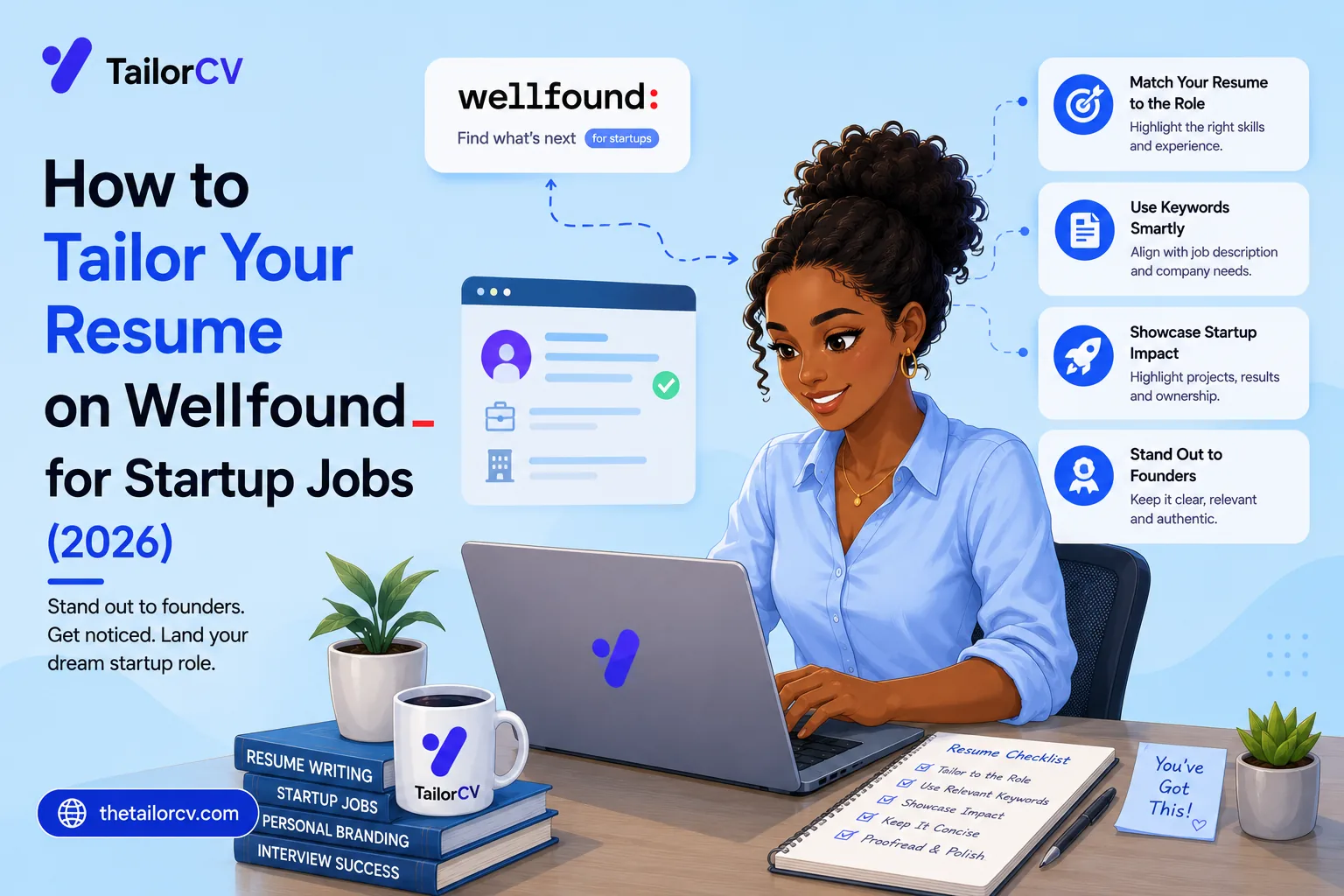
- Many startups have no ATS layer at all - a founder or hiring lead reads your application personally.
- The four tailoring moves still apply, but the emphasis shifts toward impact, breadth and stage fit.
- The honesty guardrail matters even more here, because you interview with the people you would work beside.
- Startups pack a lot into a short job description, so read for the stack, the stage, and the range they want.
- A portfolio site showing shipped work is gold at a startup, because a human is actually reading.
Wellfound (formerly AngelList Talent) is where a huge share of startup hiring happens, and startups do not read resumes the way big companies do. Applying there with the same resume you would send to an enterprise is a mismatch — not because startups are less rigorous, but because they are looking for different things. This guide covers what startups actually want, how tailoring for Wellfound differs, and how to do it in one click.
How Startup Hiring Is Different
At a large company, your resume often hits an ATS first and gets filtered by keyword before a human looks. Many startups, especially smaller ones, have no ATS at all — a founder or early employee reads every application personally. That changes what matters, and it is the core of why tailoring for a startup differs from an enterprise.
Tailoring straight from a Wellfound listing
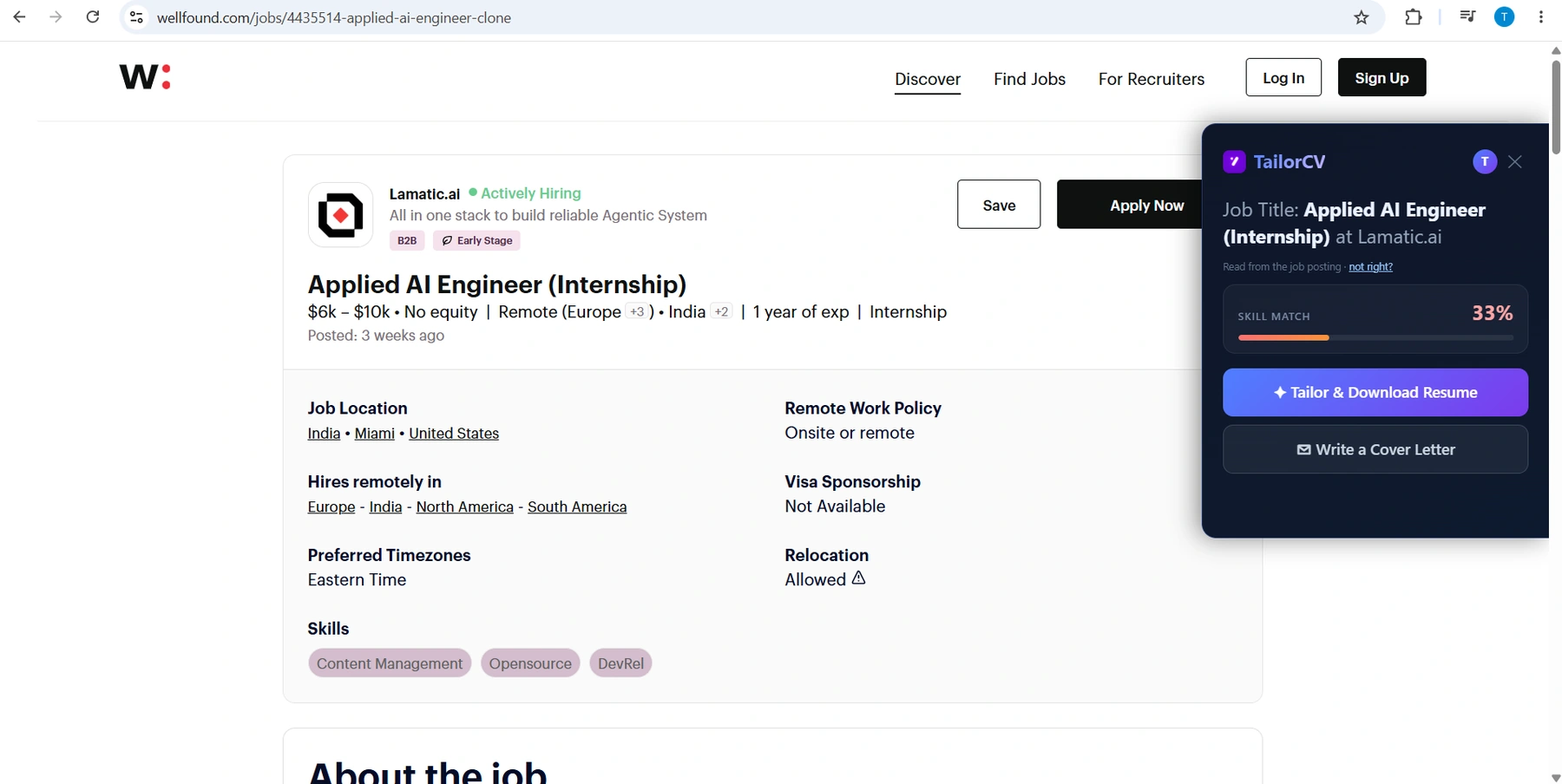
Startup boards work the same way - the extension reads the Wellfound listing you are already on, so the match check happens before you apply rather than after a rejection.
Startups tend to care about: breadth over narrow specialisation (you will wear many hats), evidence you can build and ship without much structure, direct impact you can point to, and genuine interest in their specific problem. A resume optimised purely to beat a keyword filter can actually underperform with a founder who wants to see initiative and range. So on Wellfound, you are tailoring for a human reader more than a machine — though a matched, relevant resume still wins either way.
What to Emphasise for Startups
The four tailoring moves still apply, but the emphasis shifts.
Lead with impact and ownership. Startups love people who took something from zero to shipped. Quantify it — a project you built, users you reached, a process you created. Vague responsibility statements land worse here than anywhere; generic phrasing is a bigger liability with a founder than with a filter.
Show breadth. If the role is "full-stack engineer" at a five-person startup, they mean it — they want someone who can touch frontend, backend, and maybe talk to users. Tailor to show the range the posting implies, drawing on real experience.
Match the specific stack and stage. Startups name their exact tools and their stage (pre-seed, Series A) for a reason. Match the keywords they use — the right terms still matter, just avoid stuffing because a human is reading.
Signal genuine interest. Founders can tell the difference between a mass-applier and someone who actually cares about the problem. This is where the cover letter does heavy lifting on Wellfound — a strong, specific opening about their product beats any generic pitch.
Do Not Fabricate — Especially Here
The honesty guardrail matters even more at a startup. In a small company, you interview with the people you would work beside, often in a deep technical conversation, and any exaggeration surfaces immediately. Tailoring means re-expressing your real experience to match what they value — never inventing it. A startup that catches a stretched claim in a founder conversation is a hard no, because they are hiring for trust as much as skill.
The Manual Way
By hand: read the Wellfound posting closely (startups pack a lot into a short JD), note the stack, stage and the range they want, duplicate your resume, re-emphasise your most relevant, impactful work, show breadth, keep it clean, and write a genuinely specific cover letter. Because the cover letter matters so much here, this takes longer than a big-company application done by hand — often twenty minutes-plus. Which is exactly why people fall back on a generic resume and a templated note, and exactly why founders ignore most of their applicants.
The One-Click Way on Wellfound
TailorCV's extension supports Wellfound, so you can tailor on the posting itself. Open the role, the panel reads the description off the page and shows your match score, and one click re-emphasises your resume toward what the posting values — from your real experience, in your voice. A second click drafts a cover letter built from that specific posting, which you then make genuinely personal.
That last part matters on Wellfound: use the tool to get a tailored, matched draft fast, then add the specific, human touch a founder responds to. The tool removes the mechanical tailoring so you can spend your effort on the part that actually differentiates you at a startup — showing you care about their specific problem. It works the same across LinkedIn, Indeed, Naukri and ATS boards too, so your whole search stays consistent.
Step by Step
Step 1 — Set your base resume once. Upload your resume; make sure it is solid with a free ATS score first, keep it ATS-friendly and parseable, and lean toward impact and breadth if you are targeting startups. Do it fast with a one-click tailor rather than the ten-minute manual grind.
Step 2 — Open the Wellfound role you actually want. Read it closely — the stack, the stage, the range.
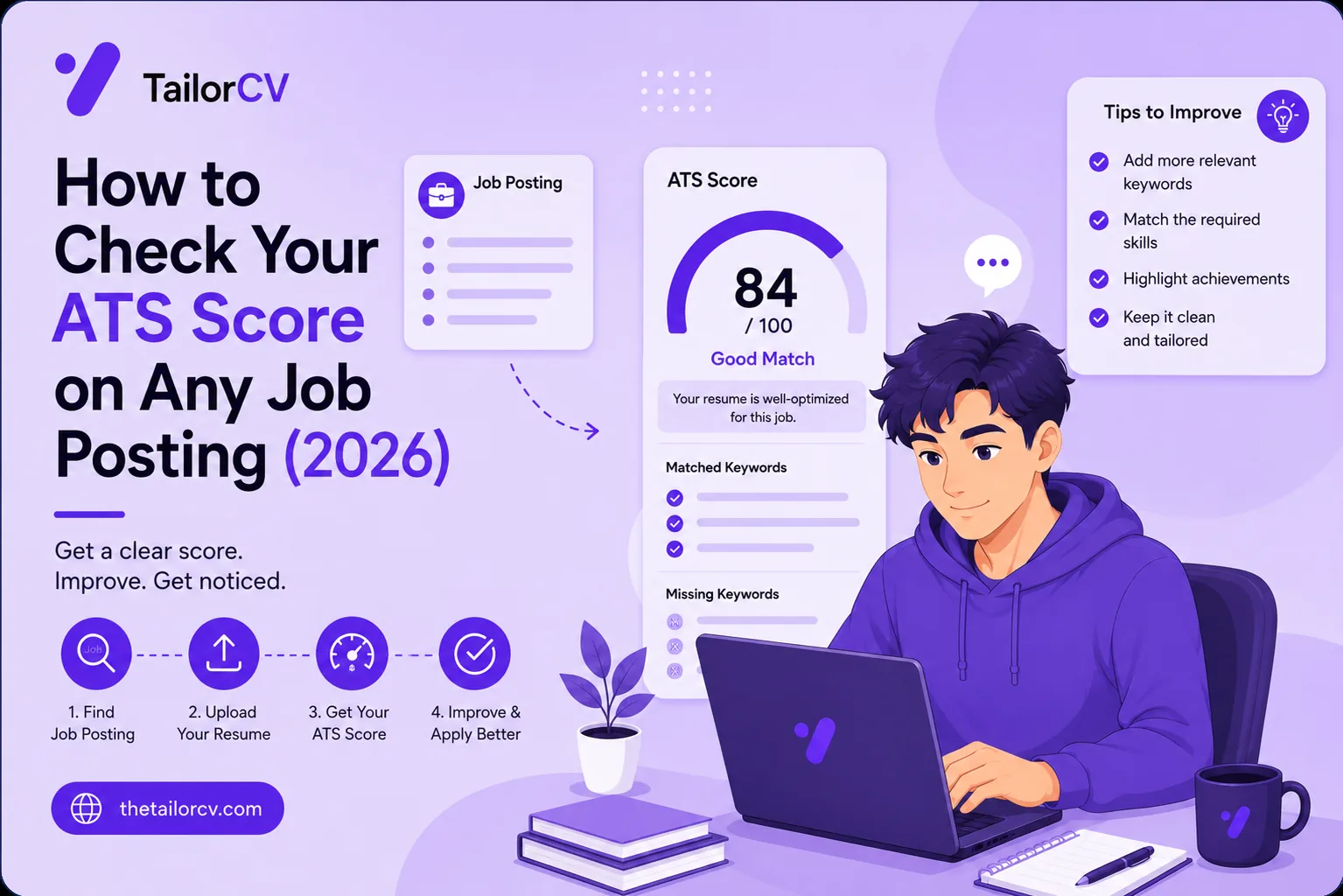
Step 3 — Check your match score and missing keywords — the difference between an ATS score and a resume score.
Step 4 — Tailor to emphasise impact, breadth and the specific stack, grounded in real experience. Download the PDF.
Step 5 — Write a genuinely specific cover letter. Generate a draft, then make it personal to their product. This is your biggest lever on Wellfound.
Step 6 — Apply, and keep each version in your library.
For Founders' Reading, Not Just Filters
Because a human reads it, a few extra things help on Wellfound. A portfolio site showing shipped work is gold at a startup — founders want to see what you have built, and linking it gives them exactly that. If you are early-career, projects that get interviews and landing a first tech job apply doubly at startups, which often value demonstrated ability over pedigree. And watch for scams — the startup space has its share of fake "equity-only" traps.
After You Apply
Startup processes move fast, so be ready. Send a follow-up after applying and after the interview. Prepare for interviews — startups lean on behavioural and practical questions, tell me about yourself, why do you want this job — and run a mock interview. Research the company hard; at a startup, knowing their product is table stakes. When an offer comes, negotiate carefully (equity complicates it). When one does not land, handle the rejection. And whether you are applying to remote startups or ones in the USA or Canada, pace yourself — fewer, tailored applications beat a generic blast, and the tailored vs generic gap is even wider with a human reading.
Why Generic Applications Fail Worse at Startups
It is worth understanding why a generic application, which merely underperforms at a big company, actively backfires at a startup — because the difference should change how you apply on Wellfound.
At a large company, a generic resume gets quietly filtered by the ATS and nobody notices; you are one anonymous rejection among thousands. At a startup, a founder reads your generic application personally, and it lands as a small insult: it says you did not care enough about their company — the thing they have poured their life into — to spend ten minutes on it. Founders talk about this constantly. A generic application is not neutral to them; it is a signal that you are mass-applying, and mass-appliers are exactly who they screen out, because early hires have to genuinely want to be there, not just employed somewhere.
The flip side is a huge opportunity. Because so many applicants send generic resumes and templated notes, a genuinely tailored application — one that shows you understand their product, their stage, and their specific problem — stands out dramatically. The bar is low precisely because most people cannot be bothered, which means the effort you do put in counts for more than it would anywhere else. This is where matching your resume honestly plus a specific cover letter, produced fast with a tool and then personalised, beats a hundred lazy applications. At a startup, tailoring is not just optimization — it is proof of the exact trait they are hiring for.
Frequently Asked Questions
How do I tailor my resume for Wellfound startup jobs? Emphasise impact, ownership and breadth over narrow specialisation, match the startup's specific stack and stage, and show genuine interest in their problem — especially in the cover letter, which matters more at startups because a human reads it. Tailor from your real experience; never fabricate, because startup interviews expose it fast.
Do startups on Wellfound use an ATS? Many small startups do not — a founder or early employee reads applications personally. Larger or later-stage startups may. Either way, a resume matched to the role wins, but at small startups you are tailoring for a human reader who values impact and range over keyword density.
Is a cover letter important on Wellfound? Yes, more than on most big-company applications. Founders respond to genuine, specific interest in their product, and the cover letter is where you show it. A tailored draft plus a personal, product-specific touch is the winning combination.
What do startups want that big companies do not? Breadth (you will wear many hats), evidence you can build and ship without much structure, direct measurable impact, and real interest in their specific mission. Tailor to surface those from your genuine experience rather than optimising purely for a keyword filter.
Putting It All Together
Wellfound is a different game from enterprise job boards. Startups often skip the ATS and read your application personally, so they reward impact, breadth, and genuine interest in their problem over pure keyword-matching — and they punish generic applications harder, because a human immediately sees the lack of care.
That raises the bar and the opportunity. Tailoring for a startup takes more effort by hand, mostly because the cover letter has to be genuinely specific — which is exactly why a tool that produces a matched resume and a tailored draft in one click frees you to spend your energy on the human touch that founders actually respond to.
Find a Wellfound role you genuinely care about, check your match, tailor toward impact and breadth, and write a cover letter that proves you understand their problem. At a startup, that combination — matched, and unmistakably interested — is what turns an application into a conversation.
See what tailoring is worth on your resume
Score your current resume against a real job description before you change a word.
Drop your resume here or choose a file
PDF only. Max 2 MB.
We never share your data or use it to train AI models.

Start from a template that tailors well
Clean structure means swapping keywords per job takes minutes, not a re-layout every time.
Was this guide useful?
Be the first to rate it.