 TD
TD

Key Takeaways
- Age bias can manifest in resume screening as assumptions about culture fit, overqualification, or outdated formats, often before qualifications are evaluated.
- Limit your work history to the past 10-15 years and include relevant earlier roles without dates to keep your resume focused and modern.
- Remove graduation dates if you graduated before 2000 to avoid age-related assumptions while still showcasing your education.
- Modernize your technology language by including current tools and platforms you are familiar with, demonstrating your relevance in today's job market.
You are one of the most experienced candidates who will apply for this role.
You have lived through industry transformations. You have managed people who are now managing companies. You have made decisions that newer candidates have only read about in case studies.
And yet - you are not getting callbacks.
You know what is happening. Everyone does. Nobody says it. Age bias.
It is illegal. It is pervasive. And it shows up in resume screening, ATS scoring, and recruiter assumptions before anyone has even read a single line about who you are.
This guide is for you.
Not to pretend the bias does not exist. Not to tell you to lie about your experience. But to give you a real, practical strategy to tailor your resume so that your decades of experience register as compelling rather than concerning.
What Age Bias Actually Looks Like in Resume Screening
Age bias rarely announces itself.
Instead, it disguises itself as:
- "Not a culture fit"
- "Looking for someone with a fresher perspective"
- "Overqualified for this position"
- ATS score mismatches on modern tool keywords
- Resume formatting that signals an older era of job searching
The signals that trigger bias - often before anyone consciously decides anything:
On the resume:
- Graduation year from a college that clearly dates you
- A 30-year career history with roles going back to the early 1990s
- Outdated technologies that are no longer in use
- No digital, remote, or cloud-related experience visible
- Email address on a provider that signals older habits (AOL, Hotmail)
- An "Objective" statement instead of a professional summary
- Listing all jobs, including entry-level roles from 25 years ago
In ATS:
- Low keyword match on modern tools (Slack, Notion, cloud platforms, Agile)
- Missing terms that have emerged as standard in the last 5-8 years
- Outdated certifications with no newer ones
None of these are fair indicators of your ability to do the job. But they all influence how your resume is perceived before your strengths are evaluated.
Step 1: Limit Your Work History to 15 Years
You do not need to show everything.
Your resume is a marketing document, not a sworn affidavit. Read ideal resume length guidance - even for senior professionals, keeping your work history focused is better than showing everything.
Limit your work history to the past 10-15 years.
If you had an earlier role that is relevant to the specific job, include it in a brief "Earlier Career" section with no dates:
Earlier Career (Selected)
- Marketing Director, [Company], managed $5M brand budget during product repositioning
- Regional Sales Manager, [Company], built the Midwest territory from $0 to $8M ARR
No dates. No graduation year. No entry-level positions.
This approach keeps your recent experience front and center while preserving the option to reference older relevant experience without triggering immediate age calculation.
Remove Graduation Dates
If you graduated before the year 2000, remove your graduation year entirely.
Read how to list education on a resume - for experienced professionals, listing degree and institution without the year is standard and raises no flags.
Nobody will question it. It is standard practice for experienced professionals.
Step 2: Modernize Your Technology Language
One of the most effective things you can do is demonstrate fluency with modern tools and environments.
If you use Slack - put it on your resume. If you work with cloud platforms (AWS, Azure, Google Cloud) - include them. If you use project management tools like Jira, Notion, Asana - list them. If you have delivered results in a remote or hybrid environment - say so.
Review skills to add to your resume in 2026 to make sure your skills section reflects current standards.
If you have genuinely not used modern tools, now is a good time to:
- Complete a short online certification (Google Analytics, AWS Cloud Practitioner, Scrum certification)
- Learn and use the most common tools in your industry
- List any recent learning explicitly: "Currently completing [Certification]"
Read how to list certifications on a resume for quick certifications that signal modernity without requiring months of study.
Step 3: Replace "Objective Statement" With a Strong Executive Summary
The Objective Statement - "Seeking a challenging position where I can utilize my skills..." - is the most reliable signal of a resume from 2005.
Understanding the difference between resume objective vs summary is critical here. Replace it immediately with a powerful professional summary.
Your summary should:
- Use present tense and modern language
- Lead with your most relevant and recent accomplishments
- Include 2-3 keywords from the target job description
- Not reference years of experience in a way that mathematically reveals your age
Before (ages you immediately):
"Objective: Seeking a senior marketing role where my 28 years of experience in brand management can contribute to organizational success."
After (modern and compelling):
"Brand strategist with a track record of repositioning B2C consumer products in competitive markets - most recently driving a 3x improvement in brand consideration scores at [Company] through a data-led campaign refresh. Experienced in omnichannel strategy, digital-first brand execution, and cross-functional creative leadership."
Same person. Completely different signal.
Read how to write a resume summary for a step-by-step framework.
Step 4: Lead With Impact, Not Tenure
Every bullet point should lead with a result - not with how long you did something.
Signals age (tenure-first): "For 12 years, led the regional sales team across the Northeast and Great Lakes territories."
Signals value (impact-first): "Grew Northeast and Great Lakes sales territory from $14M to $47M ARR over six years through account expansion, new vertical development, and a team built from 3 to 18 reps."
The second version is more compelling to every reader of every age. It also does not invite mental math about when this happened.
Quantifying your achievements with specific numbers replaces the implicit message of "I've been around a long time" with "here is the value I created."
Step 5: Modernize Your Formatting
Old resume formats signal old-era job searching. Review resume fonts and formatting to make sure your document looks contemporary.
Your resume after optimization
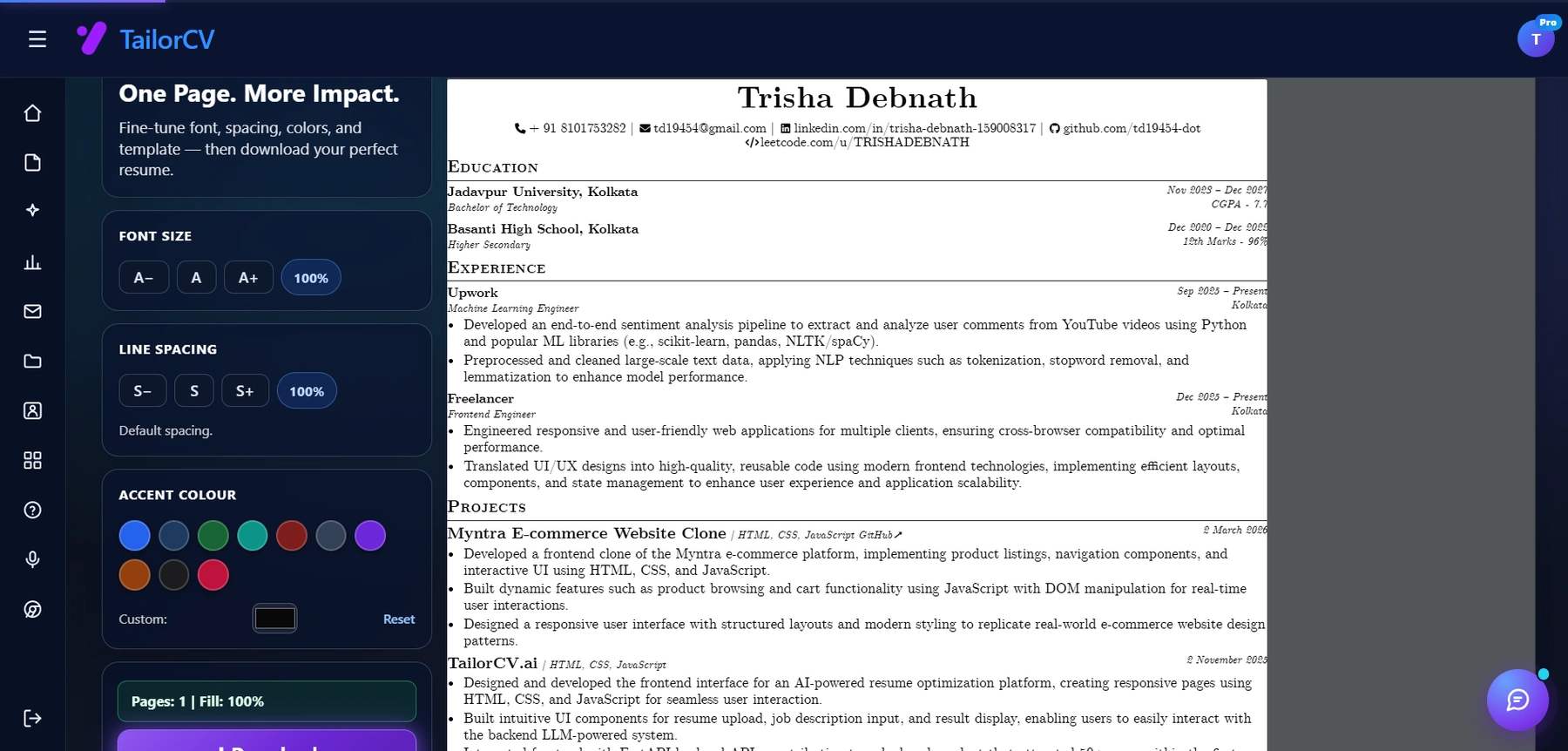
The optimized resume renders live beside the controls, so you see the page count change as you adjust.
Replace:
- Two-column layouts that some ATS cannot parse
- Serif fonts like Times New Roman or Courier
- Fully justified text alignment
- Horizontal lines as section dividers
- Headers like "References available upon request"
- Bold use of your full address
Use:
- Clean, single-column ATS-friendly format
- Modern sans-serif fonts (Calibri, Arial, Aptos)
- Left-aligned text
- Standard section headers (Experience, Skills, education)
- City, state, and LinkedIn URL - no full street address required
Use one of TailorCV's ATS-friendly templates as your base. They are designed for modern ATS systems and look contemporary without being flashy.
Step 6: Update Your Email and Digital Presence
Your email address matters.
An AOL or Hotmail address signals a digital era that ended two decades ago. Create a professional Gmail address if you have not already.
Your LinkedIn profile should be:
- Complete with a current, professional photo
- Updated with your recent roles and key accomplishments
- Active - even occasional engagement shows you are current
- Consistent with the resume you are sending
The LinkedIn and resume tailoring sync guide covers exactly how to keep both aligned during your job search.
Step 7: ATS-Optimize for Modern Keywords
This is where many 50+ candidates lose before a human ever sees them.
Modern job descriptions are full of terminology that has emerged in the past 5-10 years. If your resume was written when you last job searched (possibly several years ago), it may be missing critical keywords.
Use TailorCV's resume optimizer to check your keyword match against the job description.
Paste the JD. Upload your resume. See exactly which modern keywords are missing - and where to add them naturally.
Common modern keywords that experienced professionals often miss:
- Agile, Scrum, sprint planning
- Data-driven, KPI-led, OKR
- Cloud, SaaS, digital transformation
- Remote-first, async collaboration
- AI-assisted, automation-led
- DEI, inclusive leadership
If you have done these things (you probably have), use the modern language for them.
What To Never Do
Do not try to appear younger by omitting a role entirely if it is important Leaving a 5-year gap in your career history is more alarming than showing a 20-year-old role. Read how to explain resume gaps if there are genuine gaps in your history.
Do not use a photo In most countries, photos are not expected on resumes. Including one opens the door to explicit age discrimination.
Do not apologize for your experience Phrases like "despite my extensive background" or "while I may have more experience than required" put you on the defensive before the interview starts. This is a classic resume red flag.
Do not claim skills you do not have The interview will reveal it quickly. Modernize authentically.
Your Biggest Advantage: Depth No Junior Candidate Can Match
Here is the truth that the bias obscures:
You have seen cycles. You know what happens when companies over-hire in good times and panic-cut in downturns. You have built relationships across industries that no recent graduate can replicate. You have managed people through uncertainty and come out the other side with real stories, not theory.
That experience is not a liability. For the right role and the right company, it is exactly what they need.
Your personal brand as a seasoned professional is a genuine competitive advantage - when it is presented correctly.
Your job is to find those companies - and present yourself so compellingly that the bias does not get a chance to take over.
Make This Practical
Use this advice as interview practice, not just reading material. Start a role-specific session with the AI mock interview tool, prepare your opening with How to Answer Tell Me About Yourself, and structure evidence-heavy answers with the STAR Method Interview Answers Guide.
Before the interview, make sure the resume that earned the call is still aligned with the role. Check it with the free ATS score checker, review Common Interview Mistakes to Avoid, and use How to Follow Up After an Interview once the conversation is over.
For a detailed look at setting the right window for your level and role, read how far back your experience should go.
FAQ
Should I include my graduation year?
If you graduated before 2000, remove the year. Degree and institution are sufficient.
How far back should my work history go?
10-15 years is the standard. Anything earlier can be summarized briefly in an "Earlier Career" section without dates.
Will hiding dates raise red flags?
It is standard practice for experienced professionals. It will not raise flags. Reviewers understand the convention.
How do I address age directly if asked?
You do not need to unless it comes up. If it does, pivot to your value: "I bring [X years of specific experience] in exactly this type of role - that's something I'd offer from day one." Confidence beats defensiveness every time. Consider tailoring your resume to match the job description, as discussed in "Resume Matching for Experienced Professionals."
Related Guides
- Resume Matching for Experienced Professionals
- How to Write a Resume Summary
- How to Update Your Resume
- Skills to Add to Your Resume in 2026
- Best Free Online Certificates for Resume
- LinkedIn Profile Optimization Guide
- ATS Mistakes Experienced Professionals Make
- Executive Resume Tailoring Guide
- How to Explain Resume Gaps
- Why Your Resume Gets No Responses
Conclusion
Age bias is real. Pretending it does not exist helps no one.
But a well-tailored resume removes most of the signals that trigger it - before any human decision is made.
Limit your history to the past 15 years. Remove graduation dates. Replace your objective with a modern professional summary. Use today's terminology for the work you have been doing for decades. Update your format and digital presence. Check your ATS score and close the keyword gaps.
Your experience is not the problem. How it is presented might be.
Fix the presentation. Let your decades of real impact speak - in a language that today's hiring process can hear.
See what tailoring is worth on your resume
Score your current resume against a real job description before you change a word.
Drop your resume here or choose a file
PDF only. Max 2 MB.
We never share your data or use it to train AI models.

Was this guide useful?
Be the first to rate it.