 SS
SS

Key Takeaways
- Healthcare resumes must prioritize credentials, as licenses and certifications are essential for consideration in clinical roles.
- Specific terminology is crucial; using the correct language signals expertise and aligns with ATS requirements in healthcare applications.
- The setting of the job significantly influences resume content; familiarity with the specific environment and patient population is necessary.
- For clinical roles, licensure and certifications should be prominently displayed immediately after contact information to avoid disqualification.
- Tailoring resumes to include relevant keywords specific to the clinical specialty enhances the chances of passing ATS filters and attracting recruiter attention.
Healthcare hiring is unlike any other industry.
The stakes are different. The credentials are non-negotiable. The terminology is highly specific. And the type of hospital, clinic, specialty, or system you are applying to changes everything about how your resume should be written.
A generic resume - even a well-formatted one - can fail in healthcare for reasons that would not apply in any other field.
Missing a required certification. Using the wrong EMR system acronym. Listing a specialty that does not align with the unit's focus. Omitting a licensure verification number.
This guide covers healthcare resume tailoring across three distinct tracks: clinical roles, healthcare administration, and allied health professions.
Why Healthcare Resume Tailoring Is Different
Your resume after optimization
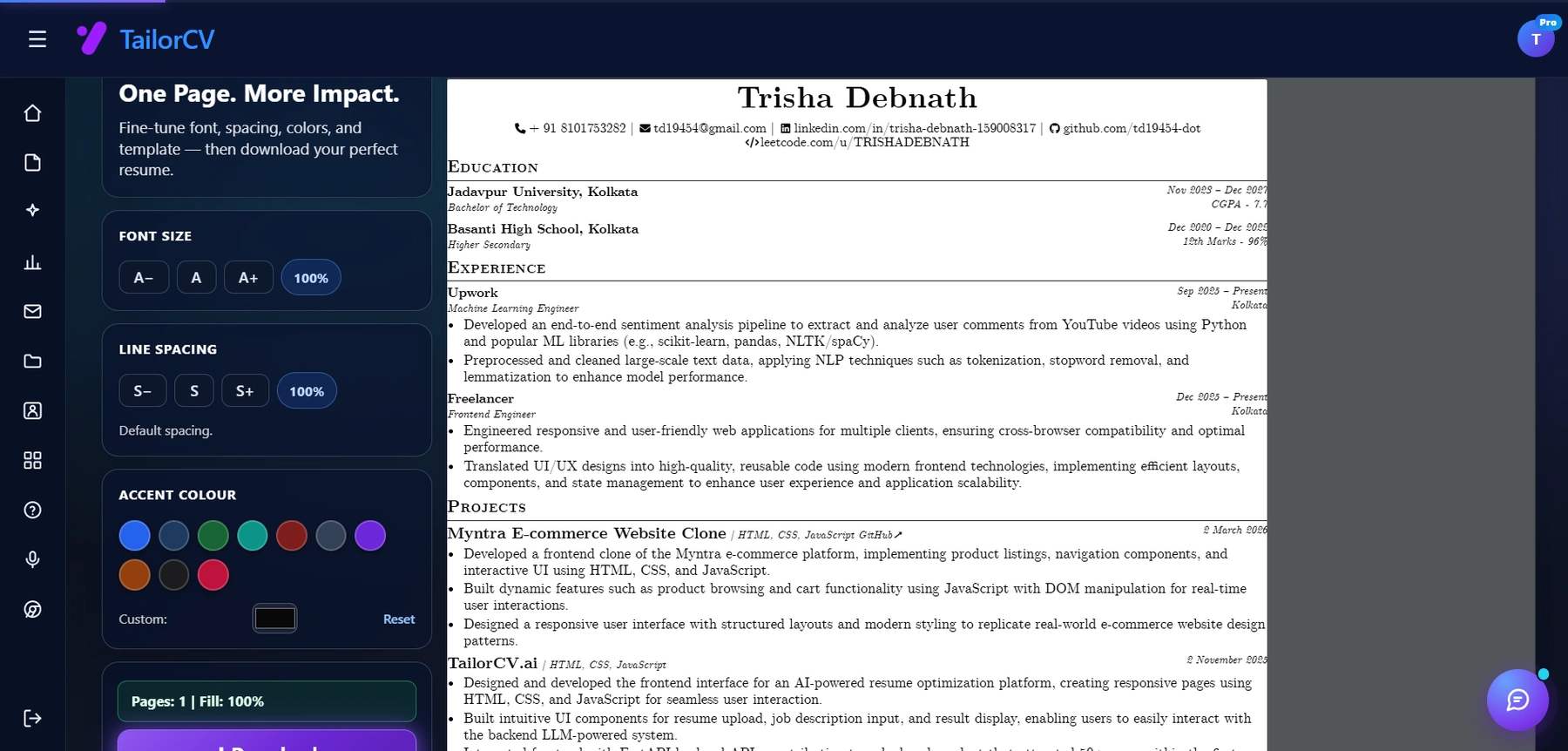
This is the resume after optimization - the tailored content is already in place, and these controls are how you fit it: font size, spacing, accent colour, template, with a live page counter.
1. Credentialing Is Not Optional
In most industries, you prove your skills through accomplishments. In healthcare, you prove your qualifications through credentials - before accomplishments are even considered.
Licenses, certifications, and registrations are required for most clinical roles. A resume that does not clearly display the right certifications is often disqualified before any human reviews it.
2. Terminology Is Highly Specific
Healthcare has a language of its own. The wrong terminology signals inexperience or poor fit - even if you have the right skills.
"Patient management" means something very different depending on whether you are a nurse, a hospital administrator, or a physical therapist. ATS systems and healthcare recruiters parse for specific terms: EMR platforms, specialty names, care settings, certification acronyms.
Understanding how ATS works is especially critical in healthcare - large hospital systems use enterprise-grade platforms that filter heavily on terminology.
3. The Setting Matters as Much as the Role
Applying to an ICU is different from applying to a community clinic. A Magnet-recognized hospital has different expectations than a rural critical access hospital. A pediatric oncology department is not the same as a general pediatric floor - even if the role is "RN."
Your resume must signal familiarity with the specific setting, patient population, and environment you are applying to.
Track 1: Clinical Roles (RN, MD, NP, PA, Pharmacist, etc.)
Required Sections for Clinical Resumes
Licensure and certifications - Make This Your Second Section
Put your licenses and certifications immediately after your contact information - before work experience.
Why: A recruiter hiring an RN for a critical care unit will check your nursing license and BLS/ACLS certifications before reading anything else. If these are buried at the bottom, you have already created friction.
Include:
- State license(s) and number(s)
- License expiration date
- Active certifications with renewal dates (BLS, ACLS, PALS, NRP, TNCC, etc.)
- Specialty certifications (CCRN, CEN, OCN, etc.)
- DEA registration (for prescribers)
- Board certification (for MDs, DOs, NPs, PAs)
Format example:
LICENSURE & CERTIFICATIONS
RN - State of Texas, #12345678, exp. December 2027
ACLS - American Heart Association, exp. March 2027
CCRN - AACN, exp. June 2026
BLS - American Heart Association, exp. March 2027
This section eliminates the recruiter's first concern immediately.
Clinical Resume Keywords by Specialty
Your resume keywords must use the specific terminology of your clinical specialty.
ICU / Critical Care: vasopressor management, ventilator weaning, hemodynamic monitoring, arterial line management, Swan-Ganz catheter, CRRT, sedation management, rapid response, titration of drips
Emergency / ED: trauma assessment, triage, FAST exam, procedural sedation, chest tube assistance, sepsis protocol, stroke alert, high-volume throughput
Oncology: chemotherapy administration, PICC line care, oncology protocols, symptom management, palliative care coordination, clinical trial enrollment
Pediatrics: developmental assessment, family-centered care, pediatric dosing calculations, growth charts, immunization schedules, child-specific communication
Surgical / Perioperative: scrub tech, circulating, PACU, sterile field maintenance, surgical instrument knowledge, positioning, counts, anesthesia support
Match the keywords from the job description exactly. Use the job description keyword extraction guide and the hidden keywords technique to find terminology embedded in the posting that isn't always obvious. If the unit uses "ARDS management" and you use "respiratory failure care" - update your language.
EMR Systems
List your EMR experience explicitly. Epic, Cerner, Meditech, Allscripts, PointClickCare - these are not just technical details. They affect how quickly you can be productive on day one.
If the posting mentions a specific EMR, confirm whether you have experience with it and how many years.
EMR Systems: Epic (3 years), Cerner (1 year), Meditech (1 year)
Clinical Accomplishment Bullets
Clinical resumes are often listed as pure responsibility statements. "Provided bedside care for patients in a 32-bed medical ICU."
This is a missed opportunity.
- Patient-to-nurse ratios
- Volume of patients (census numbers, admission rates)
- Outcomes contributed to (reduced HAPU rates, improved sepsis bundle compliance, reduced CAUTI incidence)
- Charge nurse responsibilities
- Preceptorship metrics (number of new nurses trained, months of preceptorship)
Read how to write resume bullet points for the formula - then adapt it to clinical language.
Stronger bullet: "Served as primary nurse for 3-4 critically ill patients per shift in a 32-bed MICU; served as charge nurse 40% of shifts; precepted 8 new graduate nurses over 18 months, all of whom passed NCLEX on first attempt."
This communicates clinical volume, leadership, and outcomes.
Track 2: Healthcare Administration
Healthcare administrators are evaluated on operational outcomes, financial management, regulatory compliance, and leadership - just like any other management role.
But the healthcare-specific layer matters.
Healthcare Admin Keywords
| Area | Key Terms |
|---|---|
| Quality & Safety | HEDIS, Joint Commission, CMS Core Measures, HCAHPS scores, patient satisfaction, sentinel events, root cause analysis |
| Finance | Revenue cycle management, DRG, case mix index, payer mix, claims, coding accuracy, A/R days, denials management |
| Operations | Patient throughput, capacity management, LOS (length of stay), bed management, care coordination, discharge planning |
| Regulatory | HIPAA, CMS regulations, state health department compliance, accreditation, OSHA, OIG compliance |
| HR & Staffing | PRN pool management, FTE budgeting, nursing ratios, union contracts, Magnet journey |
Use the terminology appropriate to the specific administrative role and setting. A revenue cycle manager needs different keywords than a Chief Nursing Officer.
For administrative roles, the professional summary should lead with the specific outcomes and regulatory wins that matter most to healthcare organizations - not generic management language.
Show Regulatory and Accreditation Awareness
Healthcare administrators must demonstrate knowledge of the regulatory environment.
If you led a Joint Commission survey preparation, say so. If you improved HCAHPS scores, quantify it. If you managed a CMS compliance audit, include it.
These are the accomplishments that signal "this person knows healthcare operations" - not just generic management.
Track 3: Allied Health Professions
Allied health roles - physical therapy, occupational therapy, respiratory therapy, radiology, speech-language pathology, medical imaging, and others - each have their own terminology, credentialing requirements, and setting-specific expectations.
Universal Allied Health Resume Rules
Lead with licensure and certifications - Same principle as clinical nursing roles. Read how to list certifications on a resume for format and placement.
Include specific patient populations - Peds vs. geriatric vs. adult vs. neuro vs. orthopedic. The population matters for most allied health applications.
List specialized equipment and modalities - A respiratory therapist's comfort with high-flow oxygen, non-invasive ventilation, oscillators, and bronchoscopy assistance matters. A radiographer's experience with fluoroscopy, mammography, or interventional radiology matters.
Specify settings - Acute care vs. outpatient vs. home health vs. SNF. Each requires different competencies and signals.
Match continuing education to the job description - If the role values a specific specialty certification, list it prominently if you have it.
ATS in Healthcare: What You Need to Know
Healthcare systems - especially large hospital networks and health systems - use enterprise ATS platforms (Taleo, Workday, Oracle HCM).
These systems:
- Filter by licensure status before anything else in some cases
- Match on specialty terminology and EMR platforms
- Filter by geographic location and shift availability
- May require specific application fields (licensure number, shift availability, PRN interest)
Your resume, when uploaded, will be parsed by these systems. Avoid ATS formatting mistakes - clean, simple formatting is essential. No tables, no columns, no graphics.
Use TailorCV's ATS optimizer to check your keyword match score and formatting before uploading to a healthcare ATS. The tool flags both formatting issues that cause parsing failures and missing keywords from the job description.
Before and After: Clinical Resume Bullet
Before: "Responsible for patient care in the emergency department, including triage and treatment of various conditions."
After: "Triaged and provided bedside care for 40-60 patients per shift in a Level II Trauma ED, including sepsis protocol initiation, stroke alert activation, and trauma team support; maintained compliance with door-to-physician time metrics averaging 18 minutes against a 30-minute target."
The "After" version:
- Gives volume (40-60 patients)
- Names the setting specifically (Level II Trauma ED)
- Lists specific clinical competencies
- Shows outcome data against a benchmark
This is what a healthcare recruiter and an ATS both want.
Make This Practical
Do not guess whether the resume is ready. Upload it to the free ATS score checker, compare the result with the ATS Score Guide, and fix formatting issues using ATS Resume Formatting Mistakes and ATS Resume Parser Friendly Format.
After the technical cleanup, improve relevance. Use Resume Matching With Job Description, strengthen keyword coverage with the Resume Keywords Guide, and avoid overdoing it by checking ATS Keyword Mistakes. If the layout itself is weak, rebuild with an ATS-friendly resume template.
FAQ
Should I include my NCLEX result on my nursing resume?
No - only your current active license and certifications are relevant. License status is verifiable; exam results are not listed on resumes.
How do I handle multiple state licenses?
List all active licenses with state, number, and expiration date. If you are a compact license holder, note the compact license and list the home state.
Should I include references from supervisors or physicians on my resume?
No - "references available upon request" is sufficient on the resume itself. Provide references when formally asked during the hiring process.
How specific should my unit experience be?
Very specific. "Medical-surgical nursing" is vague. "32-bed cardiac step-down unit serving post-CABG, TAVR, and EP procedure patients" tells a recruiter exactly what you have done and whether it matches their needs. For more guidance on crafting your resume, check out our Nursing Resume 2026 guide. Additionally, understanding how to read between the lines of a job description can help you tailor your resume effectively.
Related Guides
- Nursing Resume 2026
- Pharmacist Resume 2026
- Physiotherapist Resume 2026
- How to List Certifications on a Resume
- ATS Resume Formatting Mistakes
- How to Tailor Your Resume for Every Job
- Resume Matching with Job Description - Complete Guide
- Resume Keywords Guide
- How to Write Resume Bullet Points
- ATS Score Guide
Conclusion
Healthcare hiring is built on specificity.
The setting. The patient population. The credentials. The EMR systems. The specialty language.
Generic resumes do not just underperform in healthcare - they actively signal that the candidate did not take the time to understand the role or the environment.
tailor your resume to the specific setting, population, and priorities of each role. Lead with your credentials. Use the specialty language the unit uses. quantify your clinical volume and outcomes. Check your ATS score before applying.
The right role is out there. Your resume should make it impossible to overlook you.
Tailor My Healthcare Resume - Free
See what tailoring is worth on your resume
Score your current resume against a real job description before you change a word.
Drop your resume here or choose a file
PDF only. Max 2 MB.
We never share your data or use it to train AI models.

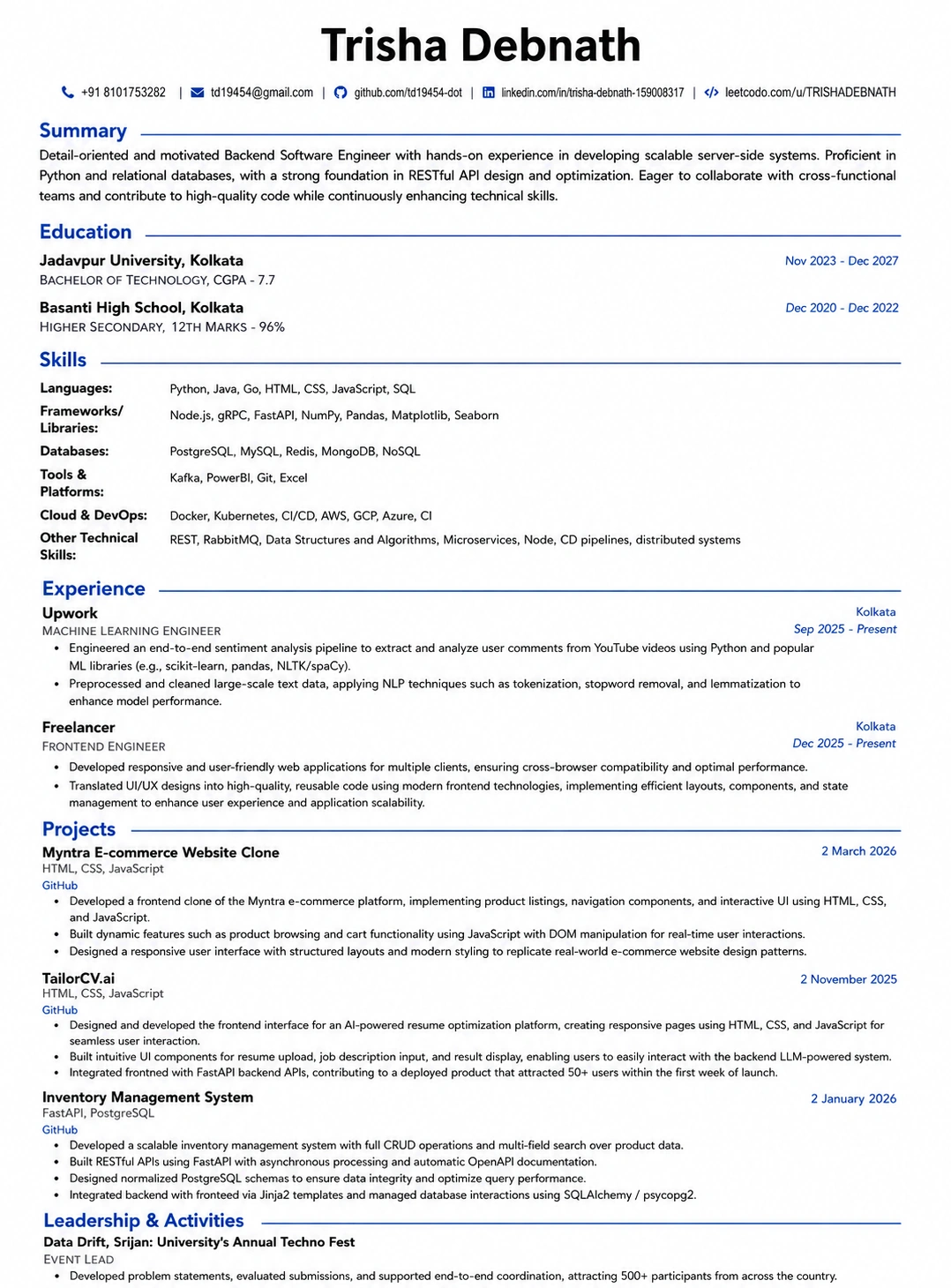
Start from a template that tailors well
Clean structure means swapping keywords per job takes minutes, not a re-layout every time.
Was this guide useful?
Be the first to rate it.