TD
TD
Key Takeaways
- The resume objective has largely fallen out of favor, as it focuses on what the candidate wants rather than what they can offer to employers.
- A professional summary is preferred, highlighting relevant experience, key strengths, and accomplishments in a way that answers the employer's needs.
- Use a summary if you have any relevant experience, including internships or projects; it is more effective for most candidates.
- An objective may be appropriate for first-time job seekers with no relevant experience, during major career changes, or in specific traditional industries.
- A well-crafted professional summary should include your title, years of experience, core strengths, and a specific, quantified accomplishment.
The resume objective was standard advice for decades: a brief statement at the top of your resume expressing what kind of job you are looking for. Today, for most candidates, the professional summary has completely replaced it - and for good reason. This guide explains the difference, who should use each, and how to write both effectively.
After choosing your approach, build your resume on an ATS-friendly template and check your score with the TailorCV ATS checker.
What Is a Resume Objective?
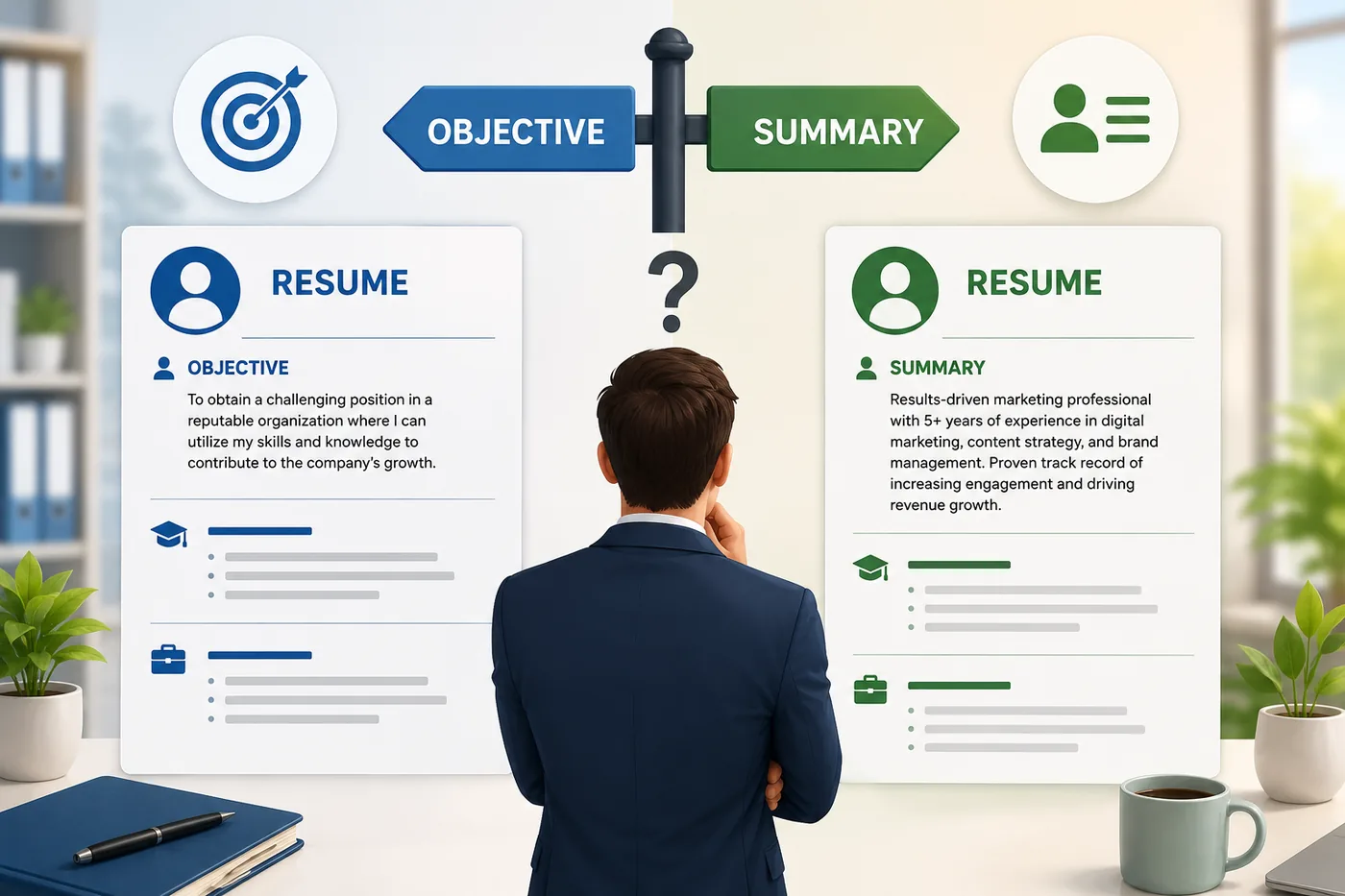
A resume objective is a 1-2 sentence statement at the top of your resume that describes what you want from your career or job search.
Classic example:
"Seeking a challenging software engineering position at a growth-stage startup where I can develop my skills and contribute to a high-performing team."
Why Objectives Fell Out of Favor
- They are employer-irrelevant. An objective tells the employer what you want - not what you can offer them. Employers care about value, not your aspirations.
- They waste space. Two lines at the top of your resume used to describe your job-seeking goals, rather than your qualifications.
- They are generic. Objectives are almost always interchangeable between candidates, adding no differentiation.
For most candidates with any experience, an objective actively weakens the top of a resume by delaying the value proposition.
What Is a Professional Summary?
A professional summary is 2-4 sentences at the top of your resume that highlights your most relevant experience, key strengths, and most impressive accomplishments. It answers the employer's question: "What can this person do for us?"
Your resume after optimization
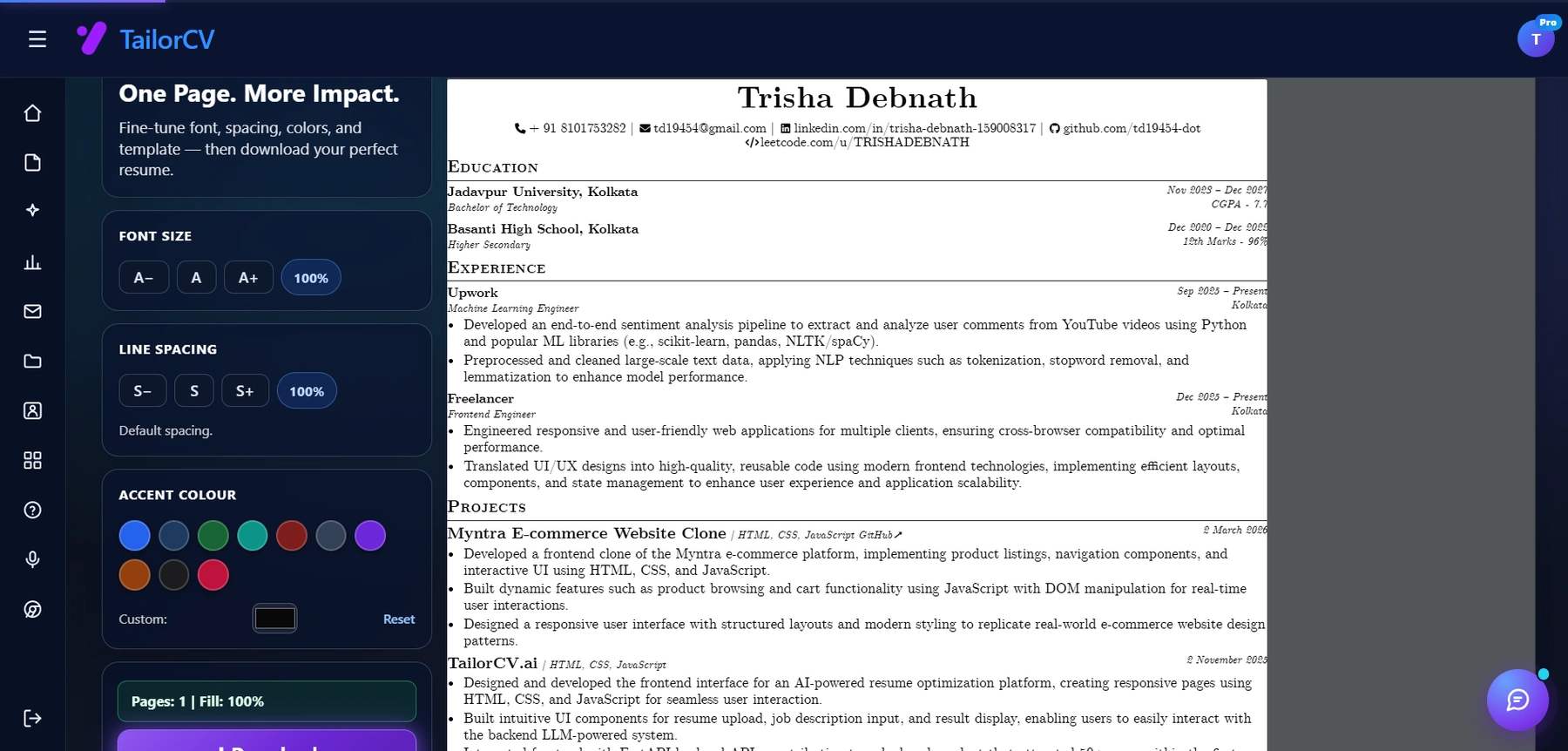
This is the resume after tailoring - the content is already matched, and these controls are how you fit it onto one page.
Example:
"data analyst with 4 years of experience transforming complex datasets into executive-level insights. Built Python and SQL pipelines that cut reporting time by 65%. Seeking to bring strong predictive modeling experience to a high-growth fintech team."
Why Summaries Are More Effective
- Employer-focused. A summary leads with what you bring, not what you want.
- Immediately differentiating. It showcases your best credentials in the first lines.
- Keyword-rich. Summaries naturally include the skills and titles ATS systems scan for.
- Flexible. Easily customized per role with minimal effort.
When to Use an Objective vs Summary
Use a Summary (Almost Always)
If you have any relevant experience - including internships, projects, or academic work - use a summary. This includes:
- Experienced professionals (any level)
- Recent graduates with relevant projects or internships
- Career changers who want to frame their transferable skills
- Anyone with more than 6 months of relevant experience
Use an Objective (In These Specific Cases)
1. True first-time job seeker with zero relevant experience
If you are genuinely applying for your first job and have no internships, projects, coursework, or freelance work to reference, an objective is acceptable because you have nothing to summarize yet.
Even here, pivot the objective slightly toward value: "First-year computer science student with demonstrated skills in Python and data structures through coursework and independent projects, seeking a junior engineering internship" is better than a pure aspiration statement.
2. Major career change where your current experience is unrelated
When your entire background is in a different field and you are starting over, an objective can acknowledge the change and frame why you are making it.
3. Some niche or traditional industries
A few traditional industries and geographies still expect an objective. When in doubt, research the conventions for your specific field and region.
How to Write a Professional Summary
Structure:
[Title/identity] + [years of experience] + [core strength or specialty]. [One specific, quantified accomplishment]. [What you bring to the target role].
Examples by Level:
Early career (1-3 years):
"Marketing analyst with 2 years of experience supporting digital campaigns at a D2C e-commerce brand. Contributed to email automation projects that increased open rates by 34%. Bringing strong analytical skills and HubSpot experience to a demand generation role."
Mid-career (5-8 years):
"product manager with 6 years building B2B SaaS products. Launched 3 product lines that collectively generated $8M in ARR. Known for deeply cross-functional communication and data-driven roadmap prioritization."
Senior level (10+ years):
"Engineering leader with 12 years building and scaling distributed systems teams at hyper-growth startups. Grew department from 4 to 40 engineers, delivering 99.99% uptime at 10x traffic scale. Currently seeking a VP-level role at a Series B or later company."
Read how to write a resume summary for full examples by role and industry. For those with no experience, read resume summary with no experience.
How to Write a Resume Objective (When You Need One)
Turn it employer-facing:
Instead of: "Seeking an entry-level marketing role to develop my skills."
Write: "Recent marketing graduate with hands-on experience in HubSpot and Google Analytics through a semester-long internship at a digital agency, seeking an entry-level role where I can grow in demand generation."
The difference: your objective includes credentials that make you relevant, not just aspirations.
Summary vs Objective: ATS Considerations
Both a summary and an objective sit in the same position at the top of your resume. From an ATS perspective, the summary is significantly better because:
- It naturally includes job title keywords ("data analyst," "product manager," "marketing specialist")
- It includes skill keywords ("Python," "SQL," "HubSpot")
- It contains accomplishment language that signals quality
An objective rarely includes keywords beyond the job title. Run your resume summary through the TailorCV ATS checker to see how well it matches each job description.
Common Mistakes with Both
Mistakes with Summaries
- Too generic. "Hardworking professional with excellent communication skills" adds zero value.
- Too long. A summary is 2-4 sentences. Five sentences becomes a paragraph that gets skipped.
- Not tailored. The same summary for every application is a missed opportunity. Adjust at least one sentence per role.
Mistakes with Objectives
- Employer-irrelevant. Stating only what you want, with nothing about what you bring.
- Too vague. "Seeking an opportunity to grow in a challenging environment" could apply to any job in any field.
The Resume Headline: A Third Option
Between the objective and summary, there is a third option: the resume headline - a single bold line under your name that states your professional identity.
Examples:
- Senior Backend Engineer | Python & AWS | Distributed Systems
- digital marketing Manager | SEO/SEM | Growth Strategy
- Certified project manager (PMP) | Agile | Healthcare IT
The headline can stand alone or precede a summary. Read how to write a resume headline for examples.
Related Guides
- How to Write a Resume Summary
- Resume Summary With No Experience
- How to Write a Resume Headline
- The Anatomy of a Perfect Resume
- How to Write a Resume from Scratch
- ATS Score Guide
- Resume Keywords Guide
- Resume Red Flags
Make This Practical
Use this guide as part of a complete job-search workflow. Check your resume with the free ATS score checker, improve targeting with the Resume Optimization Guide, and choose a clean format from the ATS-friendly resume templates.
After the resume is ready, strengthen the rest of the application. Draft a targeted letter with the AI cover letter generator, practice interviews with the AI mock interview tool, and create a project-backed proof page with the portfolio website builder if you need a stronger online presence.
Conclusion
For almost every candidate in 2026, the professional summary replaces the resume objective. A summary leads with your value, not your wants - it includes keywords that help ATS match you to roles and gives recruiters an immediate reason to keep reading.
Use an objective only if you genuinely have nothing to summarize yet. In every other case, write a tight, tailored, accomplishment-forward 2-4 sentence summary. Read how to write a resume summary, test the result with the TailorCV ATS checker, and start from an ATS-friendly template.
Dropping the objective is one of several changes at the two-year mark - see two years in and applying for a mid-level role.
Frequently Asked Questions
What is the main difference between a resume objective and a professional summary?
The key difference lies in focus: a resume objective states what you want from a job, while a professional summary emphasizes what you can offer to an employer. A professional summary highlights your relevant experience, skills, and accomplishments, making it more appealing to recruiters. For more details on crafting these sections, check out our guide on the anatomy of a perfect resume.
When should I use a resume objective instead of a summary?
Resume objectives may still be relevant for specific situations, such as when transitioning careers or applying for internships where your experience is limited. In these instances, an objective can clarify your intentions and goals. For a comprehensive overview of resume construction, refer to our post on how to write a resume from scratch.
How long should a professional summary be?
A professional summary should typically be 2-4 sentences long, allowing you to concisely showcase your key strengths and achievements. This length provides enough space to capture the attention of hiring managers while remaining brief. For more tips on writing effective resume sections, visit our resume section order guide.
Can a professional summary help improve my ATS score?
Yes, a well-crafted professional summary can enhance your ATS score by incorporating relevant keywords from the job description. This helps your resume stand out in applicant tracking systems, increasing the likelihood of being noticed by recruiters. To learn more about optimizing your resume for ATS, check our guide on how to improve your ATS score in 2026.
Should I include both a resume objective and a professional summary?
Generally, it is not advisable to include both in your resume since they serve different purposes and may create redundancy. Instead, choose the option that best highlights your qualifications and aligns with your career goals. For further insights on resume effectiveness, explore our article on how recruiters read resumes in under 10 seconds.
What is your resume scoring right now?
Scan it against a job description and get your ATS match score in about a minute.
Drop your resume here or choose a file
PDF only. Max 2 MB.
We never share your data or use it to train AI models.

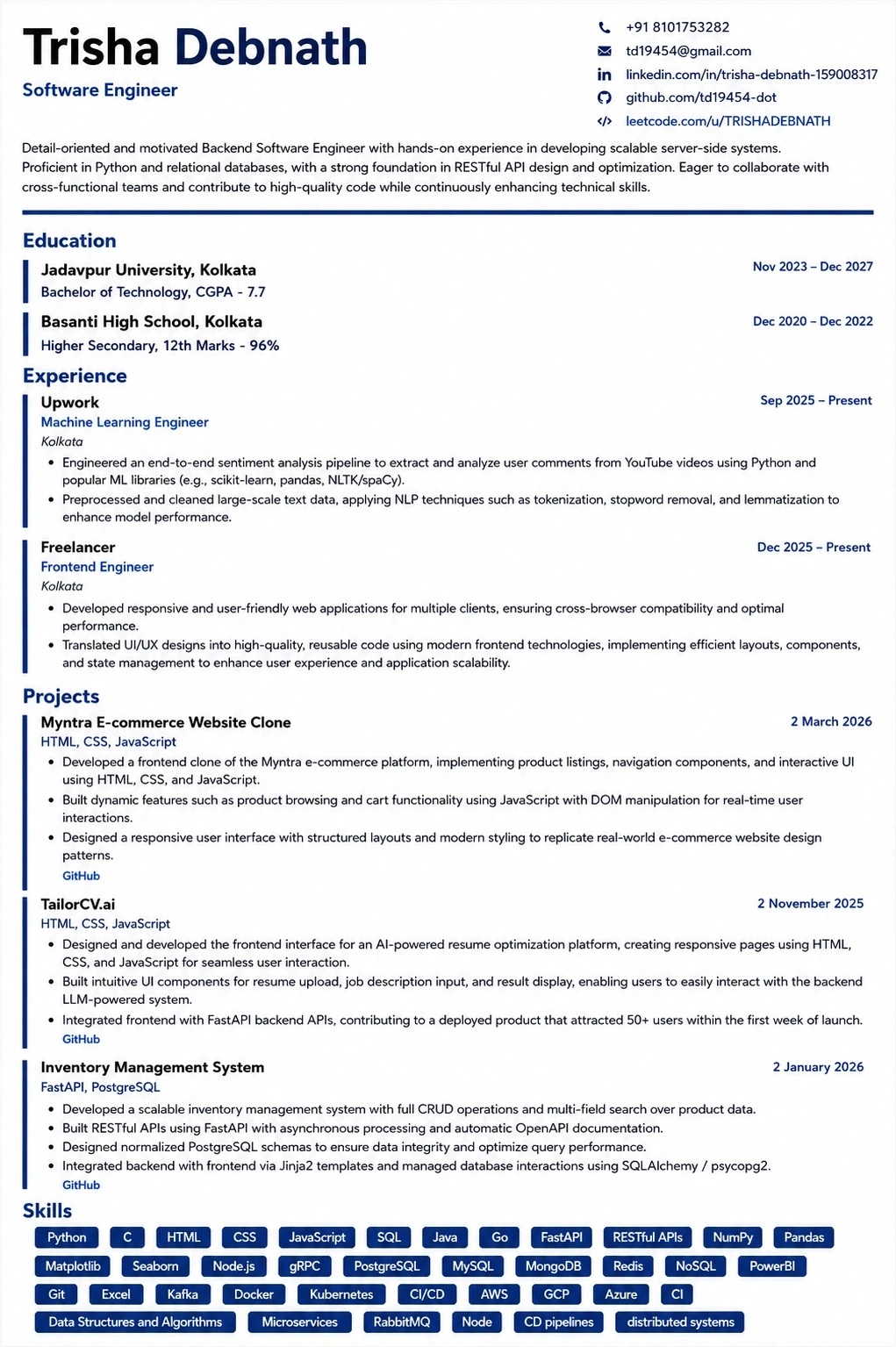
Templates that keep this structure intact
This template is ATS-tested — start from it and the formatting rules in this guide are already handled.
Was this guide useful?
Be the first to rate it.