 SS
SS

Key Takeaways
- Unexplained employment gaps can raise concerns; provide brief explanations for any gaps in your history.
- Job hopping without context may indicate commitment issues; clarify short tenures with justifications or use a skills-focused resume format.
- Generic content signals low interest; tailor your resume for each application to improve callback rates.
- Typos and inconsistent formatting suggest carelessness; proofread thoroughly and maintain consistency throughout your resume.
- Focus on achievements rather than duties; use the action + method + result formula to highlight your contributions effectively.
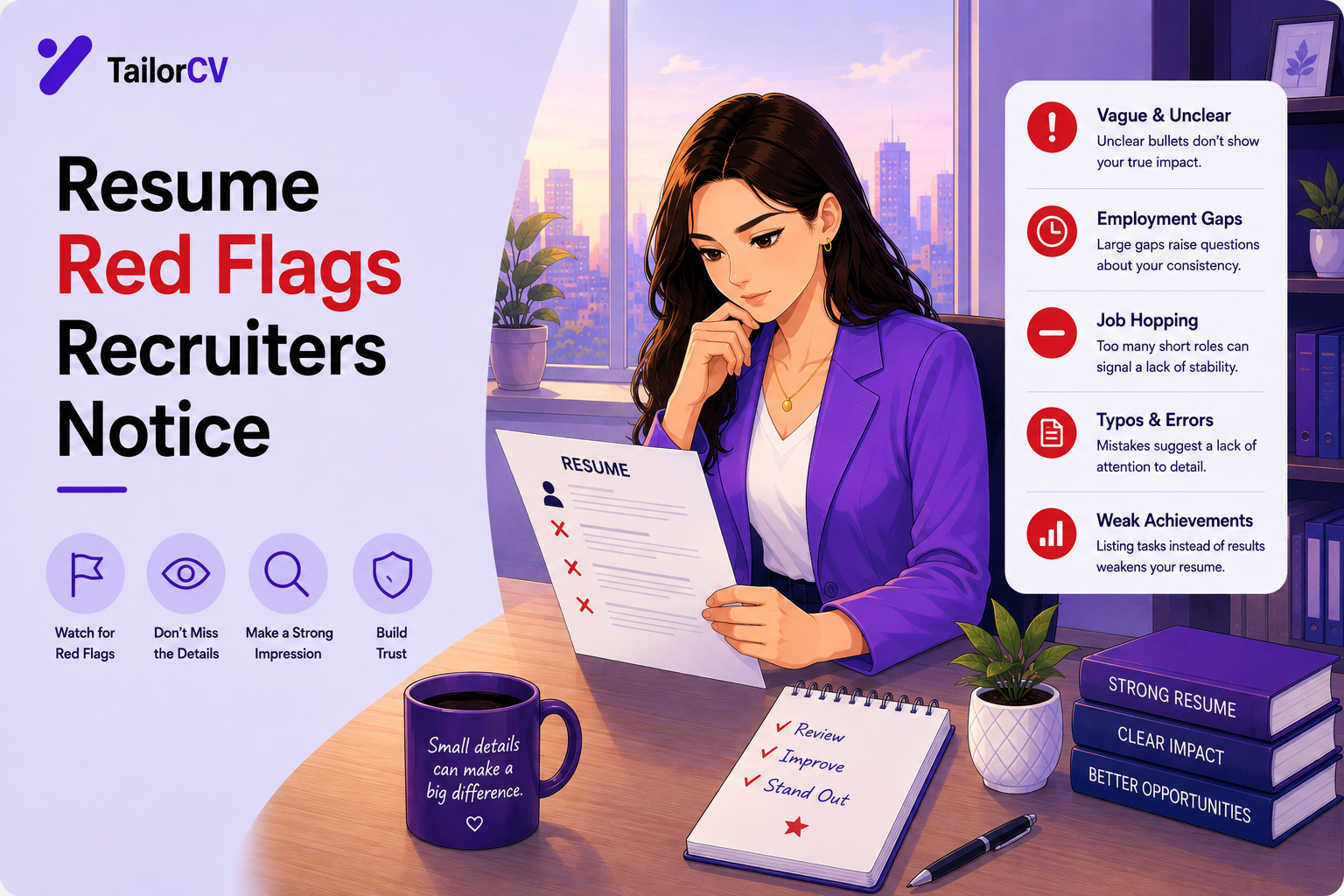
Recruiters are trained to spot problems fast. In a stack of 200+ applications, they are not looking for reasons to advance every resume - they are scanning for reasons to eliminate. Understanding which red flags trigger immediate rejection lets you remove them before your resume enters the pile.
These are the 15 most common resume red flags, what signals they send, and how to fix each one.
Before submitting, check your resume with the TailorCV ATS checker and build from an ATS-friendly template.
Red Flag 1: Unexplained Employment Gaps
A gap in your employment history without context raises the question every recruiter thinks but rarely asks: why? Unexplained gaps suggest unemployment by choice, termination, or other circumstances a recruiter has to speculate about.
Fix: Address gaps directly with a brief, neutral explanation. Caregiving, education, health, travel, personal development - all are acceptable reasons. Read how to explain resume gaps for scripts and strategies.
Red Flag 2: Job Hopping Without Context
Multiple short tenures (under 12-18 months per role) - especially a string of them - signals commitment problems, performance issues, or poor role judgment.
Fix: If your job changes were justified (company folded, contract role, acquisition), say so with a brief note. If you genuinely have many short stints, use a combination resume format that emphasizes skills and progressions over dates. Read chronological vs functional resume.
Red Flag 3: Generic, Untailored Content
A summary that says "results-driven professional seeking challenging opportunities" tells a recruiter your resume was not written for their role. Generic language immediately signals a mass-application approach - which signals low genuine interest.
Your resume after optimization
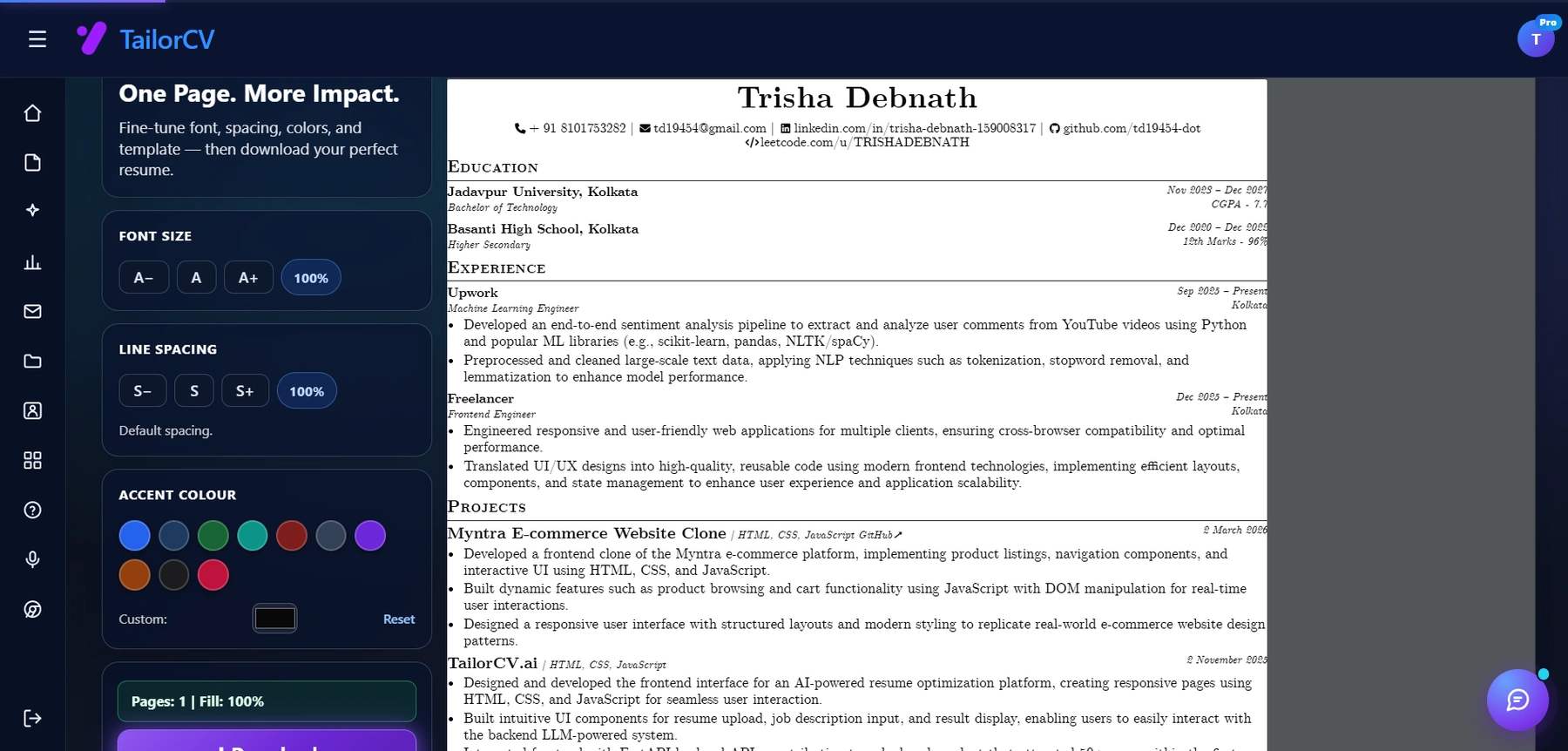
Font size, spacing, accent colour and template are all adjustable, with a live page counter.
Fix: Tailor your summary and top bullets to each role. This takes 15-20 minutes per application and dramatically increases callback rates. Read how to tailor your resume for every job and use the TailorCV optimizer to match keywords.
Red Flag 4: Typos and Grammar Errors
A single typo on a resume signals carelessness. Multiple typos signal poor attention to detail - a disqualifying trait for most roles. Recruiters who encounter typos often stop reading immediately.
Fix: Read your resume aloud. Use Grammarly or a similar tool. Have someone else proofread it. Then go through the full resume proofreading checklist before submitting.
Red Flag 5: Inconsistent Formatting
Inconsistent date formats, mixed bullet styles, varying font sizes, and misaligned indentation all signal that you did not edit your resume carefully. If you can't pay attention to formatting, will you pay attention to the job?
Fix: Review your entire resume for consistency in every formatting element - dates, bullet types, font sizes, bold usage, spacing. Start from an ATS-friendly template to avoid this from the start.
Red Flag 6: Duties Instead of Achievements
"Responsible for managing a team" is a duty. "Led a team of 8 that shipped 3 major features in 6 months, reducing customer complaints by 40%" is an achievement. A resume full of duties tells recruiters what your job was, not how well you did it.
Fix: Rewrite every bullet using the action + method + result formula. Read how to write resume bullet points that get results and how to quantify resume achievements.
Red Flag 7: Too Many Pages for the Experience Level
A 3-page resume from a 2-year professional signals poor editing judgment. The content you are including is not important enough to justify the length.
Fix: Target one page for under 10 years of experience. Cut ruthlessly. Read the ideal resume length guide and what not to put on a resume.
Red Flag 8: A Two-Column Layout
Two-column resumes look visually appealing but cause ATS parsing failures. Content in the second column is frequently scrambled or lost entirely. When a recruiter's ATS shows a mangled resume, your application often ends there.
Fix: Use a single-column layout. Read ATS resume formatting mistakes and verify with the TailorCV ATS checker.
Red Flag 9: Missing Contact Information or Broken Links
If your phone number is missing, your email is wrong, or your LinkedIn link is broken, a recruiter who wants to contact you cannot. This ends your application immediately.
Fix: Double-check every piece of contact information before submitting. Click your LinkedIn and portfolio links to confirm they work. Read the resume contact section guide.
Red Flag 10: Unexplained Skill Claims
"Expert in Java" or "Advanced Python" on a resume from a recent graduate raises skepticism. Skill level claims without supporting experience or context are easy to challenge and often backfire in interviews.
Fix: Let your experience demonstrate your skill level. Write bullets showing what you built with Java or Python rather than just claiming a level. Read skills to add to your resume.
Red Flag 11: Outdated or Irrelevant Content
Your part-time job from college, a skill from 15 years ago, an expired certification, or five bullet points about a role from 2008 - these fill space with content that actively dilutes your relevance.
Fix: Remove roles older than 10-15 years unless they are exceptional. Update or remove expired certifications. Ruthlessly edit for relevance to the target role.
Red Flag 12: Functional Resume (In Most Cases)
Recruiters recognize the functional format as a red flag. It is commonly used to hide employment gaps, disguise job-hopping, or obscure lack of relevant experience. ATS systems also struggle with it.
Fix: Use reverse chronological or combination format. Address any issues directly and honestly. Read chronological vs functional resume.
Red Flag 13: Low ATS Score
This is the red flag you cannot see - your resume is being filtered out before a human ever reads it. If you are getting zero callbacks despite applying broadly, your ATS score is likely the problem.
Fix: Run your resume through the TailorCV ATS checker to see your score, identify missing keywords, and get specific improvement suggestions. Read why is my ATS score low.
Red Flag 14: Buzzword Overload
"Synergistic cross-functional thought leadership in an agile-driven environment" means nothing. A resume packed with jargon and buzzwords without substance signals someone who can speak the language but not demonstrate the work.
Fix: Replace buzzwords with specific, verifiable accomplishments. Concrete is always stronger than corporate. Read best action verbs for resume for alternatives.
Red Flag 15: Using a Personal or Inappropriate Email Address
A resume from partyguy88@hotmail.com or xX_gamemaster_Xx@gmail.com signals immediately that this candidate is not thinking professionally about the job search.
Fix: Create a professional email: firstname.lastname@gmail.com or similar. Read the resume contact section guide for full contact formatting rules.
How to Audit Your Resume for Red Flags
- Read your resume from a recruiter's perspective - what questions does it raise?
- Check for typos, inconsistencies, and formatting issues
- Replace all duty-based bullets with achievement bullets
- Tailor the summary and top bullets to the specific role
- Run it through the TailorCV ATS checker to identify keyword gaps
- Have a trusted colleague or mentor review it
- Use the resume proofreading checklist as a final gate
Related Guides
- What Not to Put on a Resume
- How to Explain Resume Gaps
- How to Write Resume Bullet Points That Get Results
- ATS Resume Formatting Mistakes
- Ideal Resume Length Guide
- Resume Proofreading Checklist
- How to Tailor Your Resume for Every Job
- Why Is My ATS Score Low?
- Resume Contact Section Guide
- Resume Mistakes That Freshers Make
Make This Practical
Use this advice as interview practice, not just reading material. Start a role-specific session with the AI mock interview tool, prepare your opening with How to Answer Tell Me About Yourself, and structure evidence-heavy answers with the STAR Method Interview Answers Guide.
Before the interview, make sure the resume that earned the call is still aligned with the role. Check it with the free ATS score checker, review Common Interview Mistakes to Avoid, and use How to Follow Up After an Interview once the conversation is over.
Conclusion
The most common resume red flags are fixable: unexplained gaps, job-hopping without context, generic language, typos, duty-based bullets, poor formatting, and low ATS scores. Removing these red flags and replacing them with evidence of your value is the fastest path to a higher interview rate.
Run your resume through the TailorCV ATS checker to identify technical red flags, use an ATS-friendly template for formatting, and practice your answers with the mock interview tool once your resume starts generating calls.
Frequently Asked Questions
What are some common resume red flags that recruiters look for?
Common resume red flags include unexplained employment gaps, frequent job changes, and generic content. Recruiters are trained to identify these issues quickly, which can lead to immediate rejections. To ensure your resume stands out, consider using a resume review checklist to identify and address potential problems.
How can I explain employment gaps on my resume?
To effectively explain employment gaps, provide a brief and neutral context for the time away from work. Acceptable reasons include caregiving, education, or personal development. For more strategies on addressing these gaps, check out our guide on how to explain resume gaps.
What should I avoid putting on my resume?
Avoid including irrelevant information, overly generic phrases, or anything that can raise skepticism about your qualifications. For a comprehensive list of items to omit, refer to our article on what not to put on a resume.
How can I tailor my resume to specific job applications?
Tailoring your resume involves customizing your summary, skills, and experience to align with the job description. Use keywords from the job posting and highlight relevant achievements. For additional tips on crafting a compelling resume, consider using our resume templates designed for optimal impact.
Is it worth creating a portfolio website in addition to my resume?
Yes, a portfolio website can complement your resume by showcasing your work, skills, and achievements in a more dynamic format. It allows potential employers to see your projects firsthand. To learn more about the benefits, read our post on portfolio website vs resume.
Find out why your score is low
Scan your resume against the job description and see exactly which checks fail.
Drop your resume here or choose a file
PDF only. Max 2 MB.
We never share your data or use it to train AI models.

Was this guide useful?
Be the first to rate it.