TD
TD

Key Takeaways
- Contract hiring managers prioritize proven delivery in short timeframes, while permanent hiring managers focus on long-term commitment and cultural fit.
- Tailor your resume for contract roles by emphasizing project outcomes rather than duration of employment.
- Match your skills section to the specific requirements listed in the contract job description for better alignment.
- Highlight your ability to onboard quickly and deliver results promptly to appeal to contract employers.
You have been freelancing for three years.
You have worked with eight different clients. You have delivered real results on projects worth hundreds of thousands of dollars. You have managed your own schedule, your own business development, and your own finances.
And now you are applying to two different types of jobs:
One is a long-term contract role at a fintech company. The other is a full-time permanent position at a startup.
You send the same resume to both.
Both reject you.
Not because your work is not good enough. Because your resume is not telling the right story for either audience.
Contract hiring managers and permanent hiring managers are looking for completely different signals. This is the same core challenge as startup vs enterprise resume tailoring - the audience changes what you emphasize. This guide breaks down what each wants - and how to tailor your resume to win both.
The Core Difference: Contract vs. Permanent Hiring Logic
Contract hiring managers want to see:
- Proven ability to deliver in short timeframes
- Specific skills and tools that match the project scope
- History of successful client engagements
- Ability to onboard quickly and work independently
- No red flags around commitment or professionalism
Permanent hiring managers want to see:
- Long-term commitment potential
- Cultural alignment and team fit
- Growth trajectory over time
- Evidence of learning, not just doing
- Stability and loyalty
Your freelance history is a strength for contract roles. For permanent roles, it can raise questions - unless you present it correctly.
How to Tailor Your Resume for Contract Roles
Your resume after optimization
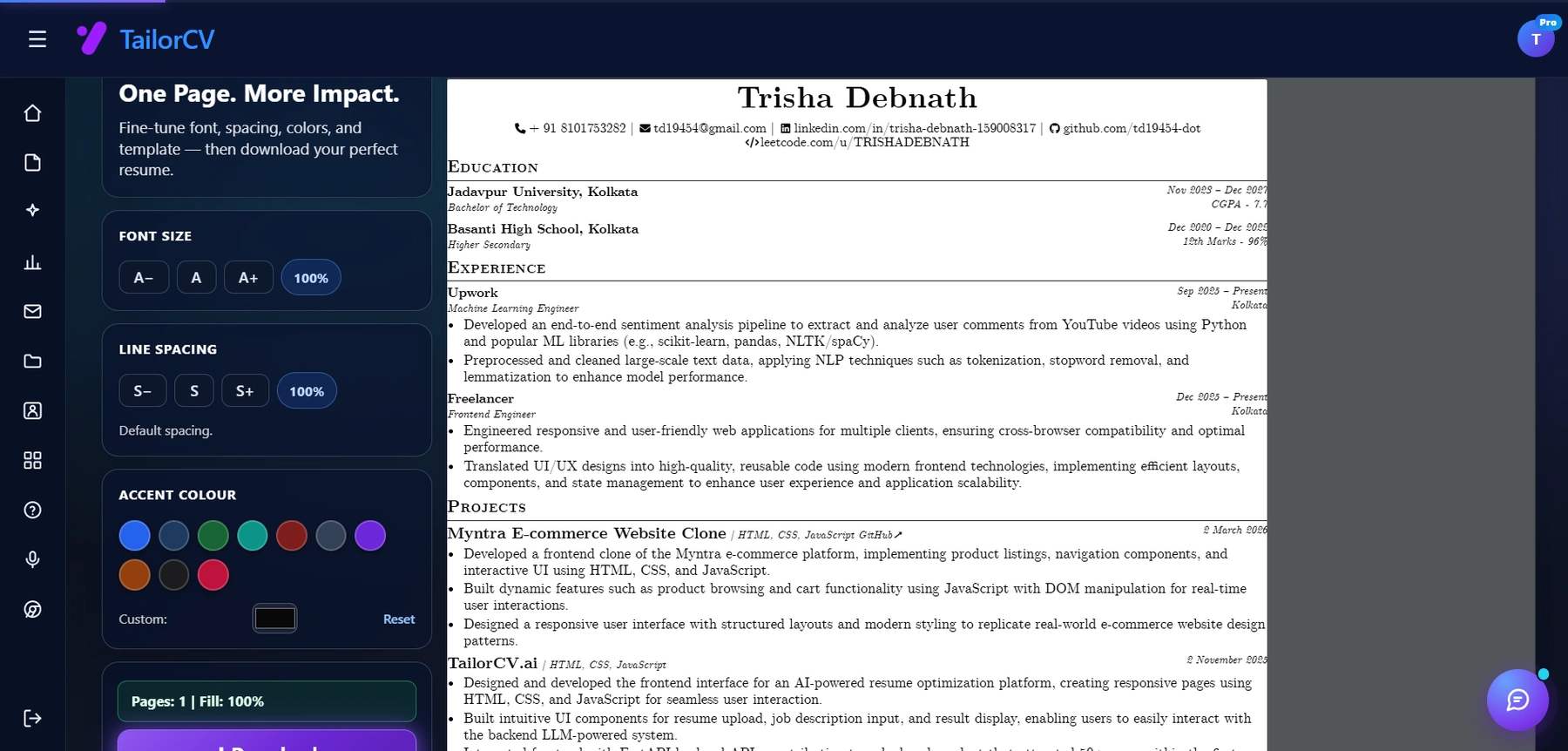
This is the optimized result, and it is usually how a spilling two-page draft gets back onto one page without deleting anything worth keeping.
1. Lead With Deliverables, Not Duration
Contract hiring is project-based. The hiring manager wants to know: can this person deliver what we need in the time we have?
Structure your freelance experience around projects, not employers.
Weak (employer-focused):
"Self-employed freelance designer, 2022-present."
Strong (project-focused):
"Freelance UX designer - Independent Consultant, 2022-present Led UX research and design for 8 client projects across fintech, healthtech, and e-commerce, delivering mobile app redesigns, onboarding flow improvements, and design systems."
Then list specific projects as bullets:
- Redesigned onboarding flow for fintech app (15k users) - reduced drop-off from 68% to 31% in 6 weeks
- Built design system from scratch for Series A healthcare platform - cut design-to-dev handoff time by 40%
- Led UX audit for e-commerce client - surfaced 12 conversion blockers, implemented fixes generating $190k in additional revenue
Each bullet answers: what did you build, for whom, and what was the result? Read how to quantify resume achievements to make your project outcomes as compelling as possible.
2. Match the Contract's Specific Skill Requirements
Contract job descriptions are usually more specific than permanent ones. They need someone who can do X, Y, and Z - immediately, without training.
Tailor your skills section to mirror the contract's exact requirements.
If the contract asks for:
- React Native
- Figma
- User testing
- Stakeholder presentations
Your resume's skills section should list exactly those, in that order if possible.
Use TailorCV's keyword analyzer to check your match against the contract job description. A high ATS keyword match is even more important for contract roles - there is less patience for uncertainty.
3. Show Speed to Value
Contract employers are paying premium rates for someone who hits the ground running.
Include signals that show you onboard fast:
- "Delivered first sprint results within week one"
- "Ramped up on client tech stack in 3 days, shipped first feature in 8"
- "Joined mid-project and restored team velocity within two weeks"
These signals directly address the contract employer's biggest risk: paying for someone who takes weeks to get productive.
4. Address Contract History Directly
If you have a history of 3-12 month contracts, a simple label helps:
software engineer - Contract Roles, 2021-Present
List clients below, with dates and key deliverables. This is standard and professional for contract professionals. It eliminates the "job hopping" misread. For more on this, read resume tailoring for job hopping - the same grouping strategy applies.
How to Tailor Your Resume for Permanent Roles When You Have Freelance History
This is where it gets nuanced.
Permanent hiring managers may look at 3 years of freelance and wonder:
- Can this person commit to a team for the long term?
- Do they know how to take direction from a manager?
- Will they leave as soon as something more interesting comes up?
Your job is to address these concerns before they become objections.
1. Frame Your Freelance Work as Entrepreneurship, Not Avoidance
There is a difference between "couldn't find a job and freelanced" and "ran a consulting business and chose clients strategically."
Present the second reality if it is true.
Your professional summary is where this framing lives.
Defensive framing:
"Freelance work while seeking full-time opportunities."
Entrepreneurial framing:
"Independent Consultant - ran a 3-year UX consulting practice working with 8 clients across fintech, healthtech, and e-commerce. Decided to pursue full-time role to build within a focused product and team long-term."
The second version shows agency and a clear decision - not desperation.
2. Emphasize Collaboration and Team Dynamics
Permanent employers worry that freelancers do not know how to work within teams.
Counter this with evidence:
- Mention team sizes and cross-functional collaborations
- Reference working within client teams (not just delivering to them)
- Highlight any experience with team processes: standups, sprints, retrospectives
3. Show Your Growth Trajectory
Freelancers who jump between projects can appear to lack a growth narrative. Counter this by showing how each project built on the last.
Linear narrative: "Began with brand design work, expanded into UX, and evolved toward full product design strategy - now seeking a Product Design Lead role to build within one product organization long-term."
This shows intentional development, not random hopping. This is also similar to the strategy in the career change resume guide - showing a clear directional arc.
4. Be Prepared to Address the "Why Now?" Question in Your Summary
Include one sentence in your summary that addresses why you are seeking a permanent role. It is better to address it than to leave the reader wondering.
"After 3 years of independent consulting, I'm seeking a full-time product role to build deeper within one mission-driven team and drive strategy beyond individual project scopes."
Honest. Clear. Addresses the implicit concern directly.
How to List Multiple Clients Without It Looking Like Job Hopping
This is one of the most common resume problems for freelancers.
Wrong approach (reads as job hopping):
Company A - UX Designer - Jan 2022 - Apr 2022
Company B - UX Designer - May 2022 - Aug 2022
Company C - Product Designer - Sep 2022 - Dec 2022
Right approach (reads as consulting):
Independent UX Consultant - Jan 2022 - Present
Selected client engagements:
- [Client A] - Redesigned checkout flow, reduced cart abandonment by 25%
- [Client B] - Led design sprint for mobile app MVP, shipped in 6 weeks
- [Client C] - Built design system from scratch, now used by 12-person design team
One entry. Multiple client bullets. The narrative is clear: this is a consulting practice, not a series of short-term jobs.
For each bullet, follow the resume bullet points formula - action verb, deliverable, measurable outcome.
The Rates and Availability Question (Contract Roles)
For contract applications, be prepared - not necessarily on your resume, but in your initial outreach - to share:
- Your hourly or daily rate (or range)
- Your availability date
- Whether you are open to on-site, hybrid, or remote arrangements - read resume tailoring for remote vs hybrid vs on-site to tailor your language accordingly
- Whether you require specific contract terms (project-based vs. hourly, payment schedule)
You do not put rates on your resume. But having these numbers ready speeds up the contract conversation significantly.
Make This Practical
Do not guess whether the resume is ready. Upload it to the free ATS score checker, compare the result with the ATS Score Guide, and fix formatting issues using ATS Resume Formatting Mistakes and ATS Resume Parser Friendly Format.
After the technical cleanup, improve relevance. Use Resume Matching With Job Description, strengthen keyword coverage with the Resume Keywords Guide, and avoid overdoing it by checking ATS Keyword Mistakes. If the layout itself is weak, rebuild with an ATS-friendly resume template.
FAQ
Should I have separate resumes for contract and permanent roles?
Yes - the emphasis, language, and framing differ enough that separate versions are worth maintaining. Start from a shared master resume and branch from there. See managing multiple resume versions for the system.
How do I explain gaps between contracts on a permanent employer's resume?
Brief labels work: "Career exploration period" or "Professional development - completed [certification]." If you freelanced during the gap, list it even if the project was small. For a full guide, read how to explain resume gaps.
Is freelance experience treated as "less" by permanent employers?
By some, yes - especially at traditional companies. The solution is strong framing, specific results, and a clear narrative about why you are seeking permanent work now. For tips on this, check out how to read between the lines of a job description to find hidden keywords.
Can I list clients by name on my resume?
Only if they are publicly referenceable. Some contracts require confidentiality. When in doubt, use "[Fintech startup, 50 employees]" instead of the client name. If you want to showcase your work, consider building a portfolio to highlight your projects.
Related Guides
- Freelancing vs Full-Time Employment
- How to Tailor Your Resume for Every Job
- How to Handle Job Hopping on a Resume
- How to Explain Resume Gaps
- Resume Matching for Career Changers
- How to Write a Resume Summary
- ATS Score Guide
- Managing Multiple Resume Versions
- Remote Job Search Guide
- Personal Branding for Professionals
Conclusion
Your freelance experience is real work. Your results are real results.
The only question is whether your resume tells the right story for the audience reading it.
Contract roles want speed, skill match, and proven delivery. Permanent roles want commitment, collaboration, and growth trajectory.
Both are stories you can tell - from the same experience.
Tailor your summary. Reframe your project list. Check your keyword match for the specific role.
Your freelance years are not a gap or a question mark. They are three years of experience that most applicants cannot match.
Present them that way.
Tailor My Freelance Resume - Free
See what tailoring is worth on your resume
Score your current resume against a real job description before you change a word.
Drop your resume here or choose a file
PDF only. Max 2 MB.
We never share your data or use it to train AI models.

Start from a template that tailors well
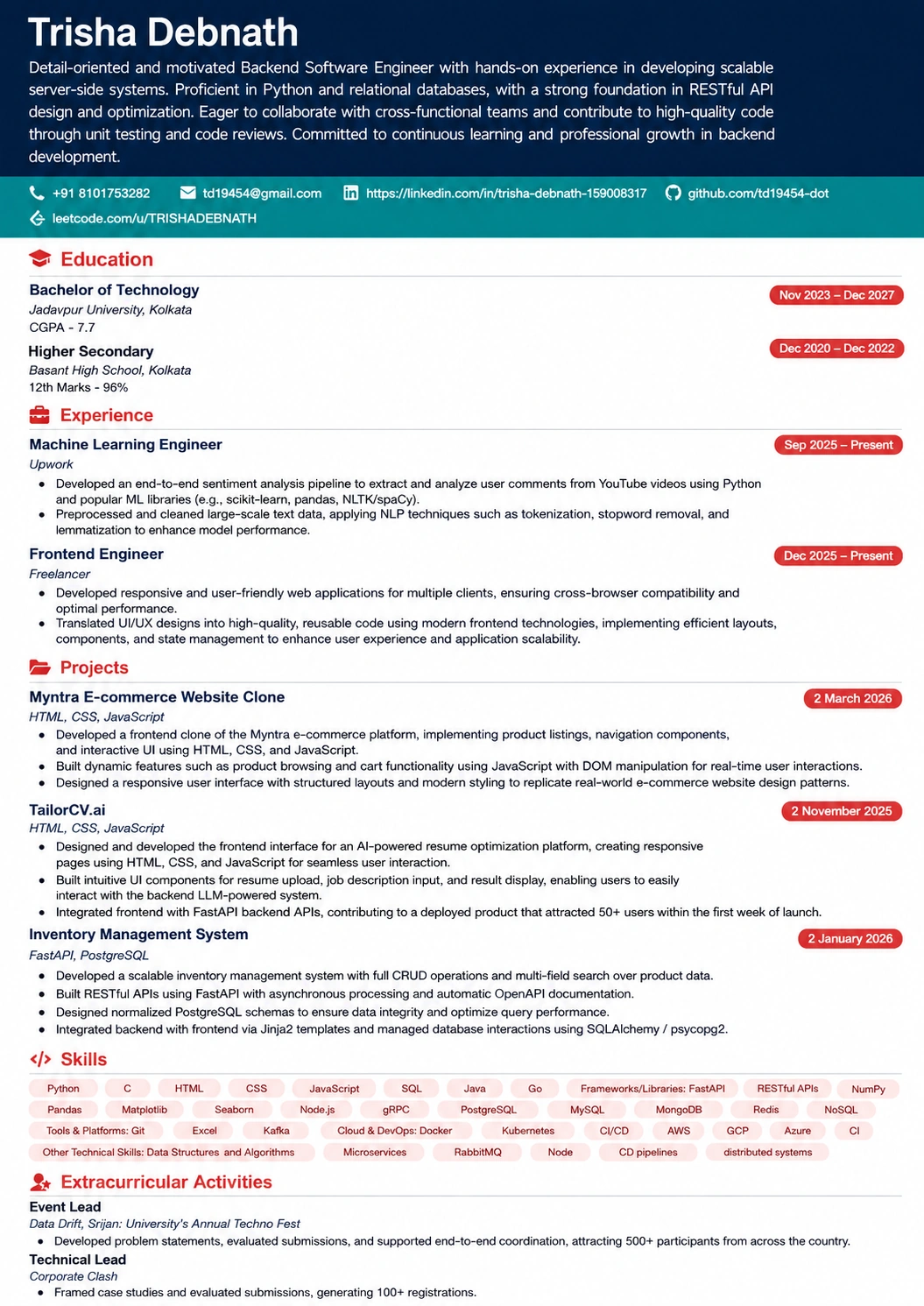
Clean structure means swapping keywords per job takes minutes, not a re-layout every time.
Was this guide useful?
Be the first to rate it.