 TD
TD
Key Takeaways
- Updating your resume between interview rounds is often unnecessary unless specifically requested or if significant changes occur in the role.
- Utilize insights gained from the first interview to tailor your preparation and responses for the next round.
- Focus on enhancing your interview answers, thank-you notes, and verbal presentation based on what you learned about the hiring manager's priorities.
- In cases of panel interviews or senior-level roles, consider creating a refined version of your resume that highlights relevant skills and experiences discussed in the first round.
You got the second interview.
That is a real win. It means your resume and first interview were strong enough to move you forward.
Now comes the part nobody talks about:
What do you do with your resume between interview rounds?
Most candidates do nothing. They assume the resume did its job and now it is a different game.
They are partially right. The resume is not the center of attention in later rounds.
But ignoring it completely is a missed opportunity - and for some candidates, the difference between the offer and the runner-up.
This guide covers when to update your resume between rounds, what to change, and how to use the insider knowledge you gained in your first interview to sharpen your positioning.
First: Understand What Changes After Round One
When you go into a first interview, you have a job description and your research. You are working with educated guesses about what the team really needs.
When you come out of a first interview, you have something much more valuable:
- Firsthand knowledge of what the hiring manager actually cares about
- The questions they asked (which reveal their priorities)
- The problems they mentioned that the role needs to solve
- The team dynamics, culture, and communication style
- Which parts of your background generated the most interest
This information is pure gold. Most candidates thank the interviewer, go home, and do nothing with it.
The strategic candidate takes 30 minutes to analyze what they learned - and uses it to prepare for the next round. This is the same principle behind reading hidden keywords in job descriptions - the interview reveals the hidden priorities the JD could not fully express.
Should You Formally Update and Resubmit Your Resume?
In most cases: no, not formally.
You do not email the recruiter a revised resume after a first interview unless:
- They specifically ask for an updated version
- The role has changed scope significantly and you want to clarify your fit
- Your first resume had an error you discovered afterward
Submitting an unsolicited "updated resume" mid-process can feel awkward or signal insecurity.
What you should do instead:
Use the updated knowledge to:
- Prepare your interview answers with sharper, more tailored examples
- Write a better thank-you note that references specific conversation topics
- Prepare for the second interview's likely deeper focus areas
- Align your verbal "resume" (how you describe your background in the room) to what you now know matters
The resume stays the same. Your preparation and presentation evolve based on what you learned.
The One Exception: The Leave-Behind Resume
Some interview processes - especially at senior levels or in consulting and finance - involve leaving a physical or digital copy of your resume with multiple interviewers.
If you know you are walking into a panel interview or executive interviews where your resume will be physically handed out or shared again, it is worth creating a refined version for that stage.
This version:
- Reflects everything you learned from the first round
- Emphasizes the specific skills and experiences the first interviewer focused on
- Has your strongest, most relevant bullet points front and center
- Is polished, clean, and error-free for a new set of eyes - run a final resume proofreading pass before printing
This is not a completely different resume. It is the same document with intentional refinements based on new information.
How to Use Round One Intelligence to Sharpen Your Positioning
Step 1: Immediately After the First Interview, Write Everything Down
Do this within an hour. Memory fades fast.
Write down:
- Every question you were asked (and your answer)
- Topics that generated visible excitement or engagement from the interviewer
- Problems or challenges the interviewer mentioned
- Anything the interviewer said about what has not been working
- Any skills or experiences they asked follow-up questions about
- Anything they said about what success looks like in this role
This is your intelligence brief.
Step 2: Identify the True Priorities
Look at your notes. What did they spend the most time on? What follow-up questions did they ask? What lit up the conversation?
These are the real priorities - the things that matter more than anything in the written job description.
A job description might list 10 requirements. Your first interview revealed which 3 the team actually obsesses over.
Step 3: Map the True Priorities to Your Background
Now look at your resume and experience. Do your strongest examples align with the true priorities you identified?
If the first interview revealed that the #1 concern is managing a transition from one platform to another - and you have done exactly that in a previous role - that experience needs to be front and center for the second round.
If the first interview revealed that the team is struggling with a specific type of problem you have solved - your answers in the second round should lead with exactly that.
This is also a good moment to check if there are any ATS keyword gaps in your original resume that the interview revealed you should have addressed.
Step 4: Prepare Sharper Stories for Round Two
Second and third interviews are almost always more behavioral and deeper than the first.
You will be asked for specific examples. The examples you choose should now be calibrated to what you know the team cares about most.
Prepare 3-5 detailed STAR stories (Situation, Task, Action, Result) that directly address the priorities you identified in round one.
Your resume got you here. Your prepared stories close the deal.
Read how to prepare for a job interview in 2026 for a full preparation framework. For the behavioral component specifically, review behavioral interview questions and answers to make sure your STAR stories are properly structured.
The Thank-You Note as a Resume Extension
Between rounds, your thank-you note is the closest thing to a resume update you should actually send.
A strategic thank-you note:
- Is sent within 24 hours of the first interview
- References specific topics from the conversation
- Reinforces your strongest relevant experience point
- Expresses genuine interest in this specific role and company
- Is personalized to the interviewer - not a template
Generic (misses the opportunity):
"Thank you for taking the time to speak with me today. I enjoyed learning more about the role and am very excited about the opportunity."
Strategic (uses your round-one intelligence):
"Thank you for the conversation yesterday. The way you described the challenge of rebuilding trust in the data pipeline after the platform migration really resonated - I went through almost exactly that at [Previous Company], where we had to rebuild credibility with 6 internal stakeholder teams after a similar transition. I'd love to bring that experience to your team. Looking forward to next steps."
The second version:
- Shows you were listening
- Reinforces a directly relevant experience
- Makes the interviewer remember you for the right reason
This is your resume, in prose form, delivered after round one. Read how to follow up after an interview for a complete guide on timing, format, and what to say.
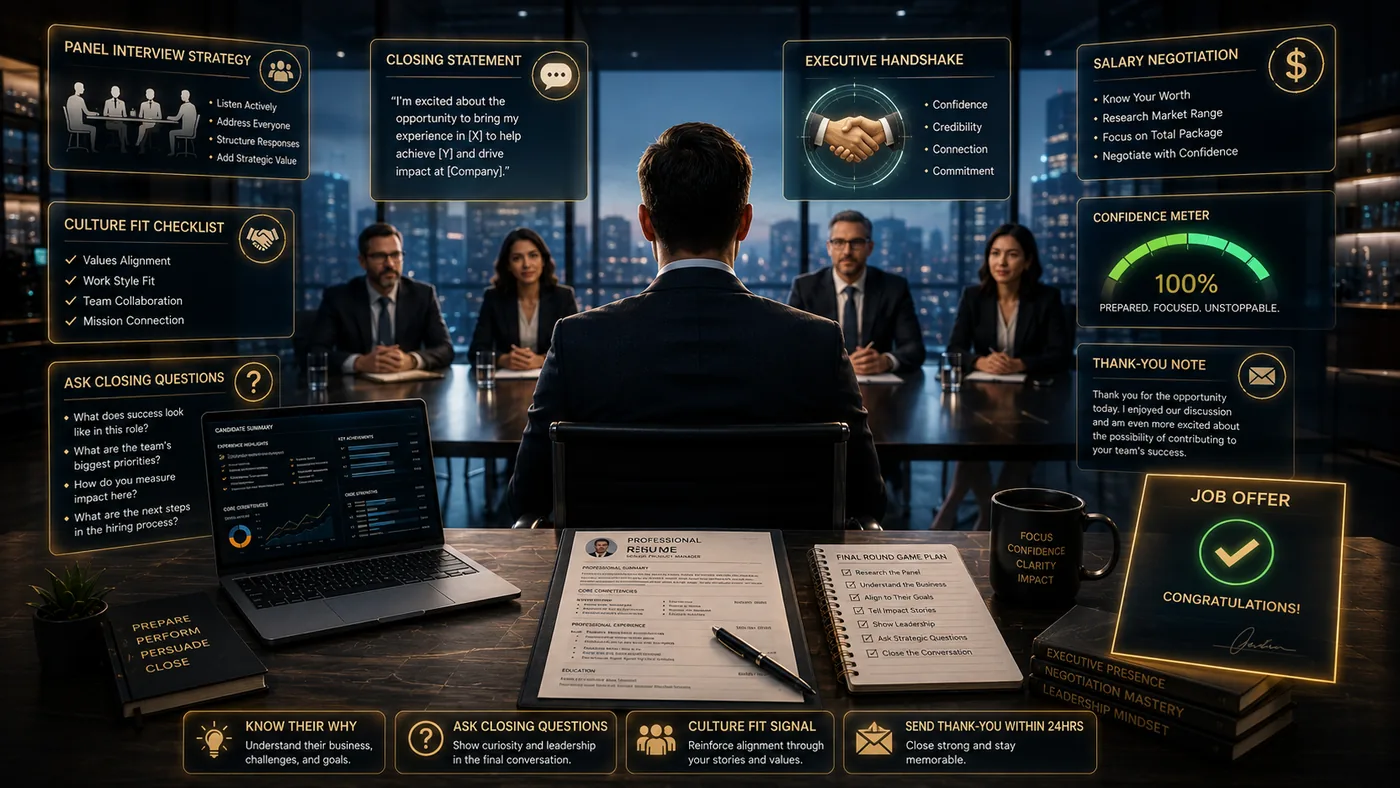
Preparing for the Final Round: What Usually Changes
By round two or three, the focus usually shifts:
Your resume after optimization
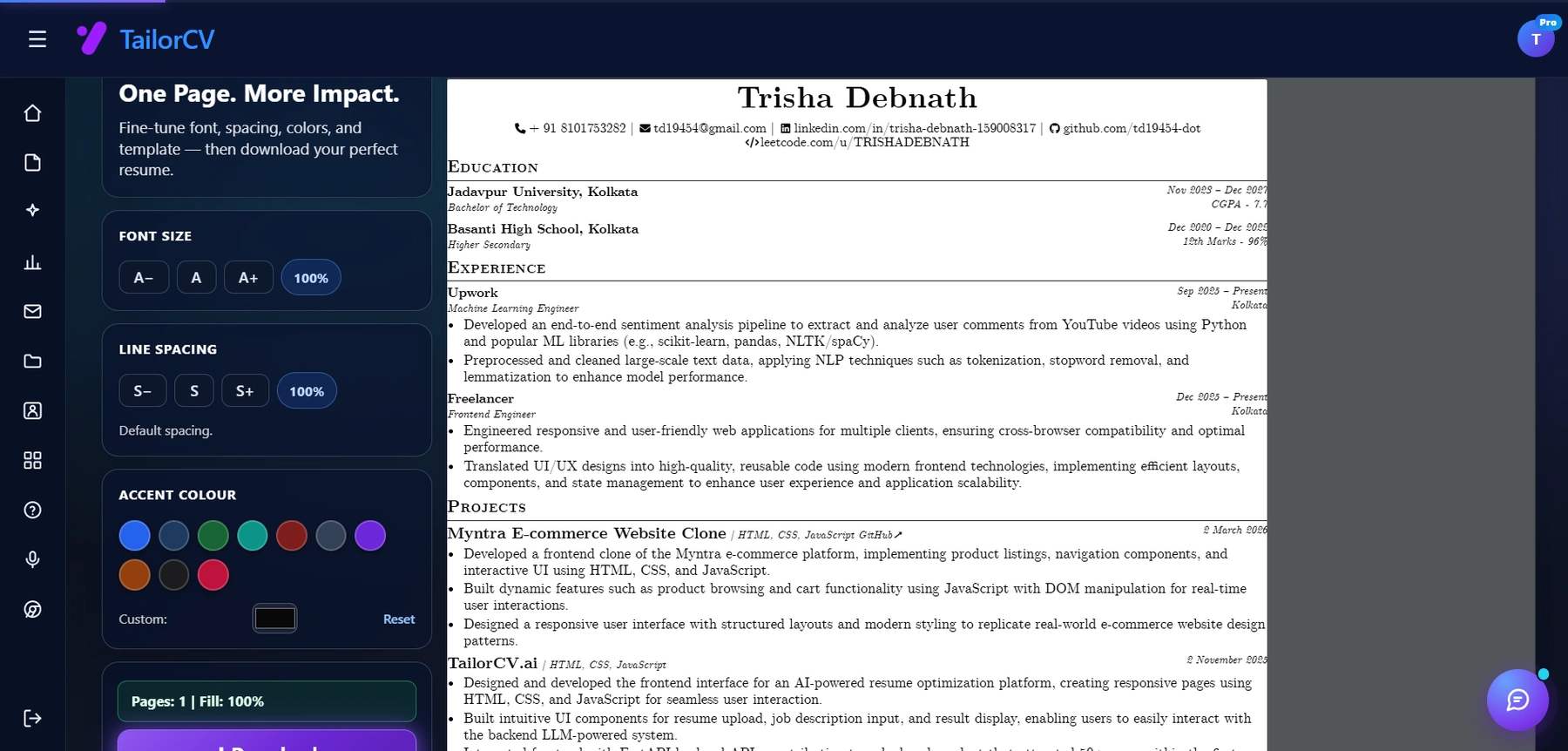
The optimized resume renders live beside the controls, so you see the page count change as you adjust.
Round 1: Can this person do the job? (skills, experience, basic fit)
Round 2: Will this person be a strong team member? (deeper behavioral, case studies, culture fit)
Round 3 / Final Round: Is this the right person? (executive interviews, team member meetings, culture confirmation)
Your resume becomes less central as you move through rounds. What replaces it:
- Case studies or presentations (prepare these if you are in consulting, product, or strategy)
- Technical assessments (for engineering roles)
- Executive interviews (focus on strategic thinking, leadership philosophy, big-picture vision)
- Team member meet-and-greets (focus on collaboration, communication style, cultural alignment)
Tailor your preparation - not necessarily your resume - for each type of round.
If a final round includes salary discussion, be ready with your research. Review how to negotiate a salary offer before reaching that stage.
When the Role Changes Between Rounds
Occasionally, the scope of the role changes between rounds.
The company may have restructured. The team's needs may have evolved. A new priority may have emerged.
If you learn of a significant change - from the recruiter or the interviewer - it is appropriate to ask whether the role scope has shifted and to confirm your understanding.
If the change is material enough that you want to update your positioning, you can say in the interview: "Based on what you shared about [new priority], I want to make sure you are aware of my experience with [specific relevant thing] - it may be even more relevant than I highlighted in my application."
This is verbal resume updating - and it is completely professional.
Using TailorCV Between Rounds
If you want to revisit your resume between rounds - to confirm your keyword match, strengthen your bullet points, or create a cleaner version for a leave-behind - TailorCV's optimizer is the fastest way to do it.
Paste the job description (or the updated priorities you identified from your first interview). Upload your existing resume. Get an ATS match report and see which areas you could strengthen.
Even if you do not formally submit an updated resume, reviewing your match score post-interview can sharpen your verbal positioning - helping you lead your round-two answers with the most relevant material.
Make This Practical
Use this advice as interview practice, not just reading material. Start a role-specific session with the AI mock interview tool, prepare your opening with How to Answer Tell Me About Yourself, and structure evidence-heavy answers with the STAR Method Interview Answers Guide.
Before the interview, make sure the resume that earned the call is still aligned with the role. Check it with the free ATS score checker, review Common Interview Mistakes to Avoid, and use How to Follow Up After an Interview once the conversation is over.
FAQ
Should I send an updated resume after a first interview?
Generally no - unless specifically requested. Use your new knowledge to improve your preparation and thank-you note instead.
What if I forgot to mention a key skill or experience in my first interview?
Bring it up naturally in round two. "I wanted to add to something from our last conversation - I also have experience with [X], which I think is directly relevant to what you described."
How long should a thank-you note be?
3-5 sentences is ideal. Long thank-you notes are not read completely. Short, specific, and warm outperforms long and generic every time.
What if the second interview is with a different person who hasn't seen my first round?
Treat it like a first interview from their perspective - but you have insider knowledge about the company's real priorities. Use it in how you frame your stories.
Is there anything I should NOT say in a second interview?
Avoid referencing things the first interviewer told you in confidence or that seemed sensitive. Also avoid signaling desperation or assuming the offer is coming.
Related Guides
- Final Round Interview Tips
- How to Prepare for a Job Interview in 2026
- How to Follow Up After an Interview
- Behavioral Interview Questions and Answers
- How to Research a Company Before Your Interview
- How to Tailor Your Resume for Every Job
- Common Interview Mistakes to Avoid
- How to Negotiate a Salary Offer
- How to Handle Job Rejection
- Resume Matching with Job Description - Complete Guide
- Campus Placement Preparation in Second Year 2026 - The Highest-Leverage Time
Conclusion
Getting to round two means your resume worked.
Now the job is different.
Your resume got you in the room. Your preparation - sharpened by what you learned in round one - is what closes the deal.
Write down everything you learned. Identify the true priorities. Calibrate your stories to match. Write a strategic thank-you note. Prepare for the shift in focus that later rounds bring.
Your resume stays largely the same. Your positioning evolves.
That evolution - from a resume-led first impression to a deeply calibrated, insight-driven later-round performance - is what separates the offer from the runner-up.
Review My Resume Before My Final Round - Free
See what tailoring is worth on your resume
Score your current resume against a real job description before you change a word.
Drop your resume here or choose a file
PDF only. Max 2 MB.
We never share your data or use it to train AI models.

Was this guide useful?
Be the first to rate it.