 SS
SS

Key Takeaways
- In 2026, adding relevant skills to your resume should focus on genuine expertise that aligns with current employer demands, particularly in AI, data, and cybersecurity.
- Cross-industry skills like AI literacy, data fluency, and proficiency in remote collaboration tools are essential for all professionals.
- Key tech skills in demand include AI/ML integration, TypeScript, Kubernetes, and advanced data science techniques like LLM fine-tuning.
- Cloud and DevOps roles require knowledge of Kubernetes, Terraform, and cloud security practices, while cybersecurity emphasizes zero trust architecture and SIEM tools.
- Utilizing an ATS score checker and an ATS-friendly template is crucial for optimizing your resume to match job descriptions.
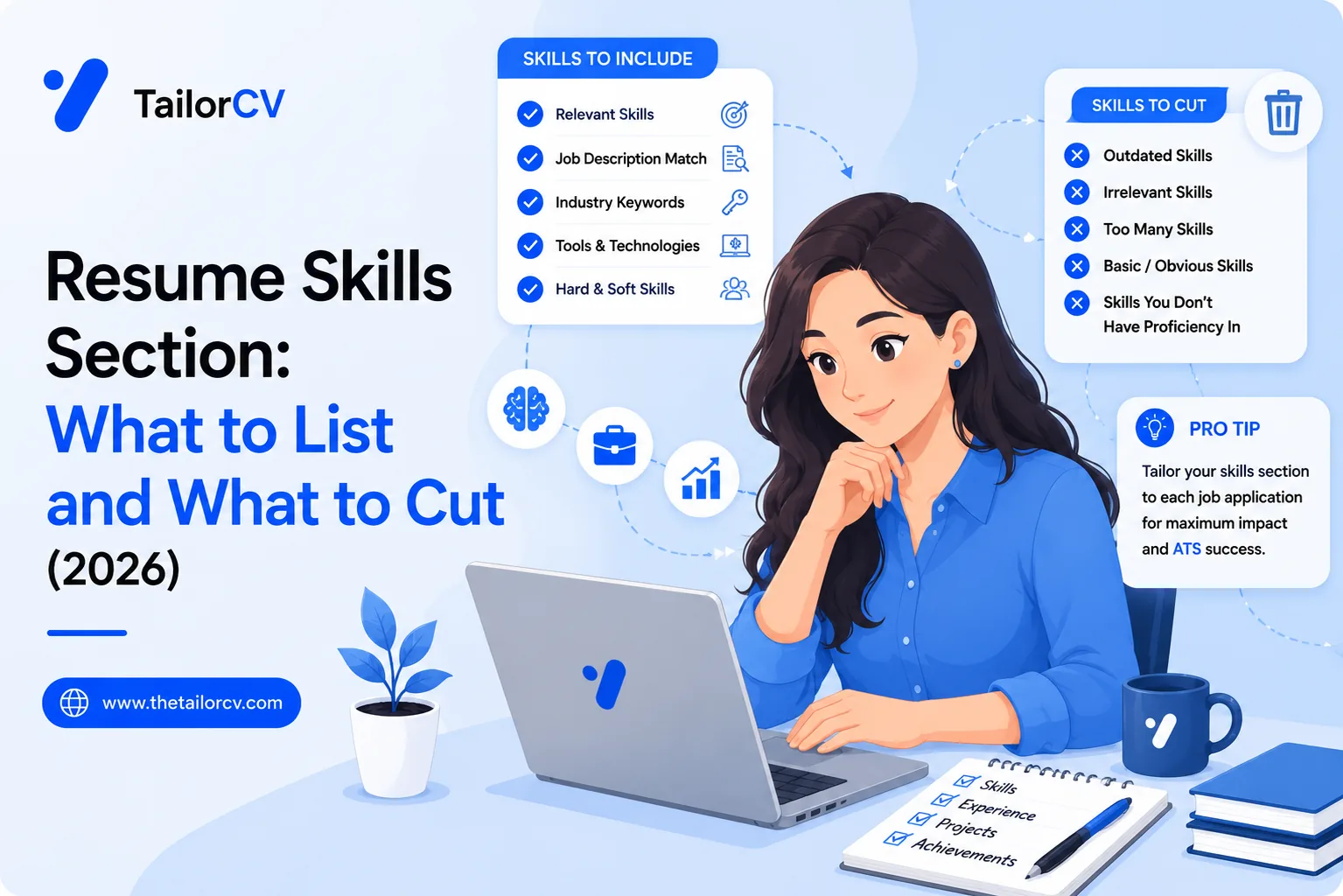
Adding the right skills to your resume in 2026 is not about listing every tool you have ever opened. It is about matching your genuine expertise to what employers are currently searching for - and making sure you can prove each skill with experience or projects.
The job market in 2026 has clear skill demand patterns. AI and automation tools are embedded in every industry. Cloud, data, and cybersecurity remain at peak demand in tech. Healthcare and education are digitizing fast. Business roles increasingly require data fluency alongside traditional soft skills.
This guide organizes the most in-demand skills by industry and role type - so you can quickly identify what to add, what to learn, and what to prioritize.
Before updating your skills, run your resume through the ATS score checker to see how your current skills match a target job description. Use an ATS-friendly template and read what not to put on a resume to understand which skills to remove. For specific role guides, see the technical skills resume guide for freshers.
Cross-Industry Skills Every Professional Needs in 2026
These skills appear across almost every industry and role type:
AI Literacy and Prompt Engineering
Working with AI tools (ChatGPT, Claude, Copilot, Gemini) to automate tasks, write code, generate content, analyze data, and improve workflows is now a baseline professional expectation across many roles.
What to add:
- AI prompt engineering
- Working with LLMs (large language models)
- GitHub Copilot (for developers)
- AI-assisted writing and editing
- AI automation tools (Zapier AI, Make.com with AI)
Data Fluency
Even non-data roles now require the ability to read dashboards, interpret A/B test results, and make data-informed decisions.
What to add:
- SQL (basic querying for non-tech roles)
- Google Analytics / GA4
- Excel / Google Sheets (advanced)
- Power BI / Tableau (basic to intermediate)
Remote Collaboration Tools
Since hybrid and remote work is standard:
- Notion / Confluence / Google Workspace
- Slack / Teams
- Loom
- Figma / Miro (for visual collaboration)
Top Tech Skills for 2026
Software Engineering
Highest demand in 2026:
| Tool | What it does |
|---|---|
| AI/ML integration | embedding LLMs, building AI-powered features (OpenAI API, Anthropic Claude API, LangChain) |
| TypeScript | now expected for most frontend and many full stack roles |
| Kubernetes and Helm | container orchestration is a standard expectation |
| Rust | growing fast for systems programming and WebAssembly |
| WebSockets and real-time | real-time features are standard product expectations |
| GraphQL | increasingly expected alongside REST |
| Testing (Playwright, Cypress) | testing discipline is a differentiator |
Data Science and ML
Highest demand:
- LLM fine-tuning and RAG - retrieval-augmented generation is now a core applied ML skill
- MLOps - MLflow, Kubeflow, production deployment
- Python with Polars - faster than Pandas, gaining adoption fast
- Vector databases - Pinecone, Weaviate, Chroma for LLM applications
- Transformer architectures - Hugging Face ecosystem fluency
- PySpark - large-scale data processing
Cloud and DevOps
Highest demand:
- Kubernetes and GitOps - ArgoCD, Flux
- Terraform / Pulumi - IaC is non-negotiable
| Tool | What it does |
|---|---|
| FinOps | cloud cost management is an explicit discipline |
| Security as code | Checkov, tfsec, OPA (Open Policy Agent) |
| Platform engineering | internal developer platform (IDP) building |
| AWS / GCP / Azure | at least one cloud certification remains a strong differentiator |
Cybersecurity
Highest demand:
- Cloud security - AWS GuardDuty, Security Hub, GCP SCC
- Zero trust architecture
- SIEM and SOAR - Splunk, Sentinel, Chronicle
- Application security - DAST, SAST, penetration testing
- OSCP / CISSP certifications
Top Data and Analytics Skills for 2026
- dbt (data build tool) - now a standard in data engineering
- Databricks - unified analytics platform growing rapidly
- Python for analytics - Polars, Pandas, Plotly, Streamlit
- BigQuery / Snowflake - cloud data warehouse proficiency
- Looker / Metabase - BI tool fluency
- SQL window functions and CTEs - expected in any senior analyst role
- A/B testing methodology - statistics behind experiment design
- Apache Kafka - real-time data streaming for data engineers
Top Business and Strategy Skills for 2026
- Financial modeling in Excel / Sheets - still the most valuable business skill
- SQL for business analysis - non-technical business professionals with SQL stand out
- Power BI or Tableau - data visualization for non-data roles
- OKR / goal-setting frameworks - used by product, strategy, and HR teams
- AI writing tools - Claude, ChatGPT, Jasper for content and analysis acceleration
- Project management tools - Jira, Notion, Linear, Asana
- Agile / Scrum basics - expected in almost every corporate role
- Stakeholder management - documented with examples, not just listed
Top Marketing Skills for 2026
- GA4 / Google Analytics 4 - Universal Analytics is retired; GA4 is the new standard
- Performance Max campaigns - Google's AI-driven ad format
- LinkedIn Ads - B2B marketing has shifted heavily to LinkedIn
- AI content generation - knowing how to use and quality-control AI content
- Email automation - HubSpot, Klaviyo flows and segmentation
- SEO with AI content strategy - content at scale with quality control
- Video marketing - YouTube, TikTok, Reels content strategy
Top Skills for Engineering Roles in 2026
Mechanical Engineering
- Generative design - AI-assisted topology optimization in SolidWorks/Fusion 360
- Digital twin - simulation-based process monitoring
- Additive manufacturing - 3D printing design for production applications
- Electric vehicle systems - BMS, thermal management, motor control
Electrical Engineering
- SiC / GaN power devices - next-generation power electronics
- Functional safety (ISO 26262) - essential for automotive electronics
- FPGA design - Verilog, VHDL for specialized computing
- Battery management systems - critical for EV and energy storage sectors
Civil Engineering
- BIM / Revit - Building Information Modeling is now expected in most structural roles
- GIS mapping - ArcGIS, QGIS for spatial analysis
- Sustainable design / LEED - green building knowledge is increasingly valued
Chemical Engineering
- Process safety digital tools - Bow-tie analysis, SIL calculations
- Green chemistry / sustainable processes - decarbonization project experience
- Bioprocess engineering - pharma and biotech growth driving demand
Top Healthcare Skills for 2026
- Epic / Cerner EMR - digital health records are universal; proficiency is a screening filter
- Telehealth platforms - Zoom Health, Doximity, Teladoc tools
- Point-of-care ultrasound (POCUS) - rapidly spreading skill for nurses and physicians
- Patient safety frameworks - ISBAR, WHO Surgical Safety Checklist, PFMEA
Your resume after optimization
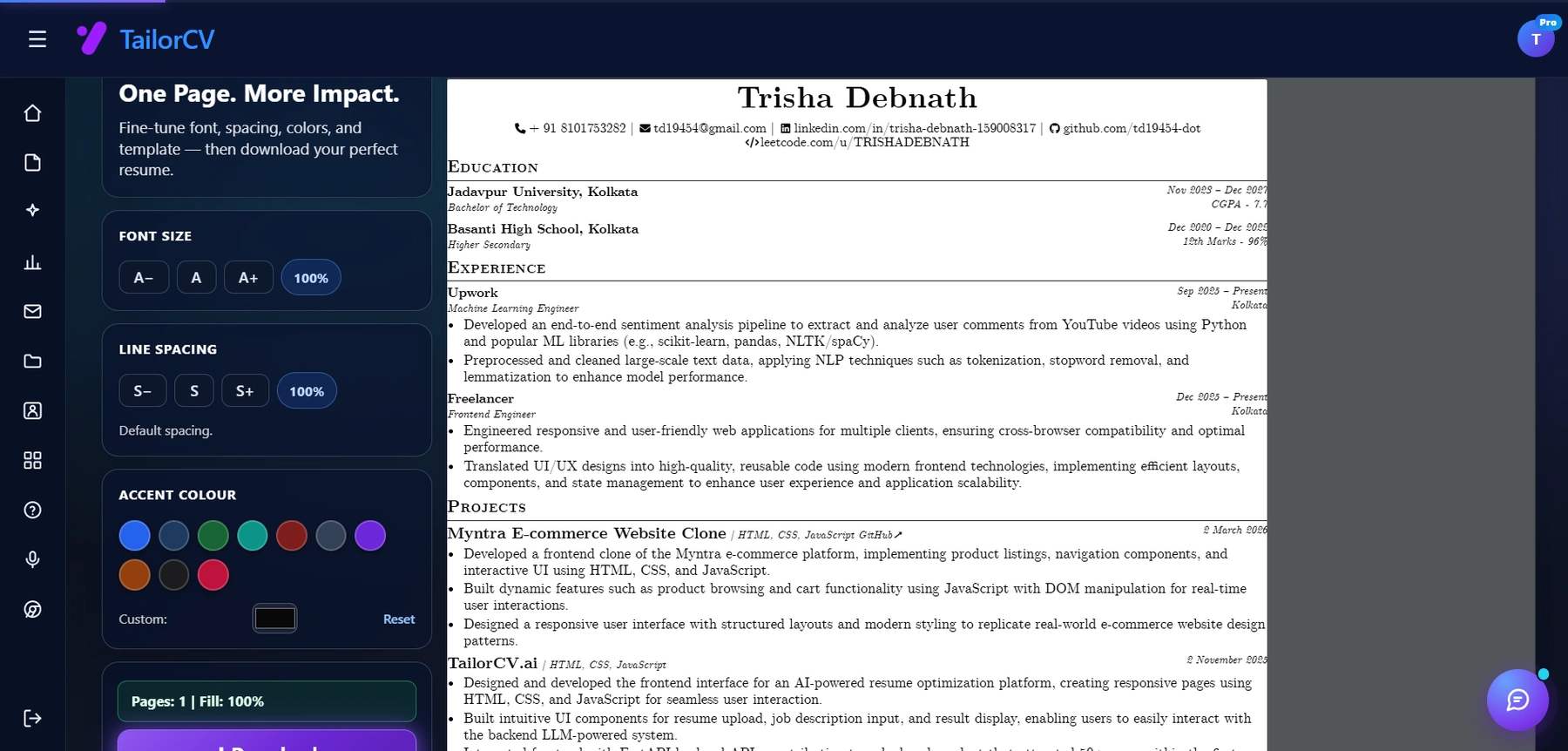
Font size, spacing, accent colour and template are all adjustable, with a live page counter.
Top Education Skills for 2026
- Google Workspace for education - Classroom, Forms, Slides, Docs
- Learning Management Systems (LMS) - Canvas, Moodle, Blackboard, Schoology
- Formative assessment tools - Nearpod, Kahoot, Pear Deck, Padlet
- Differentiated instruction technology - EdPuzzle, Flipgrid, adaptive learning platforms
- Data literacy for teachers - reading and acting on assessment analytics
How to Add New Skills to Your Resume
- Only list skills you can discuss and demonstrate in an interview
- Learn it, build a project with it, then add it
- Add a brief note in your experience section showing you used it (not just in the skills list)
- For certifications: complete an official one before listing it
Saying "currently learning Python" on your resume is weak. Saying "built 3 Python data analysis projects" with a GitHub link is strong.
Related Guides
- 35 Powerful Technical Skills in Resume for Freshers With No Experience (2026 Guide)
- 200 Best Action Verbs for Resume
- How to Quantify Resume Achievements
- Soft Skills for Resume
- How to Explain Resume Gaps
- How to List Certifications on a Resume
- How to List Education on a Resume
- How to Write a Resume Headline
- How to Write a Resume Summary
- What Not to Put on a Resume
- Cover Letter Guide
- How to Prepare for a Job Interview
- MBA Resume 2026 - Complete Guide with Examples
- Why Am I Not Getting Interviews for Jobs I'm Qualified For?
- Ideal Resume Length in 2026 - One Page or Two? Complete Guide
- Data Analyst vs Data Scientist in 2026 - Which Career Is Right for You?
- ATS Mistakes Experienced Professionals Make (And Why Your Resume Stops Working After 5+ Years)
Make This Practical
Use this guide as part of a complete job-search workflow. Check your resume with the free ATS score checker, improve targeting with the Resume Optimization Guide, and choose a clean format from the ATS-friendly resume templates.
After the resume is ready, strengthen the rest of the application. Draft a targeted letter with the AI cover letter generator, practice interviews with the AI mock interview tool, and create a project-backed proof page with the portfolio website builder if you need a stronger online presence.
Conclusion
The most valuable skill additions in 2026 are AI/LLM integration, cloud-native tools, data fluency across all roles, and the modern stack in your specific domain.
Once you have updated your skills, run your resume through the TailorCV ATS score checker to verify your new skills match the job descriptions you are targeting. Use ATS-friendly templates and read the resume optimization guide for complete resume guidance.
Frequently Asked Questions
What are the top skills to include on a resume in 2026?
In 2026, the most sought-after skills span across various industries, with a strong emphasis on AI literacy, data analysis, and cybersecurity. Skills such as AI prompt engineering, familiarity with large language models, and data fluency are essential. Additionally, integrating soft skills like communication and adaptability will enhance your profile, making it more attractive to potential employers.
How can I demonstrate my AI skills on my resume?
To effectively showcase your AI skills, include specific tools and technologies you have experience with, such as ChatGPT or GitHub Copilot. Highlight projects where you've utilized these tools to automate tasks or analyze data. Consider adding a link to your portfolio if it features relevant AI-related work to provide tangible proof of your abilities.
What should I do if I lack certain in-demand skills for my desired job?
If you find gaps in your skills compared to job requirements, focus on learning and certification programs to build those competencies. For example, you could pursue online courses in data analytics or AI tools. Once you gain these skills, ensure to list certifications on your resume to validate your new expertise.
How do I quantify my achievements related to these skills?
Quantifying your achievements can significantly enhance your resume. Use metrics to describe how your skills led to improvements in efficiency, revenue, or project outcomes. For instance, if you automated a process that saved time, specify how much time was saved. For more tips, refer to our guide on how to quantify resume achievements.
Are there specific action verbs I should use to describe my skills?
Yes, using strong action verbs can make your resume more impactful. Words like "automated," "designed," or "optimized" can effectively convey your contributions and skills. For a comprehensive list tailored to various roles, check out our post on the 200 best action verbs for resume.
What is your resume scoring right now?
Scan it against a job description and get your ATS match score in about a minute.
Drop your resume here or choose a file
PDF only. Max 2 MB.
We never share your data or use it to train AI models.

Templates that keep this structure intact
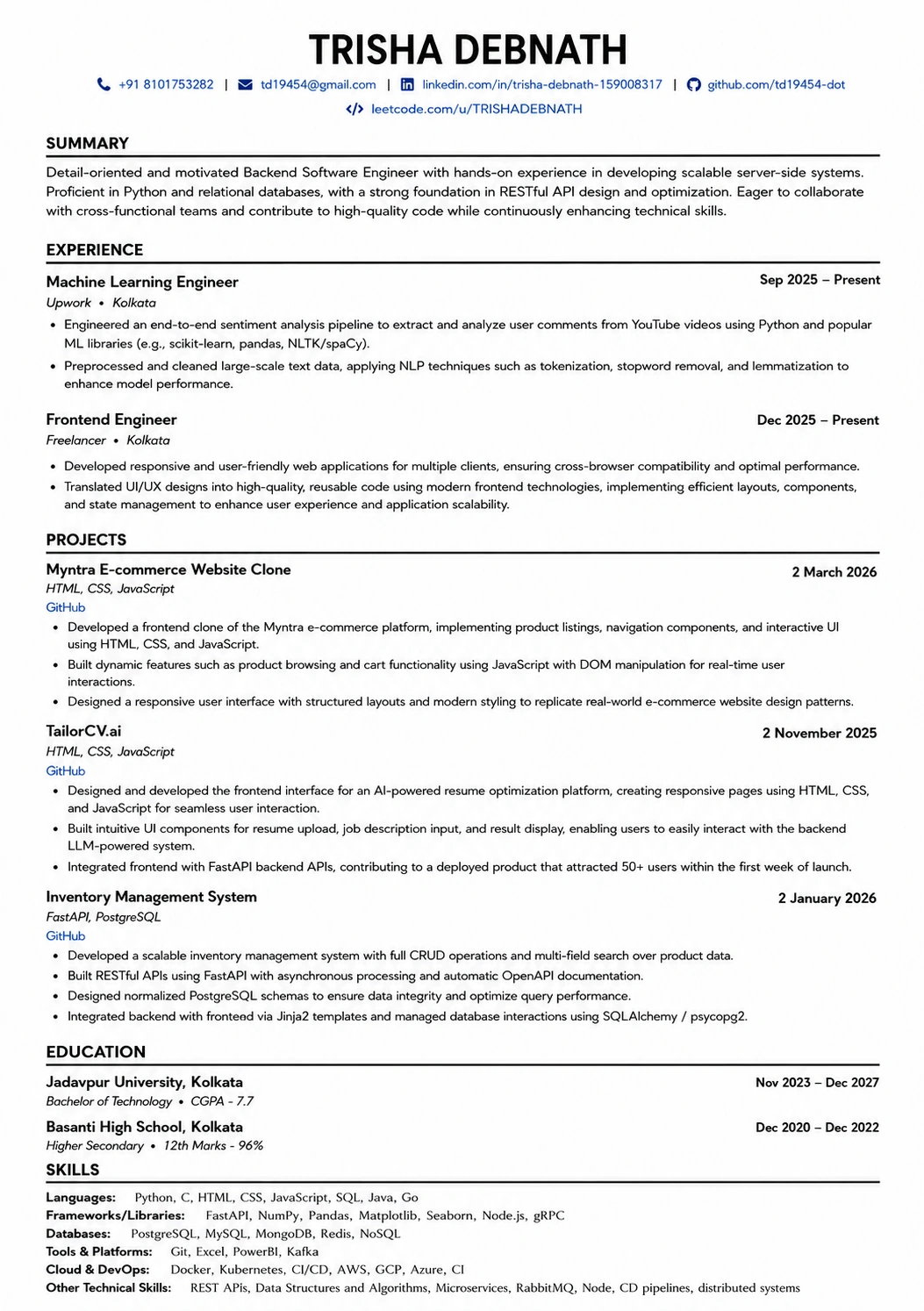
This template is ATS-tested — start from it and the formatting rules in this guide are already handled.
Was this guide useful?
Be the first to rate it.