SS
SS

Key Takeaways
- Resume conventions vary significantly by country, affecting format, length, and personal details included.
- In the US, resumes should be one page, without photos or personal information like date of birth or nationality.
- The UK typically uses a two-page CV format, includes a personal statement, and also avoids photos to minimize bias.
- Understanding and adhering to country-specific resume norms is crucial for job applicants to demonstrate market knowledge and professionalism.
You are a strong candidate.
Your experience is real. Your results are impressive. Your resume - built to US standards - is clean, one page, keyword-optimized.
You apply to a role in Germany. You hear nothing.
You apply to a role in the UK. Still nothing.
You apply in Australia. A recruiter replies: "Can you send a CV instead?"
You send your resume. They do not reply.
International job searching is one area where resume advice almost universally fails you. Every guide assumes you are applying in one country. Most assume that country is the United States.
The reality is that resume conventions - format, length, photo, personal details, cover letter expectations - differ significantly between countries.
Applying with a US-style resume to a German, UK, or Australian employer signals that you did not bother to understand the market you are entering.
This guide gives you the country-specific knowledge you need. For federal government applications in the US specifically, see the federal government resume guide - that is another major context where standard resume advice fails candidates.
Why Country-Specific Resume Conventions Exist
Resume norms are shaped by legal environments, cultural expectations, and historical hiring practices.
Germany requires a professional photo because personal presentation is part of the cultural evaluation. The US prohibits asking for most personal information to prevent discrimination. The UK lands somewhere in between.
These are not arbitrary preferences. They reflect what each culture's hiring system is built around.
Ignoring country norms does not make you stand out as bold or innovative. It makes you look like you did not research the market.
The United States
Length: 1 page for most roles. 2 pages for senior professionals with 10+ years of experience. See ideal resume length guidance for a full breakdown.
Photo: Never. Including a photo is considered a red flag in the US and can expose employers to discrimination liability.
Personal details: No date of birth, no marital status, no nationality, no national ID. Name, email, phone, city/state, and LinkedIn URL are standard.
Format: Clean, ATS-optimized, single-column preferred. Skills section, professional summary, work experience (reverse chronological), education.
Objective vs. Summary: Summary is now standard. Objective statements are considered outdated. Read resume objective vs summary for the differences.
Cover letter: Optional for most applications but recommended for roles you strongly want. See the cover letter guide 2026.
ATS: 98% of Fortune 500 companies and most mid-size companies use ATS. Keyword optimization is critical. Avoid ATS formatting mistakes that cause parsing failures.
Use TailorCV's ATS optimizer before applying to any US role.
The United Kingdom
Length: 2 pages is standard. 3 pages for senior roles. "CV" is the standard term - though the document structure is similar to a US resume for most industries.
Photo: Generally not included. UK employers are trained to evaluate on merit, and photos can introduce unconscious bias concerns (similar to US).
Personal details: Name, contact details, and LinkedIn are standard. Date of birth and nationality are not expected. Professional development and qualifications are important.
Format: Similar to US in most respects. However, a "Personal Statement" (2-3 sentences at the top) is more common than in the US. This is essentially the UK equivalent of a resume summary.
References: "References available upon request" is standard - or sometimes two named references are included at the bottom for more traditional industries.
cover letter: More expected than in the US. Many UK employers treat the cover letter as a significant part of the application.
Spelling: British English is expected. "Organisation" not "organization." "Colour" not "color." ATS and human reviewers in the UK notice American spelling inconsistencies.
Salary: Do not list salary history on your CV. If asked in an application form, give a range based on research. Read how to negotiate a salary offer before entering any salary range.
Germany and the DACH Region (Austria, Switzerland)
Germany has some of the most specific resume conventions in the world.
Length: 2-4 pages is normal. German employers expect comprehensive documentation.
Photo: Expected and almost universal. A professional, business-appropriate headshot is standard. The photo should be recent, high quality, and show professional attire. No casual selfies.
Personal details: Name, date of birth, place of birth, nationality, marital status, and address are all conventionally included. Note: some progressive German companies are moving away from this as part of diversity initiatives - but it remains the majority norm.
Document structure: German CVs typically include: photo + personal details, professional summary, work experience, education, further qualifications, language skills, IT skills, interests/hobbies, references.
The "Anschreiben" (cover letter): In Germany, the cover letter (Anschreiben) is typically more formal and important than in many other markets. It should be addressed to a specific person and follow formal letter conventions.
Certifications and qualifications: Germans are extremely credential-focused. Any relevant diploma, certificate, or professional qualification should be listed with the issuing institution. Review how to list certifications on a resume for the right format before adapting to German conventions.
Dates: Day/Month/Year format is standard in Germany. (21.03.2022, not March 21, 2022 or 03/21/2022)
Language: If applying to a German company, a German CV may be required or expected - even if the role is primarily in English. For international companies operating in Germany, English CVs are usually accepted.
France
Length: 1 page maximum in most cases. French recruiters are notoriously strict about length.
Photo: Common but not universal. A professional headshot is conventional for French CVs.
Personal details: Name, address, date of birth are conventional. Nationality is often included for non-French applicants.
Language: French CVs for French companies should be in French. For multinational companies, English is accepted - but demonstrate French language proficiency if you have it.
Structure: Photo (top right), personal details, professional profile, work experience, education, skills and languages. Very clean and structured.
cover letter ("Lettre de Motivation"): Expected for most applications and taken seriously. Should be formal, demonstrating both professional fit and enthusiasm.
Canada
Length: 1-2 pages. Very similar to US standards.
Photo: Not included for the same legal reasons as the US.
Language: Canada is officially bilingual. In Quebec and some federal roles, bilingual French-English capability is a significant advantage. Check the posting language.
Format: Extremely similar to US. ATS optimization is important. Many Canadian employers use the same ATS platforms as US companies.
Key difference: Volunteer work and community involvement carry more cultural weight in Canadian hiring than in US applications. If you have strong community involvement, include it on your resume.
Australia and New Zealand
Length: 2-4 pages. Australian employers expect more detail than US employers.
Photo: Not typically included. Similar legal framework to US and UK.
Personal details: Name, location, phone, email. No date of birth or nationality required.
References: Australia has a stronger reference culture than the US or UK. 2-3 references with contact information are often included at the end of the CV - or "references available upon request" with actual referees ready immediately.
cover letter: Expected and taken seriously. Personalized, specific, and professional.
Key difference: Australian job applications often include a "selection criteria" response - a separate document addressing specific stated criteria for the role. This is especially common for government and healthcare roles. Failure to include it can result in automatic disqualification.
Japan
Length: A standardized template - the Rirekisho - is the conventional format for Japanese employers. It is a structured form, not a free-format document.
Photo: Required on the Rirekisho. Typically a formal passport-style photo attached to the upper left corner.
Language: Japanese is expected for most domestic companies. For international companies operating in Japan, English CVs are often accepted or required.
Handwritten vs. printed: Traditionally, the Rirekisho was handwritten (showing diligence). Today, printed versions are widely accepted, but for traditional companies, a handwritten original still signals respect for the process.
For international applicants: Most multinational companies operating in Japan accept an English CV alongside the Japanese Rirekisho.
India
Length: 2-3 pages is common. Indian CVs are often more detailed than Western equivalents.
Personal details: Date of birth, gender, and marital status are commonly included, though this is shifting in modern tech-focused companies.
Photo: Common, especially in traditional industries. Less expected in tech startups and international companies.
Language: English is standard for professional applications. Indian CVs are virtually always in English.
Format: Career objective, education (often listed before work experience for recent graduates), work experience, skills, projects, certifications, personal details.
How to Quickly Adapt Your Resume for an International Application
Step 1: Research the Target Country's Norms
Use the country-specific guidance above. For lesser-known markets, search "[Country] CV format" or consult in-country HR resources.
Step 2: Build a Country-Specific Base Version
Do not try to adapt your US resume line by line. Build a country-specific base version that follows the local conventions:
- Adjust length
- Add or remove photo
- Add or remove personal details
- Adjust spelling and date formats
- Structure sections in the expected order
Track these versions using the managing multiple resume versions system - the file naming and folder structure guidance there applies directly to international versions too.
Step 3: Tailor for the Specific Role
Once you have a country-appropriate base, tailor it for the specific job description exactly as you would for any application - keyword matching, summary alignment, skills emphasis.
Use the hidden keywords technique to decode what the international employer is really looking for beyond the explicit requirements.
Use TailorCV's optimizer for the keyword matching step. The tool works regardless of country - paste the job description and upload your resume to see your keyword match and gap analysis.
Step 4: Consider Language Requirements
If the role or company expects the local language, a translation is not optional. Use a professional translator or a native speaker for review - machine translation of a professional document is not sufficient.
Make This Practical
Do not guess whether the resume is ready. Upload it to the free ATS score checker, compare the result with the ATS Score Guide, and fix formatting issues using ATS Resume Formatting Mistakes and ATS Resume Parser Friendly Format.
After the technical cleanup, improve relevance. Use Resume Matching With Job Description, strengthen keyword coverage with the Resume Keywords Guide, and avoid overdoing it by checking ATS Keyword Mistakes. If the layout itself is weak, rebuild with an ATS-friendly resume template.
Key Resume Differences by Country
Understanding the key differences in resume conventions can help you tailor your application effectively for different job markets.
| Feature | United States | Germany | Australia |
|---|---|---|---|
| Length | 1 page (2 pages for senior roles) | 1-2 pages, typically longer | 2-3 pages, more detail encouraged |
| Photo | Never included | Required, professional presentation | Optional, but can enhance appeal |
| Personal Details | Minimal (no age, marital status) | Full address, date of birth, marital status | Full address, but no date of birth |
| Language | English (American) | German (or English for international roles) | English (Australian) |
| Work Experience Format | Bullet points, concise descriptions | Detailed descriptions with responsibilities | Bullet points, but can include personal achievements |
| References | Generally not included, "Available upon request" | Often included directly in the resume | Typically provided separately |
FAQ
Should I use a CV or a resume for international applications?
In most countries outside the US and Canada, "CV" is the standard term - even when the document looks similar to what Americans call a resume. Use the term the posting uses.
If I am applying remotely (from the US to a UK company), which format do I use?
Use the UK format. The company's location determines the convention, not yours.
Can I use the same resume for European Union countries?
The EU has a standard template called the Europass CV, which is recognized across EU member states. Using it signals awareness of European conventions. However, it is not required - and country-specific CVs may still be preferred in Germany or France.
How do I handle the photo requirement for Germany if I am uncomfortable including one?
This is a personal decision. Omitting a photo may reduce your chances slightly with traditional German employers. International companies with offices in Germany are generally more flexible. Consider reviewing our guide on resume references if you need additional tips. You might also find it helpful to explore resume tailoring for job seekers over 50 for insights on adapting your application materials.
Related Guides
- Resume vs CV
- How to Tailor Your Resume for Every Job
- Federal Government Resume Guide
- Resume File Format Guide
- Remote Job Search Guide 2026
- Cover Letter Guide 2026
- ATS Score Guide
- Photo on Resume
- How to Match Your Resume to a Remote Job Description
- Managing Multiple Resume Versions
Conclusion
The world is hiring globally. Your resume needs to be globally intelligent.
A US resume will not work in Germany. A German CV will feel out of place in Canada. An Australian application without selection criteria responses will be auto-rejected for government roles.
Learn the conventions. Build country-specific base versions. Tailor for the specific role.
Your experience is the same everywhere. The presentation changes with the market.
Get the format right - and give your experience the global audience it deserves.
Optimize My Resume for Any Market - Free
See what tailoring is worth on your resume
Score your current resume against a real job description before you change a word.
Drop your resume here or choose a file
PDF only. Max 2 MB.
We never share your data or use it to train AI models.

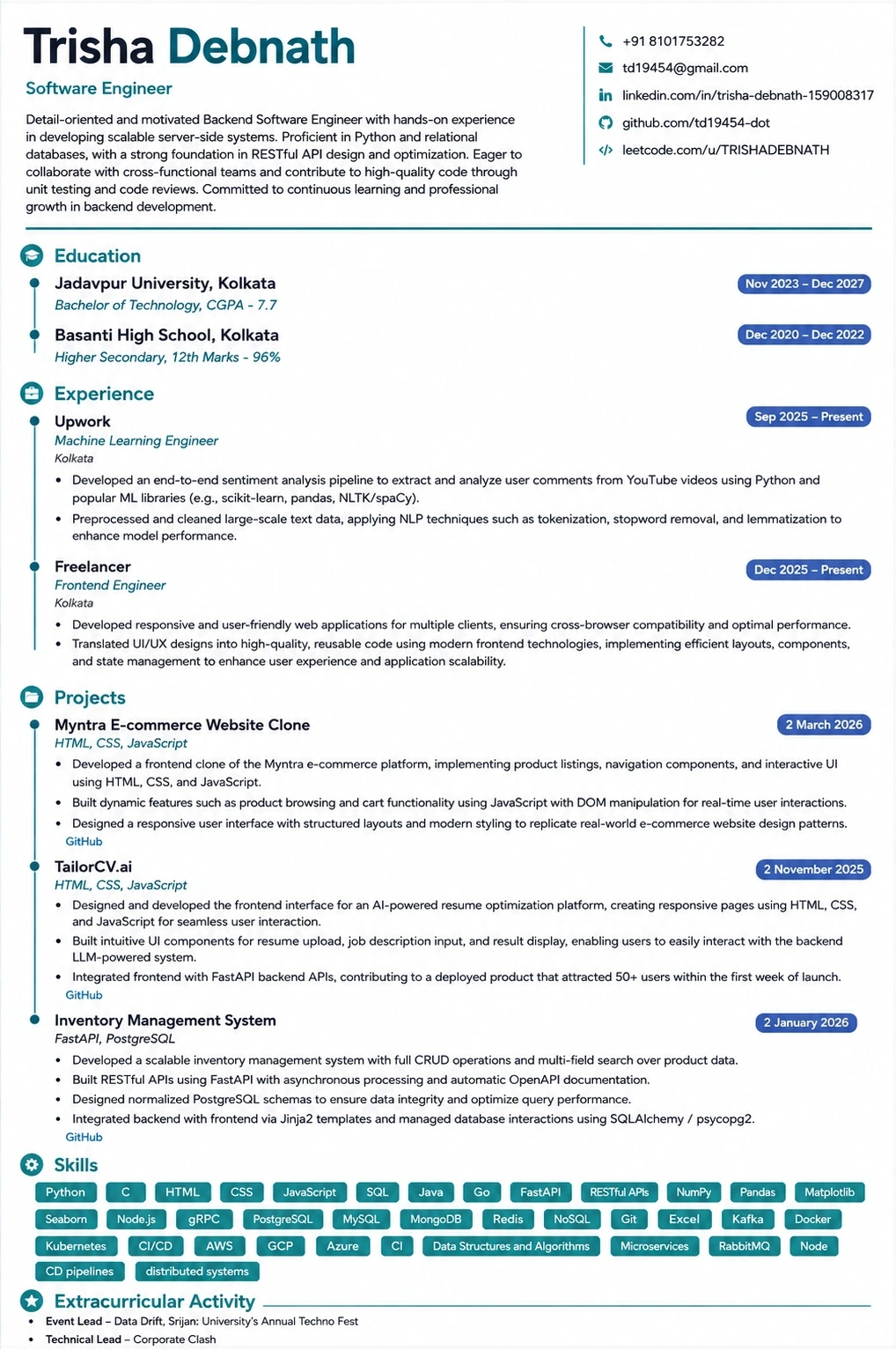
A layout that works with a short history
Leads with skills and projects instead of years of experience you do not have yet.
Was this guide useful?
Be the first to rate it.