SS
SS

Key Takeaways
- Resume bullet points should focus on accomplishments rather than just job duties to stand out to recruiters.
- A strong bullet point includes an action, method or skill, and the impact or result, ideally quantified.
- Use specific formulas for crafting bullet points: Action + Result, Action + Method + Result, or Action + Scale + Result for senior roles.
- Transform weak bullet points into strong ones by adding measurable outcomes and specific actions taken.
Most resume bullet points are weak. They describe job duties rather than accomplishments, use passive language, and give recruiters nothing memorable to anchor their evaluation. A few simple changes to how you write bullets can dramatically increase your callback rate.
This guide gives you the formula, real before-and-after examples, and the rules that separate a good bullet from a forgettable one.
Before polishing your bullets, make sure your overall resume scores well with the TailorCV ATS checker and is built on an ATS-friendly template.
Why Bullet Points Matter So Much
Bullet points are the primary content recruiters read in the work experience section - the section that carries the most weight in the hiring decision. They are also what ATS systems scan for keyword matches.
A strong bullet does three things:
- Shows what you did (action)
- Shows how you did it (method or skill)
- Shows the impact (result, often quantified)
A weak bullet only does one of these - usually the first, without any depth.
The Three Best Bullet Formulas
Formula 1: Action + Result (Simple and Effective)
[Strong verb] + [what you did] + [quantified result]
"Reduced customer onboarding time from 5 days to 1 day by redesigning the intake workflow."
"Increased monthly recurring revenue by 23% by launching an email re-engagement campaign targeting dormant subscribers."
Formula 2: Action + Method + Result
[Strong verb] + [what you did] + [how] + [result]
"Improved API response time by 60% by migrating from synchronous to asynchronous processing using Node.js event loops."
"Reduced churn rate by 15% by analyzing exit survey data and implementing product changes based on top-cited frustrations."
Formula 3: Action + Scale + Result (For Senior Roles)
[Strong verb] + [scope/scale] + [what you did] + [result]
"Led a team of 12 engineers to deliver a 3-year-deferred platform migration in 8 months, enabling $4M in new enterprise contracts."
Before and After: 10 Real Transformations
1. Software Engineering
Before: "Responsible for fixing bugs in the backend system"
After: "Resolved 47 critical backend bugs over Q3, reducing production incidents by 38% and improving system uptime to 99.97%"
2. Marketing
Before: "Managed social media accounts for the company"
After: "Grew Instagram following from 8K to 62K in 9 months by launching a weekly user-generated content series and strategic hashtag campaigns"
3. Sales
Before: "Exceeded sales targets regularly"
After: "Exceeded quarterly sales targets by an average of 31% for 6 consecutive quarters, generating $1.2M in new business"
4. Data Analysis
Before: "Used Excel and SQL to analyze data"
After: "Built automated SQL dashboards that reduced weekly reporting time from 12 hours to 45 minutes, freeing the analytics team for higher-value work"
5. Customer Service
Before: "Handled customer complaints and resolved issues"
After: "Resolved an average of 85 customer inquiries daily with a 96% satisfaction rating, consistently ranking in the top 5% of the service team"
6. Project Management
Before: "Managed multiple projects simultaneously"
After: "Managed 4 concurrent product launches worth $2.3M, delivering all on schedule and under budget by an average of 8%"
7. HR/Recruiting
Before: "Screened resumes and interviewed candidates"
After: "Reduced time-to-hire from 42 days to 19 days by redesigning the candidate screening process and implementing structured interview scorecards"
8. Finance
Before: "Prepared financial reports for management"
After: "Automated monthly financial close process using Excel macros, reducing preparation time by 60% and eliminating recurring manual errors"
9. Education/Training
Before: "Delivered training sessions to new employees"
After: "Designed and delivered onboarding program for 50+ new hires across 3 departments, reducing ramp-up time by 25%"
10. Design
Before: "Created designs for marketing campaigns"
After: "Designed 12 digital campaign assets per month that contributed to a 41% increase in click-through rate vs the previous creative team's work"
Start Every Bullet With a Strong Action Verb
The opening verb sets the tone for the entire bullet. Weak openings ("helped," "assisted," "was responsible for") immediately signal a passive, duty-focused bullet.
Building the resume section by section
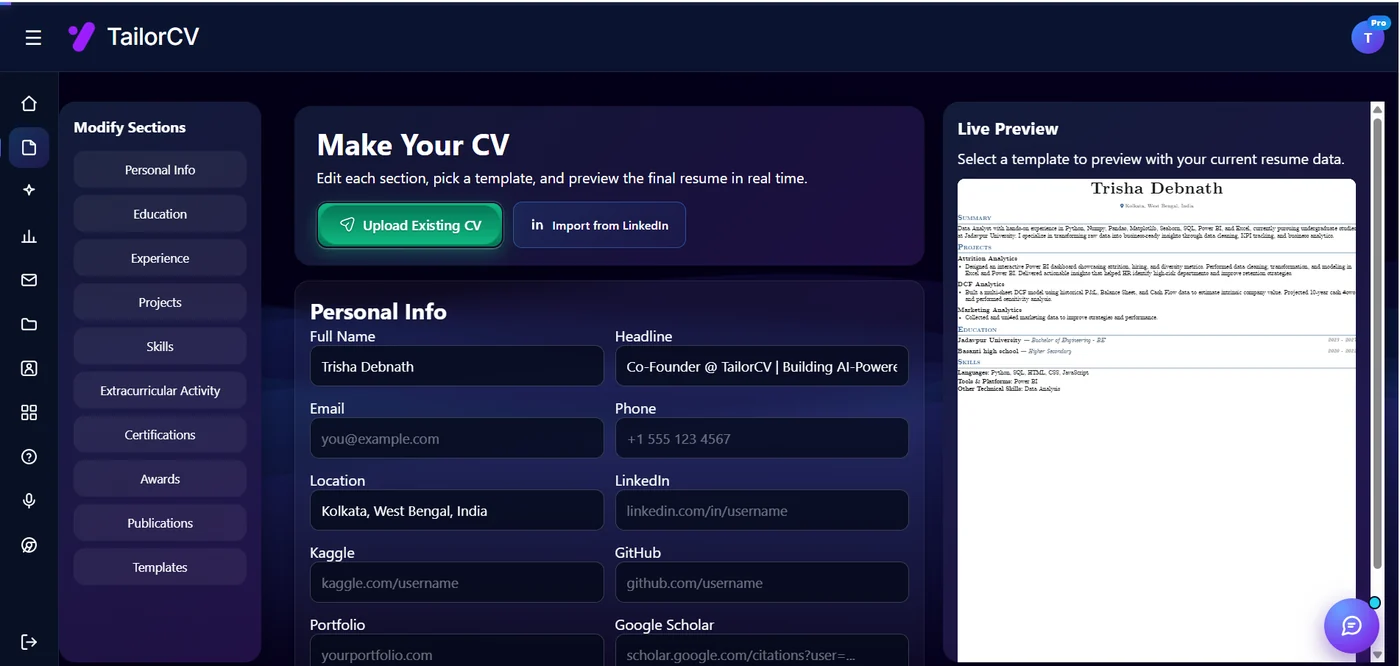
You can start from an existing CV or import from LinkedIn instead of retyping everything.
Use strong, specific verbs:
| What | Details |
|---|---|
| Building/creating | Developed, Engineered, Designed, Built, Launched, Created, Established |
| Improving | Optimized, Streamlined, Reduced, Accelerated, Improved, Enhanced, Transformed |
| Leading | Led, Managed, Directed, Oversaw, Mentored, Coordinated, Spearheaded |
| Achieving | Exceeded, Delivered, Achieved, Surpassed, Completed, Generated |
| Analyzing | Analyzed, Modeled, Evaluated, Researched, Identified, Assessed |
Read 200 best action verbs for resume for a categorized list by function.
How to Quantify When You Don't Have Numbers
The most common objection: "I don't have exact numbers." Here's how to still add impact:
- Estimate proportions: "Reduced processing time by approximately 40%"
- Use scale: "Supported a team of 25 sales representatives"
- Use frequency: "Delivered 3 client presentations per week"
- Use before/after: "Cut manual data entry from 8 hours to 30 minutes per week"
- Use comparison: "Outperformed team average by 20%"
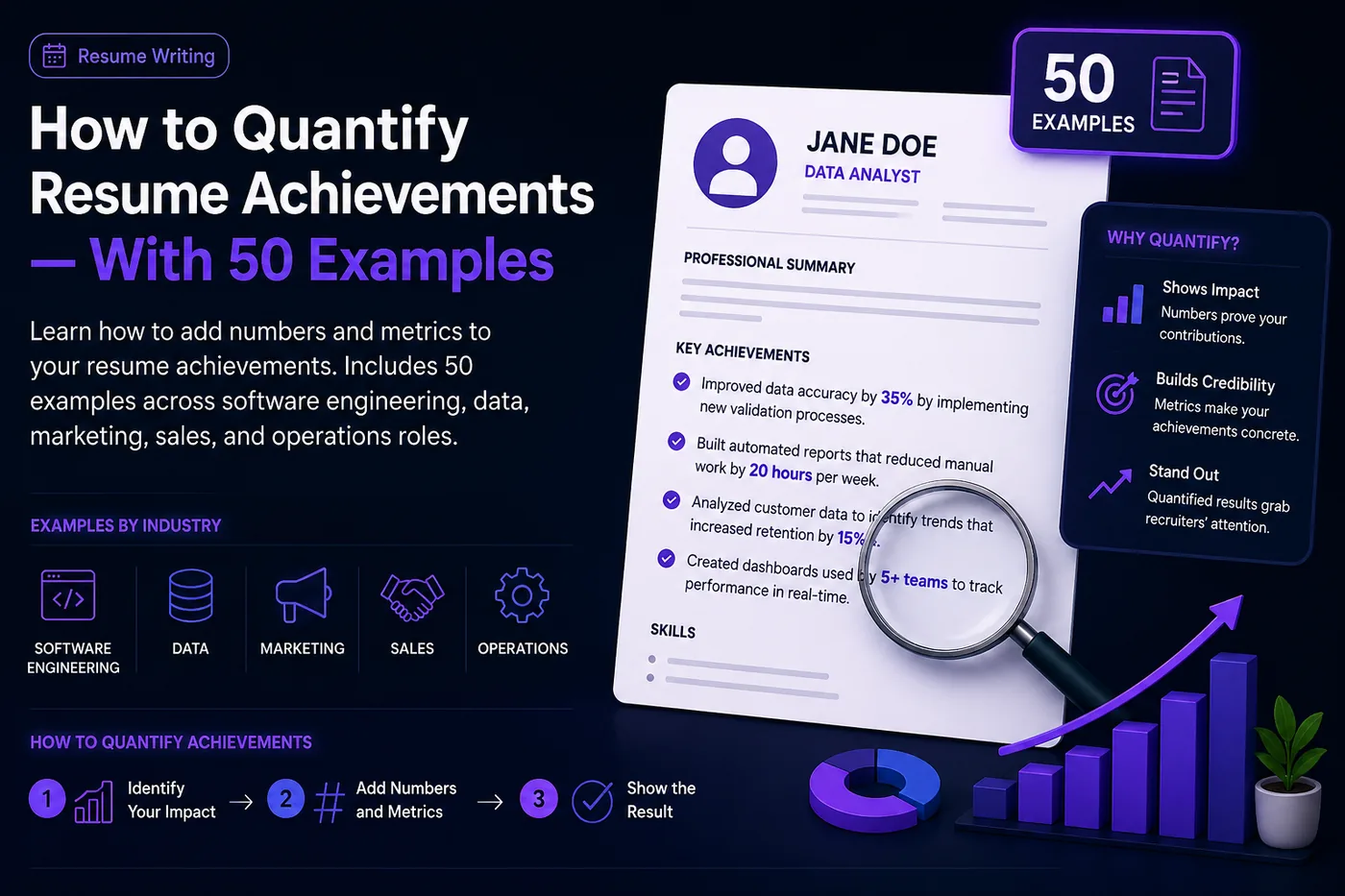
You rarely need exact numbers - reasonable estimates and relative comparisons communicate impact effectively. Read how to quantify resume achievements for more techniques.
Bullet Point Rules
- 3-6 bullets per role - For current or most recent roles, 4-6; for older roles, 2-3
- 1-2 lines per bullet - Three-line bullets are too long; cut them
- Lead with the verb - No "I" or "My" - implied subject is always you
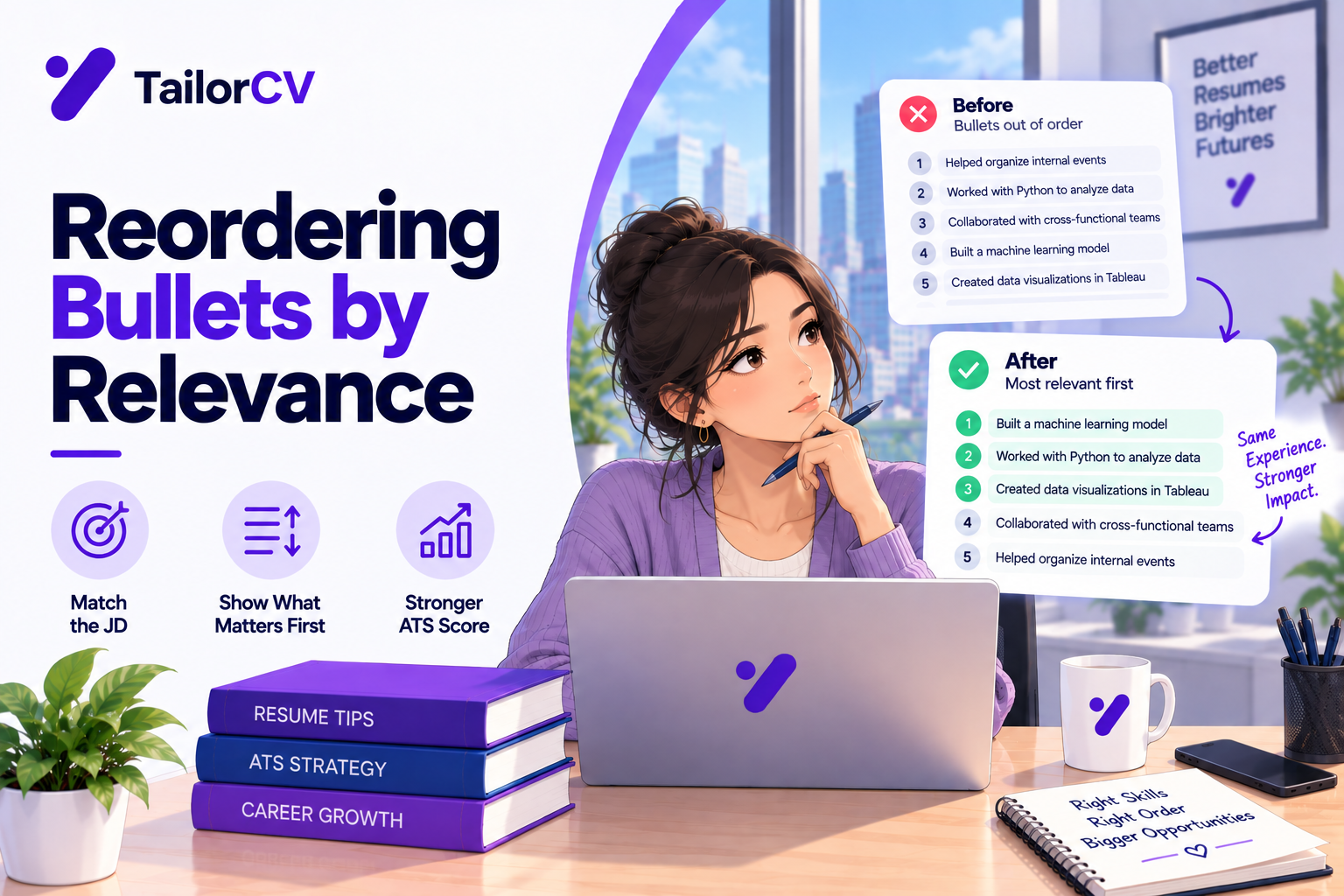
- Tailor to the job - Prioritize bullets that match the target role's keywords. Read how to tailor your resume
- Use present tense for current role, past tense for previous roles
- Avoid buzzwords - "Synergized cross-functional stakeholders" means nothing
- No periods or ending punctuation - Bullets are fragments, not sentences
Common Bullet Point Mistakes
Mistake 1: Listing duties instead of achievements
Duties tell recruiters what your job was. Achievements tell them how well you did it. Replace "Responsible for X" with "Achieved X by doing Y."
Mistake 2: Starting with weak verbs
"Helped," "assisted," "supported," "participated in" - all signal low ownership and low impact.
Mistake 3: No numbers or impact
"Improved website performance" is forgettable. "Improved website load time from 4.2s to 0.9s, reducing bounce rate by 28%" is memorable.
Mistake 4: Too many bullets
Eight bullets per role dilute the strongest ones. Keep 3-6 and make each count.
Mistake 5: Generic, non-tailored bullets
The same 5 bullets for every application is a guaranteed low match rate. Tailor at least 3 bullets per role to the specific job description.
ATS and Bullet Points
ATS systems scan your bullet points for keyword matches. Tailor your verb choices and skill mentions to match the language in the job description. Use the TailorCV ATS checker to see which keywords you are missing and where you can improve your match score.
Related Guides
- Best Action Verbs for Resume
- How to Quantify Resume Achievements
- How to Tailor Your Resume for Every Job
- The Anatomy of a Perfect Resume
- How Recruiters Read Resumes in Under 10 Seconds
- Resume Keywords Guide
- ATS Score Guide
- Resume Proofreading Checklist
Make This Practical
Use this guide as part of a complete job-search workflow. Check your resume with the free ATS score checker, improve targeting with the Resume Optimization Guide, and choose a clean format from the ATS-friendly resume templates.
After the resume is ready, strengthen the rest of the application. Draft a targeted letter with the AI cover letter generator, practice interviews with the AI mock interview tool, and create a project-backed proof page with the portfolio website builder if you need a stronger online presence.
Conclusion
Great resume bullet points follow a consistent formula: strong action verb + what you did + quantified impact. They replace duty lists with achievement stories. They start with power verbs, end with numbers, and are tailored to each role you apply for.
Use the TailorCV ATS checker to verify your bullets contain the right keywords for each job, build on an ATS-friendly template, and practice explaining your achievements in mock interview prep before your call.
Most achievements are shared, so it helps to know how to show your part - tailoring when your work was a team effort covers the wording.
Frequently Asked Questions
Why should I focus on bullet points in my resume?
Bullet points are crucial because they are the primary content recruiters read in the work experience section, which significantly influences hiring decisions. Well-crafted bullet points not only highlight your achievements but also help your resume get past ATS filters. For more tips on structuring your resume, check out our guide on the resume section order.
What is the best formula for writing strong resume bullet points?
The best formulas for writing impactful bullet points include Action + Result and Action + Method + Result. These structures ensure you showcase your achievements by detailing what you did, how you did it, and the results you achieved. For a deeper understanding of quantifying your achievements, refer to our article on how to quantify resume achievements.
How can I make my bullet points stand out to recruiters?
To make your bullet points stand out, use strong action verbs, quantify your results, and focus on the impact of your work. This approach not only captures attention but also demonstrates your value to potential employers. If you're looking for examples of impactful resumes, our post on resume trends for 2026 might provide some inspiration.
What are common mistakes to avoid when writing resume bullet points?
Common mistakes include using passive language, focusing on job duties instead of achievements, and failing to quantify results. These pitfalls can make your bullet points forgettable and less impactful. To learn more about effective resume writing, consider looking into our guide on how to write a resume from scratch.
How can I ensure my resume is ATS-friendly?
To ensure your resume is ATS-friendly, use a clear structure, relevant keywords, and an ATS-friendly template. You can also check your resume's compatibility with ATS using our free ATS score checker. This will help you identify areas for improvement and increase your chances of getting noticed by recruiters.
What is your resume scoring right now?
Scan it against a job description and get your ATS match score in about a minute.
Drop your resume here or choose a file
PDF only. Max 2 MB.
We never share your data or use it to train AI models.

Templates that keep this structure intact
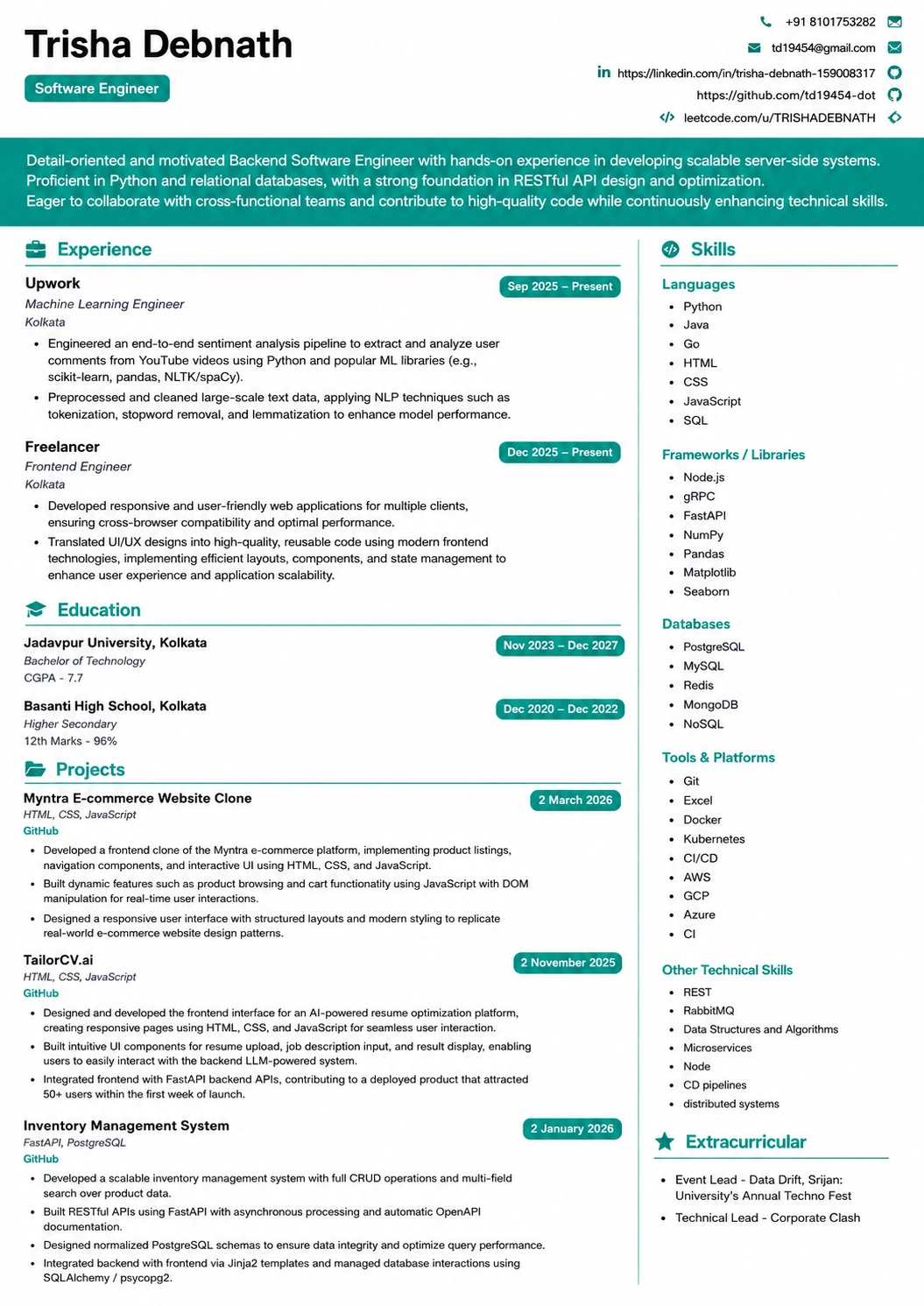
This template is ATS-tested — start from it and the formatting rules in this guide are already handled.
Was this guide useful?
Be the first to rate it.