 SS
SS
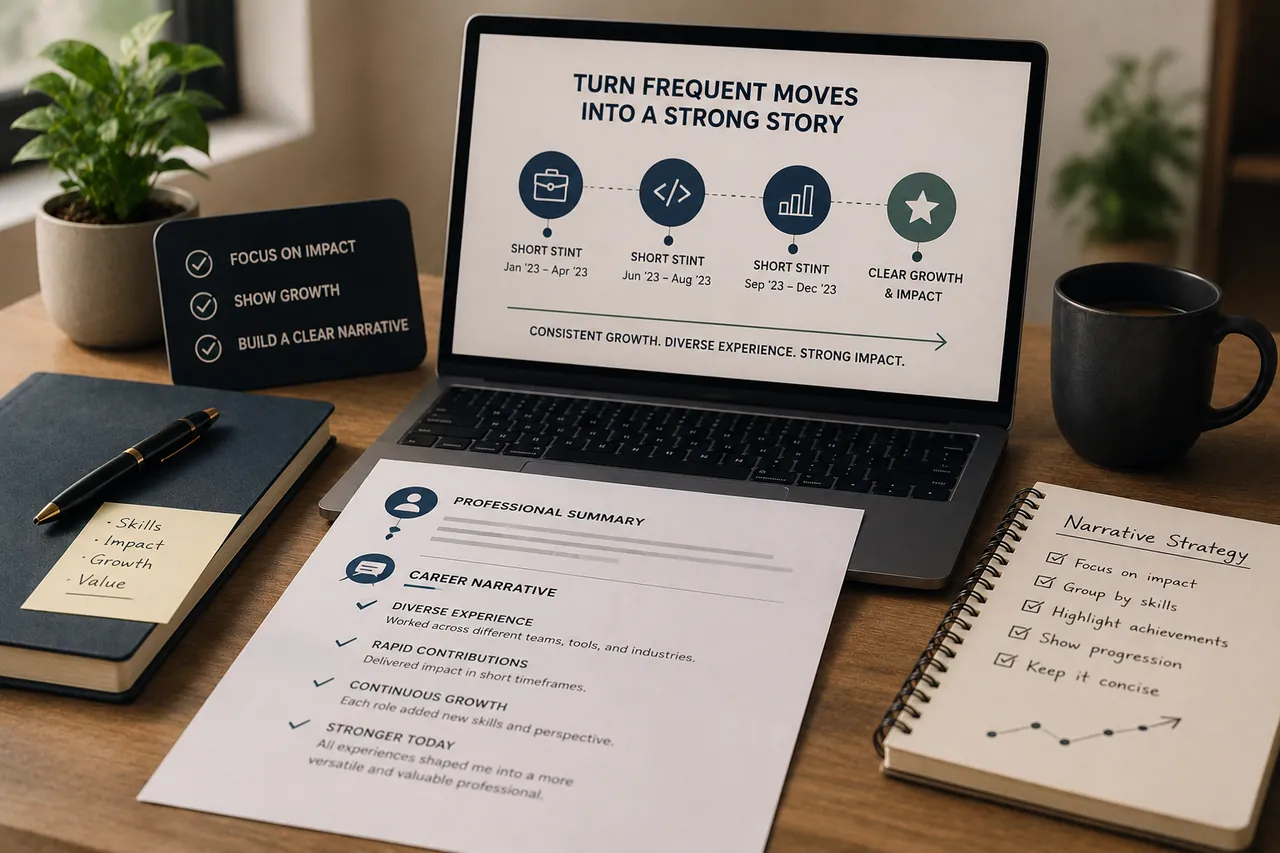
Key Takeaways
- Job hopping can be perceived negatively by recruiters unless presented with context and rationale.
- Short roles in the tech industry are often acceptable, especially if they involve contract work or layoffs.
- Address hiring managers' concerns about investment, reliability, and fit by providing clear explanations for short tenures.
- Add context to problematic short roles in your resume to eliminate assumptions about your job changes.
- Group related short roles under a single header to present a cohesive narrative and highlight your accomplishments.
You have changed jobs four times in five years.
Some of those moves were intentional - better opportunities, toxic environments escaped, higher growth. Some were not - layoffs, restructurings, roles that evaporated. Some were a mix of both.
Now you are applying for a new role, and you are staring at your resume wondering: how bad does this look?
Here is the honest answer:
It depends entirely on how you present it.
A recruiter who sees "4 jobs in 5 years" with no context reads it as a resume red flag.
A recruiter who sees the same history - presented with clear rationale, progression, and strong results - reads it as someone who has accumulated diverse experience rapidly.
Same history. Completely different impression.
This guide shows you how to get to the second impression.
When Does "Job Hopping" Actually Hurt You?
First, let us calibrate what is actually a problem.
| Option | What to know |
|---|---|
| Rarely a problem: | Roles under 3 years in the tech industry (this is the norm) · Contract roles or project-based work (see resume tailoring for freelance and contract roles) · Any role that was a layoff (documented) · One short role in an otherwise stable career · Moves that show clear upward progression |
| Sometimes a problem: | Two or more roles under 12 months in a row · Multiple lateral moves with no visible growth narrative · A pattern of leaving within weeks (6 months or less) · Short stints at companies that do not overlap into a clear story |
| More likely a problem: | 5+ jobs in 3 years with no explanation · Short stints at the same type of role without progression · Gaps between short stints that add up |
Even in the worst case, there is almost always a presentable version of the story.
The Underlying Fear You Are Addressing
Hiring managers who worry about job hoppers are actually worried about:
- Wasted investment - "Will we train and onboard this person only to have them leave in 6 months?"
- Reliability - "Can we count on this person to see through hard projects?"
- Fit issues - "Is there a pattern of not meshing with teams or managers?"
Your resume and interview strategy need to address all three concerns - explicitly or implicitly.
Strategy 1: Reframe Each Short Role With Context
One of the most effective techniques is simply adding a reason to each short role.
You can do this in parentheses after the company name or dates.
Examples:
- "January 2022 - August 2022 (company-wide layoff - reduced from 120 to 30 employees)"
- "March 2023 - September 2023 (6-month contract engagement - project completed)"
- "June 2021 - February 2022 (acquired by [Company], role eliminated post-acquisition)"
This eliminates the guesswork. The recruiter does not have to assume the worst. You have pre-answered the question.
Valid one-line context reasons that work:
- Layoff
- Company acquisition / restructuring
- Contract / project-based role
- Startup shutdown
- Relocation
- Career pivot (deliberate and explained)
- Company closure
Do not explain every move. Add context only for the ones that look problematic - typically anything under 12 months.
Strategy 2: Group Related Short Roles Under One Header
If you did a series of contract or consulting roles, group them.
Before (looks like job hopping):
Software Engineer, Company A - Jan 2022 - Jun 2022
Software Engineer, Company B - Jul 2022 - Dec 2022
Software Engineer, Company C - Jan 2023 - Jul 2023
After (reads as consulting):
Freelance Software Engineer - Contract Engagements, Jan 2022 - Present
- [Company A]: Built payment API integration for e-commerce platform, serving 50k daily transactions
- [Company B]: Led migration from monolith to microservices, cutting deploy time from 3 hours to 20 minutes
- [Company C]: Built real-time notification system for B2B SaaS platform, serving 8k enterprise users
One entry. Three impressive results. The job hopping narrative disappears.
This works particularly well in tech, design, consulting, and marketing - where project-based work is normal and respected.
Strategy 3: Lead With Results, Not Tenure
The most powerful antidote to a job hopping concern is undeniable results.
Your resume after optimization
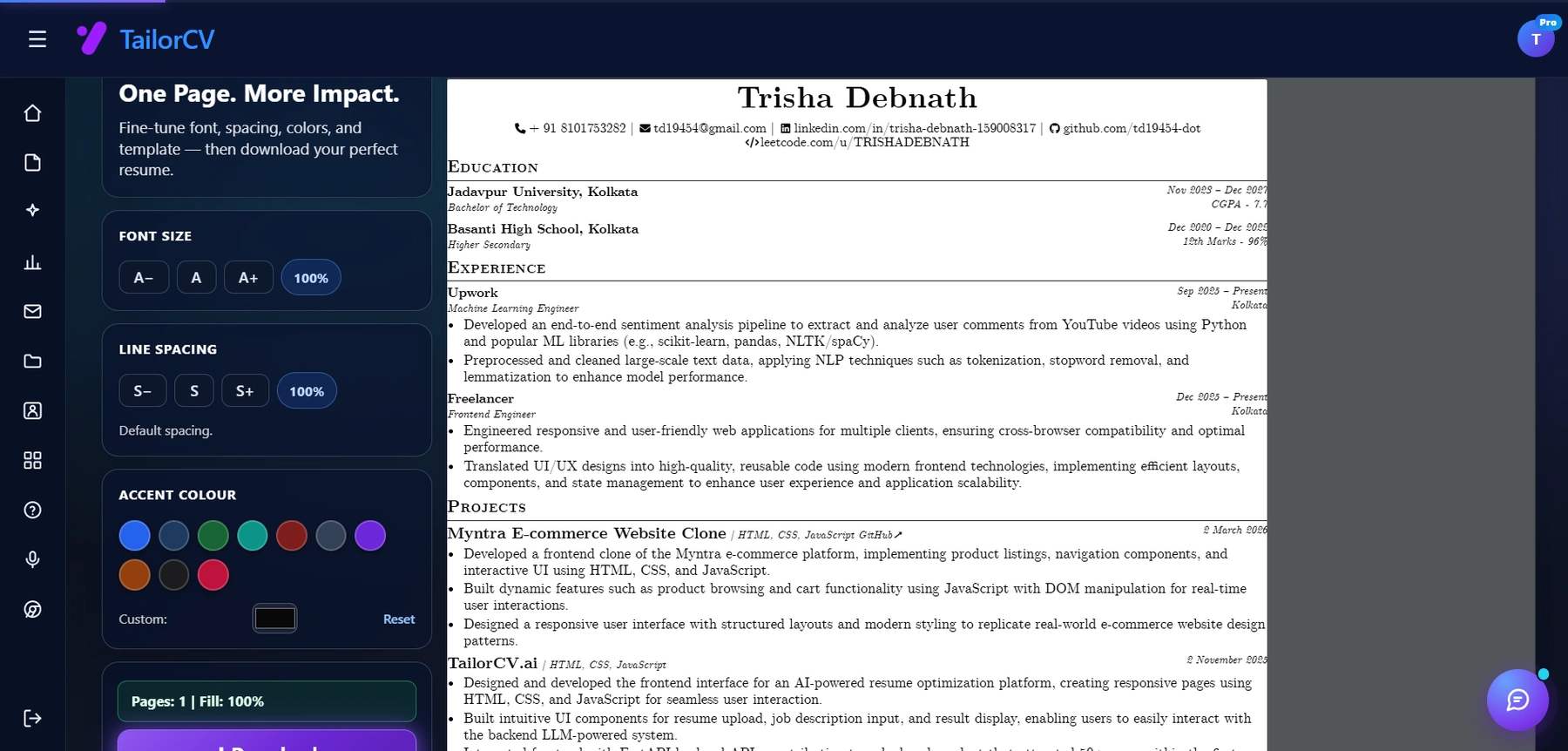
This is the optimized result, and it is usually how a spilling two-page draft gets back onto one page without deleting anything worth keeping.
If every role on your resume has a strong "here is what I accomplished" bullet at the top, the reader is focused on what you did - not how long you stayed.
Weak (draws attention to short tenure):
"software engineer at [Company], January - October 2022. Contributed to backend development projects."
Strong (leads with impact):
"software engineer at [Company], January - October 2022 (contract) Rebuilt the core data ingestion pipeline, reducing processing time from 4 hours to 22 minutes and unblocking a customer integration that had been delayed for 3 months."
10 months. Real result. The duration becomes secondary to the impact.
Read how to write resume bullet points for the formula. Also quantify your achievements - a specific number beside a short tenure is far more reassuring than a vague responsibility.
Strategy 4: Tell a Growth Narrative in Your Summary
Your professional summary is the best place to set a frame before the reader reaches your experience section.
Use it to establish that your moves were intentional - about growth and learning - not random or reactive.
Without a narrative frame: The reader gets to your work history and sees 4 companies in 5 years and forms their own (possibly negative) story.
With a narrative frame:
"Full-stack engineer who has deliberately built across three distinct technical environments - startup, enterprise SaaS, and fintech - to develop a rare combination of speed-to-ship and systems-level thinking. Each role added a specific depth: distributed systems at [Company A], real-time data processing at [Company B], payments infrastructure at [Company C]. Ready to apply that breadth within one focused product team."
Now the reader reaches your experience section with the right frame. Each short role confirms the narrative rather than questioning it.
Strategy 5: Remove the Shortest and Least Relevant Roles
You do not have to include everything.
If you had a role that lasted 2 months before a mutual agreement to part, and it adds nothing to your narrative, omit it.
Rules for what to omit:
- Any role under 3 months with no material achievement
- Early-career roles that are no longer relevant (10+ years ago)
- Roles that contradict your current career direction
Important: do not leave unaccountable gaps. If you omit a 3-month role and it creates a 6-month gap, you may need to explain the gap instead. Read how to explain resume gaps for the right approach.
Strategy 6: ATS-Optimize Despite the Complex History
Multi-role resumes can have ATS problems.
Each company entry competes for keyword space. A resume with 6 companies in the same space often has keyword repetition across sections, which can actually lower semantic match scores.
For your ATS optimization:
- Put the most relevant keywords in your summary and most recent role's bullets (highest weight)
- Do not repeat the same keywords across every role - vary them
- Check your overall match score before applying
Read the resume keyword density guide to understand how to spread keywords across a multi-entry resume without triggering stuffing penalties.
Use TailorCV's ATS optimizer to check your keyword match and identify what is missing - the tool handles complex multi-role histories and tells you exactly where to add keywords.
Tailoring for Companies With Different Cultures Toward Job Hopping
Job hopping tolerance varies by company culture:
Startups and tech companies: Very tolerant of short tenures - they expect it. Focus on results and skills.
Enterprise companies: More cautious. Add context for short roles, emphasize any longer tenures, show stability signals. Read startup vs enterprise resume tailoring for the right language adjustments.
Financial services and government: Most conservative. Flag legitimate reasons (layoffs, contracts) clearly. Emphasize your longest and most stable roles.
Creative industries: Very tolerant. Clients, project-based work, and agency environments are the norm.
Tailor the emphasis and framing based on who is reading your resume. The same history reads differently in different contexts.
What Not to Do
Do not lie about dates Round to quarters or years if exact months are unimportant for the role - but do not inflate or deflate dates. Employment verification catches this.
Do not hide company names Using "confidential company" for every employer raises more questions than short tenures.
Do not apologize in your summary Phrases like "despite frequent career changes" or "although I have held several positions" put you on the defensive before anyone asked. This is one of the classic resume red flags that signals insecurity.
Do not over-explain One brief context note per short role is enough. An exhaustive defense of every decision reads as insecure.
Make This Practical
Do not guess whether the resume is ready. Upload it to the free ATS score checker, compare the result with the ATS Score Guide, and fix formatting issues using ATS Resume Formatting Mistakes and ATS Resume Parser Friendly Format.
After the technical cleanup, improve relevance. Use Resume Matching With Job Description, strengthen keyword coverage with the Resume Keywords Guide, and avoid overdoing it by checking ATS Keyword Mistakes. If the layout itself is weak, rebuild with an ATS-friendly resume template.
For several short roles in a row, grouping them under one heading often works better than deleting them - see cutting irrelevant experience without creating a gap.
FAQ
How many jobs in X years is too many?
In tech: 3 jobs in 5 years is normal. 4-5 raises questions. 6+ requires strong framing. In finance or government: 2 jobs in 5 years can already prompt questions. Context matters.
Should I address job hopping in my cover letter?
Briefly - one sentence acknowledging your diverse experience and what you have gained from it, then pivot to why this specific role is right for the long term. Do not dwell. Read the cover letter guide 2026 for how to frame this.
What if a hiring manager brings it up in the interview?
Have a prepared, confident, non-defensive answer. "I've moved deliberately - each role gave me [specific skill/experience]. I'm now at a point where I want to go deep in one place, and this role is exactly that opportunity for me." Use behavioral interview preparation to practice answering this question under pressure.
Does a long tenure at one company look better?
For stable, traditional industries - yes. For fast-moving tech environments - not necessarily. A 7-year tenure in a company that did not grow or change may read as comfortable stagnation. Consider resume tailoring for contract and freelance roles vs. permanent jobs for insights on how to present your experience effectively. Additionally, understanding how to read between the lines of a job description can help you align your experience with what employers are seeking.
Related Guides
- How to Explain Resume Gaps
- How to Tailor Your Resume for Every Job
- Tailored vs Generic Resume
- Resume Red Flags
- Resume Tailoring for Contract and Freelance Roles
- How to Write a Resume Summary
- How to Write Resume Bullet Points
- ATS Score Guide
- Why Your Resume Gets No Responses
- Resume Tailoring Startup vs Enterprise
Conclusion
Job hopping is only a problem if you let your resume make it one.
With the right framing, the same history of frequent moves reads as breadth of experience, high curiosity, and diverse technical exposure.
Add context to short roles. Group contract work under one header. Lead every role with a real result. Tell a growth narrative in your summary.
Then tailor the emphasis based on who is reading it.
Your history is not the issue. The story you tell about it is everything.
Tailor My Job-Hopping Resume - Free
See what tailoring is worth on your resume
Score your current resume against a real job description before you change a word.
Drop your resume here or choose a file
PDF only. Max 2 MB.
We never share your data or use it to train AI models.

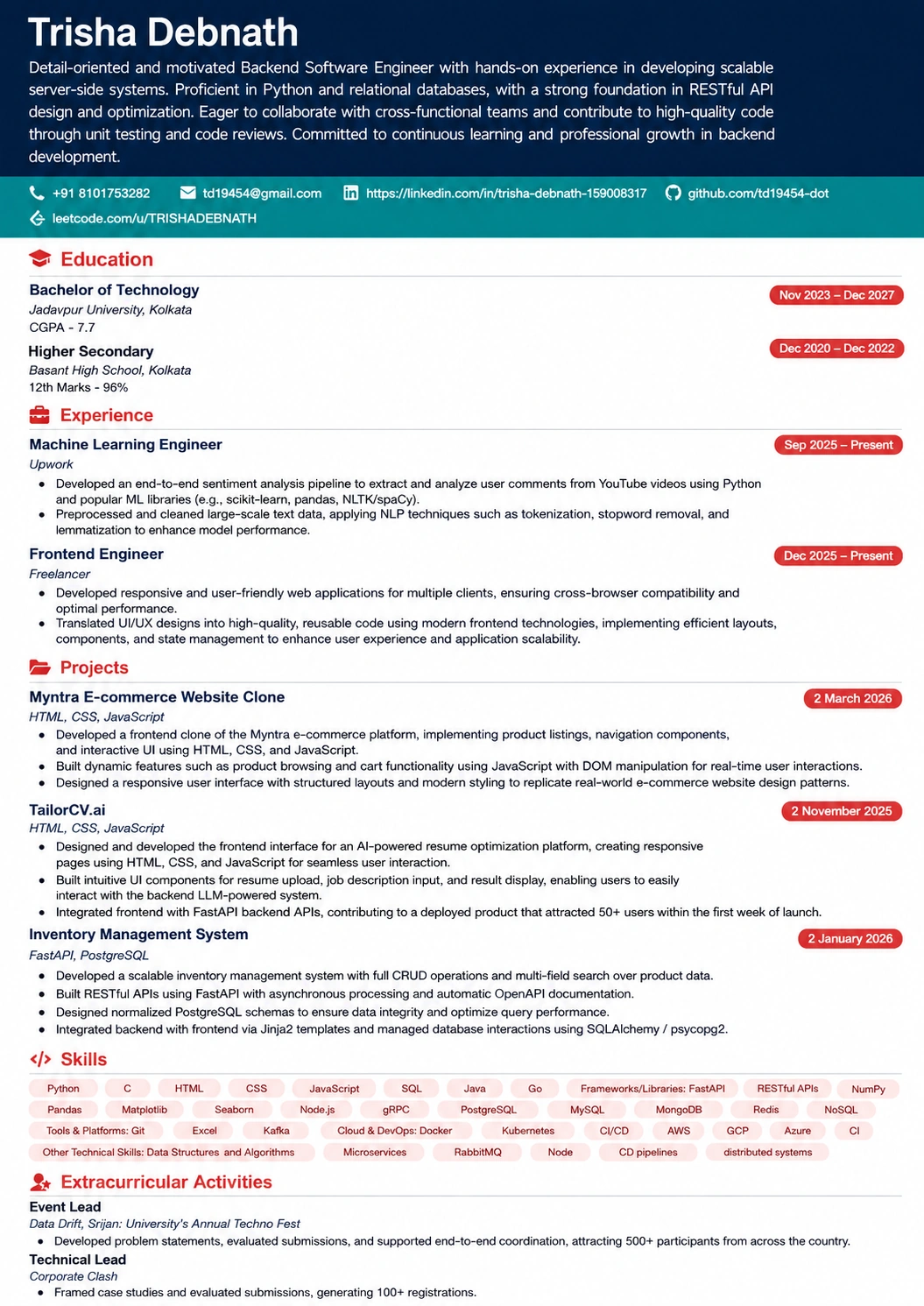
Start from a template that tailors well
Clean structure means swapping keywords per job takes minutes, not a re-layout every time.
Was this guide useful?
Be the first to rate it.