 TD
TD
Key Takeaways
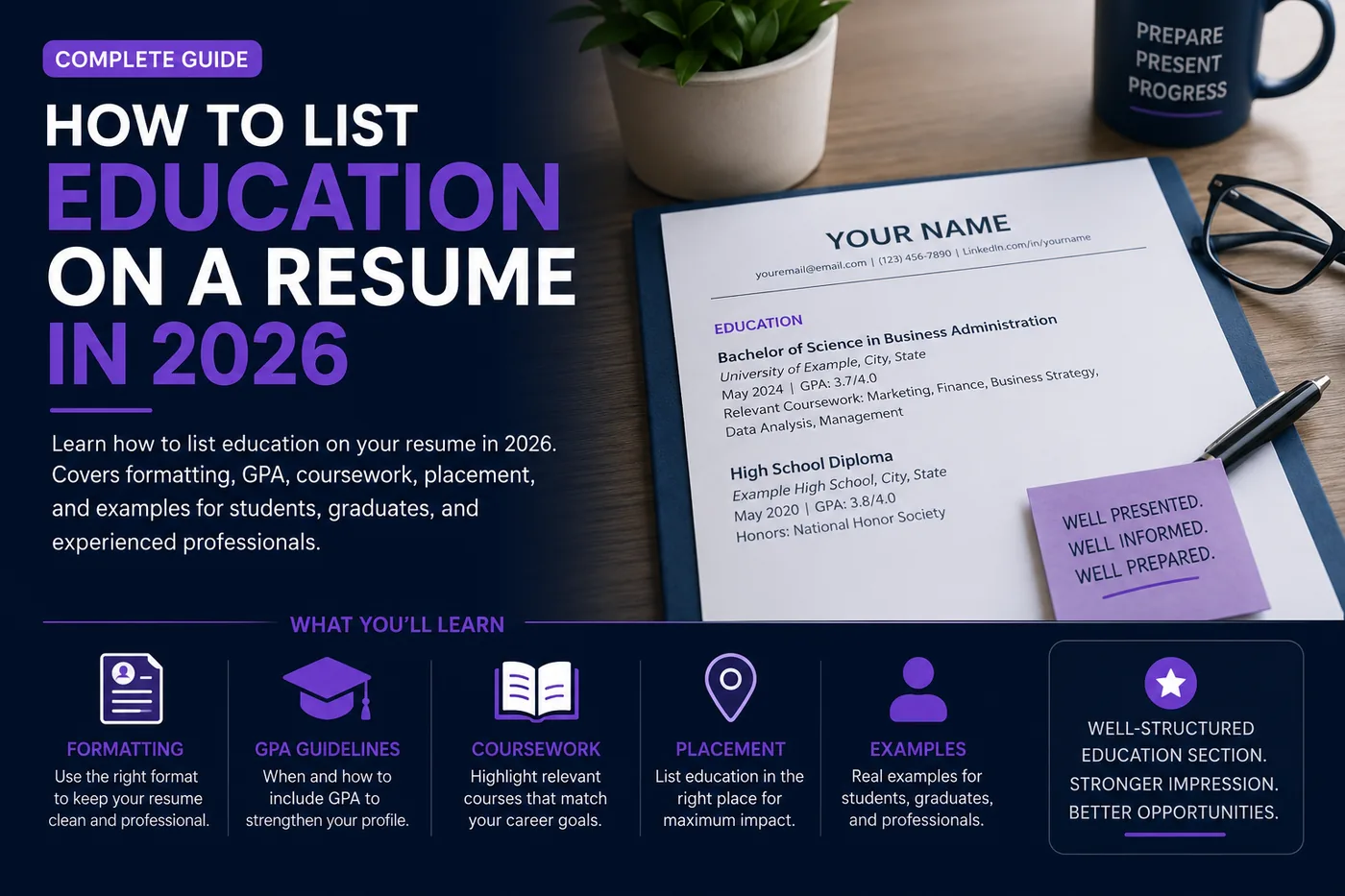
- Include core elements in the education section: degree type, institution name, location, graduation year, GPA, relevant coursework, and honors if applicable.
- Place the education section near the top for students and recent graduates, and lower for experienced professionals where work experience is prioritized.
- Include GPA if it is strong (3.5+ or 8.0+) and you are a recent graduate; otherwise, omit it to avoid negative impressions.
- List relevant coursework only if you are a student or recent graduate and it directly relates to the job; remove it once you have relevant work experience.
- Use a clear format for the education section, emphasizing degree, institution, and graduation year for clarity and professionalism.
The education section seems simple, but candidates make surprisingly common mistakes - including the wrong details, placing it incorrectly, or including (or omitting) GPA at the wrong times. How you list education matters more for some candidates (students, freshers) than others (experienced professionals), but everyone should get it right.
This guide covers exactly how to list education on your resume for every situation.
Before finalizing, run your resume through the ATS score checker and use an ATS-friendly template.
What to Include in the Education Section
Core elements:
- Degree type and major (e.g., Bachelor of Technology in Computer Science)
- Institution name
- Location (city, or city and country)
- Graduation year (or expected graduation)
- GPA / CGPA (if strong - see below)
- Relevant coursework (for students and freshers)
- Honors, awards, or distinctions (if applicable)
Your resume after optimization
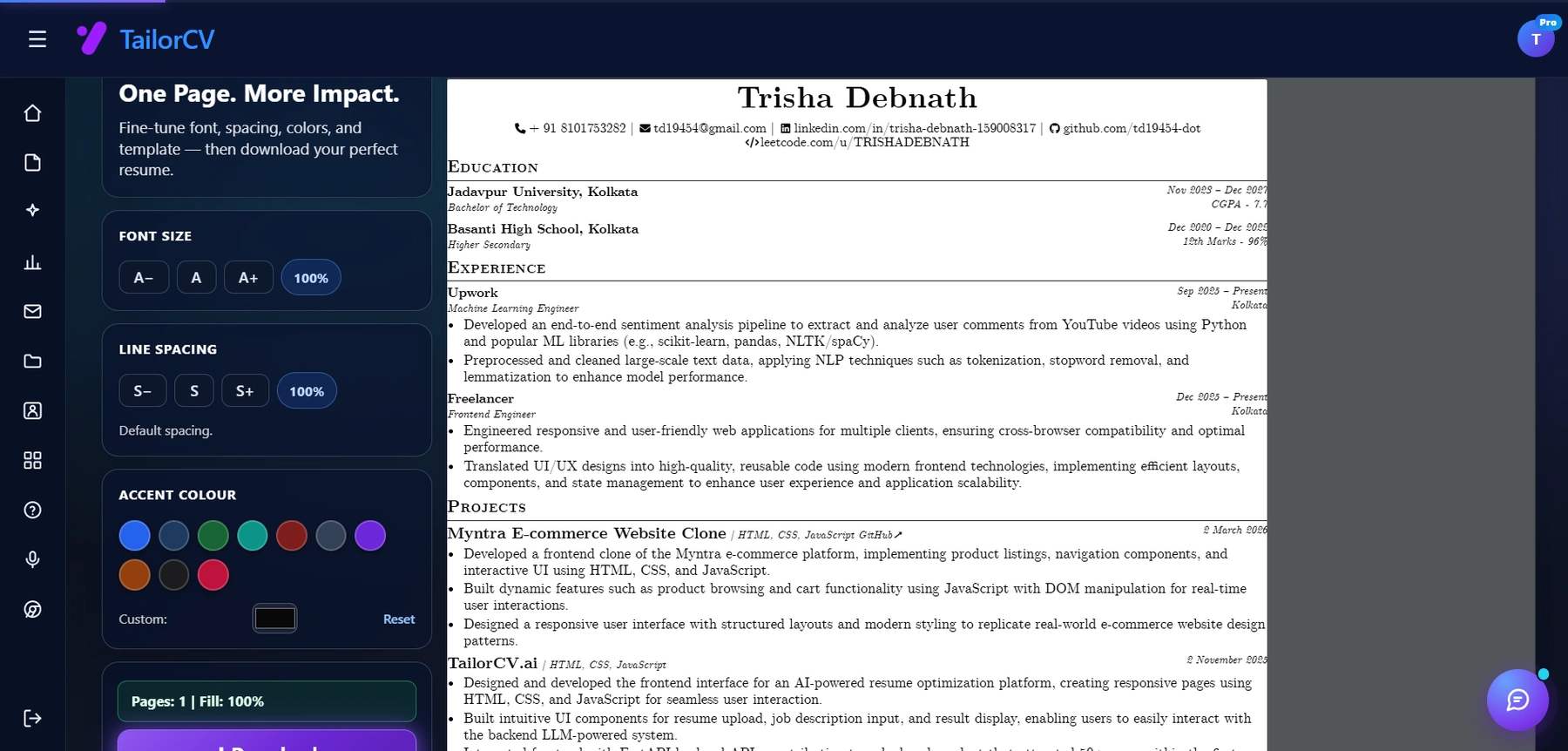
This is the resume after tailoring - the content is already matched, and these controls are how you fit it onto one page.
Education Section Format
Standard format:
Degree | Institution | Graduation Year GPA (if strong) | Relevant details
Example:
Bachelor of Technology in Computer Science VIT University, Vellore | 2026 CGPA: 8.7/10 | Relevant Coursework: Data Structures, Algorithms, DBMS, Operating Systems
Where to Place Your Education Section
Students and Recent Graduates: Near the Top
If you are a student or recent graduate with limited work experience, place education near the top (after your summary), since it is one of your strongest qualifications.
Experienced Professionals: Near the Bottom
Once you have several years of relevant work experience, your experience matters more than your education. Move the education section below your work experience.
Should You Include Your GPA?
Include GPA If:
- It is strong: 3.5+ out of 4.0, or 8.0+ out of 10
- You are a student or recent graduate (within ~2 years)
- The employer or industry specifically values academic performance
Leave Off GPA If:
- It is below 3.5 / 8.0
- You have several years of work experience (experience speaks louder)
- The role does not care about academic performance
A low GPA listed prominently can hurt you. If your GPA is not strong, simply omit it - listing it is not required.
Major GPA Option
If your overall GPA is mediocre but your major GPA is strong, you can list the major GPA: "Major GPA: 3.8/4.0."
Relevant Coursework - When to Include
Include relevant coursework if:
- You are a student or recent graduate
- The coursework is directly relevant to the target role
- You need to demonstrate knowledge in areas where you lack work experience
Example for an entry-level data role: "Relevant Coursework: Statistics, machine learning, Database Systems, Data Mining, Linear Algebra"
Remove coursework once you have relevant work experience - your job experience replaces the need to list courses.
Education Section Examples by Situation
Current Student
Bachelor of Science in Computer Science (Expected May 2027) University of Delhi | New Delhi, India CGPA: 8.9/10 Relevant Coursework: Data Structures, Algorithms, Operating Systems, DBMS, Web Development Dean's List (2024, 2025)
Recent Graduate
Bachelor of Technology in Information Technology Anna University, Chennai | 2025 CGPA: 8.4/10 | Relevant Coursework: Software Engineering, Cloud Computing, Networks
Experienced Professional (Education at Bottom, Concise)
education Bachelor of Engineering in Mechanical Engineering Pune University | 2018
Master's Degree
education Master of Business Administration (MBA), Finance Indian Institute of Management, Bangalore | 2024
Bachelor of Commerce University of Mumbai | 2020
(List most recent/advanced degree first)
Multiple Degrees
List in reverse chronological order (most recent first). Include both, but keep older degrees concise.
Special Situations
Incomplete Degree
If you started but did not finish a degree, you can list it honestly: "Completed 3 years of Bachelor of Science in Physics | University of XYZ | 2019-2022" Or list relevant coursework completed.
Online Degrees and Bootcamps
List legitimate online degrees and bootcamps like any other education: "Full Stack Web Development Bootcamp | [Bootcamp Name] | 2025"
Currently Pursuing Further Education
"Master of Data Science (Part-time, Expected 2027) | [University]"
High School
Only include high school if:
- You are currently in high school or a recent high school graduate with no college
- The high school is exceptionally prestigious and relevant
Once you have a college degree, remove high school.
Common Education Section Mistakes
Mistake 1: Listing a low GPA
If your GPA is below 3.5/8.0, omit it. You are not required to include it.
Mistake 2: Keeping education at the top with years of experience
Experienced professionals should lead with work experience, not education.
Mistake 3: Including high school with a college degree
Remove high school once you have a degree.
Mistake 4: Listing irrelevant coursework
Only include coursework relevant to the target role, and only as a student/fresher.
Mistake 5: Inconsistent formatting
Keep degree, institution, and date formatting consistent throughout.
Related Guides
- How to List Certifications on a Resume
- Soft Skills for Resume
- What Not to Put on a Resume
- 200 Best Action Verbs for Resume
- How to Quantify Resume Achievements
- How to Write a Resume Headline
- How to Write a Resume Summary
- Top Skills to Add to Your Resume
- Chronological vs Functional Resume
- How to Explain Resume Gaps
- How to Make Your Resume ATS-Friendly
- Ideal Resume Length
- How to Write a Resume with AI in 2026 - Smart Use Without the Risks
- MBA Resume 2026 - Complete Guide with Examples
- Cover Letter Guide 2026 - How to Write a Cover Letter That Gets Read
- 10 ATS Resume Formatting Mistakes That Get You Rejected Before a Human Reads Your Resume
- How to Write a Resume Summary With No Experience (10 Real Examples for 2026)
Make This Practical
Use this guide as part of a complete job-search workflow. Check your resume with the free ATS score checker, improve targeting with the Resume Optimization Guide, and choose a clean format from the ATS-friendly resume templates.
After the resume is ready, strengthen the rest of the application. Draft a targeted letter with the AI cover letter generator, practice interviews with the AI mock interview tool, and create a project-backed proof page with the portfolio website builder if you need a stronger online presence.
Conclusion
List your education clearly: degree, institution, year, and GPA only if strong. Students and freshers should place education near the top with relevant coursework; experienced professionals should keep it concise at the bottom. Remove high school once you have a degree, and omit a weak GPA.
Run your resume through the TailorCV ATS score checker and read how to list certifications on resume and the resume optimization guide for complete guidance.
Frequently Asked Questions
How should I format my education section on a resume in 2026?
The standard format for listing your education is to include your degree type, major, institution name, and graduation year. You can also add your GPA if it is strong and any relevant coursework or honors. For example: "Bachelor of Technology in Computer Science, VIT University, Vellore | 2026, CGPA: 8.7/10 | Relevant Coursework: Data Structures, Algorithms." For more formatting tips, check out our Resume Section Order Guide.
When should I include my GPA on my resume?
You should include your GPA on your resume if it is strong, typically above a 3.0 on a 4.0 scale. This is especially relevant for students and recent graduates who may not have extensive work experience. If your GPA is not strong, it’s better to omit it and focus on other strengths, such as relevant coursework or skills. For additional insights, refer to our guide on How to List Certifications on a Resume in 2026.
Where should I place my education section on my resume?
For students and recent graduates, the education section should be placed near the top of your resume, right after your summary, as it is one of your strongest qualifications. In contrast, experienced professionals should place it towards the bottom, allowing their work experience to take precedence. For more on section order, see our Resume Section Order Guide.
What should I do if I have multiple degrees?
If you have multiple degrees, list them in reverse chronological order, starting with the most recent. Include the degree type, major, institution name, and graduation year for each. This format helps employers quickly identify your highest level of education and relevant qualifications. For more tips on highlighting your achievements, check out our post on 200 Best Action Verbs for Resume in 2026.
Is it necessary to include relevant coursework on my resume?
Including relevant coursework is especially important for students and recent graduates who may have limited work experience. It showcases your knowledge and skills related to the job you are applying for. However, experienced professionals should focus on their work experience instead. For guidance on crafting a compelling resume summary, visit our article on How to Write a Resume Summary in 2026.
What is your resume scoring right now?
Scan it against a job description and get your ATS match score in about a minute.
Drop your resume here or choose a file
PDF only. Max 2 MB.
We never share your data or use it to train AI models.

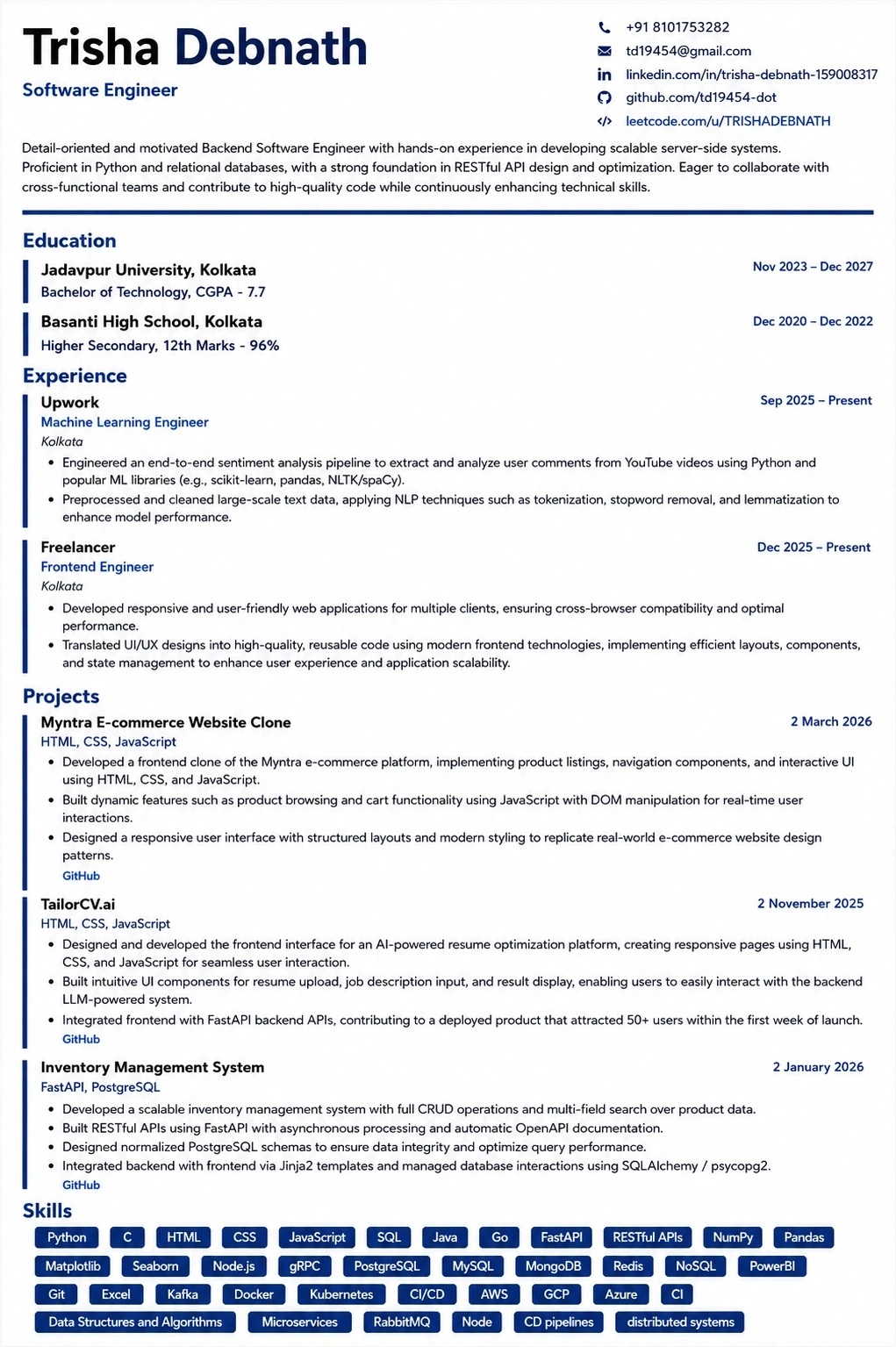
Templates that keep this structure intact
This template is ATS-tested — start from it and the formatting rules in this guide are already handled.
Was this guide useful?
Be the first to rate it.