SS
SS

Key Takeaways
- An internal cover letter is essential as hiring panels may include members unfamiliar with your track record.
- Highlight specific achievements from your current role and explain your motivation for applying to the new position.
- Acknowledge the potential relationship shift if managing former peers and avoid assuming the job is yours.
- Structure your letter clearly by stating the role, connecting your experience to the new role's requirements, and addressing the transition thoughtfully.
- Be authentic and emphasize your understanding of the company culture to differentiate yourself from external candidates.
Cover Letter for an Internal Job Application - Template and Tips
Applying for a role inside your own company feels like it shouldn't need a cover letter - everyone already knows you. But that familiarity can work against you if you don't put your case in writing: hiring panels often include people from other teams who don't know your track record, and a lazy or missing letter can read as a lack of seriousness about the move.
Generating the letter from a job description
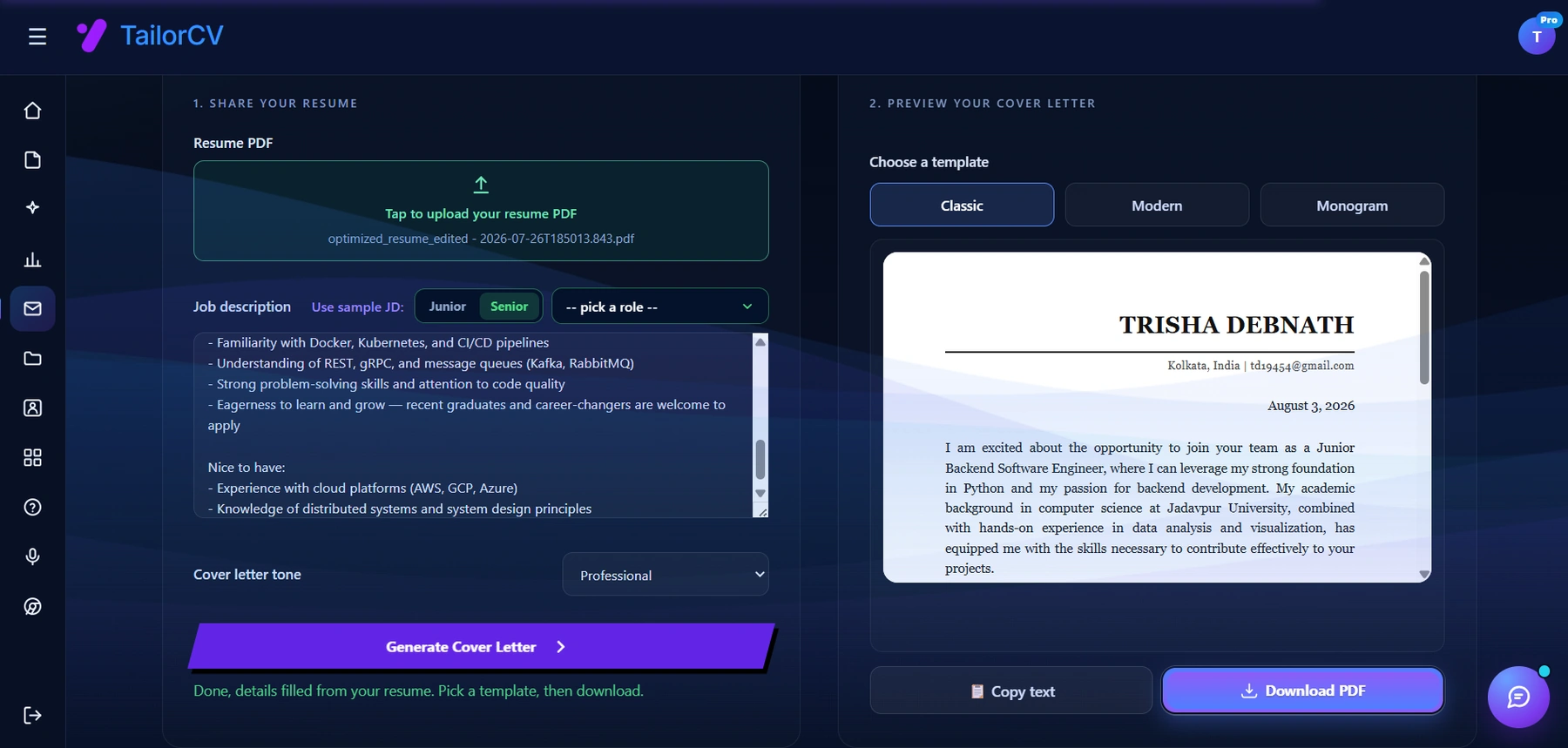
Details are pulled from your resume automatically, and the tone control decides how formal the letter reads before you download it.
Before writing, pair this with the internal job application resume guide, and check your fit against the posted role using the free ATS score checker - internal postings get scored the same way external ones do.
What Makes an Internal Cover Letter Different
- You can reference specific, verifiable results from your current role - use real numbers, not vague claims. See how to quantify resume achievements.
- You should explain why now and why this move, since colleagues will wonder about your motivation.
- You need to address the relationship shift if you're applying to manage former peers or move across departments.
- You should avoid assuming the job is yours - overconfidence reads poorly to a hiring panel, even one that already knows you.
The Structure
1. State the role and your current position clearly
Even if everyone technically knows you, be explicit for anyone unfamiliar reviewing the file.
2. Connect your track record to the new role's requirements
Mirror the actual job posting's language and match it to specific wins from your current role - projects shipped, metrics improved, initiatives led.
3. Explain your motivation honestly
Growth, new challenge, better fit for your skills - be specific rather than generic. Avoid anything that sounds like you're just trying to escape your current team or manager.
4. Acknowledge the transition thoughtfully
If you'd be moving to a new manager or team, a short line about wanting to contribute to their goals shows you've thought it through.
Full Template
Dear [Hiring Manager's Name],
I'm writing to apply for the [Role] position on the [Team] team. I've been with [Company] for [X years/months] as a [Current Title], where I [one strong, specific, quantified achievement].
Over that time, I've developed [2-3 skills relevant to the new role] - most recently through [specific project or initiative]. This work has made me increasingly interested in [target role's core focus], and I believe my track record inside the company gives me a head start on contributing quickly.
I'd welcome the opportunity to bring that experience to your team and to keep growing within [Company]. I'm happy to share more detail on any of the projects mentioned, or answer questions from [current manager's name] about my performance and readiness for this move.
Thank you for considering my application.
Sincerely,
[Your Name]
Handling the Awkward Parts
- Applying above former peers? Focus the letter on capability, not authority - let your results speak.
- Leaving a manager who may be unhappy? Talk to them before applying if possible; a surprised manager can complicate the process. See how to quit your job professionally for tone guidance that applies just as well to internal moves.
- Worried about being "just the internal candidate"? Treat this like any other competitive application - practice your pitch with the AI mock interview tool exactly as you would for an external role.
Additional Tips for Crafting Your Internal Cover Letter
Be Authentic
While it's important to be professional, don't hesitate to let your personality shine through. Colleagues and managers appreciate authenticity. Consider sharing a brief anecdote or a personal insight that connects you to the new role or team. This can make your letter more memorable.
Highlight Your Company Knowledge
Emphasize your understanding of the company culture, mission, and goals. This can set you apart from external candidates. For instance, you might write, "Having been part of [Company] for [X years], I have a deep appreciation for our commitment to [specific value or mission], and I am excited about the opportunity to contribute to this further."
Use Concrete Examples
When discussing your achievements, be specific. Instead of saying, "I improved team performance," you could say, "I implemented a new reporting system that improved team productivity by 20% over six months." This specificity not only demonstrates your impact but also provides a compelling case for your candidacy.
Address Future Contributions
In addition to highlighting past accomplishments, consider discussing how you envision contributing to the new role. This forward-thinking approach shows that you are proactive and invested in the future of the team and company.
Common Mistakes to Avoid
- Generic Statements: Avoid using clichés or vague phrases. Instead of saying, "I'm a team player," provide an example that illustrates this trait.
- Neglecting Formatting: Just because it's an internal application doesn't mean you should skip professional formatting. Use clear headings, bullet points, and a clean layout to ensure readability.
- Ignoring the Job Description: Tailor your letter to the specific job description. Highlight the skills and experiences that are most relevant to the new position.
Example of a Strong Internal Cover Letter
Subject Line: Application for [Role] Position
Dear [Hiring Manager's Name],
I hope this message finds you well. I am excited to submit my application for the [Role] position on the [Team] team. I have been with [Company] for [X years/months] as a [Current Title], where I successfully [specific achievement, e.g., "led a project that resulted in a 30% increase in customer satisfaction ratings"].
Throughout my tenure, I have honed skills in [relevant skills], particularly through [specific project or initiative that relates to the new role]. This experience has fueled my passion for [target role's core focus], and I am eager to leverage my insights and expertise to contribute effectively to your team.
I am particularly drawn to this opportunity because [specific reason related to the new role, e.g., "I believe my background in digital marketing aligns perfectly with the goals of the new team"]. My familiarity with [Company]’s operations and culture positions me uniquely to add value from day one.
Thank you for considering my application. I look forward to the possibility of discussing how I can contribute to the continued success of [Company].
Best regards,
[Your Name]
Checklist for Your Internal Cover Letter
- unchecked: Clearly state the role and your current position.
- unchecked: Reference specific achievements and metrics.
- unchecked: Explain your motivation for applying.
- unchecked: Acknowledge the transition and relationship dynamics.
- unchecked: Use professional formatting and a clear layout.
- unchecked: Avoid clichés and generic statements.
- unchecked: Tailor your letter to the specific job description.
Common Mistakes to Avoid in Your Internal Cover Letter
When crafting your internal cover letter, it’s essential to avoid some common pitfalls that could undermine your application. Here are key mistakes to watch out for:
Keeping every tailored resume with its job
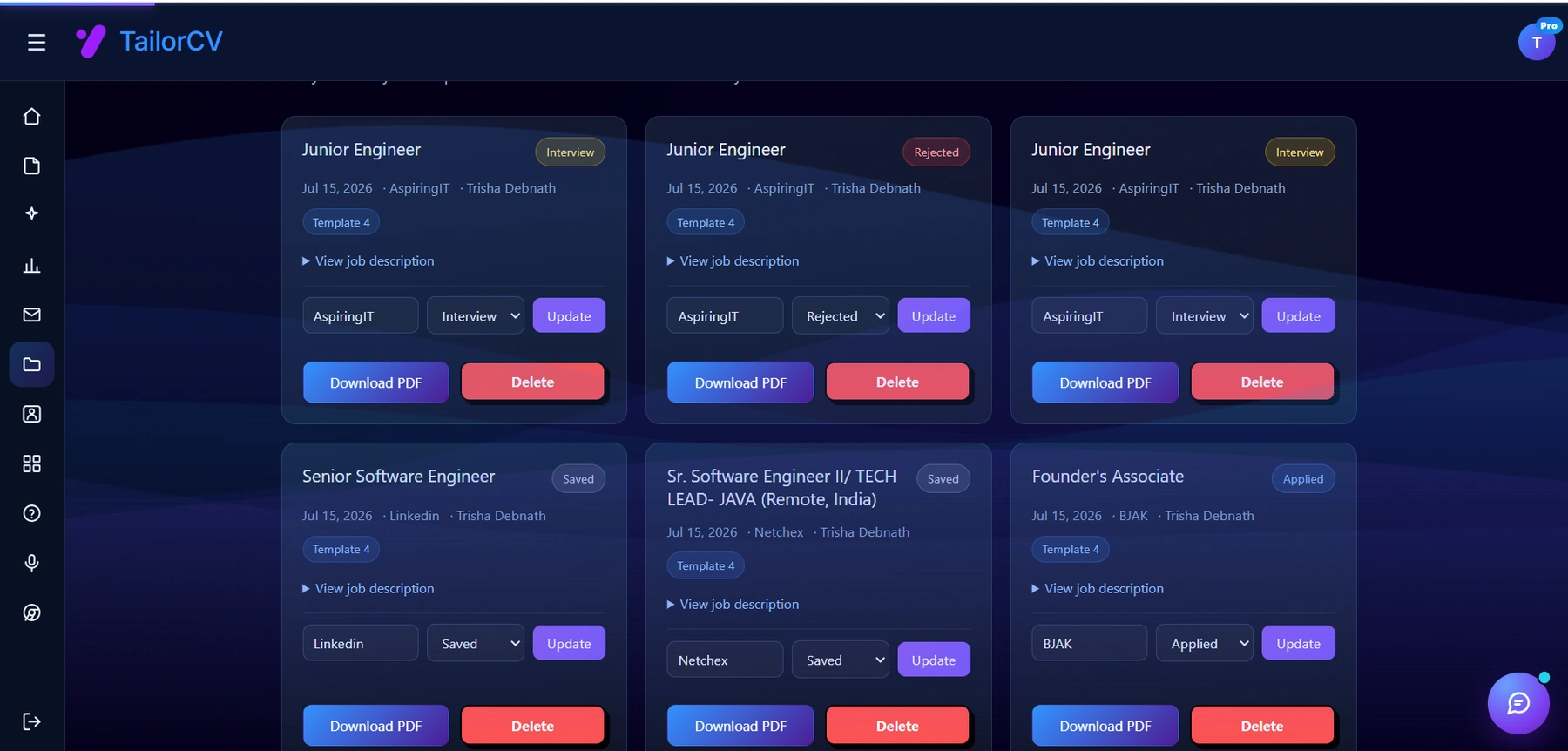
Every resume you tailor is saved against the job it was written for, with the company, the job description and a status you can move from Saved to Applied to Interview. That is the part a spreadsheet usually gets wrong - the tracker and the actual document drift apart, and you end up guessing which version you sent.
What the finished letter looks like
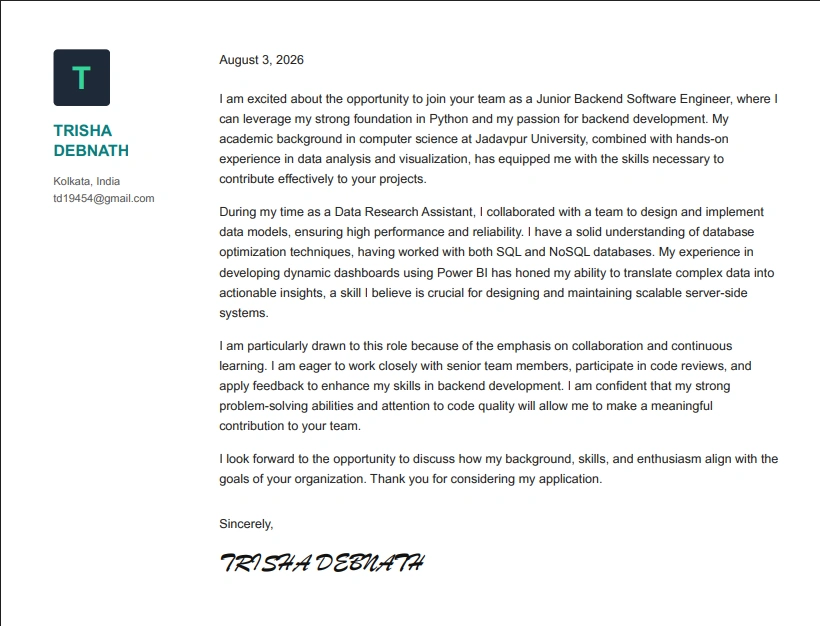
The same rules with a little more styling: the header is real text, not an image, so the layout stays readable to both a recruiter and a parser.
-
Neglecting Company Culture: Failing to align your language and tone with the company culture can create a disconnect. Make sure your cover letter reflects the values and ethos of your organization.
-
Being Overly Casual: While you may have an established rapport with your colleagues, remember that a cover letter is still a formal document. Avoid slang and overly casual language.
-
Not Highlighting Internal Experience: Don’t forget to emphasize your contributions to the company. Highlight specific projects or initiatives where you made a significant impact.
-
Ignoring the Job Description: Tailor your cover letter to the specific role you’re applying for. Failing to address the qualifications and skills mentioned in the job description can weaken your application.
-
Underestimating the Power of Proofreading: Spelling and grammatical errors can create a negative impression. Always proofread your cover letter or have a colleague review it before submission.
Do's and Don'ts for Your Internal Cover Letter
Creating an effective internal cover letter involves knowing what to do—and what to avoid. Here’s a quick reference guide:
Do's
- Do Personalize Your Letter: Address it to the hiring manager or relevant decision-maker if possible.
- Do Mention Your Current Role: Clearly state your current position and how it relates to the new role.
- Do Use Specific Examples: Provide concrete examples of your achievements and contributions within the company.
- Do Show Enthusiasm: Express genuine interest in the new position and how it aligns with your career goals.
- Do Keep It Concise: Aim for a one-page cover letter that gets straight to the point.
Don'ts
| Step | What to do |
|---|---|
| Don’t Be Overly Familiar | Maintain professionalism and avoid being too casual, even if you know the team well |
| Don’t Focus on Salary or Benefits | Your cover letter should emphasize your skills and fit for the role, not compensation |
| Don’t Use Jargon | Avoid industry jargon that may not be universally understood, especially if it might alienate some readers |
| Don’t Ignore Your Career Goals | Make sure to articulate how this position fits into your broader career aspirations |
| Don’t Rush the Process | Take your time to craft a thoughtful letter rather than submitting a generic one |
Step-by-Step Guide to Tailoring Your Internal Cover Letter
To ensure your internal cover letter stands out, follow this step-by-step guide:
-
Research the New Role: Understand the job description, required skills, and team dynamics. Familiarize yourself with any recent changes or projects within the department.
-
Reflect on Your Achievements: List down your significant contributions to your current role that would be relevant to the new position. Use metrics or specific examples to quantify your impact.
-
Draft a Strong Opening: Start with a compelling introduction that states your current position and your intention to apply for the new role. Mention how long you’ve been with the company and express your enthusiasm.
-
Connect Your Experience: In the body of your letter, make clear connections between your past experiences and the requirements of the new role. Use specific examples to illustrate your suitability.
-
Conclude with Confidence: End with a strong conclusion that reiterates your interest in the position and expresses your eagerness to discuss your application further.
-
Edit and Refine: After drafting your letter, take a break and return to it with fresh eyes. Look for areas to improve clarity and impact. Consider using tools like ATS checker to ensure it meets application standards.
Scenarios: When to Use Your Internal Cover Letter
Knowing when to submit your internal cover letter can be crucial for a successful application. Here are a few scenarios to consider:
-
Promotion Opportunities: If you’re applying for a higher position within your department, an internal cover letter is essential to highlight your readiness for increased responsibilities.
-
Department Transfers: When seeking a transfer to another department, your cover letter should explain your reasons for the move and how your skills can benefit the new team.
-
New Projects or Initiatives: If a new project is being launched, and you want to join the team, your cover letter should demonstrate your enthusiasm for the project and how your past experiences align with its goals.
-
Response to Internal Job Postings: If your company has posted an internal job opening, use your cover letter to formally express your interest and articulate why you are the best fit for the role.
By following these guidelines, you can enhance your internal cover letter and increase your chances of securing your desired position within the company. If you’re also considering a cover letter for a career change, be sure to adapt your approach accordingly.
Conclusion
Crafting an internal cover letter is an opportunity to showcase your accomplishments and aspirations while acknowledging the unique context of your current workplace. By highlighting your achievements, addressing potential concerns, and demonstrating your commitment to the team and company, you can create a compelling case for your candidacy.
For further assistance, consider exploring our cover letter guide or using our templates to create a standout application. Remember, your internal application is just as important as any external one - invest the time to make it shine!
Frequently Asked Questions
Do I really need a cover letter if everyone already knows me?
Yes, especially if the hiring panel includes people outside your immediate team. A letter puts your case in writing and shows you're taking the process seriously - see cover letter mistakes to avoid.
Should I tell my current manager before applying?
In most cases, yes - it prevents an awkward surprise and often earns you an internal advocate. Check your company's specific internal mobility policy first.
How is an internal cover letter different from a promotion request?
A promotion typically happens within your existing role and team; an internal application is for a different open role, sometimes competitive with external candidates. If you're seeking a promotion instead, see how to get a promotion and how to ask for a raise.
What if I don't get the internal role?
Ask for specific feedback and keep building toward the skills gap - see how to handle job rejection for a constructive next-step framework.
Make This Practical
Treat an internal move with the same rigor as an external one. Check your resume's match to the posted role with the free ATS score checker, tighten your letter with the AI cover letter generator, and rehearse your pitch with the AI mock interview tool before the panel interview.
Conclusion
Internal doesn't mean informal. Put your track record in writing, explain your motivation honestly, and prepare exactly as you would for an outside opportunity.
Was this guide useful?
Be the first to rate it.