 TD
TD

Key Takeaways
- An AI cover letter generator produces better results when provided with a full job description rather than just a job title.
- Job descriptions contain specific skills, priorities, and company culture insights that help tailor the cover letter effectively.
- Using the exact language from the job description in your cover letter signals alignment with the employer's expectations.
- The generator can prioritize content and adjust tone based on the details provided in the job posting.
- A cover letter generator works best when used in conjunction with a tailored resume, ensuring consistency in messaging and vocabulary.
An AI cover letter generator can turn your resume and a job description into a focused cover letter in minutes, but only if you feed it the right input. Paste in a job title and you get a generic letter that could apply to a thousand companies. Paste in the actual job description and the tool has something real to work with: the employer's own language, their stated priorities, and the specific problems they are hiring someone to solve. This post is about that difference, and how to use it well.
Use the AI cover letter generator after optimizing your resume with the ATS score checker so the letter and the resume are pulling from the same tailored story.
Why the Job Description Changes Everything
A job title tells an AI generator almost nothing. "Marketing Manager" could mean brand strategy at a 500-person company or solo-founder growth hacking at a 5-person startup. The generator has no choice but to fall back on generic phrasing, because it does not know what this employer actually wants.
A full job description is a different kind of input entirely. It contains:
- The exact skills and tools the employer listed, in their own wording
- The order of priorities (what is listed first is usually what matters most)
- Signals about team size, seniority, and reporting structure
- Phrases that reveal company culture ("fast-paced," "cross-functional," "founder-led")
- The specific problem the role exists to solve, often buried in the first paragraph
When you paste that text into a generator alongside your resume, the tool can mirror the employer's own language back in your letter. That matters more than it sounds like it should. Recruiters and hiring managers wrote that description; seeing their own priorities reflected in your opening paragraph reads as attention, not coincidence. This is the same principle behind keyword extraction from job postings, applied to prose instead of a resume's skills section.
Job Title vs Full Job Description: What the AI Actually Uses
If you only give an AI generator a job title, it has to guess at everything else. It will produce something structurally correct but semantically empty: the right number of paragraphs, the right tone, none of the substance. This is the letter equivalent of a resume that just lists "responsible for managing team" without saying which team, doing what, or achieving what result.
Feed it the full posting instead, and the generator can do three things a title alone never allows:
- Match vocabulary. If the posting says "own the roadmap," your letter can say "own," not "manage" or "oversee." Small word choices signal fit.
- Prioritize correctly. If the first two bullet points are about stakeholder communication and the last three are about a specific software tool, the letter should lead with communication, not the tool.
- Surface unstated context. A posting that mentions "rapid growth" or "newly formed team" tells you this role rewards initiative over process-following. A generator that sees this can adjust tone accordingly, and so can you when you edit the draft.
This is also why a cover letter generator works best as a companion to resume tailoring, not a separate exercise. If you have already gone through how to match your resume to a job description, you already have the vocabulary and priorities extracted. Reuse that work here instead of starting over.
Worked Example: Job Posting to Opening Paragraph
Here is a short, realistic excerpt from a job posting for a customer success role:
What the finished letter looks like
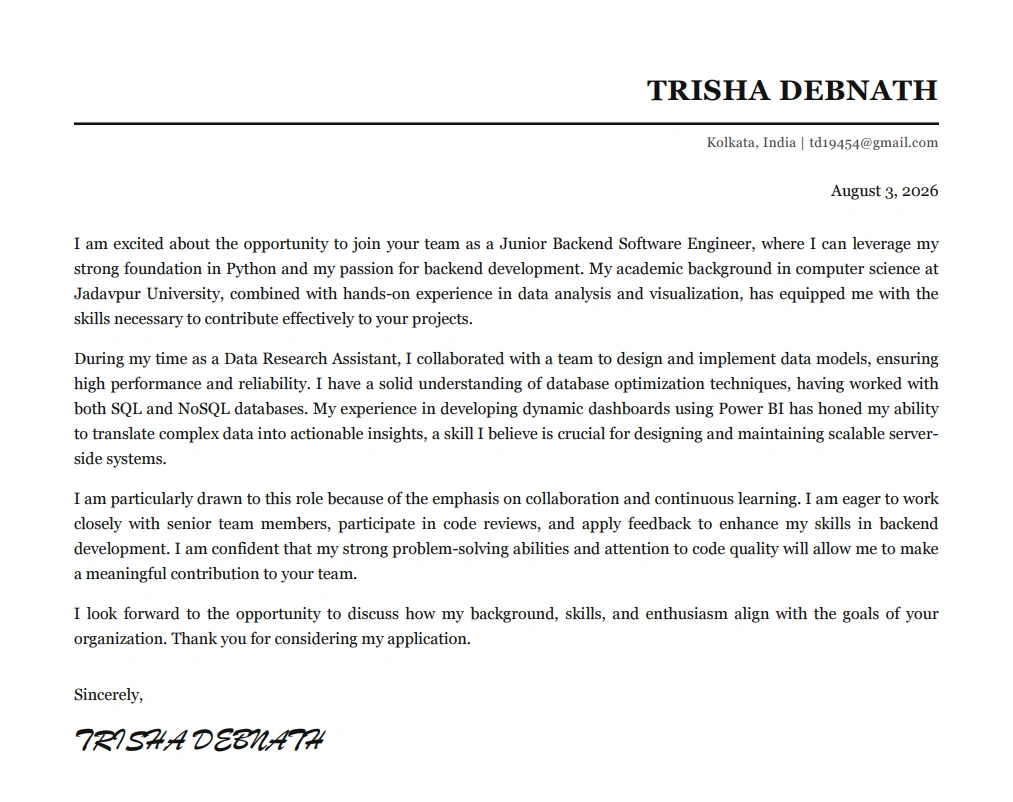
A format like this parses cleanly - one column, standard headings, everything the parser needs where it expects to find it.
"We're looking for a Customer Success Manager to own renewals and expansion for our mid-market accounts. You'll work directly with our Head of Sales to reduce churn, and you'll need to be comfortable presenting usage data to skeptical stakeholders. This is a newly created role reporting into a five-person CS team."
Now compare two possible opening paragraphs. First, what a generic, title-only prompt produces:
"I am excited to apply for the Customer Success Manager position at your company. I have a proven track record of building strong client relationships and driving customer satisfaction, and I believe my skills make me a great fit for your team."
That paragraph could be sent to any company hiring any CSM, anywhere. Nothing in it responds to what this posting actually said. Now here is an opening built from the same resume, but generated using the full posting above as input:
"Your posting for Customer Success Manager describes a newly created role focused on renewals and expansion for mid-market accounts, with direct exposure to your Head of Sales on churn reduction. That is close to the role I held at [Company], where I owned a $2M mid-market renewal book and cut quarterly churn by presenting usage data directly to account stakeholders, the same skeptical-audience scenario your posting describes."
The second version does not just sound more specific, it proves the candidate read the posting and mapped their own experience onto its specific language: "newly created role," "mid-market," "renewals and expansion," "presenting usage data to skeptical stakeholders." That is the mechanism a job-description-driven generator gives you that a title-only one cannot.
What to Give the AI for the Best Output
The quality of a generated letter is a direct function of the quality of the input. To get an output closer to the second example above rather than the first, provide the generator with:
- The full job description text, not a summary and not just the title. Copy and paste the entire posting, including the "about us" section if there is one.
- Your resume, ideally already tailored to this role rather than your generic master resume.
- The company name and, if you know it, the hiring manager's name or title.
- Two or three real achievements you want highlighted, described with actual numbers or outcomes, not just responsibilities. "Reduced churn 12% in two quarters" gives the generator something to anchor a sentence around. "Responsible for customer success" does not.
- Any context the resume alone does not explain, such as a career change, an employment gap, or an internal transfer.
The achievements matter more than most people expect. A generator can only be as specific as the facts you hand it. If you give it vague inputs, it will produce vague, enthusiasm-heavy sentences to fill the space, which is exactly the pattern recruiters have learned to recognize as AI-generated filler. Ground it in specifics and the enthusiasm becomes redundant, because the specifics carry the persuasion.
A Structure Worth Following
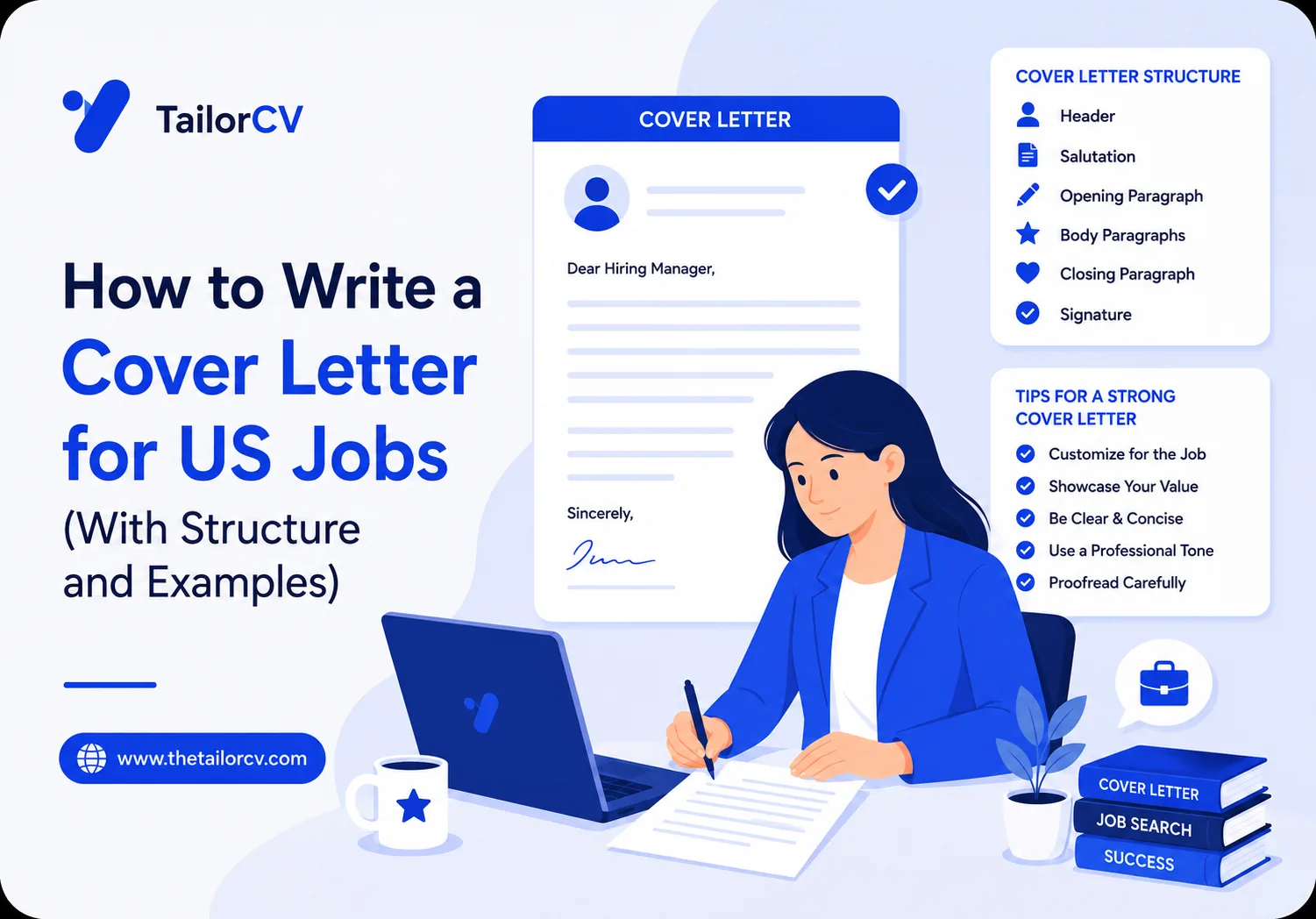
You do not need to relearn cover letter structure here. The Cover Letter Guide 2026 covers the fundamentals in depth. In short, a job-description-driven letter should still follow four compact parts:
- Opening that references something specific from the posting, not just the job title
- Fit, one or two skills or requirements from the posting matched to your background
- Proof, a specific example with a measurable result
- Close, a confident, low-friction next step
What changes when you generate from a real job description is not the shape of the letter, it is how much real content fills that shape. If your structure is right but the sentences are generic, the problem is almost always the input you gave the generator, not the template.
Why AI-Generated Letters Still Need a Human Editing Pass
A generated draft is a first draft, not a final one. Even with a strong job description as input, three problems show up consistently and need a human to catch them.
Generating the letter from a job description
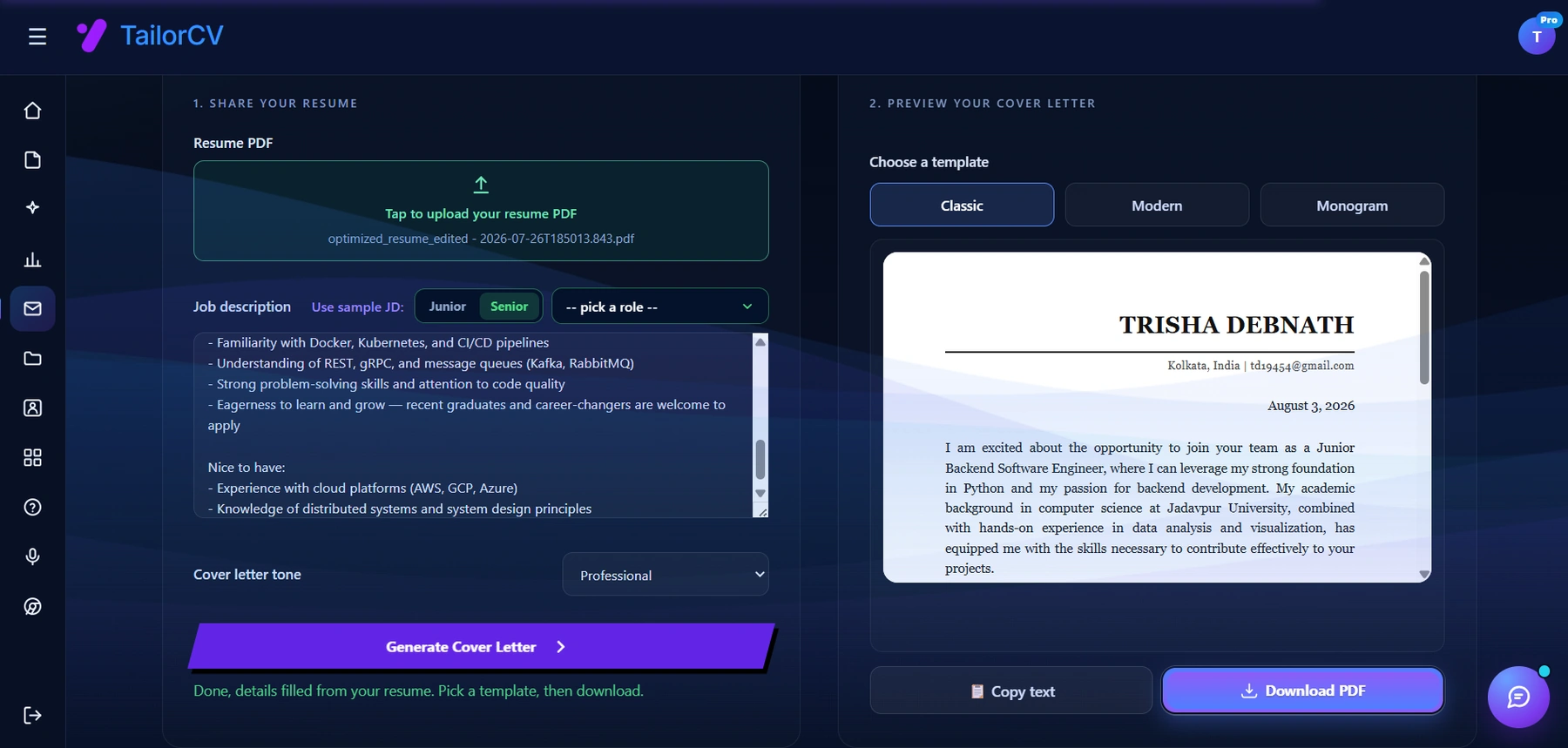
The whole flow sits on one screen: your resume and the job description on the left, the finished letter on the right. Details are pulled from the resume so you are editing rather than starting from a blank page, and the tone control decides how formal it reads before you download.
Fact-check every company-specific claim. If the generator references something about the company (a product name, a stated mission, a recent milestone), verify it is accurate before you send it. Generators can restate what you gave them incorrectly, or infer details that were not actually in the posting.
Cut AI-sounding stock phrases. Certain phrases have become recognizable enough that experienced recruiters read them as a signal the letter was generated and never touched again. Watch for:
- "I am excited to apply for..."
- "I have a proven track record of..."
- "I am confident that my skills and experience..."
- "I would welcome the opportunity to..."
- "This role aligns perfectly with my passion for..."
None of these are wrong exactly, they are just overused to the point of being invisible, or worse, a mild red flag. Replace them with the specific detail they are standing in for. Instead of "proven track record," name the number. Instead of "excited to apply," say what specifically in the posting caught your attention.
Adjust tone to match company culture. A generator working from a formal, corporate job posting will produce a formal letter. A generator working from a casual startup posting full of exclamation points might produce something that reads as trying too hard. Read the posting's own tone and nudge the letter to match it, a beat more restrained than the posting rather than a beat more enthusiastic.
This editing pass is quick if the input was good, but skipping it entirely is the fastest way to send a letter that technically mentions the right company but still reads as mass-produced. If you want a broader list of what tends to go wrong, Cover Letter Mistakes to Avoid in 2026 is a useful companion check before you hit send.
Tailoring One Letter for Multiple Similar Roles
If you are applying to several similar roles at once, say, three Customer Success Manager postings at three different companies, you do not need to generate each letter completely from scratch, but you also cannot just find-and-replace the company name. Recruiters compare notes more than candidates expect, and a letter that is obviously a template with the company name swapped in is worse than no letter at all.
A better approach:
- Generate a base version using your strongest, most transferable achievement and the job description that is most detailed or most representative of the group.
- Regenerate the opening and fit sections for each specific posting, feeding the actual job description for that company each time. The opening paragraph is where company-specific language needs to live; keep that part fresh for every application.
- Keep your proof paragraph flexible. If one posting emphasizes data analysis and another emphasizes stakeholder relationships, you may need two versions of your proof example pulled from the same underlying achievement, angled differently.
- Change the close to match how you are applying. A referral-based application can reference the referral; a cold application through a portal should not pretend otherwise.
The efficiency gain is real, you are not rebuilding a letter's structure five times, but the specificity has to be rebuilt every time or the whole exercise defeats its own purpose. This is the same discipline behind tailoring a resume for every job rather than sending one resume everywhere: reuse the framework, regenerate the specifics.
Troubleshooting: When the Output Falls Flat
Even with a good job description as input, generated letters sometimes miss. Here is what to do for the most common failure modes.
The letter is too generic. This almost always means the input was too generic. Go back and check: did you paste the full job description, or just a summary? Did you include specific achievements with numbers, or general responsibilities? Regenerate with more detail rather than trying to manually punch up a thin draft.
The letter is too long. Generators tend to over-explain. Cut anything that repeats what is already on your resume word for word, and cut any sentence that could apply to a different job posting without changing a single word. A cover letter should be readable in under a minute; if it is pushing past three-quarters of a page, it is too long.
The letter does not reflect your actual experience. This happens when the resume you provided is outdated, too generic itself, or missing the achievement that is actually most relevant to this role. Fix the input, not the output. Update the resume section you are pulling from, or manually add the missing achievement to your prompt before regenerating.
The letter overstates something. If the generator infers a skill level or scope you did not actually have, correct it manually before sending. This is a fact-check issue, not a style issue, and it is the single most important thing to check in the editing pass.
The tone feels off for the company. Regenerate with a note about the tone you want ("more formal," "more direct," "less corporate") or adjust manually. A mismatch here is usually minor but noticeable to someone who works there every day.
Make This Practical
A cover letter is strongest when it is built on top of a resume that is already tailored to the same job description. Start with the free ATS score checker to see how your resume matches the posting, adjust based on what it flags, and only then generate the letter with the AI cover letter generator so both documents are telling the same story with the same vocabulary.
If you want the letter's structure double-checked against best practice, the Cover Letter Guide 2026 walks through length, tone, and formatting in more detail than this post covers. For specific situations, Cover Letter for a Career Change and Cover Letter With No Work Experience both build on the same job-description-driven approach for cases where your resume needs more context than usual. And once your resume and cover letter are ready, keep the same specificity going into the interview with the AI mock interview tool, since the achievements you highlighted in your letter are likely to come up as follow-up questions.
FAQ
Do I need to paste the entire job description, or just the requirements section?
Paste the entire thing, including the intro and "about us" text. The requirements section gives you skills to match, but the surrounding text often reveals tone, priorities, and context that a bullet list of requirements leaves out.
Can an AI cover letter generator work from just a job title if I do not have the full posting?
It can produce something, but it will be noticeably more generic. If the original posting has been taken down, search for a cached version or a similar posting from the same company to recover as much specific language as possible.
How is this different from just using the general Cover Letter Guide?
The Cover Letter Guide 2026 covers structure, tone, and formatting fundamentals that apply to any letter. This post is specifically about how feeding a real job description into a generator changes the substance of the output, not the shape of it.
Will recruiters know the letter was AI-generated?
They can usually tell when a letter is generic and unedited, less so when it is specific, accurate, and edited by hand afterward. The tell is not the tool, it is whether the content reflects real, checkable specifics about the company and your experience.
Should the cover letter repeat my resume?
No. If a sentence in the letter says exactly what a bullet point on your resume already says, cut it from the letter or rewrite it to add context the resume could not fit, like the reasoning behind a result rather than just the result itself.
What if the job description is vague or poorly written?
Work with what is there and fill gaps with research: the company's website, recent news, or the team's public content. A vague posting is also a signal to keep your letter shorter rather than padding it to match a length that does not fit the input you have.
Can I use this approach for internal job applications?
Yes, and it matters even more there, since an internal reader already knows your general background and will notice generic phrasing faster. See Cover Letter for an Internal Job Application for how to adjust the approach when the "employer" already has an employment record for you.
Does this work for remote job postings too?
Yes, though remote postings often emphasize different things, like communication style and time zone overlap, that are worth mirroring specifically. Cover Letter for Remote Jobs covers what to pull out of a remote-specific posting. Additionally, consider checking our ATS-Friendly Cover Letter Format to ensure your letter meets the necessary standards.
Next Step
Paste your resume and a real job description into the AI cover letter generator and compare the first draft against the generic-opening example in this post, then edit until it sounds like you.
Was this guide useful?
Be the first to rate it.