 TD
TD

Key Takeaways
- A career change cover letter should explain the reason for the pivot and highlight transferable skills to address potential concerns from recruiters.
- Structure the letter with a focus on connection, a clear statement of transition, specific examples of transferable skills, and proof of momentum through relevant projects or coursework.
- Avoid apologizing for the career change and instead own the narrative while ensuring the letter addresses the specific needs of the target role and company.
- Customize each cover letter to reflect genuine motivation for the role and the company, rather than using a generic template.
A career change cover letter has one job the resume can't fully do: explain why you're pivoting, in your own voice, before a recruiter decides you're "not a fit" on paper alone. Get this letter right, and it becomes your strongest asset in the entire application - stronger than the resume itself.
Before writing, make sure your resume is already tailored for the switch. Then use the AI cover letter generator to draft a first version in your voice, and check your resume's match with the free ATS score checker before you send anything.
Why Career Change Cover Letters Are Different
A standard cover letter assumes continuity - same title, same industry, a logical next step. A career-change letter has to do more work:
- Address the pivot directly instead of hoping the recruiter won't notice
- Translate past experience into the transferable skills the new role actually needs
- Show genuine motivation, not just "I want a change"
- Prove you've already started building relevant skills - courses, projects, freelance work
If you skip the explanation, most recruiters will assume the gap in relevance is a gap in ability. Owning the story removes that doubt.
The 4-Part Structure
What the finished letter looks like
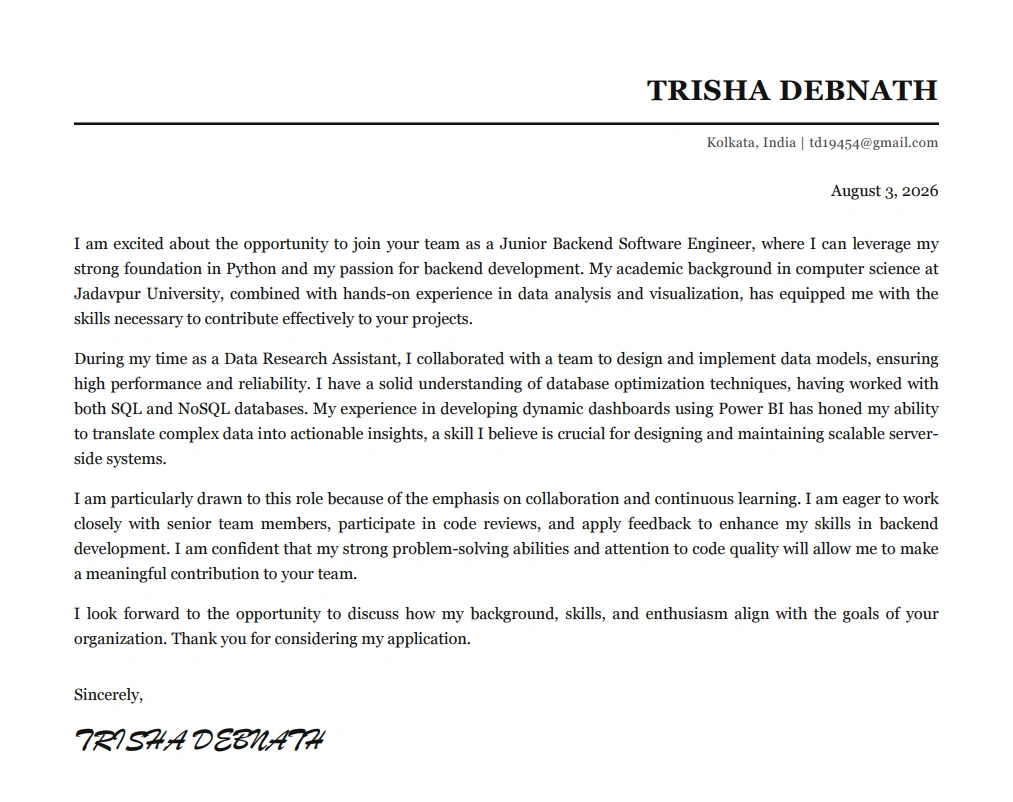
A format like this parses cleanly - one column, standard headings, everything the parser needs where it expects to find it.
1. Open with the connection, not the confession
Don't lead with "I know I don't have direct experience." Lead with what connects your background to the role.
"Five years leading operations for a 40-person logistics team taught me how to build processes that scale - which is exactly the kind of systems thinking I want to bring to a project management role."
2. Name the transition honestly, in one line
"After five years in operations, I'm moving intentionally into project management, building on the process and stakeholder skills I already use daily."
3. Prove the transferable skills with specifics
Use the same specificity you'd use in a resume bullet point - numbers, tools, outcomes. See how to quantify resume achievements for the framework.
4. Show proof of momentum
Certifications, a portfolio project, freelance work, or coursework all signal that you're serious, not just curious. If you're moving into a portfolio-driven field, see career change portfolio and developer portfolio project ideas.
Full Template
Dear [Hiring Manager's Name],
Generating the letter from a job description
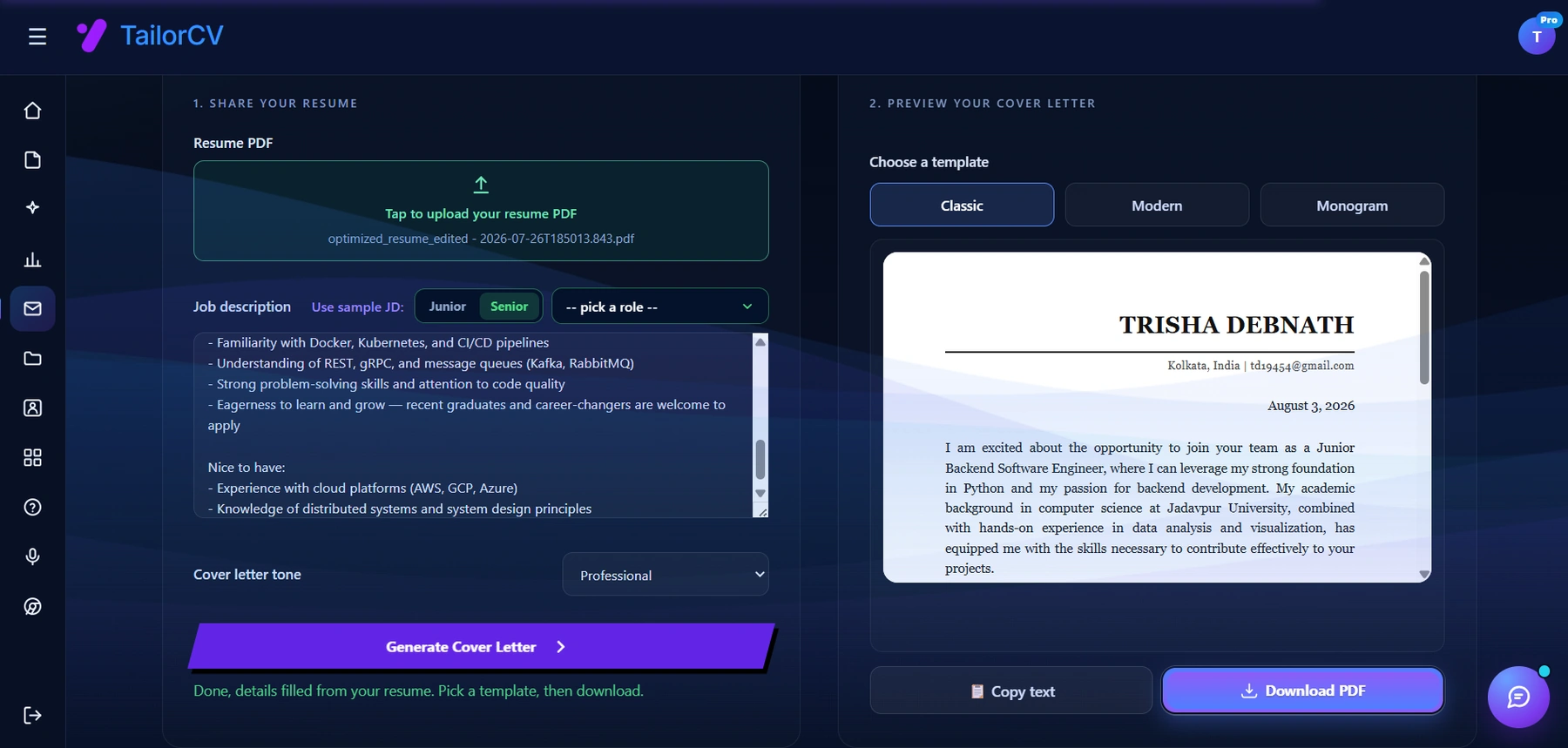
The whole flow sits on one screen - resume and job description on the left, the finished letter on the right - so you are editing rather than starting from blank.
For the past [X years], I've worked in [current field], where I [one strong, specific achievement with a number]. That work built skills in [2-3 transferable skills] that map directly onto what [Company] needs for this [Target Role] position.
I'm making an intentional move into [target field] because [genuine, specific reason - not generic]. I've already started building toward it: [certification / project / freelance work / relevant coursework].
What draws me to [Company] specifically is [something real about the company, product, or team]. I'd welcome the chance to bring my [core transferable strength] to your team while continuing to grow into [target role].
Thank you for considering my application - I'd love to talk through how my background translates into this role.
Sincerely,
[Your Name]
Common Mistakes to Avoid
- Apologizing for the career change instead of owning it - see cover letter mistakes
- Listing every past job instead of the skills that transfer
- Vague motivation like "I've always been interested in this field" with no specifics
- Forgetting to mirror the job description's own language
- Sending the same letter to every company without customizing the "why this company" line
Concrete Steps for Crafting Your Cover Letter
Step 1: Research the Target Role and Company
Understanding the nuances of the new role and the culture of the organization can significantly enhance your cover letter. Here are some ways to gather this information:
- Job Description Analysis: Highlight keywords and phrases that resonate with your experience. Use these phrases in your cover letter.
- Company Culture: Visit the company's website, read their mission statement, and check their social media profiles to get a sense of their values and work environment.
- Networking: If possible, connect with current or former employees via LinkedIn to gain insights into the company culture and specific skills they value.
Step 2: Identify and Articulate Transferable Skills
Identify the skills from your previous roles that translate to the new position. This can be done through:
- Skill Mapping: Create a chart that lists your current skills alongside the skills required for the new role. This visual can help you articulate your value effectively in your cover letter.
- Specific Examples: Think of specific instances where you demonstrated these skills. Quantify your achievements to make them more compelling.
Step 3: Build Your Proof of Momentum
Demonstrating that you've taken proactive steps toward your new career can set you apart. Here's how to do it:
- Courses and Certifications: Mention any relevant online courses or certifications you've completed. For instance, if you're moving into data analysis, highlight any data analytics certifications.
- Projects: If you've worked on relevant projects, include them. For example, if you're transitioning to a business analyst role, discuss a project where you analyzed data to drive business decisions.
- Freelance Work: If applicable, mention freelance work related to the new field. This shows real-world application of your new skills.
Real Examples of Effective Career Change Cover Letters
Example 1: From Marketing to Data Analysis
Dear Hiring Manager,
For the past five years, I've worked in marketing, where I successfully increased our social media engagement by 150% through data-driven strategies. This experience honed my analytical skills, which I now want to apply in a data analyst role at [Company].
I am intentionally transitioning into data analysis because I find great satisfaction in deriving insights from data. To this end, I've completed a certification in Data Analytics and worked on a freelance project analyzing consumer behavior trends.
What draws me to [Company] specifically is your innovative approach to data-driven marketing. I would love to bring my analytical mindset and marketing experience to your team while further developing my skills in this new role.
Thank you for considering my application. I look forward to discussing how my background translates into this role.
Sincerely,
[Your Name]
Example 2: From Teaching to Project Management
Dear [Hiring Manager's Name],
For the past seven years, I’ve been a high school science teacher, where I led a team of educators to implement a new curriculum that improved student engagement by 40%. This experience has equipped me with exceptional organizational and leadership skills that align perfectly with the requirements for the project management position at [Company].
I am making a deliberate shift into project management because I am passionate about leading teams and projects to successful outcomes. I have recently completed a Project Management Professional (PMP) certification and have been managing the logistics of our school’s annual science fair, coordinating over 100 students and volunteers.
I am particularly impressed by [Company]’s commitment to innovation in project delivery. I am eager to contribute my skills in team leadership and project execution while continuing to learn and grow in this exciting field.
Thank you for considering my application. I look forward to the opportunity to discuss how my background can contribute to your team.
Sincerely,
[Your Name]
Checklist for Finalizing Your Cover Letter
- Personalization: Ensure that the letter is addressed to a specific person, not a generic "Hiring Manager."
- Clear Structure: Follow the 4-part structure outlined earlier for clarity and flow.
- Proofread: Check for grammar and spelling mistakes. A polished letter reflects professionalism.
- Feedback: Before sending, have a friend or mentor review your cover letter for clarity and impact.
- ATS Optimization: Use the ATS score checker to ensure your cover letter aligns with industry standards.
- Follow-Up: Consider sending a follow-up email a week after submitting your application to reiterate your interest.
By following these steps and using the provided templates and examples, you can craft a compelling cover letter that effectively communicates your career transition and showcases your qualifications. With the right approach, your cover letter can become a powerful tool in your job search, opening doors to new opportunities in your desired field.
Moving from manager back to individual contributor needs a similar explanation; moving back from management to IC covers the resume and letter together.
Frequently Asked Questions
Should I mention my career change in the cover letter or hide it?
Address it directly in one or two sentences. Trying to hide it usually backfires once the recruiter reaches your resume - see how ATS detects generic resume for why vague framing gets flagged.
How long should a career change cover letter be?
Three to four short paragraphs, under 300 words. Recruiters skim - use the cover letter guide for exact formatting.
What if I have zero direct experience in the new field?
Lean on projects, coursework, and transferable soft skills. Pair this with resume with no experience and fresher resume projects that get interviews even if you're not a fresher - the framing works the same way.
Can AI write this letter for me?
AI can draft a strong first version fast - use the TailorCV cover letter generator - but you should still personalize the company-specific line and verify every claim is true. See AI resume tailoring without losing your voice.
Make This Practical
Pair this letter with a resume that's already been tailored for the new field. Check your match with the free ATS score checker, tighten the story using how to tailor your resume for every job, then practice explaining your pivot out loud with the AI mock interview tool before the real conversation.
Conclusion
A career change cover letter isn't a confession - it's a pitch. Connect your past to the future role, prove momentum, and let the AI cover letter generator help you get the wording sharp before you hit send.
Was this guide useful?
Be the first to rate it.